What's on this page
- Why bagged concrete is a different question
- Bag yields: what a bag actually makes
- The bag-count formula: cubic feet over yield, round up
- Bags per cubic yard, and the crossover you should respect
- Fence post holes: the math that surprises everyone
- How deep, how wide: sizing the post hole
- A worked fence: ten posts, start to finish
- Deck footings and sonotubes: bags per tube
- Small slabs and pads: a worked 4x4 pad
- Setting posts: wet-set, dry-set, and fast-setting bags
- Mixing a bag: water, working time, and consistency
- By hand or by mixer: how many bags before you rent
- The bags-versus-ready-mix crossover, in real numbers
- Buying extra: the ten percent rule
- Fast-setting versus standard mix
- Storage and shelf life
- Where the bag count goes wrong
- The pre-buy checklist
- The bottom line
Ask “how much concrete do I need” and you usually mean a truck: cubic yards, a chute, a delivery window. Ask “how many bags of concrete do I need” and you are somewhere different, standing over a post hole or a small pad with a hardware-store receipt, and the honest answer is a bag count, not a yardage. This manual is built for that second question, the small-job, buy-it-off-the-pallet side of concrete where the unit is one 80 pound sack at a time and the whole skill is not over-buying a heavy thing you have to lift twice.
The math is short and it never changes: work out the cubic feet your job needs, divide by what one bag yields, and round up. Everything else here is putting real numbers into that line, the bag yields you can trust, the fence-post and footing volumes that surprise everyone the first time, and the point where the bag count gets so high you should put the sacks down and read our concrete manual instead, because you have a truck job. For a first pass on your own numbers, our estimator does the arithmetic in seconds.
Key takeaways
- An 80 pound bag yields about 0.6 cubic feet, a 60 pound bag about 0.45, a 50 pound bag about 0.375, and a 40 pound bag about 0.30; every count starts from these yields.
- The formula is one line: cubic feet needed, divided by bag yield, rounded up to whole bags, plus a small cushion.
- A 12 inch fence post hole 2 feet deep needs roughly 1.4 cubic feet of concrete, about two and a half 80 pound bags per post, and hand-dug holes always run a little over.
- Around 45 of the 80 pound bags make one cubic yard; near that point the mixing labor argues for a truck, covered in our concrete manual.
- Buy about 10 percent extra for irregular holes and spillage, keep bags dry and off the ground, and return what you never open.
Why bagged concrete is a different question
Bagged concrete and ready-mix are the same material sold at two completely different scales of effort, and the question you are really asking sorts you into one or the other before any math starts. Ready-mix is a volume problem: how many cubic yards, which truck, what delivery window. Bagged concrete is a count-and-carry problem: how many sacks, how heavy is the pile, and can one or two people mix it inside the time the material gives you. The reason this manual exists separately from our cubic-yard concrete manual is that the two questions have different failure modes and different right answers.
The jobs that live on the bag side are specific and common: setting fence posts, mailbox posts, and deck footings; pouring a small pad for an air conditioner, a shed corner, or a grill; patching a step; anchoring a basketball hoop. What they share is small volume and awkward geometry, the exact combination where a truck’s delivery minimum and short-load fee make no sense and a pallet of bags does. The moment the count climbs past a pallet, though, the logic flips, and knowing where that line sits is half of what this manual teaches.
Bag yields: what a bag actually makes
A bag’s weight is not its volume, and the number that matters for every calculation here is the yield: how many cubic feet of placed, mixed concrete one bag makes. The weight on the bag tells you how much it hurts to carry; the yield tells you how far it goes. As illustrative, widely cited figures, an 80 pound bag of standard concrete mix yields about 0.6 cubic feet, a 60 pound bag about 0.45, a 50 pound bag about 0.375, and a 40 pound bag about 0.30. Notice the pattern: yield tracks weight almost exactly, because it is the same material, so a 40 pound bag is genuinely half the concrete of an 80.
Cubic feet of concrete per bag, by bag size
Illustrative yields for standard concrete mix; read the exact figure off the bag you buy.
The 80 pound bag is the workhorse because it moves the most concrete per trip to the mixing tub. Smaller bags mean more bags, more openings, and more handling for the same placed volume, which matters once the count runs past a dozen.
The practical upshot is to standardize on one bag size for a job and buy the biggest you can comfortably lift, because handling, not price per bag, is the real cost of bagged work. Every extra bag is a sack to carry, a top to tear, a tub to scrape, and a mixing cycle to time. Two exceptions pull the other way: choose smaller bags if the person mixing cannot safely lift 80 pounds, and choose fast-setting products in their own sizes for post work, covered later. Otherwise the 80 pound bag and its 0.6 cubic foot yield are the default this manual calculates from.
The bag-count formula: cubic feet over yield, round up
Here is the entire method, and it is one line. Find the cubic feet of the shape you are filling, divide by the bag’s yield in cubic feet, and round up to whole bags: bags = cubic feet needed / yield per bag, rounded up. That is it. A pad that needs 5.3 cubic feet, divided by 0.6 for the 80 pound bag, is 8.8, which rounds up to 9 bags. The same pad in 60 pound bags is 5.3 divided by 0.45, or 11.8, rounding to 12. The formula does not care what the shape is; it only needs the cubic feet, and the next sections work out that number for each common job.
Rounding up is not optional, and it always goes up, never to the nearest. You cannot buy 8.8 bags, and a job that is 0.8 of a bag short is a job that stops with wet forms and a hard-setting batch while someone drives back to the store. This is the same asymmetry our general estimating manual describes for every material: the cost of one bag too many is that you return it or keep it, while the cost of one bag too few is a stalled pour. Round up first, then add the cushion the buying-extra section covers, and treat the exact division as a floor you build a margin on top of.
Bags per cubic yard, and the crossover you should respect
Sooner or later the bag count meets the cubic yard, because that is the unit the concrete world is really organized around, and the conversion is worth memorizing. A cubic yard is 27 cubic feet, so bags per yard is just 27 divided by the yield: about 45 of the 80 pound bags, 60 of the 60 pound bags, 72 of the 50 pound bags, or 90 of the 40 pound bags. Say those numbers out loud once and the whole scale of bagged work becomes clear: even the biggest, most efficient bag takes 45 openings and 45 mixing cycles to make one cubic yard, which is roughly the concrete in a small shed pad.
That 45-bags-per-yard figure is the single most useful number for deciding whether you are still on the bag side of the fence at all. Under a cubic yard, bags are almost always the right call. As the job approaches and passes a full yard, the sheer labor of mixing forty-plus sacks by hand starts to cost more than any delivery fee you were avoiding, and the answer shifts toward a truck or a rented mixer. Our concrete manual works this crossover with the short-load economics behind it; for now, hold on to 45 bags per yard as the mental tripwire.
Fence post holes: the math that surprises everyone
Fence posts are the reason most people ever count concrete bags, and the number always surprises them, because a post hole is a cylinder and cylinders hold more than they look. The volume of a hole is radius squared times pi times depth, and then you subtract the post itself. Take the standard case: a 12 inch diameter hole (6 inch radius, or 0.5 feet), 2 feet deep. That is 0.5 times 0.5 times 3.14 times 2, about 1.57 cubic feet of hole. A 4x4 post is really 3.5 inches square, so it displaces about 0.085 square feet times 2 feet, roughly 0.17 cubic feet, leaving about 1.4 cubic feet of concrete per hole.
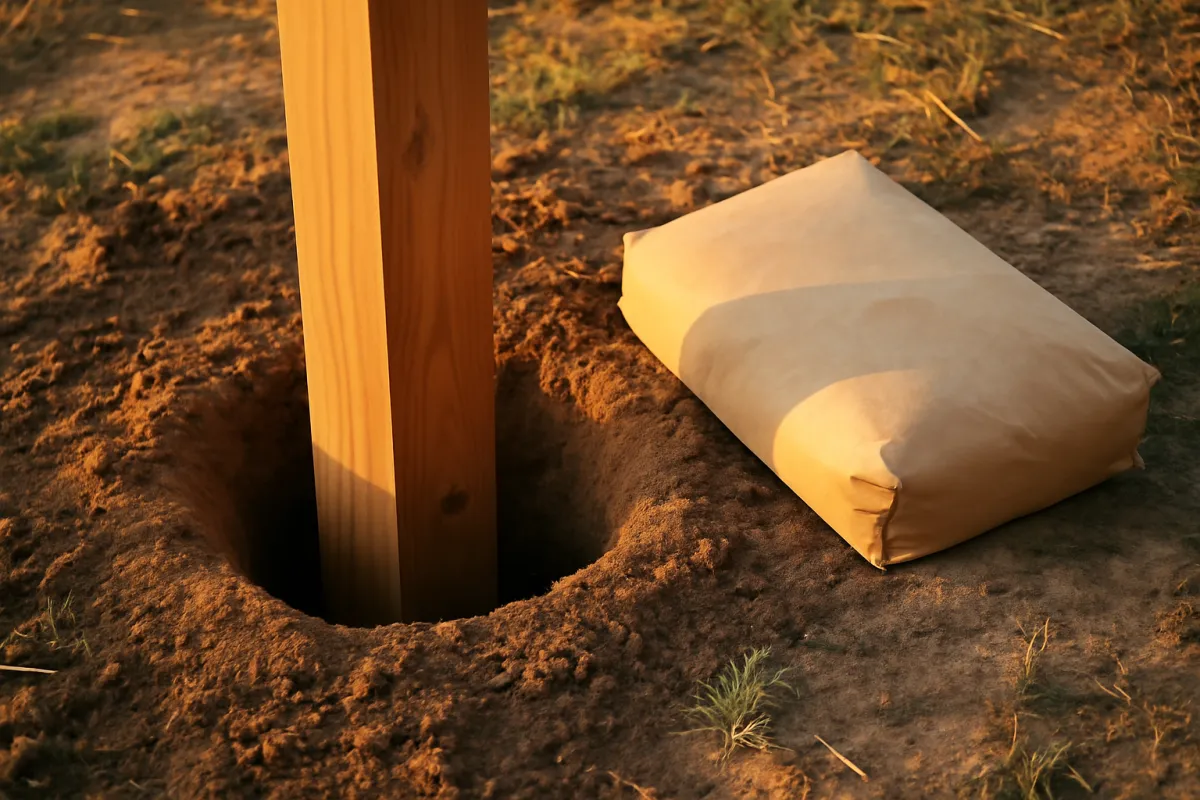
Turn that 1.4 cubic feet into bags and the surprise lands. At 0.6 cubic feet per 80 pound bag, one post needs about 2.3 bags; at 0.45 for the 60 pound bag, about 3.1. Round for a single post and you are buying two to three bags for one hole, which is why a modest ten-post fence quietly becomes thirty-odd bags and a loaded truck bed. People routinely under-buy here because they picture the post, not the annulus of concrete around it, and the annulus is most of the volume. Multiply your per-post figure by the post count, then add margin, and never estimate a fence by eye.
How deep, how wide: sizing the post hole
The bag count for a fence is set almost entirely by two numbers you choose, hole diameter and depth, so it pays to know how they move the total. A common rule of thumb sizes the hole diameter at about three times the post width, so a 3.5 inch 4x4 wants roughly a 10 to 12 inch hole, and sets the depth at about a third of the post’s above-ground height, deeper in loose soil and below the local frost line in cold climates. Those choices are structural, not just quantity questions, so treat them as the spec and calculate from them rather than trimming them to save bags.
Depth and diameter do not move the total equally, and diameter is the sharper lever because it is squared. Going from a 12 inch hole to a 10 inch hole at the same depth cuts the concrete by roughly 30 percent, while going from 2 feet deep to 2.5 feet adds 25 percent. As illustrative per-post figures for a 4x4: a 12 inch hole at 2 feet deep is about 1.4 cubic feet, at 2.5 feet about 1.75, and at 3 feet about 2.1, which is roughly two and a half, three, and three and a half 80 pound bags respectively. Set diameter and depth from the fence’s real needs first, then let those numbers drive the count, and plug your own into the estimator to see the sensitivity for yourself.
A worked fence: ten posts, start to finish
Put it all together on one real order. The fence: ten 4x4 posts, 12 inch holes, 2.5 feet deep, in standard 80 pound bags. Each hole holds 0.5 times 0.5 times 3.14 times 2.5, about 1.96 cubic feet; the post displaces roughly 0.21, leaving 1.75 cubic feet of concrete per post. Ten posts is 17.5 cubic feet. Divide by 0.6 and the bare count is 29.2 bags, which rounds to 30 before any margin. Now add for the reality of hand-dug holes, which belly wider than the auger at the bottom and never match the textbook cylinder, and round the order to about 33 bags.
A ten-post fence concrete order, by where the bags go
Illustrative 33-bag order of 80 pound bags for ten 4x4 posts, 12 inch holes, 2.5 feet deep.
The formula only predicts the first segment, about 29 bags. The other four bags are the margin that keeps you from a store run on the last post, and any unopened sacks go back for a refund.
The order that comes out of this, about 33 eighty-pound bags for a ten-post fence, is roughly 2,600 pounds of dry mix, well over a ton to carry, open, and mix. That weight is the real message of the worked example: the bag count is not just a shopping number, it is a labor plan, and thirty-plus bags is a genuine two-person day or a reason to rent a mixer. Scale it to your own post count with the estimator, and if your fence runs to dozens of posts, price the mixing effort honestly before you commit to bags.
Deck footings and sonotubes: bags per tube
Deck and porch footings are post holes with a cardboard tube in them, and they calculate the same way, as cylinders, except you do not subtract a post because the whole tube fills with concrete. A sonotube’s volume is radius squared times pi times depth, full stop. The three common diameters and a typical 4 foot depth make a handy reference: an 8 inch tube (4 inch radius) holds about 1.4 cubic feet, a 10 inch tube about 2.2, and a 12 inch tube about 3.1, which is roughly 2.5, 3.7, and 5.2 of the 80 pound bags per tube before margin.
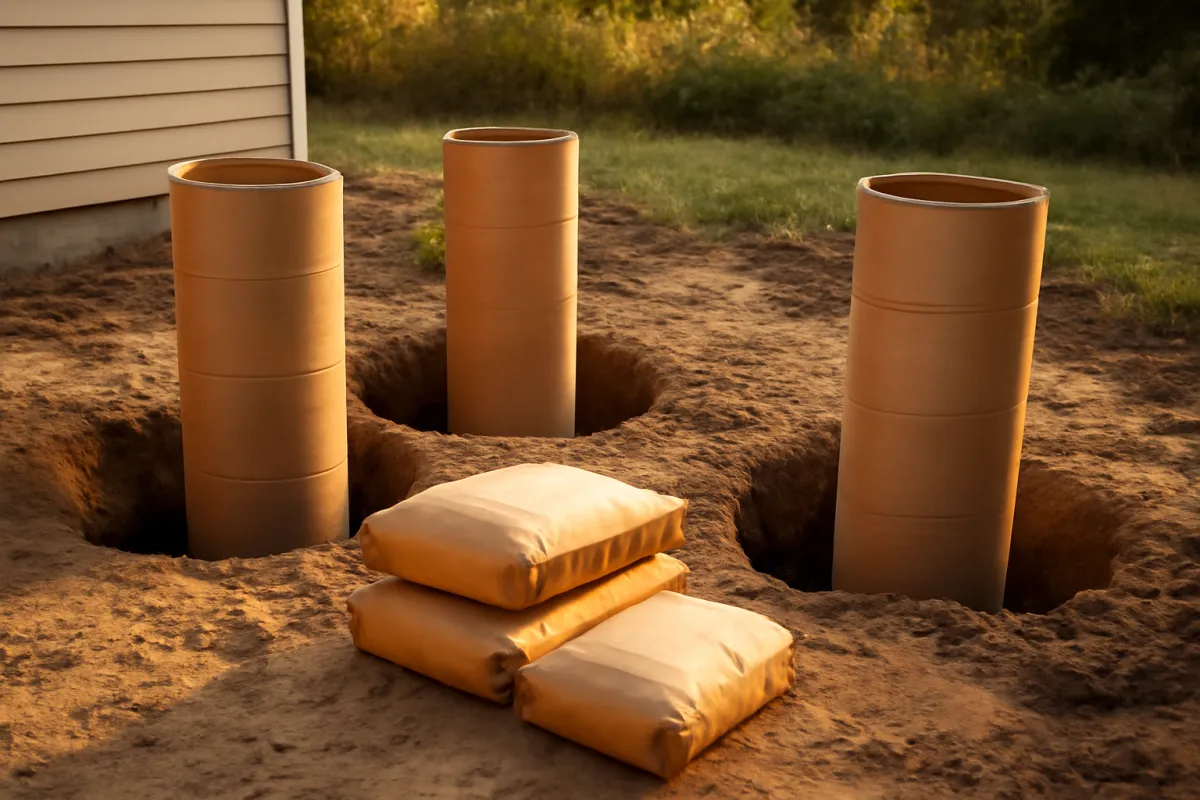
Footings punish eyeball estimates even harder than fence posts because the tubes are wider and often deeper, sitting below the frost line, and a deck can easily want six, eight, or a dozen of them. Six 10 inch tubes at 4 feet is about 13 cubic feet, roughly 22 of the 80 pound bags; step up to 12 inch tubes and the same count is closer to 32 bags. That is comfortably into the range where a rented mixer earns its rental, and getting close to the point where a short-load truck deserves a phone call, especially if the footings and a slab are being poured the same day. Diameter is again the squared lever, so confirm the footing spec with the deck’s design before you count sacks.
Small slabs and pads: a worked 4x4 pad
Slabs and pads are the flattest, friendliest bag jobs, because the shape is a simple box: length times width times thickness, all in feet. Work the classic small pad, 4 feet by 4 feet at 4 inches thick. Four inches is 0.333 feet, so the volume is 4 times 4 times 0.333, about 5.3 cubic feet. Divide by 0.6 and that is 8.8, rounding to 9 of the 80 pound bags, or about 12 of the 60 pound bags. Add a little for spillage and a slightly deep spot and call it 10 eighty-pound bags for a tidy air-conditioner or shed-corner pad.
Notice how quickly a pad approaches the bag ceiling. That 4x4 pad at 9 bags is fine; stretch it to a 6 by 6 foot pad at the same thickness and the volume jumps to 12 cubic feet, about 20 bags, and a modest 8 by 10 patio at 4 inches is 26.7 cubic feet, roughly 45 bags, which is exactly one cubic yard and exactly the crossover. A patio-sized slab in bags means mixing forty-plus sacks in sequence while the first ones you placed are already setting, which risks cold joints between batches and is precisely the job our concrete manual argues belongs to a truck. Bags love a small pad and resent a big one.
Setting posts: wet-set, dry-set, and fast-setting bags
Posts can be set three ways, and which one you pick changes both the product and the count. Wet-setting is the traditional method: mix standard concrete with water in a tub, shovel it around the plumbed post, and let it cure over a day or two before hanging anything. Dry-setting uses a fast-setting product poured dry into the hole around the post, with water added on top; the mix pulls the water down and cures in place, often in 20 to 40 minutes, with no tub and no mixing. Fast-setting products are sold in their own bag sizes, commonly 50 pounds, and are made specifically for this.
The choice is about speed and scale rather than strength for most fences. Dry-setting a fast product is unbeatable for a long fence line where you want to plumb, brace, and move on without waiting on a tub, and it is why fence crews reach for it. Wet-setting standard mix is the call when you are already mixing for a nearby pour, when you want the working time to fine-tune a heavy gate post, or when a spec calls for it. Both fill the same hole, so the cubic-foot math above is identical; only the product and the cure clock change. Read the bag, because a product labeled for post-setting behaves differently from a general concrete mix even at the same weight.
Mixing a bag: water, working time, and consistency
Once the count is set, the work is mixing, and mixing has its own small discipline that decides whether the bags you counted actually reach their strength. Standard mix wants roughly 6 pints, about three quarters of a gallon, of water per 80 pound bag as an illustrative starting point, scaled down for smaller bags. Add water gradually, not all at once, and stop when the mix holds its shape on the hoe but is still plastic and workable, the texture of thick oatmeal. Too dry and it will not consolidate around rebar or the post; too wet and it flows easily but cures measurably weaker, because excess water leaves voids as it evaporates.

The other governor is time. Standard mix gives you a working window, commonly under an hour before it becomes unworkable, and that window shrinks in heat and with fast-setting products down to minutes. The rule that follows is to mix only what you can place before it stiffens, which for hand-mixing is usually one to two bags per batch. Trying to mix six bags in a wheelbarrow at once, then racing to place them, is how the last of the batch goes in half-set and weak. Batch small, place immediately, and clean the tub between rounds so cured lumps do not contaminate the next mix.
By hand or by mixer: how many bags before you rent
The bag count doubles as a tool decision, because hand-mixing and machine-mixing have very different comfortable ranges. By hand, in a wheelbarrow or mixing tub with a hoe, one person can reasonably mix and place up to roughly ten to fifteen 80 pound bags in a session before fatigue starts costing consistency, and that is genuine work. Past that, a portable electric or towable mixer changes the job: it holds a couple of bags per batch, mixes them evenly while you place the last batch, and turns a punishing afternoon into a steady rhythm. The rental is cheap next to the labor it saves on any job above a dozen bags.
Set the thresholds as rough tripwires against your counted bags. Under about ten bags, mix by hand and skip the rental. From ten to forty-something bags, one cubic yard, rent a mixer and the day becomes manageable. At or past that yard, forty-five bags and up, the real question is whether you should be buying bags at all, because a rented mixer full of bag after bag is doing a truck’s job the hard way. This is the same tripwire as the crossover section, seen from the labor side: the mixer extends the practical bag range, but it does not move the point where ready-mix simply wins.
The bags-versus-ready-mix crossover, in real numbers
The whole manual points at one decision, and it deserves stating plainly with numbers. Below about one cubic yard, roughly 45 of the 80 pound bags, bags are the right tool: no delivery minimum, no short-load fee, no truck-access worry, work at your own pace, and unopened bags go back for a refund. That covers nearly every fence, most small pads, and a deck’s worth of footings. The flexibility is real and it is why bags exist. The moment your count crosses into the low forties of 80 pound bags, though, every advantage starts to invert.
Above a yard, ready-mix wins on the things bags cost you: consistent strength from a single batch instead of forty hand-mixed ones, the mixing labor removed entirely, and a lower price per yard of material. The catch is delivery economics, the short-load fee on small truck orders, which creates a genuine gray zone between about one and two yards where a rented mixer and a pallet of bags, a short-load delivery, or splitting a truck with a neighbor are all defensible. Past two yards the truck is simply the answer. Our concrete manual works this crossover in full, with the short-load fee math and the cubic-yard formula behind it; if your bag count is telling you a yard or more, that is the manual to read next.
Buying extra: the ten percent rule
Every bag count off the formula is a minimum, not an order, and the gap between the two is the margin you buy on purpose. A working figure is about 10 percent extra, the same allowance our estimating manual applies to every material, and for bagged concrete it covers specific, predictable losses: hand-dug holes that belly wider than planned, a slightly deep spot in a slab, mix left clinging to the tub and wheelbarrow, and the occasional bag that has hardened in storage and gets set aside. None of these is avoidable and all of them eat into the exact count, so the formula-perfect order runs short on the last hole about as reliably as it rains on pour day.
Bagged concrete makes the 10 percent rule especially easy to follow, because the downside of buying extra is almost nothing. Unopened bags return to the store for a refund at most suppliers, so over-buying costs a receipt and a second trip, while under-buying costs a stalled pour with a setting batch and a same-day store run. Round the formula up to whole bags first, then add roughly one bag in ten, and lean toward the higher side on irregular, hand-dug work where the geometry is least predictable. The margin is not padding; on bag jobs it is the cheapest insurance the register sells.
Fast-setting versus standard mix
Two families of product sit on the shelf and they suit different jobs, so match the mix to the work rather than grabbing the nearest bag. Standard concrete mix is the general-purpose choice: it needs mixing with water, gives a working window of up to an hour, and cures to full strength over the usual timeline, days to weeks. It is what you want for pads, slabs, footings you will mix in a tub, and anywhere you need time to place, consolidate, and finish the surface. Its yields, 0.6 cubic feet for the 80 pound bag and down, are the numbers this manual has calculated from throughout.
Fast-setting mix trades working time for speed. It sets hard in 20 to 40 minutes, can be dry-poured around a post with water added on top, and lets a fence crew move down the line without waiting on cure. The cost of that speed is time to work: you cannot leisurely finish a broad surface with a product that stiffens in half an hour, so fast-setting suits posts and small, deep pours rather than slabs you need to trowel. The bag sizes and yields differ from standard mix, so read the specific product’s coverage rather than assuming the 0.6 cubic foot figure, and never substitute one family for the other without checking that it suits the job.
Storage and shelf life
Concrete mix is a perishable in slow motion, because the cement in it reacts with any moisture it can reach, so how you store bags decides how many of your counted sacks are actually usable on pour day. Unopened and kept genuinely dry, a bag commonly lasts several months up to about a year, but dry mix pulls moisture from humid air and damp concrete floors, and a bag that sits on a garage slab through a wet season can partly cure inside its own wrapper. The tell is simple: a good bag breaks up into loose powder, while a bag with hard lumps that will not crumble has already started to set and belongs in the trash, not the tub.
Store bags to protect the count you paid for. Keep them on a pallet or boards off the floor, sealed under plastic, in the driest space available, and buy close to when you will pour rather than stockpiling months ahead. Opened or partial bags degrade fastest once air reaches the cement, so fold and tape them tightly and use them first. On any job where the bags will sit a while before pouring, inspect the pile before you start and set aside the hardened ones, which is one more reason the 10 percent margin is worth carrying: the bag that failed in storage is a bag you were glad to have bought spare.
Where the bag count goes wrong
The mistakes on bag jobs repeat, and naming them is cheaper than making them. The biggest is the fence-post surprise: estimating by the post instead of the hole, forgetting that the concrete is the wide ring around the post and that a single hole is two to three bags, then buying a fraction of what the fence needs. Close behind is the unit slip that plagues all volume work, using inches where the formula wants feet, which for a slab produces an answer twelve times too large or too small depending on which way it flips. The physical sanity check catches both: does this number of bags sound like a wheelbarrow or a pallet, and does that match the job in front of me.
The subtler errors are about margin and product. Ordering the formula-exact count with no cushion, then running one bag short on the last hole. Mixing too wet to make the shovel work easier, and quietly losing the strength you were paying for. Grabbing fast-setting mix for a slab you need time to finish, or standard mix for a dry-set post. And the planning miss that contains the rest, counting bags the morning of the pour instead of the day before, leaving no time to buy the ones you are short. Bagged concrete forgives almost everything except a setting clock, so do the counting, the buying, and the staging before the water ever hits the mix.
The pre-buy checklist
The whole manual, compressed to the note worth keeping on your phone at the store.
- Get the cubic feet first. Box for pads (L x W x thickness in feet), cylinder for holes and tubes (radius squared x pi x depth), minus the post for fence holes.
- Divide by the yield, round up. About 0.6 cubic feet per 80 pound bag, 0.45 per 60, 0.375 per 50, 0.30 per 40; whole bags only, always rounding up.
- Sanity-check against 45. Around 45 of the 80 pound bags make a cubic yard; if your count is near or past it, price a mixer or a truck.
- Add about 10 percent. Irregular holes, deep spots, tub residue, and the odd hardened bag; unopened sacks go back for a refund.
- Match the mix to the job. Standard for slabs and anything you finish; fast-setting for posts and quick, deep pours.
- Plan the labor. Under ten bags by hand, ten to forty by mixer, past a yard read the concrete manual and rethink bags entirely.
- Buy close to pour day, store dry. Bags off the floor, under plastic, inspected for hard lumps before the first tub.
Run the note top to bottom and the pour becomes the quiet kind: the right pile of bags, one calm mixing rhythm, and nothing set half-hard while somebody drives to the store.
The bottom line
The bagged-concrete question is one line of arithmetic carrying a heavy bag: cubic feet needed, divided by what a bag yields, rounded up, plus about 10 percent for the ways real holes and slabs disagree with the formula. The yields are worth memorizing, roughly 0.6 cubic feet for the 80 pound bag on down, and so is the fence-post reality that one hole is two to three bags and a ten-post run is thirty-odd. The one judgment the numbers hand you is when to stop buying bags at all, near 45 of them, one cubic yard, where the mixing labor outgrows the delivery fee you were dodging. Work your own posts, footings, or pad through our estimator, read the concrete manual the moment your count says a yard or more, and skim the gravel manual if the same holes need a compacted base under them. Count the bags before pour day, and the heavy work stays just heavy, never a scramble.
Read this as workbench education, not a specification. Every yield, bag count, hole volume, water figure, and cure time above is an illustrative worked example, and the specific product you buy, your supplier, your soil, and your climate will each move the real numbers. Bag yields, water ratios, set times, and frost depths vary by brand and region, and anything structural or load-bearing, from a deck footing to a gate post, should be sized against the local building code with a qualified professional in the loop. Confirm the yield printed on the actual bag and settle the count before you mix, because concrete keeps its own schedule once the water goes in.
Frequently asked questions
How much concrete does an 80 lb bag make?
An 80 pound bag of standard concrete mix yields roughly 0.6 cubic feet of wet, placed concrete, an illustrative figure that varies a little by brand and how wet you mix it. That is the number every bag-count calculation starts from: divide the cubic feet your job needs by 0.6 and round up. For quick reference, a 60 pound bag makes about 0.45 cubic feet, a 50 pound bag about 0.375, and a 40 pound bag about 0.30, so smaller bags cost more handling per cubic foot placed. Always read the yield printed on the bag you actually buy, since it is the manufacturer's own number for that product.
How many bags of concrete do I need?
Work out the cubic feet your job needs, then divide by the bag's yield and round up to whole bags. A small 4 by 4 foot pad at 4 inches thick is about 5.3 cubic feet, which is roughly nine 80 pound bags before any margin. A single 12 inch fence post hole 2 feet deep holds around 1.4 cubic feet of concrete after the post displaces its share, close to two and a half 80 pound bags. The formula never changes: cubic feet divided by bag yield, rounded up, plus a small cushion for irregular holes and spillage.
How much concrete do I need for a 4x4 post?
A common setup is a 12 inch diameter hole, 2 feet deep, holding about 1.57 cubic feet total; a 4x4 post displaces roughly 0.17 cubic feet, leaving about 1.4 cubic feet of concrete per post. That is close to two and a half 80 pound bags or a little over three 60 pound bags for each post, before margin. Deeper or wider holes climb fast: the same hole at 3 feet deep needs closer to three and a half 80 pound bags. Because hand-dug holes belly out at the bottom, budget an extra bag for every few posts rather than buying the exact count.
How many bags of concrete make a cubic yard?
A cubic yard is 27 cubic feet, so the count is 27 divided by the bag's yield. That works out to about 45 of the 80 pound bags, 60 of the 60 pound bags, 72 of the 50 pound bags, or 90 of the 40 pound bags per cubic yard. Those counts are exactly why bags suit small jobs and turn punishing at slab scale: a single cubic yard is around 45 bags to carry, open, and mix by hand against a setting clock. Our concrete manual works the cubic-yard side of the same material in full.
When should I stop buying bags and order a ready-mix truck?
A common crossover sits near one cubic yard, roughly 45 of the 80 pound bags. Below it, bags win on flexibility, no delivery minimums, and the ability to return what you do not open; above it, the labor of mixing dozens of bags by hand starts to outweigh any saving. Between about one and two cubic yards is a gray zone where a rented mixer or a short-load delivery both make sense. Past two yards, the truck almost always wins, a decision our concrete manual covers with the short-load fee math behind it.
How much water does a bag of concrete need?
Standard mix needs roughly 6 pints, about three quarters of a gallon, per 80 pound bag as an illustrative starting point, less for smaller bags in proportion. Add water gradually and stop when the mix holds a shape but is still workable, like thick oatmeal, because too much water permanently weakens the cured concrete. The exact figure is printed on the bag and is worth following, since a batch mixed too wet loses strength you cannot get back. Mix only what you can place inside the working window, usually under an hour for standard mix.
Can I pour concrete mix dry into a post hole?
Some fast-setting products are designed for it: you set the post, pour the dry mix around it, then add water on top, and the mix cures in place, often in 20 to 40 minutes. Standard concrete mix is not designed for this and should be mixed with water first for reliable strength. Dry-setting is popular for fence posts because it is fast and needs no mixing tub, but it suits posts and light footings, not structural pours. Check the bag: only products labeled for post-setting or fast-setting should be dry-poured.
How long does a bag of concrete mix last in storage?
Kept dry and off the ground, an unopened bag commonly stays usable for several months up to about a year, but dry mix is thirsty and absorbs moisture from humid air and damp floors. A bag that has gone hard in spots, or that will not break up into loose powder, has partly cured and should be discarded rather than mixed. Store bags on a pallet, sealed under plastic, in a dry space, and buy close to when you will pour. Opened bags degrade faster once air reaches the cement, so fold and seal any partial bag tightly.