What's on this page
- The formula, and the inches trap inside it
- From cubic yards to tons: why the yard sells by weight
- Recommended depths, use by use
- Base plus top: why a driveway wants two gravels
- Gravel types and what each one covers
- The compaction factor: order about twenty percent extra
- Working a real driveway end to end
- Cubic yards, made physical
- Edging and containment: keeping the order in place
- Bags or bulk: where the crossover sits
- Delivery versus pickup economics
- The over and under-ordering tradeoff
- Driveway math versus French-drain math
- Measuring odd shapes and curved drives
- Where the estimate goes wrong
- The pre-order checklist
- The bottom line
Gravel is the material where the answer hides in a single unit conversion, and the unit changes twice on the way to the order. You measure a driveway in feet and inches, the supplier prices it by the cubic yard or, more often, by the ton off a truck scale, and the volume that actually fills the space is more than the finished depth on your tape suggests, because loose stone compacts under its own weight and the first pass of a wheel. Miss any one of those steps and the delivery arrives short, leaving thin, hollow patches that pothole by the second winter, or long, leaving a heap you spend a weekend spreading somewhere it was never meant to go.
The math itself is short: area times depth in feet, divided by 27, plus a compaction allowance, then a conversion to tons if that is how your yard sells it. This manual works that line end to end for the three jobs that cover almost every gravel order, a driveway, a path, and a drainage trench, and then covers what the formula alone will not tell you: the recommended depths by use, why a driveway wants two different gravels stacked, the twenty percent you add for compaction, and where bagged stone stops making sense. It is a sibling to our concrete manual, which runs the same volume-over-27 logic for a different material, and to our general estimating manual, which lays out the coverage-plus-waste method underneath all of it. For a first pass on your own numbers, our estimator does the arithmetic in seconds, and for the volume method behind every material, not just gravel, our yardage calculator manual runs the length, width, and depth math on the page as you read.
Key takeaways
- The formula is length × width × depth in feet, divided by 27 for cubic yards; depth in inches must convert to feet first, the single most common error.
- Bulk gravel is often sold by the ton, and typical crushed stone runs roughly 1.4 tons per cubic yard, so multiply your yards by about 1.4 to speak the supplier's language.
- Add about 20 percent over the raw volume for compaction: loose stone settles and packs when placed and driven on, and short leaves thin, potholing spots.
- Depth is set by use: paths around 2 to 3 inches, driveway surface about 3 inches over a 4 to 6 inch base, drainage trenches a foot or more, all illustrative.
- Bagged gravel loses to bulk fast: a bag holds about half a cubic foot, so past a fraction of a yard, delivery by the ton or yard is cheaper and far less lifting.
The formula, and the inches trap inside it
Every gravel estimate is the same calculation as every other bulk-material estimate: the volume of the space you are filling, converted into the unit the yard sells in. For the flat, rectangular jobs that dominate gravel work, that volume is length times width times depth, and the trap, exactly as in concrete, is units. Your dimensions arrive mixed, a 40 by 12 foot pad, 4 inches deep, and the formula demands one unit throughout. Convert depth to feet first: 4 inches is 4/12, or 0.333 feet. The volume is then 40 × 12 × 0.333, about 160 cubic feet.
The second conversion is the one first-timers skip entirely: bulk gravel is measured by the cubic yard, and a cubic yard is 27 cubic feet, three feet in each of three dimensions. Divide 160 by 27 and the pad needs just under 6 cubic yards. Leave depth in inches and the same arithmetic returns an answer twelve times too large; forget the divide-by-27 and you have a number in cubic feet that no yard will recognize. Written as one line: (length ft × width ft × depth in ÷ 12) ÷ 27 = cubic yards. Our concrete manual runs this identical line for slabs and footings, and our estimating manual frames why the same shape of math carries across every material you buy by volume. Every driveway, path, and trench in this manual runs through that one line, and everything after it is adjustment.
From cubic yards to tons: why the yard sells by weight
Gravel adds a conversion that paint and mulch do not, because the yard usually does not sell it by volume at all. Trucks are weighed at a scale on the way out, so the ticket comes in tons, and your cubic-yard figure has to cross over. Typical crushed stone weighs roughly 1.4 tons per cubic yard, so a 6 cubic yard order is about 8.4 tons. That 1.4 is an illustrative planning figure, not a physical constant: denser stone and wet material weigh more per yard, lighter or drier stone less, so the exact number belongs to the specific product, and a quick check with the yard settles it.
The practical move is to carry both numbers. Calculate in cubic yards, because volume is what fills a measured space and what your tape produces, then multiply by about 1.4 to get the tonnage the supplier quotes and the truck delivers. When you call, you can state either and let them translate, but knowing both means the conversation, and the invoice, make sense. This is also why a gravel order and a mulch order feel different at the yard even at the same cubic volume: mulch is light and sold by the yard, gravel is heavy and sold by the ton, and the ton is simply the weight of the volume you already calculated.
Recommended depths, use by use
Depth is the input that moves a gravel order more than any measuring error will, and unlike area it is not something you read off the ground: it is a spec you choose from the job. The depths below are illustrative starting points, and local ground conditions, traffic, and drainage all move them, but they anchor the estimate. A garden path or walkway commonly runs shallow, around 2 to 3 inches, enough to cover the ground and stay put underfoot. A driveway’s finished driving surface is often about 3 inches of finer gravel, but it sits on a coarser base of roughly 4 to 6 inches, so the total stone depth for a full build runs 6 to 9 inches, not 3. Drainage trenches such as a French drain typically want the most, a foot or more of stone around the pipe, because the whole point is a deep reservoir of open voids for water to move through. Our gravel depth reference tabulates these depths use by use, paver bases and pea gravel included, in one bookmarkable place.
Recommended gravel depth by use
Illustrative depths; local conditions and traffic move the real figures.
Bar widths track the depth figures: the drainage trench holds roughly six times the stone per square foot of a garden path, which is why a short French drain can rival a much larger path in cubic yards. Confirm the depth spec before any other number, because it scales the whole order.
The lesson the chart carries is that square footage alone tells you almost nothing about the order until depth is fixed. A large path at 2 inches and a small trench at 12 inches can want the same tonnage, so the first question on any gravel job is not how big but how deep, and the answer comes from what the surface has to do.
Base plus top: why a driveway wants two gravels
A driveway is the job that most often surprises people on volume, because it is not one layer of gravel but two, built for two different purposes. The base layer is coarse, angular stone, commonly a larger crushed rock, laid 4 to 6 inches deep to spread vehicle load and lock together under compaction so the drive does not rut. On top of that goes a shallower layer, around 3 inches, of finer gravel that packs to a smoother, more comfortable driving surface and sheds water. The two do different jobs: the base carries weight, the top drives and drains, and neither works well alone, a single deep layer of coarse rock is rough and loose, a single layer of fine gravel over soft ground ruts under the first heavy delivery.
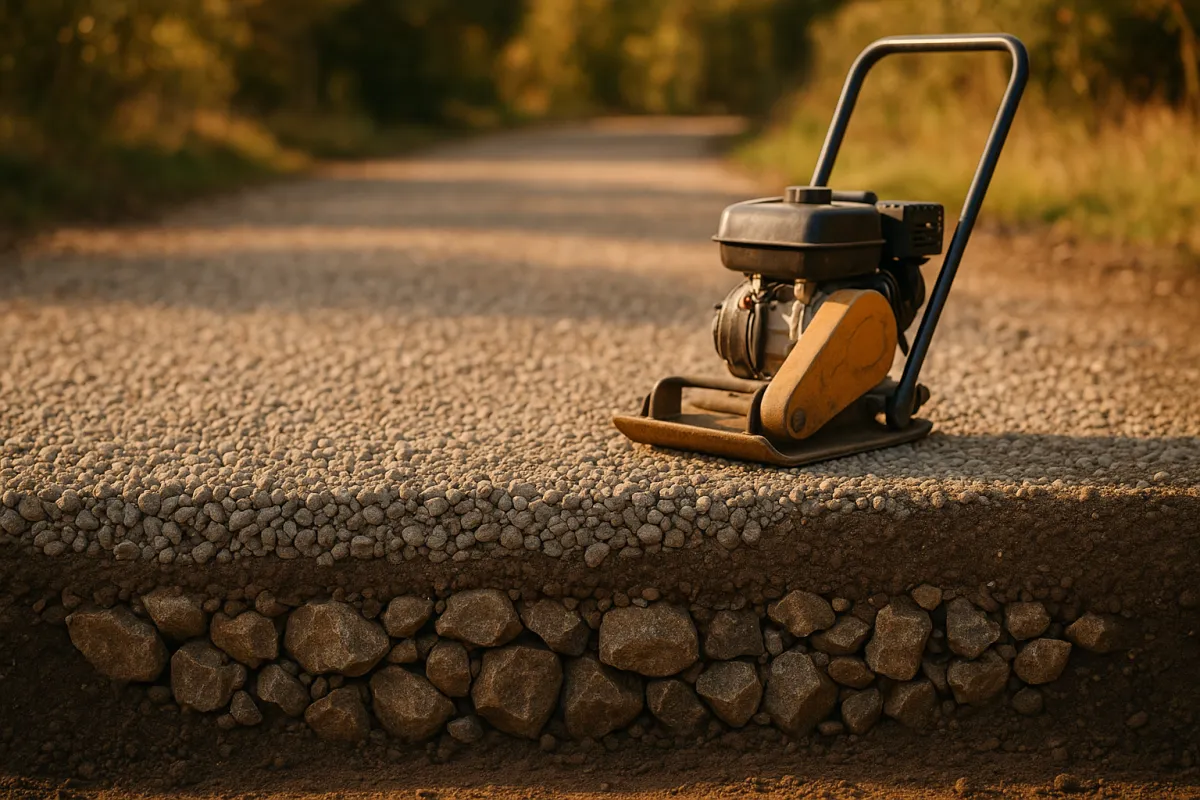
For the estimate, that means a full driveway is two volume calculations stacked, the base at its depth and the top at its depth, usually in two different products at two different prices. Add them for the total tonnage, but keep them separate on the order so the yard sends the right stone for each. The stackbar below breaks a representative driveway order into where the material goes, base, top, and the compaction allowance the next section covers, so the two-layer reality is visible before the truck is booked.
A driveway gravel order, by destination
Illustrative split of a two-layer driveway order, base plus top plus the compaction allowance.
The base is the bulk of the order because it is the deepest layer; the top is shallower, and the compaction allowance rides on both. Order the base and top as separate products so each gets the right stone, then add the allowance across the whole.
Gravel types and what each one covers
Gravel is a category, not a product, and the type changes both the job it suits and, slightly, the volume-to-weight it delivers. The names vary by region, but a few families recur. Crushed stone is angular rock that locks together under compaction, which makes it the standard base and driveway material because it stays put. A common base grade is a dense mix of stone and fines, sometimes called base rock or road base, that compacts to a near-solid layer. A well-known drainage and surface grade is a clean, angular stone with the fines washed out, often labeled by a number such as #57, whose open voids drain freely and which is favored around pipe and under slabs. Pea gravel is small, smooth, rounded stone, comfortable underfoot and attractive in paths and patios, but it rolls rather than locks, so it wanders without firm edging and is a poor structural base.
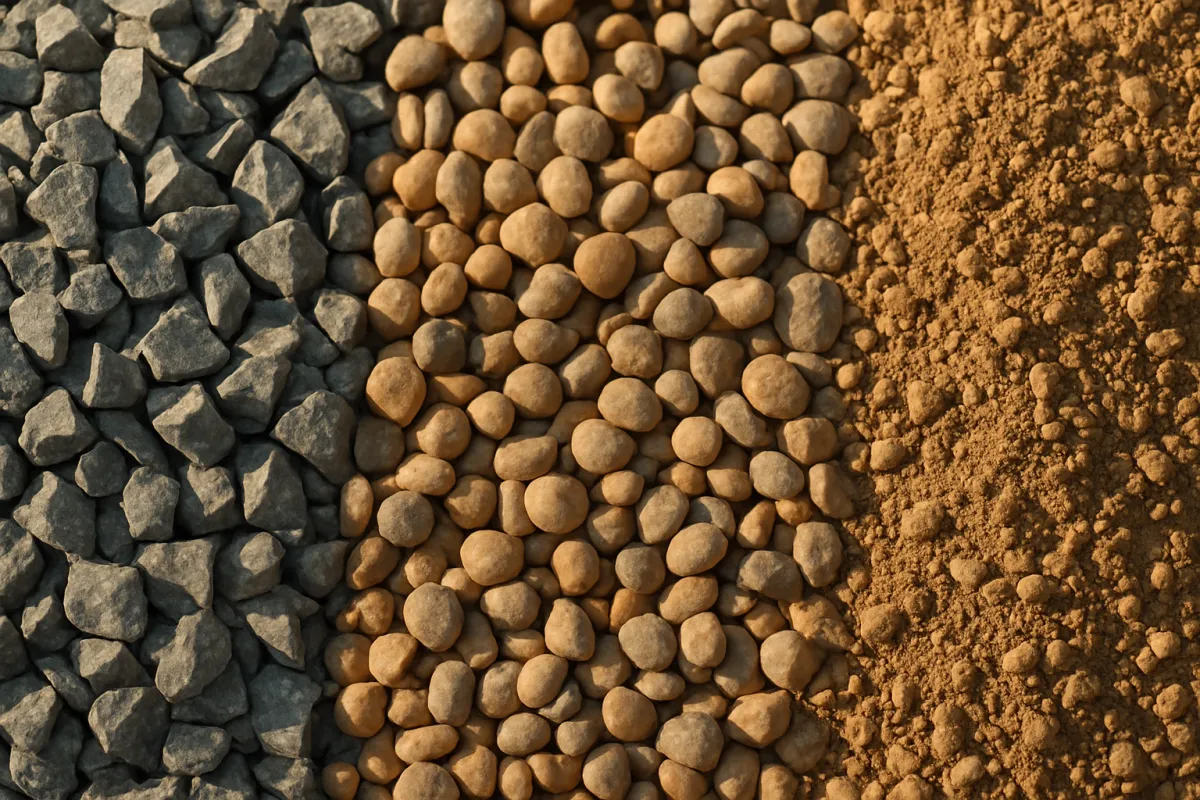
For estimating, the coverage math is identical across types, volume over 27, but two type-driven adjustments matter. First, compaction differs: dense base grades pack down more than clean angular drainage stone, so the allowance you add is a little higher for base material and a little lower for the washed stone in a French drain. Second, weight per yard drifts by type, which is why the 1.4 tons per yard figure is a planning number and the yard’s own weight for the specific product is what the scale ticket reflects. Choosing the type is a spec decision, comfort and looks for a path, lock and load for a base, drainage for a trench, and it belongs before the volume math, not after, because it steers both the depth and the allowance.
The compaction factor: order about twenty percent extra
Here is where gravel departs from a tidy volume formula, and the departure is not waste in the concrete sense but physics. Loose gravel poured from a truck occupies more space than the same stone once it has been raked level and driven on, because the air gaps between stones close as the material settles and compacts. So the volume that fills your measured depth is more than the finished depth implies: you are ordering enough loose stone that, once packed, still reaches the depth you specified. The common allowance is around 20 percent over the raw formula volume, and soft or uneven subgrades that swallow the first inches of stone can push it higher.
The direction of the error is what sets the number, exactly as it does with concrete. Order 20 percent long and the surplus is cheap: it tops up low spots, extends a path, or sits in a corner for next season, gravel does not spoil. Order formula-exact and the shortfall is expensive in a slow way, the finished layer comes up thin in the spots that settled most, those thin spots hold water and pothole first, and the fix is a second small delivery at the yard’s least favorable pricing for a partial load. Twenty percent is not padding, it is the difference between a layer that holds up and one that dishes out early, and it is the single adjustment most first-time gravel orders leave out.
Working a real driveway end to end
Walk a driveway through completely, because the worked version surfaces every decision the formula hides. The plan: a single-vehicle driveway, 100 feet long by 10 feet wide, resurfaced with a 4 inch layer of gravel. Area first: 100 × 10 is 1,000 square feet. Depth in feet: 4 inches is 0.333. Volume: 1,000 × 0.333 is about 333 cubic feet. Over 27, that is roughly 12.3 cubic yards from the formula, the number before any real-world adjustment.
Now the corrections that make it an order. Add the compaction allowance, about 20 percent, and 12.3 becomes roughly 14.8 cubic yards, the loose volume you actually buy so the packed layer holds 4 inches. Convert to the unit the yard delivers in: at about 1.4 tons per cubic yard, 14.8 yards is roughly 20.7 tons on the truck scale. As an illustrative cost, at a planning figure of a few tens of dollars per yard or ton for common crushed stone, the material lands somewhere in the low-to-mid hundreds before a delivery fee, with the exact number coming only from a local quote. Round up to the yard’s ordering increment, and the driveway that took ten minutes with a tape and this line arrives in one delivery instead of one-and-a-crisis. Run your own dimensions through our estimator to get the same chain of numbers for your drive.
Cubic yards, made physical
The cubic yard stays abstract until the first time you move one by hand, so calibrate it. One cubic yard of gravel is 27 cubic feet and, at roughly 1.4 tons, about 2,800 pounds, well over a ton of stone. It fills about 9 to 14 heaped contractor wheelbarrow loads, and it covers a meaningful but smaller patch than newcomers expect: at 3 inches deep, one cubic yard spreads over roughly 100 square feet, and at 4 inches, closer to 80. That coverage-per-yard sense is the fastest sanity check on any estimate.
The physical sense earns its keep twice. At estimate time it catches unit slips: if the formula says a short garden path needs 9 yards, the math went wrong somewhere, because 9 yards is a driveway’s worth of stone, not a walkway’s. At delivery time it sets the labor plan, because a gravel order does not place itself. Ten or fifteen yards is twenty-plus tons of material that arrives as a single heap and has to be barrowed, raked, and leveled before it can be compacted, which is why the wheelbarrow count and the number of hands belong in the plan alongside the tonnage. A delivery that lands Saturday morning is a Saturday of moving stone, and knowing that in advance is the difference between a finished drive and a half-spread pile under Monday’s rain.
Edging and containment: keeping the order in place
An estimate assumes the gravel stays where you put it, and loose stone’s natural tendency is to migrate, so containment is part of the job and sometimes part of the order. Without a firm edge, gravel spreads sideways under traffic and weather, the layer thins at the margins, and the drive or path creeps into the lawn and the flowerbeds, which quietly means you keep needing more stone to maintain the depth you paid for. Edging, a physical border of timber, steel, stone, or a purpose-made paver restraint, holds the material and preserves the depth, which protects the estimate over time as much as the compaction allowance protects it on day one.
Rounded stone like pea gravel needs edging most, because smooth stones roll rather than lock and will not hold a slope or a boundary on their own; angular crushed stone is more forgiving but still benefits from a defined edge on a driveway. For estimating, edging is a linear-feet item, the perimeter of the area, and it is easy to forget on the volume-focused order sheet and then need on install day. The related containment layer is underneath: many gravel jobs sit on a geotextile fabric that separates the stone from the soil, stopping the gravel from sinking into soft ground and weeds from growing up through it, which preserves depth from below the way edging preserves it from the sides. Fabric is an area item, the footprint plus overlap, and it belongs on the same order as the stone.
Bags or bulk: where the crossover sits
Bagged gravel and bulk gravel are the same stone at wildly different scales of effort and cost, and the crossover comes fast. A bag of gravel typically holds only about half a cubic foot, which means it takes well over 50 bags to equal a single cubic yard, and at driveway scale the arithmetic turns absurd: our 14.8 yard example would be hundreds of bags, each lifted, carried, opened, and emptied. Below a fraction of a yard, for a small repair, a container garden, or a tiny path, bags win on convenience: no delivery minimum, no truck to schedule, buy exactly what you need and carry it home.
Past that fraction of a yard, bulk wins decisively, on both price and labor. Bulk gravel by the ton or the yard costs a small fraction per unit of what bagged stone does, because you are not paying for the bag or the handling, and a single delivery replaces dozens of lifts. The gray zone is narrow: somewhere between a fraction of a yard and a yard or two, a delivery fee can make a small bulk order and a bag pile close on total cost, and there the decision turns on whether you have a way to receive and move bulk stone. Above a yard or two, as our estimating manual frames for materials generally, bulk is simply the answer, and the only real question is delivery versus pickup.
Delivery versus pickup economics
Once you are buying bulk, the next fork is how the stone gets to the site, and the economics turn on quantity and distance. Delivery adds a fee, sometimes flat, sometimes by distance, but it drops a full order in one trip exactly where you want it, which for anything past a yard or two is usually worth it because the alternative is many trips in a pickup with a load limit measured in fractions of the order. A half-ton pickup carries only a fraction of a cubic yard of gravel safely, since a single yard already outweighs the truck’s rating, so self-hauling a multi-yard order means many round trips and real wear on the vehicle.
The rule of thumb is that the delivery fee spreads across the whole order, so the bigger the load, the smaller the fee looks per yard, which is another reason to buy the compaction allowance and any second job in one delivery rather than two. Pickup makes sense only for genuinely small bulk orders, a fraction of a yard the truck can carry in one honest load, and even then the yard’s loader filling your bed in two minutes is the easy part, the unloading and the trips are the cost. When comparing quotes, as our contractor-quote thinking suggests for any material, put the delivery fee inside the total and compare the all-in number per ton delivered, not the sticker price per ton at the yard, because the fee is where a cheap-looking quote hides its real cost.
The over and under-ordering tradeoff
Every gravel order lands on one side of the exact number, and the two sides are not symmetric, so it pays to know which way to lean. Under-ordering is the expensive direction in slow motion: the layer comes up thin somewhere, usually the spots that settled most or the low corners the subgrade swallowed, and thin gravel over soft ground is where potholes start. The fix is a second delivery for a partial load, the least economical order a yard fills, plus a repeat of the spreading labor, plus the finished surface never quite matching where old meets new. Short is not a catastrophe the way a mid-pour concrete shortfall is, but it is a recurring, irritating cost that compounds over seasons.
Over-ordering is the cheap direction. Gravel does not spoil, cure, or expire, so a surplus is just stone in a corner waiting for the next low spot, the extension of a path, or the bed under a shed floor. The practical target is the formula volume plus the compaction allowance, rounded up to the yard’s increment, which naturally lands a little long, and that is correct: a small deliberate surplus costs the price of a fraction of a yard, while a shortfall costs a whole extra delivery and a patched-in seam. The one caution against gross over-ordering is receiving and storing it, a heap has to go somewhere and get moved, so buy generously but not blindly, and have a spot for the extra before it arrives.
Driveway math versus French-drain math
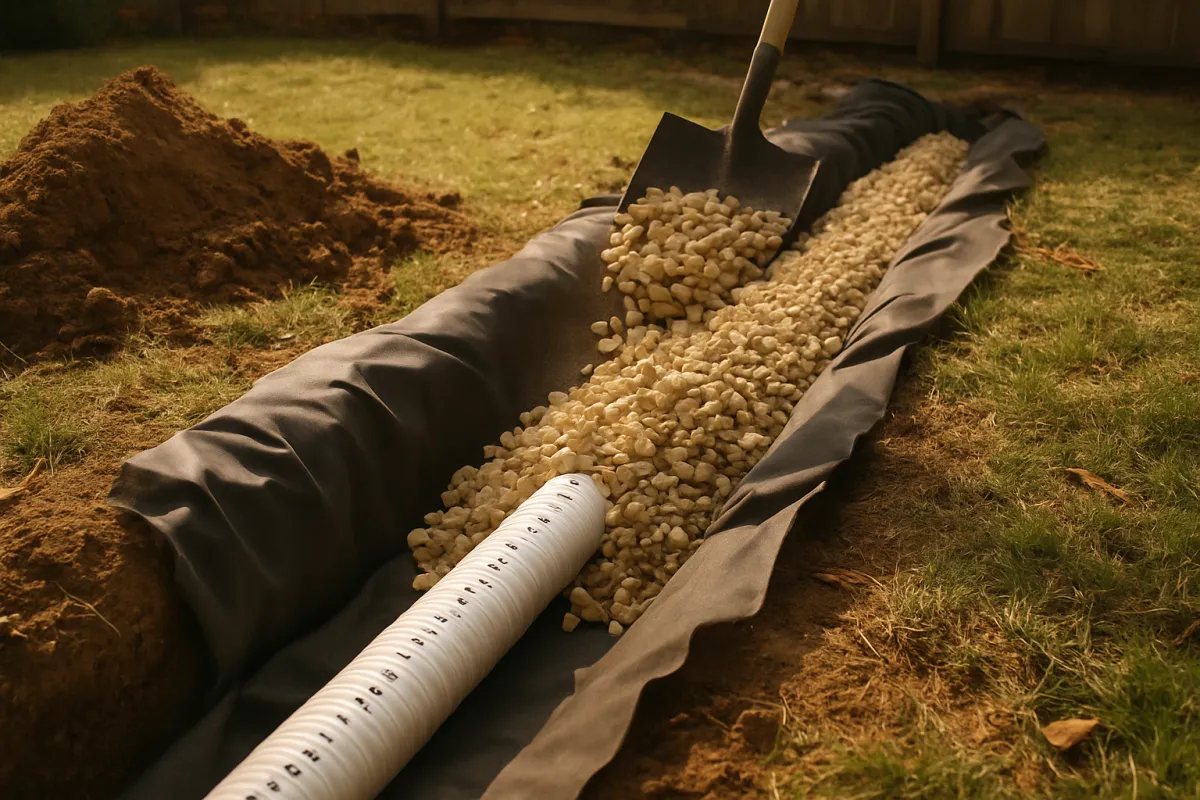
Two gravel jobs look different but run the same line, and comparing them shows how depth and stone type, not area, drive the order. A driveway is a broad, shallow job: large area, modest depth per layer, finished for load and driving, calculated as area times layer depth over 27, twice if it is base plus top. A French drain is the opposite, a narrow, deep job: small footprint, large depth, calculated as trench length times width times depth over 27, and it wants clean, angular, washed stone whose open voids carry water rather than the dense, packing base a driveway uses.
The instructive contrast is per-square-foot volume. A driveway at a few inches of stone uses a few tenths of a cubic yard per hundred square feet of area; a French drain at a foot deep uses several times that per foot of trench, which is why a short drain surprises people on tonnage. An illustrative 40 foot trench, one foot wide and one foot deep, is 40 cubic feet, about 1.5 cubic yards before allowance, a modest number that still outweighs a much larger shallow path. The compaction allowance also flips slightly: drainage stone is chosen not to pack tight, so it settles less than a dense driveway base, and the allowance can be a touch lower. Same formula, opposite geometry, and the reason to calculate rather than eyeball: the deep, narrow job hides its volume, and the broad, shallow one hides its total behind two stacked layers.
Measuring odd shapes and curved drives
Real driveways and beds refuse to be clean rectangles, and the estimating move for every irregular footprint is the same one our concrete manual uses: decompose the shape into pieces you can already solve, calculate each, and sum. An L-shaped drive is two rectangles sharing an edge. A drive that widens into a parking apron is a rectangle plus a second rectangle. A rough or wandering boundary gets approximated as the rectangle that would contain it, with the overage joining the allowance. Sketch the decomposition on paper with dimensions before touching a calculator, because the sketch is where a forgotten section announces itself, the arithmetic never fails, only the inventory of pieces does.
Curves need one adjustment. A circular pad or a rounded turnaround is radius squared times pi times depth, the same cylinder math the concrete manual uses for post holes, at gravel depth. A curved driveway is estimated as its centerline length times its width times depth, which treats the curve as a straightened strip and comes close enough for a bulk order. Curved and irregular jobs earn a point or two more allowance than clean rectangles, because the eye-fitted boundary always encloses a little more area than the plan promised and curved edges spread more, so let the extra ride in the compaction and shape allowance rather than trying to compute the curve exactly. Complexity in footprint is never a math problem with gravel, only a bookkeeping one, and the sketch is the bookkeeping.
Where the estimate goes wrong
Gravel’s failure patterns repeat reliably enough to list in descending order of expense. Unit slips lead, exactly as in concrete: depth left in inches instead of converted to feet, the divide-by-27 forgotten, or cubic yards and tons confused so the order is off by the 1.4 factor in one direction or the other. Each produces an answer wrong by a multiple, not a margin, which is why the physical sanity check, does this sound like a path or a driveway, catches more disasters than careful re-arithmetic. Depth assumptions follow: calculating a driveway as one 3 inch layer when it is a 6 inch base plus a 3 inch top, or forgetting that a drainage trench wants a foot, both discovered when the delivered pile runs visibly short of the marked depth.
The subtler failures round out the list. Skipping the compaction allowance entirely, then watching the finished layer settle thin and pothole. Ordering formula-exact and feeding the shortfall to a partial-load delivery fee. Forgetting the containment items, edging and fabric, that keep the depth you paid for from migrating into the lawn or sinking into the soil. And the planning failure that contains the others: eyeballing the order the day the truck is booked instead of measuring the week before, leaving no room to re-measure, re-spec the depth, or add the allowance when the numbers disagree. Gravel rewards the boring virtues, early measurement, checked units, a real allowance, and it invoices every shortcut in second deliveries and early potholes.
The pre-order checklist
The whole manual, compressed to the sheet worth keeping in the truck.
- Fix the depth spec first. By use: paths around 2 to 3 inches, driveway top about 3 over a 4 to 6 inch base, drainage a foot or more, all illustrative and subject to local conditions.
- Measure the footprint, decompose odd shapes. Length times width for each rectangle, sum the pieces, sketch before you calculate.
- Run the line. (L ft × W ft × depth in ÷ 12) ÷ 27 = cubic yards, per layer, then add the layers.
- Add about 20 percent for compaction. More on soft subgrades; the shortfall potholes, the surplus fills low spots.
- Convert to tons if the yard sells by weight. Cubic yards × roughly 1.4 for common crushed stone; confirm the product’s own weight.
- Pick bags or bulk by the crossover. Under a fraction of a yard, bags; past it, bulk delivery almost always wins on price and labor.
- Compare quotes all-in. Put the delivery fee inside the total and compare cost per ton delivered, and stage the site to receive and spread the pile.
Run the list top to bottom and the delivery becomes what it should be: one truck, one heap, one weekend of spreading, and a layer that holds its depth.
The bottom line
Gravel estimating is one line of arithmetic with a weight conversion bolted on: length by width by depth in feet, over 27, plus about 20 percent for the way loose stone packs down, then times roughly 1.4 if the yard sells by the ton. The craft around the line is knowing which input dominates, depth above all, which direction of error costs more, short always costs more in slow potholes and partial-load fees, and where the jump from a few bags to a booked delivery actually sits. Work your own driveway, path, or trench through our estimator, read the concrete manual for the same volume logic on a less forgiving material, or the general estimating method for the coverage-plus-waste thinking underneath all of it, and give the order its week of lead time. The delivery that follows will be the dull, single-truck, correctly-deep kind, which in gravel is the only kind worth having.
Treat this as shop-floor education, not a specification. Every depth, coverage figure, weight, conversion, and cost above is an illustrative worked example, and your stone type, your supplier, your region, and your ground will each move the real numbers. Weight per yard, compaction behavior, and drainage performance all vary with the specific product, so confirm depths, the yards-to-tons conversion, and any structural or drainage detail against local practice and a qualified professional before you order, and settle the final quantity with your supplier when you book the delivery.
Frequently asked questions
How do I calculate how much gravel I need?
Multiply length by width by depth, all in feet, to get cubic feet, then divide by 27 to convert to cubic yards, the unit bulk gravel is measured in. A 40 by 12 foot area at 4 inches deep (0.333 feet) is about 160 cubic feet, or just under 6 cubic yards. Add roughly 20 percent because gravel compacts as it settles and is placed, and round up to the supplier's ordering increment before you call.
How many yards of gravel do I need for a driveway?
It depends on the area and the total depth of stone, which for a full driveway is usually two layers, a coarse base and a finer top. A common single-vehicle drive of about 100 by 10 feet at 4 inches of gravel works out near 12 cubic yards from the formula, and closer to 15 once the compaction allowance is added. A full base-plus-top build at 6 to 8 inches total can double that, so settle the depth spec before running the number.
How many tons of gravel are in a cubic yard?
Gravel weighs roughly 1.4 tons per cubic yard for typical crushed stone, though the exact figure shifts with stone type and moisture, so treat 1.4 as an illustrative planning number, not a guarantee. Many suppliers sell and deliver by the ton because trucks are weighed at a scale, so once you have your cubic yards you often multiply by about 1.4 to talk the same language as the yard. Confirm the specific conversion for the product you are buying when you order.
How deep should gravel be for a driveway?
A common approach layers the stone: a coarse base of about 4 to 6 inches for load bearing, topped with roughly 3 inches of finer gravel for the driving surface, though local ground conditions and traffic change the figures. Paths and walkways commonly run shallower, around 2 to 3 inches, and drainage trenches like French drains often want a foot or more of stone around the pipe. Depth is the estimate's most sensitive input, so confirm it before calculating, because doubling depth doubles the order.
Should I order extra gravel for compaction?
Yes. Loose gravel settles and is compacted when it is placed and driven on, so the volume that fills the space is more than the finished depth suggests. A common allowance is around 20 percent extra over the raw formula volume, sometimes more on soft subgrades that swallow the first inches of stone. Running short leaves thin, hollow spots that pothole early, so the extra is cheap insurance, and any surplus fills low spots or a second path.
Is it cheaper to buy gravel in bags or in bulk?
For very small jobs, bagged gravel wins on convenience with no delivery minimum, but the crossover comes quickly. A bag typically holds only about half a cubic foot, so it takes well over 50 bags to equal a single cubic yard, which is why bulk by the ton or yard is dramatically cheaper per unit past a fraction of a yard. Once your project needs more than a handful of bags, pricing a bulk delivery almost always pays, even after a delivery fee, and it saves a great deal of lifting.
How much does a yard of gravel cost?
As an illustrative planning figure, bulk gravel commonly runs somewhere in the range of a few tens of dollars per cubic yard or per ton for common crushed stone, with decorative stone costing more and delivery added on top. Prices vary widely by region, stone type, and how far the truck drives, so the only reliable number is a quote from a local yard for your specific product and quantity. Buying more in one delivery usually lowers the effective cost because the delivery fee spreads across more material.
How much gravel do I need for a French drain?
A French drain is trench volume, so calculate length times width times depth in feet, over 27, the same as any other gravel job, then add for the perforated pipe you subtract very little for. An illustrative 40 foot trench, 12 inches wide and 12 inches deep, is about 40 cubic feet, or roughly 1.5 cubic yards before allowance. Drainage trenches use clean, angular stone that resists packing tight, and they typically want more depth than a surface job, so the per-foot volume runs higher than a shallow path.