What's on this page
- What concrete costs, three prices at once
- Ready-mix price per cubic yard
- From price per yard to your bill: the volume side
- Bagged concrete: price per bag
- The bag-to-truck cost crossover
- Installed cost per square foot, the number you actually want
- What drives the price of concrete
- The short-load fee, the small-pour gotcha
- Delivery and the minimum-order charge
- Labor cost for a slab
- Decorative, stamped, and colored premiums
- What common projects cost, by size
- DIY bags, DIY ready-mix, or hire a pro
- How to estimate your own concrete cost
- Ways to cut the cost
- A worked 400 square foot patio, priced three ways
- Concrete cost per cubic meter
- Using a concrete cost calculator
- Where cost estimates go wrong
- The cost-estimate checklist
- The bottom line
Ask “how much does concrete cost” and you will get three different right answers, because concrete is priced three different ways depending on who is buying and how much. A batch plant quotes it per cubic yard off the truck. A hardware store sells it per bag off a pallet. A contractor prices it per square foot, poured and finished and walked away from. Those three numbers describe the same grey material, but they are not interchangeable, and confusing them is how people end up shocked at a quote or short on a receipt.
This manual prices concrete all three ways and then explains the fees, the labor, and the finish premiums that sit between the sticker and the real bill. It is the cost companion to two manuals you will want open alongside it: our concrete manual works out the cubic yards your job actually needs, and our bagged-concrete manual counts the sacks for small pours. Cost is always volume times price plus labor, so once you know your volume from those, this manual turns it into money. For a fast first pass on the volume, our estimator does the arithmetic in seconds.
Key takeaways
- Ready-mix commonly runs an illustrative 140 to 180 dollars per cubic yard delivered, roughly 5 to 8 dollars per 80 pound bag, and about 6 to 10 dollars per square foot poured and finished.
- The per-square-foot installed figure is the number most people actually want, because it already bundles concrete, forming, the pour, and a basic finish.
- The short-load fee is the small-pour gotcha: a surcharge, often 50 to 150 dollars per yard short of the minimum, that can rival the concrete's own price on tiny orders.
- Labor is frequently the largest single share of an installed slab, which is why local wage rates move the bill more than the concrete does.
- Three cost paths exist for any pour: DIY bags, DIY ready-mix, or hiring a pro, and the right one depends almost entirely on your volume.
What concrete costs, three prices at once
Before any single number is useful, separate the three prices, because each answers a different question. The per cubic yard price is a wholesale material figure: what a batch plant charges for a yard of wet mix delivered to your forms, and it is what you pay when you order a truck. The per bag price is a retail material figure: what a store charges for a sack you mix yourself, best for jobs measured in cubic feet rather than yards. The per square foot installed price is a finished-job figure: what a contractor charges to form, pour, and finish a flat surface, labor and all.
The trap is comparing across these without converting. A yard of ready-mix at an illustrative 160 dollars sounds cheap next to 8 dollars a square foot until you remember the yard only covers about 80 square feet at 4 inches thick, and that 160 dollars buys you a pile of wet concrete, not a finished slab. This manual keeps the three straight and shows how they connect: material cost comes from volume times a per-unit price, and the installed price is that material plus the labor to place and finish it. Get the three prices sorted and every quote you receive suddenly makes sense.
Ready-mix price per cubic yard
Ready-mix is concrete’s wholesale unit, and the per cubic yard price is where any larger job starts. As an illustrative, widely cited range, a standard residential mix runs roughly 140 to 180 dollars per cubic yard delivered, with a common working midpoint near 160 dollars. That figure is remarkably variable, more than almost any other number in this manual, because it tracks cement prices, aggregate costs, and diesel fuel, all of which move with the wider economy. A quote you got last season is a guess this season, so treat any printed number as a placeholder for a live call to a local batch plant.
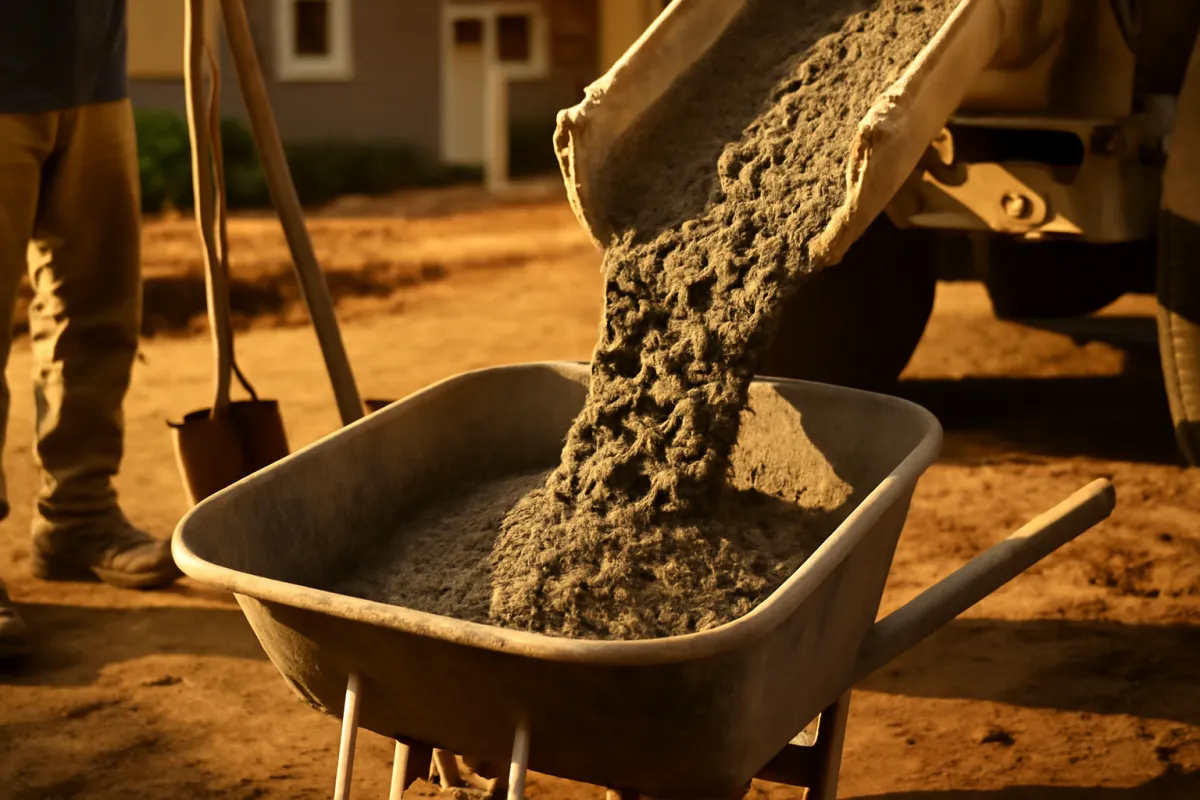
What the per-yard number does not include is the reason it can mislead. It is material only, delivered to an accessible site, before the short-load fee on small orders, before any labor, and before the finish. A higher-strength mix, say 4,000 PSI instead of 2,500, adds modestly per yard; fiber reinforcement, accelerators for a cold-weather pour, or a long haul from the plant each add more. To turn this price into a real material cost you need your volume, which is exactly what our concrete manual works out, and then it is one multiplication.
From price per yard to your bill: the volume side
Cost is volume times price, so the per-yard number is only half the equation until you know how many yards you need. That is the volume side, and it is pure geometry: length times width times thickness, all in feet, divided by 27 to get cubic yards. A 12 by 20 foot patio at 4 inches thick is about 80 cubic feet, or just under 3 cubic yards, which at an illustrative 160 dollars a yard is roughly 480 dollars of material. Our concrete manual walks that formula end to end, including the inches-to-feet conversion that trips up nearly everyone the first time.
Two adjustments turn the raw volume into an honest material cost. First, the waste allowance: real subgrades sit slightly low, forms bow a little, and some mix stays in the truck, so a 5 to 10 percent cushion is standard, the same allowance our estimating manual applies to every material. Order the exact figure and you risk a stalled pour and a second delivery fee. Second, suppliers sell in increments, often quarter or half yards, so you round up to what they will actually deliver. Run your own footprint through our estimator to see the yards, then multiply by the local per-yard quote for a material cost you can trust.
Bagged concrete: price per bag
Below a cubic yard, the truck stops making sense and the unit becomes the bag. An 80 pound bag of standard mix commonly runs an illustrative 5 to 8 dollars retail, with 60, 50, and 40 pound bags costing less per bag but more per cubic foot of concrete placed. The catch hiding in that price is yield: an 80 pound bag makes only about 0.6 cubic feet of wet concrete, so you are paying a retail markup on a small volume. Per cubic foot placed, bagged concrete is meaningfully more expensive than ready-mix, and that gap only widens as the job grows.
Do the conversion once and the economics land. Because roughly 45 of the 80 pound bags make a single cubic yard, a yard bought in bags at an illustrative 6 dollars each is about 270 dollars of material, well above the 160 dollars the same yard costs off a truck. You are paying for convenience, no delivery minimum, and the ability to return what you never open. For small jobs that premium is worth every cent, because the flexibility and zero delivery fees win. Our bagged-concrete manual works the full bag count for posts, footings, and small pads, and it is the manual to read the moment your job is measured in cubic feet rather than yards.
The bag-to-truck cost crossover
The single most useful cost decision in bagged versus ready-mix is where the two cross, and it sits close to one cubic yard. Below it, bags win on total cost despite the higher per-unit price, because you dodge every delivery fee, every short-load surcharge, and every truck-access worry, and you return unopened sacks for a refund. That covers nearly every fence, most small pads, and a deck’s footings. The flexibility is real money saved on a small job, not a rounding error.
Above a yard, the per-unit gap starts to dominate and the labor turns punishing. Mixing 45 bags by hand to make one cubic yard is a genuine two-person day, and every bag is a sack to carry, tear, and scrape, so the ready-mix price advantage compounds with the labor you avoid. Between about one and two yards is a documented gray zone where a short-load delivery, a rented mixer with a pallet of bags, or splitting a truck with a neighbor are all defensible. Past two yards the truck simply wins. Our bagged-concrete manual covers this crossover from the labor side, with the bag counts behind it.
Installed cost per square foot, the number you actually want
For most people the honest answer to “how much does concrete cost” is not a yard price or a bag price at all: it is the installed cost per square foot, because that is what a contractor charges to hand you a finished slab. As an illustrative range, a plain poured-and-finished slab commonly runs about 6 to 10 dollars per square foot, with roughly 8 dollars a fair planning midpoint. That figure bundles everything the material prices leave out: the concrete itself, the forming, the pour, and a basic broom finish, plus the crew’s time and overhead.
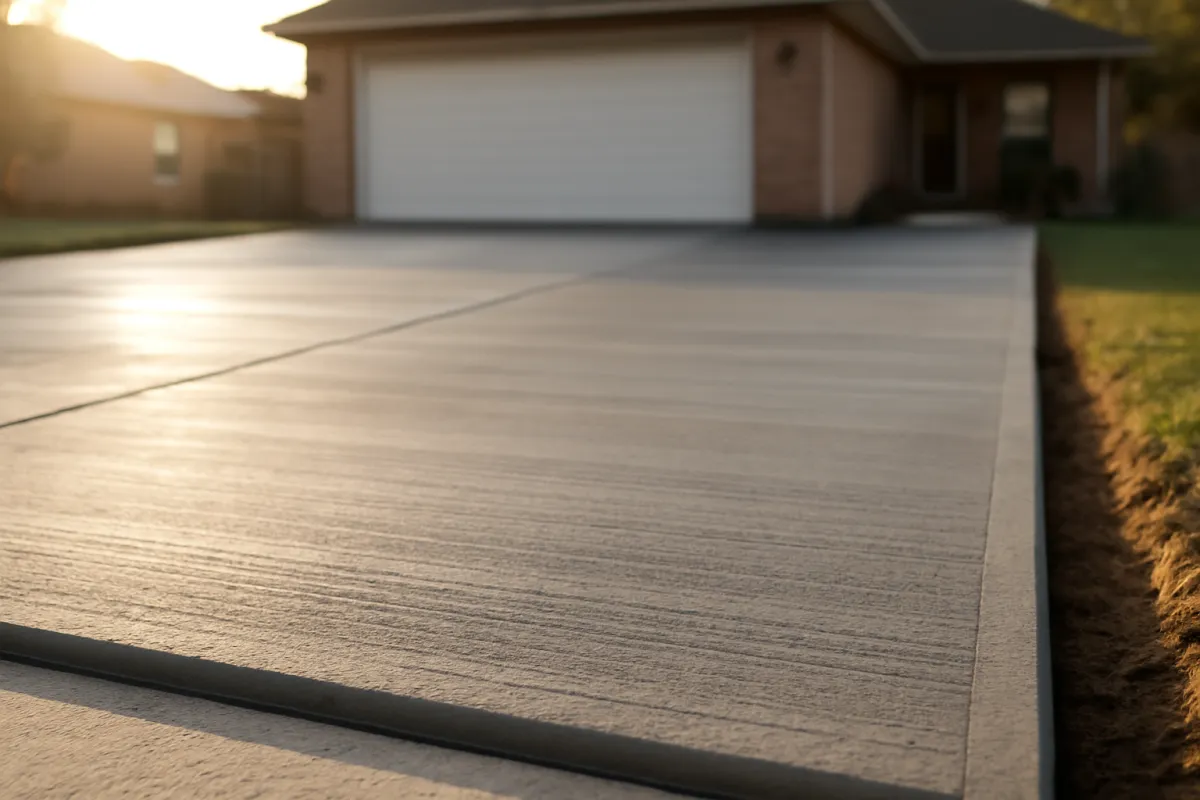
The reason this number is so useful is that it is directly comparable to your project size, which you can measure with a tape and no math. A 200 square foot patio at 8 dollars a foot is a roughly 1,600 dollar illustrative starting point, all in. What moves it is thickness (a driveway at 5 or 6 inches costs more per foot than a 4 inch patio), site prep, access for the truck, and above all the finish. Keep this per-square-foot figure as your headline number and use the material prices to understand what sits inside it.
Illustrative installed cost per square foot, by finish
Poured-and-finished flatwork, material and labor bundled; local rates and site conditions move every bar.
The finish is the biggest single lever on installed cost. A plain grey slab and a stamped one use nearly the same concrete; the gap is almost all labor, forms, color, and sealing, which is why stamped can run more than double a broom finish.
What drives the price of concrete
Concrete’s price is the sum of several inputs that each move independently, and knowing them explains why two quotes for the same slab can differ by hundreds. Strength is the first: PSI rises with cement content, and a 4,000 PSI mix for a driveway costs modestly more per yard than a 2,500 PSI footing mix. Region is the second and often the largest, because both material availability and labor rates are local, and a busy building season tightens truck supply and pushes quotes up. Fuel sits underneath both, since diesel powers the batch plant and the delivery truck, so a fuel spike raises the material price and the delivery fee at once.
Then come the add-ons that ride on top of the base mix. Additives (accelerators for cold weather, retarders for hot, fiber or air-entrainment for durability) each add per yard. Reinforcement is a common one people forget to price: rebar or welded wire mesh, plus the labor to place it, adds material and time to any structural slab. Thickness quietly multiplies everything, because going from 4 to 6 inches adds 50 percent to the volume and therefore 50 percent to the material bill. Settle strength, reinforcement, and thickness as a spec before you calculate, because each is a cost decision disguised as a construction detail.
The short-load fee, the small-pour gotcha
The short-load fee is the number that ambushes people ordering their first small pour, and it deserves its own section because it can rival the concrete’s own price. Ready-mix plants have an economical minimum, often around 3 to 5 cubic yards, below which they charge a surcharge, because the truck, drum, and driver cost the same to dispatch whether the load is full or nearly empty. As an illustrative figure, that fee commonly runs 50 to 150 dollars per cubic yard short of the minimum, and some plants charge a flat small-load fee instead, often in the 100 to 250 dollar range.
Run the arithmetic on a small order and the gotcha is obvious. Suppose you need 1.5 yards but the plant’s minimum is 4, and it charges 60 dollars per yard short: that is 2.5 short yards, or 150 dollars added to a material cost of only about 240 dollars. Your small pour just cost 60 percent more than the sticker suggested. This is precisely why the bag-to-truck crossover is not a clean per-yard comparison, and why batching several small pours into one delivery, or choosing bags below a yard, so often saves real money. Always ask a plant for its minimum and its short-load policy before you assume the per-yard price is your price.
Delivery and the minimum-order charge
Delivery is a cost even when the load is large, and it comes in a few flavors worth separating from the short-load fee. Some plants fold a standard delivery charge into every order, a flat fee for the truck rolling to your site, often modest on a full load and steep as a share of a small one. Others set a minimum order value rather than a minimum yardage, so a tiny pour is billed up to that floor regardless of how little concrete you actually take. Distance matters too, since a site far from the batch plant can add a per-mile charge or simply price out because concrete has a working window and cannot ride in the drum forever.
Two more delivery-day costs catch people off guard. The first is standby or waiting time: a truck holds concrete for a limited window, and if your crew is not ready to place it, some plants bill by the minute past a grace period, which rewards having the site, the tools, and the help staged before the truck arrives. The second is access: if the truck cannot reach the forms and you need a pump or a line of wheelbarrows, that is added cost or added labor. Ask about delivery charge, minimum order, waiting time, and access when you book, not at the chute.
Labor cost for a slab
Labor is the quiet giant of an installed price, frequently the largest single share, which is why the per-square-foot figure sits so far above the raw material cost. Forming a slab, setting reinforcement, placing the concrete, screeding it flat, floating and troweling the surface, and cleaning up is skilled, time-sensitive work done against a setting clock. As an illustrative split of a plain 8 dollar per square foot slab, the concrete material might be only 2 to 3 dollars of it, with the remaining 5 or 6 dollars going to labor, forming materials, finishing, and overhead. That is the gap between ordering a truck yourself and hiring the job out.
The labor share also explains why regional wage rates move an installed quote more than the concrete price does. Two contractors buying the same yard of ready-mix will still quote different totals because their crews cost different amounts, and a decorative finish that demands hours of hand-tooling widens the spread further. When you compare bids, you are largely comparing labor and finish, not material, so ask each bidder what the price includes: forming, reinforcement, finish type, control joints, and cleanup. Our chart below breaks a poured slab into where the money goes, and labor’s dominance is the whole point of the picture.
Where the cost of a poured concrete slab goes
Illustrative split of a plain, broom-finished residential slab installed by a crew; shares vary by region and finish.
Material is under half of a plain installed slab. That is why a per-yard price alone understates the real cost so badly, and why the finish, which is almost pure labor, is the biggest lever on the total.
Decorative, stamped, and colored premiums
A plain grey slab and a decorative one start from nearly the same concrete, so the premium for a fancy finish is almost entirely labor and materials added on top, which is why it climbs so fast. Coloring is the entry point: an integral color mixed through the batch or a surface color hardener commonly adds a few dollars per square foot, taking a plain slab into the roughly 10 to 13 dollar illustrative range. Exposed aggregate, where the top layer is washed to reveal the stone, lands in a similar band because it trades the trowel finish for a wash-and-seal process that takes its own time and skill.
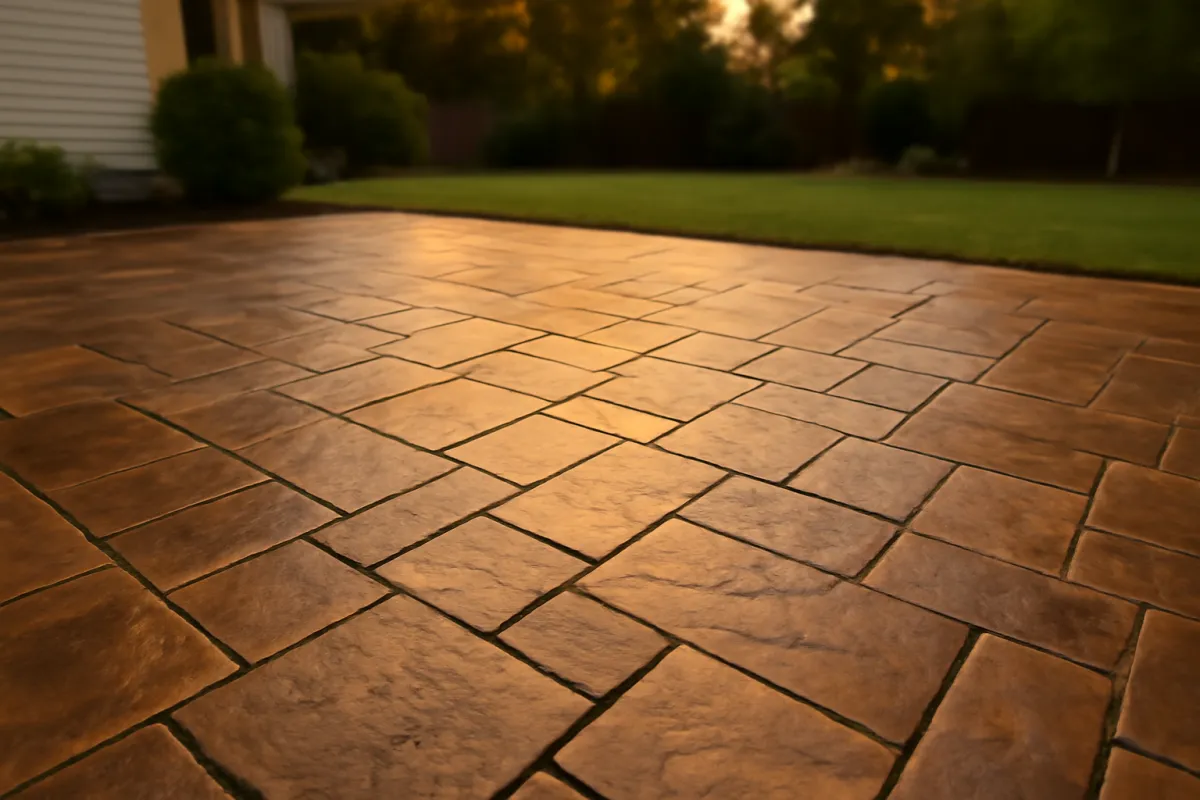
Stamped concrete is the top of the residential range, commonly 12 to 20 dollars per square foot as an illustrative figure, and occasionally higher for complex multi-color patterns. The premium buys pattern mats pressed into the wet surface, release agents, one or more colors, detailed hand-tooling around edges, and a sealer that has to be reapplied over the years. None of that changes the cubic yards you order, so the volume side of your estimate is identical to a plain slab; the difference is stacked entirely on the labor and finishing lines. Decide the finish before you gather bids, because it can more than double the installed price of the exact same footprint.
What common projects cost, by size
Turning per-square-foot figures into whole-project totals is where the numbers get concrete, so here are a few common jobs priced illustratively at a plain-finish rate. A sidewalk, say 4 feet by 40 feet, is 160 square feet, roughly 1,300 dollars at 8 dollars a foot, and about 2 cubic yards of material. A patio at 12 by 16 feet is 192 square feet, an illustrative 1,500 dollars or so plain, and quickly more with a decorative finish. A shed or equipment slab at 12 by 12 feet is 144 square feet, near 1,150 dollars plain. These are starting points, not quotes, but they frame the scale.
Larger and thicker jobs climb steeply because both area and thickness push the total. A driveway at 16 by 40 feet is 640 square feet, and because driveways want 5 to 6 inches and often reinforcement, an illustrative installed range of 8 to 12 dollars a foot puts it somewhere around 5,000 to 8,000 dollars. A garage-sized 24 by 24 foot slab is 576 square feet, similar territory. The pattern is clear: small flatwork lives in the hundreds to low thousands, driveways and large slabs in the several thousands, and any decorative finish shifts the whole range up. Measure your footprint, pick a per-foot rate for the finish you want, and you have a defensible ballpark before a single bid arrives.
DIY bags, DIY ready-mix, or hire a pro
Every pour has three cost paths, and the right one is set almost entirely by volume. The first is DIY bags: buy sacks, mix them yourself, and pour. It is cheapest in total for small jobs because you avoid all delivery and labor costs and buy only what you open, but the per-unit material price is highest and the labor is yours. This path owns everything under about half a cubic yard and stays reasonable up to roughly a full yard with a rented mixer. Below that line, nothing beats it on cost.
The second path is DIY ready-mix: order a truck but form, place, and finish it yourself. Here you get the low per-yard material price and skip contractor labor, but you take on a short-load fee if you are under the minimum and, more importantly, the real risk, because finishing concrete well is a timed skill and mistakes cure permanently. The third path is hiring a pro, which is the per-square-foot installed price, and it wins as jobs grow because the labor share you would otherwise supply is large, skilled, and unforgiving. As a rough map: bags under a yard, DIY ready-mix in the one-to-three yard range if you are confident finishing, and a pro for anything large, structural, or decorative.
How to estimate your own concrete cost
Putting it together is a short procedure you can run before any quote. Step one is volume: length times width times thickness in feet, divided by 27, for cubic yards, which our concrete manual walks through with the unit conversions that catch people out, and which our estimator computes in seconds. Add a 5 to 10 percent waste allowance, the same cushion our estimating manual uses for every material, so you are pricing the amount you will actually order, not the theoretical minimum.
Step two is turning volume into two comparison numbers. Multiply your yards by an illustrative per-yard price for a material cost, the DIY-truck figure. Then multiply your square footage by an installed per-square-foot rate for the finish you want, the hire-a-pro figure. The difference between those two is essentially what a crew charges to form, pour, and finish, which tells you what you are buying if you hire out and what you are taking on if you do not. Add any short-load fee if your yardage is under the plant minimum, plus reinforcement and site prep. Run those steps and you walk into bidding with a number, which is the best protection against a quote you cannot judge.
Ways to cut the cost
Concrete cost has real levers, and pulling them before you order beats haggling after. The biggest is thickness: pour to the spec the job needs and no deeper, because every extra inch is a straight percentage added to the volume and the material bill, so confirm 4 inches is enough rather than defaulting to 6. The second is batching: combine several small pours into one delivery to clear the plant’s minimum in a single trip and dodge repeated short-load fees, which is why crews pour the sidewalk, the pad, and the footings the same morning when they can.
More savings hide in timing and finish. Ordering in the off-season or midweek can find softer quotes than a peak-season Saturday. Choosing a plain broom finish over a decorative one is the largest single cut available, since the finish is almost pure labor. Doing the site prep yourself (excavation, gravel base, forming) hands the crew a ready job and trims the labor line, though only attempt what you can do correctly, because a bad base costs more than it saves. And supplying your own labor for the parts you can handle, or picking the DIY-bags path under a yard, converts the largest cost, labor, into your own time. Cut thoughtfully, never by under-ordering or thinning the slab below spec.
A worked 400 square foot patio, priced three ways
Nothing clarifies the three prices like one job costed through all of them, so take a 400 square foot patio at 4 inches thick. The volume is 400 times 0.333, about 133 cubic feet, or 4.9 cubic yards, and with a 10 percent allowance you would order about 5.5 yards. That volume figure feeds every path, and it is exactly what our estimator produces from the footprint and thickness.
Path one, DIY bags: at roughly 45 of the 80 pound bags per yard, 5.5 yards is around 250 bags, an illustrative 1,500 dollars in material alone, plus a brutal amount of mixing, which is why nobody bags a job this size. Path two, DIY ready-mix: 5.5 yards at an illustrative 160 dollars is about 880 dollars of concrete, comfortably over a plant minimum so likely no short-load fee, but you form, place, and finish 400 square feet yourself, a serious skilled day. Path three, hire a pro: 400 square feet at an illustrative 8 dollars a foot is about 3,200 dollars plain, all in, or closer to 5,000 to 6,000 dollars stamped. The material is the same 5.5 yards in every case; what changes is who supplies the labor and the finish, and the spread between 880 dollars of concrete and a 3,200 dollar installed price is the clearest possible picture of what labor and finishing cost.
Concrete cost per cubic meter
Buyers working from metric plans, or getting quotes abroad, will see concrete priced per cubic meter rather than per cubic yard, and the two are close enough to confuse. A cubic meter is about 1.31 cubic yards, so a per-cubic-meter price covers roughly a third more material than the same figure per cubic yard. To compare a metric quote against the ranges in this manual, multiply the per-yard figure by about 1.31: an illustrative 160 dollars per cubic yard is in the neighborhood of 210 dollars per cubic meter for the same mix, before any fees, labor, or finish.
The volume side converts the same way. Where a domestic estimate divides cubic feet by 27 for cubic yards, a metric one divides by 35.3 for cubic meters, because a cubic meter holds about 35.3 cubic feet. The 12 by 20 foot patio that came to just under 3 cubic yards is about 2.27 cubic meters, and multiplying that by an illustrative per-cubic-meter price gives the material cost in metric terms directly. Every other cost step, the waste allowance, the short-load fee, the finish premium, and the labor share, applies unchanged.
As with every figure in this manual, treat the per-cubic-meter number as an illustrative planning range, not a quote. Metric markets carry their own delivery minimums, small-load surcharges, and regional labor rates, and cement and fuel prices move a cubic meter as readily as a cubic yard. Convert the volume with the factor, apply a live local price to it, and the metric bill reads with the same three prices, material, fees, and labor, that drive the cost anywhere.
Using a concrete cost calculator
A concrete cost calculator turns the two numbers this manual keeps separate, the material figure and the installed figure, into one quick comparison for your own footprint. Enter the area, the thickness, and the finish, and a good tool works the volume first, length times width times thickness in feet over 27, then multiplies the yards by an illustrative per-yard price for the material cost and the square footage by a per-square-foot rate for the installed cost. The gap between those two is what a crew charges to form, pour, and finish, which is the single most useful thing a calculator can show you before a bid arrives.
The material coverage estimator on this page handles the volume side, and the companion below carries it through to both an illustrative material cost and an installed cost so you can see the labor share fall out. Treat every figure a concrete cost calculator returns as a planning range rather than a quote, because the per-yard price, the short-load fee, and the finish premium are all local and volatile. Use the tool to walk in with a defensible number, then confirm it against a live, written quote for your job in your area.
Where cost estimates go wrong
The cost mistakes repeat, and naming them is cheaper than paying for them. The biggest is pricing material and calling it the job: quoting yourself the 880 dollars of concrete for the patio above and being stunned by a 3,200 dollar bid, when the difference is the labor you were never going to supply. Close behind is forgetting the short-load fee on a small pour, so the sticker per-yard price understates the real cost by half. Both come from treating one of the three prices as the whole answer.
The subtler errors sit in the inputs. Pricing 4 inches and pouring 6, which quietly adds 50 percent to the material. Leaving out reinforcement, site prep, or old-surface removal, all of which are real lines on a real bill. Comparing bids without checking what each includes, so a low number that omits finishing looks better than a complete one that does not. And the planning miss that contains the rest, getting a single quote and treating it as the market, when regional labor rates move the total more than anything else. Price all three ways, list every add-on, and gather more than one bid, and the final number stops surprising you.
The cost-estimate checklist
The whole manual, compressed to the note worth keeping when you price a pour.
- Get the volume first. Length times width times thickness in feet, divided by 27, plus a 5 to 10 percent allowance; this drives every cost path.
- Pick the right price. Per yard for a truck, per bag under a yard, per square foot for a finished job by a pro; never compare across them without converting.
- Add the fees. Short-load surcharge under the plant minimum, delivery charge, minimum order, and waiting time; ask the plant before you assume the per-yard price.
- Price the finish honestly. Plain broom is the baseline; colored, exposed, and stamped stack labor on top and can more than double the installed number.
- Remember labor is the giant. On an installed slab, material is often under half; local wage rates move the bill more than the concrete does.
- Choose your path by volume. Bags under a yard, DIY ready-mix in the one-to-three yard range if you can finish, a pro for large, structural, or decorative work.
- Get more than one bid. And check what each includes: reinforcement, forming, finish, joints, and cleanup.
Run the note top to bottom and the quote you receive becomes something you can judge, not just accept.
The bottom line
How much concrete costs depends on which of three prices you mean, and the honest planning answer uses all of them: roughly 140 to 180 illustrative dollars per cubic yard for ready-mix, about 5 to 8 dollars per 80 pound bag, and near 6 to 10 dollars per square foot poured and finished, with decorative work well above that. The per-square-foot figure is the one most people actually want, because it bundles the concrete, the forming, the pour, and the finish into the finished-slab number, and it makes plain that labor, not material, is the larger cost. Work your volume through our concrete manual and estimator, count the sacks with our bagged-concrete manual if your job is under a yard, add the short-load fee and the finish premium, and gather more than one bid. Price it all three ways and the truck, the quote, and the receipt all stop holding surprises.
Treat this as workbench education, not a price quote. Every dollar figure above, per yard, per bag, per square foot, per fee, and per project, is an illustrative planning range, and your batch plant, your contractor, your region, your mix strength, and the season will each move the real numbers, often significantly. Concrete pricing is unusually local and unusually volatile, tied to cement, aggregate, fuel, and labor markets that shift week to week, so the only figure you should build a budget on is a live, written quote for your job in your area. Anything structural or load-bearing should be specified against the local building code with a qualified professional, and reinforcement, thickness, and mix strength are engineering decisions before they are cost decisions.
Frequently asked questions
How much does concrete cost per cubic yard?
As an illustrative, widely cited range, ready-mix concrete runs roughly 140 to 180 dollars per cubic yard delivered, with a common working figure near 160 dollars for a standard residential mix. That price is for the material dropped off the truck, before any short-load fee, before labor, and before finishing. Higher-strength mixes, fiber or additives, and long delivery distances push the per-yard number up, while a full, easy-access load keeps it near the low end. Always get a live quote from a local batch plant, because fuel, region, and demand move this number more than any other.
How much does concrete cost per square foot installed?
A common illustrative range for a plain, poured-and-finished slab is about 6 to 10 dollars per square foot, with roughly 8 dollars a reasonable planning midpoint. That number bundles the concrete, the forming, the pour, and a basic broom finish, which is why most people find it far more useful than the per-yard price. Decorative work climbs quickly: colored or exposed-aggregate finishes commonly land around 10 to 13 dollars, and stamped concrete often runs 12 to 20 dollars per square foot. Thickness, site access, and how much prep the ground needs all move the figure.
How much does a bag of concrete cost?
An 80 pound bag of standard concrete mix commonly runs about 5 to 8 dollars as an illustrative retail figure, with smaller 60, 50, and 40 pound bags costing proportionally less per bag but more per cubic foot placed. Because an 80 pound bag yields only about 0.6 cubic feet, bagged concrete is expensive per unit of volume once a job grows: roughly 45 bags make a single cubic yard. That is why bags win on small pours and lose badly at slab scale. Our bagged-concrete manual works the bag count and the crossover in full.
Is it cheaper to mix your own concrete or order a truck?
For very small jobs, under about half a cubic yard, mixing bags yourself is usually cheaper because you avoid every delivery fee and buy only what you open. As the volume climbs toward a full cubic yard, roughly 45 of the 80 pound bags, the math flips: ready-mix costs less per yard of material and saves punishing labor. The gray zone between one and two yards is where short-load fees and mixing effort trade off. Past two yards, a truck almost always wins on both cost and consistency.
What is a short-load fee and how much is it?
A short-load fee is a surcharge ready-mix suppliers add when your order falls below their economical minimum, often around 3 to 5 cubic yards, because the truck and driver cost the same to dispatch no matter how full the drum is. Illustrative figures commonly run 50 to 150 dollars per cubic yard short of the minimum, and some plants charge a flat small-load fee instead. On a tiny pour the fee can rival the concrete's own price, which is the single biggest reason small orders feel so expensive. Batching several small pours into one delivery is the usual fix.
How much does it cost to pour a concrete driveway?
As an illustrative total, a plain concrete driveway commonly runs roughly 8 to 12 dollars per square foot installed, so a modest 16 by 40 foot driveway, about 640 square feet, often lands somewhere in the 5,000 to 8,000 dollar range. Driveways usually want 5 to 6 inches of thickness and sometimes rebar or wire mesh, both of which raise the number above a thin patio slab. Site prep, removal of an old surface, and decorative finishes add more. Treat any single figure as a starting point and get local bids, because labor rates vary widely by region.
How much does a concrete pad cost?
A plain concrete pad, a shed floor, an equipment base, or a hot-tub slab, commonly runs about 6 to 10 dollars per square foot installed as an illustrative figure, so a 10 by 12 foot pad, 120 square feet, often lands somewhere near 700 to 1,200 dollars poured and finished. Doing it yourself with ready-mix drops the outlay to roughly 1.5 cubic yards of concrete, an illustrative few hundred dollars of material before any short-load fee. Thickness, site access, and reinforcement all move the number, so price the volume first and get a local quote before you budget.
Why is concrete so expensive right now?
Several inputs stack up: cement and aggregate prices, diesel fuel for both delivery and the batch plant, and labor, which is often the largest single share of an installed job. When fuel spikes, both the per-yard material price and the delivery fee rise together. Regional demand matters too, since a busy building season tightens truck availability and pushes quotes up. Because labor commonly makes up a large part of an installed slab, wage rates in your area can move the final bill more than the concrete itself does.
How do I estimate the cost of my own concrete project?
Start with volume: length times width times thickness in feet, divided by 27, gives cubic yards, which our concrete manual walks through step by step. Multiply that by an illustrative per-yard material price for the material cost, then compare it against an installed per-square-foot figure that already bundles labor and finishing. The gap between those two numbers is essentially what you are paying a crew to form, pour, and finish. Our estimator handles the volume side in seconds, and our estimating manual covers the waste allowance that keeps you from ordering short.