What's on this page
- The formula, and the number that trips everyone up
- Cubic yards or bags: pick your unit first
- Working a real bed end to end
- Measuring irregular beds: rectangles and circles
- How deep should mulch actually go
- New bed versus a top up: the depth decision
- Coverage per cubic yard by depth
- How many bags make a cubic yard
- Bags versus bulk: the real crossover
- Delivery versus pickup economics
- Where the yards actually go
- Mulch types and how coverage shifts
- The over- and under-ordering tradeoff
- Refresh frequency and annual volume
- Edging and bed prep
- Common depth mistakes: too deep, rot, and volcano mulching
- Where the estimate goes wrong
- The pre-order checklist
- The bottom line
Mulch is where a simple volume calculation quietly turns into a landscaping decision, because the number you compute is only half the story. Get the arithmetic right and order too shallow, and the bed looks bald by midsummer and the weeds win; order the fashionable extra-thick layer, and you have spent money to smother the very roots you meant to protect. The volume is easy. Knowing how deep to fill and how to buy it is the part worth reading.
This manual works the mulch estimate from the tape measure to the checkout, starting with the one formula that answers “how much mulch do I need” for any bed, then covering what the formula cannot: the depth decision, the bag-versus-bulk crossover, the delivery economics, and the over-versus-under tradeoff that decides how much cushion to add. It sits alongside our general estimating manual and our concrete manual, which share the same coverage logic on other materials; for a quick pass on your own bed, our estimator runs the numbers in seconds.
Key takeaways
- The formula is area in square feet times depth in inches divided by 324, which gives cubic yards directly; the 324 folds inches-to-feet and cubic-feet-to-yards into one step.
- Two to three inches is the common depth range: three for a fresh bed, often just an inch of top-up when refreshing, and depth moves the order more than any measuring error.
- A cubic yard holds about 13.5 of the standard 2 cubic foot bags; a bag covers roughly 12 square feet at 2 inches and 8 at 3 inches.
- Bulk beats bagged on price per yard almost always; the commonly cited crossover where bulk wins overall sits around two to three cubic yards, delivery fee included.
- Too deep is a real failure, not a safe margin: past three or four inches mulch can rot roots, and volcano mulching against trunks invites disease.
The formula, and the number that trips everyone up
Every mulch estimate is the same calculation: the volume of the space you are filling, converted into the unit mulch is sold in. That space is the bed’s area times the depth of the layer, and the whole trick is units. You measure the bed in feet, but you spread mulch in inches, and the two cannot meet in one formula until you reconcile them. The clean way to do it is to memorize one number, 324, and let it carry both conversions at once: area in square feet, times depth in inches, divided by 324, equals cubic yards.
That 324 is not magic, it is bookkeeping. A cubic yard is 27 cubic feet, and there are 12 inches in a foot, so 27 times 12 is 324. Dividing by it converts your square-feet-times-inches figure straight into yards without a detour. If you prefer to see the steps, the long way is identical: multiply area by depth in inches, divide by 12 to turn the depth into feet and get cubic feet, then divide by 27 to reach cubic yards. Both roads arrive at the same place. The short road just skips the intermediate number where mistakes hide.
The error that dominates every mulch miscalculation is the units slip: treating the depth as feet, or forgetting to convert at all. Spread a bed 3 inches deep, plug in 3 as if it were feet, and the answer comes out twelve times too large, a driveway of mulch for a flower border. Whenever the yard count sounds absurd, the depth conversion is the first suspect, and the physical sanity check catches it faster than re-checking the arithmetic.
Cubic yards or bags: pick your unit first
Before you calculate anything, decide which unit you are buying in, because it changes what the final number needs to be. Mulch sells two ways: in bulk by the cubic yard, delivered or picked up loose, and in bags, most commonly the 2 cubic foot size, sometimes 1.5 or 3. The volume of your bed is the same either way, but the order is expressed differently, and rounding happens at different granularity. A yard is a coarse increment; a bag is a fine one.
For bulk, you compute cubic yards and round up to the supplier’s increment, often a half or quarter yard. For bags, you compute cubic feet and divide by the bag size, then round up to whole bags. Our estimator will hand you both from a single set of measurements, but the habit worth building is deciding the unit at the start, because it steers the rest of the trip: bulk means a pile on the driveway and a wheelbarrow afternoon, bags mean trunk space and a receipt per unit. The right choice depends on size, and the crossover between them has real numbers, worked below.
Working a real bed end to end
Walk one bed through completely, because the worked version surfaces every decision the formula hides. The plan: a single bed, 20 feet long by 15 feet wide, going in fresh at 3 inches deep. Area first, length times width, is 300 square feet. Then the formula: 300 times 3, divided by 324, is 2.78 cubic yards. That is the honest volume of the space, before any rounding or cushion.
Now translate it into an order. In bulk, 2.78 yards rounds up to 3 at a supplier selling whole yards, or 2.75 where they sell quarters. In bags, the same volume is 75 cubic feet (300 times 3, divided by 12), and at 2 cubic feet per bag that is 37.5, so 38 bags. Notice the two units disagree on how much surplus you carry: the whole-yard bulk order leaves you a fifth of a yard spare, while the bag count rounds to a near-exact fit. Neither is wrong; they round at different scales.
The cost sketch makes the crossover visible. At an illustrative 40 dollars per delivered yard, the 2.78 yard order runs around 110 dollars in bulk. At an illustrative 4 dollars per 2 cubic foot bag, 38 bags run about 152 dollars, before you have lifted one. For a bed this size the pile wins on both price and labor, which is exactly the pattern the next sections generalize. Run your own bed through the estimator and the same two numbers, yards and bags, come back side by side.
Measuring irregular beds: rectangles and circles
Real beds refuse to be neat rectangles, and the move for every awkward footprint is the same one our estimating manual makes for any material: decompose the shape into pieces you can already solve, compute each, and sum the areas. An L-shaped bed wrapping a patio corner is two rectangles sharing an edge; a bed that fattens in the middle is a rectangle plus the bulge treated as its own block. Sketch the decomposition on paper with dimensions before you touch a calculator, because the sketch is where forgotten sections announce themselves, and the arithmetic never fails, only the inventory of pieces does.
Curves need one more formula, and it is the circle: radius squared times pi, where the radius is half the width across the center. A round bed around a tree, 10 feet across, has a 5 foot radius, so its area is 5 times 5 times 3.14, about 78 square feet. A half-circle bed against a wall is that number halved. For a bed that is roughly a long oval, a fair approximation is length times width times 0.8, which trims the corners a plain rectangle would over-count.
Freeform, kidney-shaped borders resist exact formulas, so estimate them as the smallest rectangle that would contain the bed and let the overage fold into the cushion, or step the curve into short straight strips and add those. Either way, an irregular bed earns a point or two more cushion than a clean rectangle, because the eye-fitted boundary always encloses a little more ground than the tape suggested.
How deep should mulch actually go
Depth is the input that moves the order most, and it is a decision, not a measurement, so settle it before any math. The common target for most beds is 2 to 3 inches of mulch. That range is deep enough to do mulch’s actual jobs, suppressing weeds by blocking light, holding soil moisture through dry spells, and moderating soil temperature, without crossing into the territory where the layer starts working against the plants. Below about 2 inches, weeds punch through and the soil dries fast; the layer is decoration, not function.
The reason depth dominates the estimate is pure arithmetic: it is a straight multiplier on volume. Hold the bed at 300 square feet and the order scales one for one with the inches. Two inches is 1.85 yards, three inches is 2.78, four inches is 3.70. Going from 2 to 3 inches adds a full fifty percent to what you buy and haul, which is why a casual “let’s make it a bit deeper” at the supply yard is a real budget line, not a rounding note. Confirm the number you are spreading before you calculate, not after the pile lands.
Depth also interacts with the plants. Around delicate perennials and in vegetable beds, the lighter end of the range keeps stems breathing; in shrub borders and around established trees, the fuller end holds up longer between refreshes. The target is a spread you fill to, not a floor you keep adding on top of, a distinction the top-up section makes concrete.
New bed versus a top up: the depth decision
The single biggest swing in a mulch order is whether the bed is fresh or being refreshed, and most people calculate as if every bed were empty. A brand-new bed, or one scraped clean, gets the full target depth, the 3 inches of the worked example. A bed that was mulched last year still holds some of that layer, partly decomposed but present, and the job is not to bury it under another full 3 inches. It is to top up the difference.
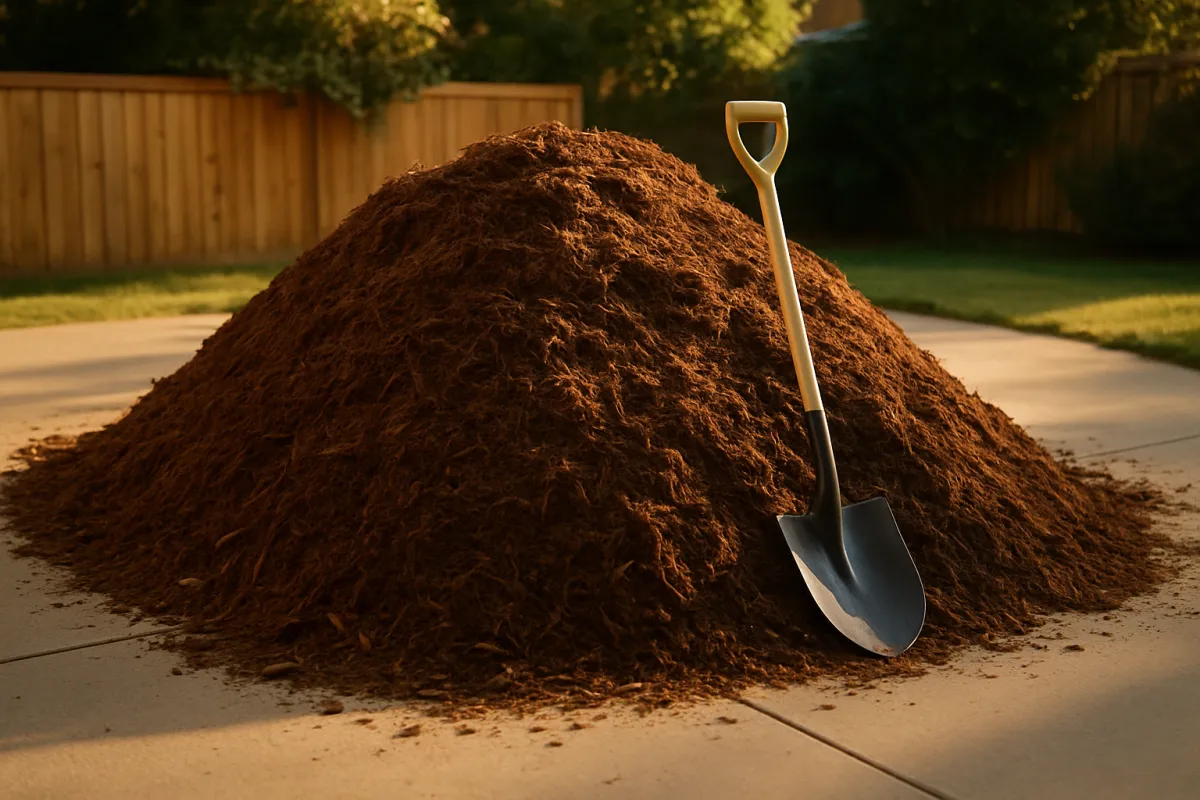
Measure what is already down. If the old layer has thinned to an inch and your target is three, you need 2 inches of top-up, which is two-thirds of a full install, not the whole thing. Calculate the top-up as its own depth: area times the top-up inches over 324. Skipping this step is how people end up with beds climbing higher every year, an expensive way to reach the too-deep failure the depth-mistakes section warns about. The correct annual habit is measure, subtract, buy the difference, which usually means a lighter order than the first install and a bed that stays at its target depth instead of creeping past it.
Coverage per cubic yard by depth
Because depth is the lever, it helps to see how much ground one cubic yard actually covers as you crank the depth up. A yard is a fixed 27 cubic feet of material; spread it thin and it goes far, spread it thick and it disappears fast. The relationship is a simple inverse, and it is the same physics that made concrete thickness so decisive, applied to a much cheaper material with much lower stakes.
Coverage per cubic yard by depth
Square feet one cubic yard covers, at each common depth.
A yard covers 324 square feet at 1 inch and only 81 at 4, a straight inverse. The 324 in the coverage line and the 324 in the formula are the same number: one cubic yard spread one inch deep is exactly 324 square feet.
The chart is also the quickest field estimate when you do not have a calculator handy. Know your bed’s rough square footage and your target depth, and the coverage figure gives you the yards in one division: 300 square feet at 3 inches, where a yard covers 108, is 300 over 108, about 2.8 yards, the same answer the formula gave. It is the formula turned inside out, and it is worth keeping in your head for the supply-yard conversation.
How many bags make a cubic yard
When you buy in bags, the bridge you need is bags per yard, and it comes straight from the cubic-foot count. A cubic yard is 27 cubic feet. Divide by the bag size and you have the count: the standard 2 cubic foot bag gives 13.5 bags to the yard, the smaller 1.5 cubic foot bag gives 18, and the larger 3 cubic foot bag gives 9. Those are the numbers that turn a tidy yardage into a haul, and they surprise people the first time, because 13.5 bags is a loaded cart and a yard is not a large order.
Run the worked bed through it. The 2.78 yard job, in 2 cubic foot bags, is 2.78 times 13.5, about 38 bags, which matches the cubic-feet route from earlier (75 cubic feet over 2). That is the same 38 bags to buy, load, carry to the bed, open, empty, and flatten for recycling. One yard of that is manageable; three yards, past 40 bags, is the point where the bag route stops being convenient and starts being a chore you did to yourself, which is exactly the crossover the next section prices out.
The per-yard bag count also exposes the hidden cost of bags that the shelf price hides: handling. Every bag is a unit to move twice, once into the car and once out of it, and the labor does not appear on the receipt. For a few bags it is nothing. For dozens it is the afternoon.
Bags versus bulk: the real crossover
Bagged and bulk mulch are the same material at wildly different scales of effort and price, and the crossover deserves honest numbers. Per cubic yard, bulk is almost always cheaper, often meaningfully so, because you are not paying for the plastic, the palletizing, or the shelf space, only the material and its delivery. Bags carry a convenience premium baked into every unit. Against that, bags win on flexibility: no delivery minimum, no pile blocking the driveway, no leftover to store, and you buy precisely what fits your car and your afternoon.
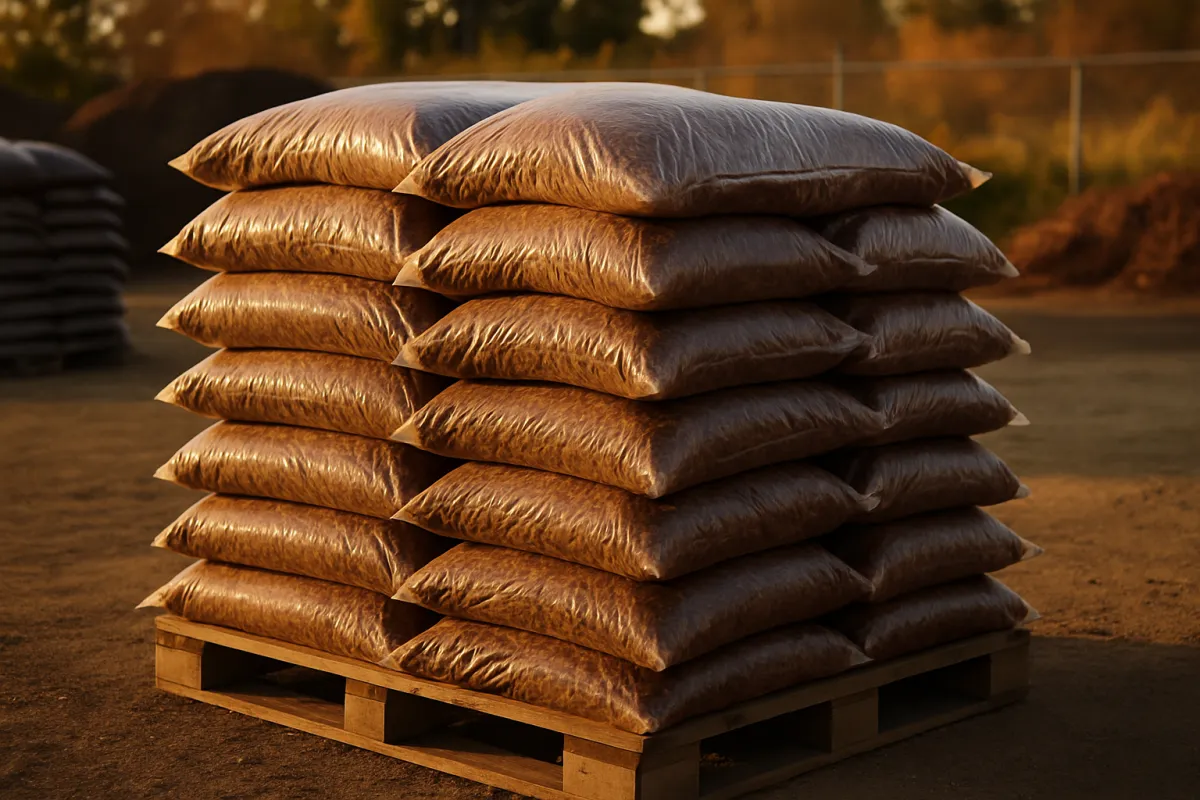
The commonly cited crossover sits around two to three cubic yards. Below it, the delivery fee spread over few yards keeps bags competitive, and their convenience often decides it. Above it, bulk pulls ahead on price even after the fee, and the labor gap widens fast, because emptying 40 bags is real work that a single dumped pile skips. Between about one and three yards is a genuine gray zone where either answer is defensible on the numbers, and the tie-breaker is usually access: whether a truck can reach your driveway and whether you have somewhere to stage a pile. Past three yards, bulk is nearly always the call, on both cost and sanity.
One caution that mirrors the estimating manual: do not let a tidy bag count lull you into under-buying. Bag math tempts precision, and precision here means running short with the last strip of bed still bare and the store a second trip away.
Delivery versus pickup economics
Bulk mulch reaches you two ways, and the choice is a small economics problem. Delivery adds a flat fee, often a meaningful fraction of a small order’s material cost, but it lands the whole pile at your driveway in one drop. Self-pickup skips the fee but demands a truck or trailer that can carry loose mulch, and a cubic yard of it runs several hundred to over a thousand pounds depending on how wet and what type, which is real weight on real suspension. Most passenger vehicles top out around a yard of loose mulch before the load is unwise.
The fee changes the crossover math from the previous section. On a one-yard order the delivery charge can rival the mulch itself, which is another reason bags stay competitive at small scale. On a three or four yard order the same flat fee spreads thin and all but disappears per yard, tilting the decision hard toward bulk delivery. The rule of thumb: the larger the order, the more delivery pays for itself, and the more the bagged alternative loses on both price and labor.
Batching helps at the margin, the same way it does with concrete’s short loads. If a neighbor also needs mulch, one delivery split two ways halves the fee for each of you, and a shared pile is no harder to divide than to spread. And if you are ordering other bulk landscape material the same week, gravel, compost, topsoil, many suppliers will combine the trip, which is worth a phone call before you pay two delivery fees for one afternoon’s work.
Where the yards actually go
It helps to see where the money goes on a mid-size bulk order versus doing the same job in bags, because the split explains why bulk pulls ahead as the pile grows. Take an illustrative three-yard job and break each route into three parts: the material itself, the premium you pay for the format (the delivery fee for bulk, the bag markup for bagged), and the value of your own labor moving it.
Bulk versus bagged for a 3-yard job
Illustrative split of total effort and cost, each route to 100 percent.
Bulk shrinks the premium slice (one delivery fee) and the labor slice (one dumped pile, not 40 bags), so more of the spend is mulch. Bagged inflates both, which is the whole crossover in one picture.
The lesson the split teaches is that price per yard is only part of the comparison. The labor slice is invisible on the receipt but very real in the body, and at three yards it is the difference between a pleasant afternoon with a wheelbarrow and a grim relay of plastic bags. Count it, and bulk’s lead over bagged is wider than the shelf prices alone suggest.
Mulch types and how coverage shifts
The volume math is identical for every mulch, because you are filling the same space to the same depth, and a cubic yard of any material covers 108 square feet at 3 inches. What changes between types is not the order-day calculation but the annual one: how fast the material settles and breaks down, and therefore how often you top up. For a single purchase, calculate by volume and ignore the type. For a year of planning, the type is the variable.
Shredded hardwood and bark are the dense, long-holding options: they knit together, resist blowing, and decompose slowly, so a bed mulched with them holds its depth well and refreshes on the lighter end. Lighter organics, straw, fine bark, and pine needles, are airier going down and compress and decay faster, so they may thin noticeably within a season and want more frequent topping up, meaning more total material over a year even though the first order is the same volume. Wood chips sit in between and vary with size.
Inorganic mulches change the frequency picture entirely. Rubber mulch and stone do not decompose, so once installed they are rarely reordered on an annual cycle; the volume calculation is a one-time event, and the higher upfront cost buys years of not repeating it. The tradeoff is that inorganic mulches do not feed the soil the way decomposing organics do, which is a garden decision beyond this manual’s arithmetic. Whatever the material, the order-day formula does not change, only how soon you run it again.
The over- and under-ordering tradeoff
Every estimate ends with the same question our estimating manual frames for all materials: how much cushion to add, and which direction of error costs more. With mulch the asymmetry is gentler than with concrete, and it points the opposite way, which is worth understanding rather than defaulting to “buy extra.”
Under-ordering costs a second trip. Run a few square feet short and the bed sits half-finished until you fetch more, an annoyance and a wasted errand but not a ruined job; mulch does not set on a clock, so the bare strip waits patiently. Over-ordering, with bulk, leaves a pile you must find a home for, spread thicker than you meant (which risks the too-deep failure), stash for next season, or haul away. Leftover bags store cleanly and keep, so the over-order penalty is smaller for bagged than for bulk.
That balance argues for a modest cushion, not a generous one. A common practice is to add roughly 5 to 10 percent to the computed volume to cover uneven spreading and beds that measured a little optimistically, and to round up to the supplier’s increment, which often supplies the cushion by itself. The one place to lean fuller is an irregular or sloped bed where the tape under-reads the real surface. Otherwise, mulch is a material where buying close is fine, because the cost of a little short is a trip, not a crisis, and the cost of a lot long can be a smothered root.
Refresh frequency and annual volume
The first mulch order is the big one; the ones after it are top-ups, and planning the year means thinking in top-ups, not installs. Most organic mulches are refreshed about once a year, commonly in spring, though the interval tracks the material: quick-decomposing straw and fine bark may want attention more than once a season, while shredded hardwood can hold color and structure well past a year. Inorganic mulches, as noted, mostly opt out of the cycle entirely.
The annual volume is smaller than the install volume precisely because you are topping up. If the bed holds an inch of last year’s mulch and the target is three, the year’s order covers 2 inches, two-thirds of a fresh install; if it holds two inches, you buy one inch, a third. Measuring the remaining depth before each refresh, rather than reflexively reordering the original amount, is what keeps beds from creeping deeper every year and keeps the annual spend honest. It is the same measure-subtract-buy discipline the top-up section laid out, applied on a calendar.
For a multi-bed property, the yearly planning move is to sum the top-up volumes across beds and order once, in bulk, rather than bag-by-bag per bed. The combined top-up often clears the bulk crossover even when no single bed would, which is how a property with several small beds still buys like a big order and captures the per-yard savings.
Edging and bed prep
The mulch estimate assumes the bed is ready to receive it, and a little prep protects both the material and the calculation. Clean edging, a cut trench, a stone or steel border, or a spade-cut lip, does two jobs: it keeps mulch in the bed instead of migrating onto the lawn, which is lost volume you paid for, and it gives a clean line to measure to, which is where your square footage came from. A bed with vague, creeping edges both loses mulch and defies accurate measurement.
Prep also decides whether you are mulching bare soil or fighting weeds through the layer. Pulling existing weeds before mulching, rather than burying them, is what lets a 3 inch layer actually suppress regrowth; a weed with a running head start pushes through mulch that would have stopped a seed. Some gardeners lay a permeable landscape fabric or a few sheets of plain cardboard under the mulch as an extra weed barrier, which does not change the volume you spread on top but does change how long the suppression lasts.
None of this alters the formula, but it protects the number the formula produced. Mulch that stays in a well-edged bed at an even depth is mulch doing its job for the money; mulch spilling onto the grass or spread unevenly over un-weeded ground is a good calculation undone by skipped prep.
Common depth mistakes: too deep, rot, and volcano mulching
The most damaging mulch mistakes are all one mistake wearing different clothes: too much depth. Mulch’s benefits, moisture retention, weed suppression, temperature moderation, all turn against the plant past a point. A layer beyond three or four inches can hold water against roots and crowns until they rot, choke the soil’s oxygen exchange, and become a sheltered highway for pests and fungal disease. The material meant to protect the bed starts suffocating it, and the damage is slow enough that the cause is easy to miss.
The signature version is volcano mulching: heaping mulch in a tall cone against a tree trunk. It looks tidy and deliberate and it is quietly harmful, because bark is not adapted to sit buried in moist mulch. Trapped moisture against the trunk invites rot, disease, and insects, and roots confused by the deep pile can grow upward into it and girdle the tree over years. The correct shape is the opposite: a flat, even layer that stays a few inches clear of the trunk, a doughnut, not a volcano, so the flare of the trunk breathes.
The estimating discipline that prevents all of this is the top-up habit from earlier: measure what is there, add only what reaches the target, and never treat a full fresh layer as the default every year. Depth mistakes are not calculation errors, they are the result of skipping the measurement and adding by reflex, and they are the reason “how much mulch do I need” is a smaller question than “how deep should it end up.”
Where the estimate goes wrong
The failure patterns repeat reliably enough to list in order of expense. The units slip leads: depth entered as feet instead of inches, or the divide-by-324 forgotten, each throwing the answer off by multiples, not margins, which is why the physical sanity check, does this sound like a flower bed or a dump truck, catches more errors than re-checking the math. Next is the fresh-versus-top-up confusion, ordering a full install for a bed that already holds half its depth, which over-buys and, if spread, over-deepens.
Then the softer misses. Measuring only the tidy rectangle and forgetting the wings, so the order runs short at the corners; forgetting that curved and irregular beds enclose more ground than a rectangle, or less, and skipping the shape adjustment. Casually adding depth at the supply yard, “make it three instead of two,” without recomputing, and then wondering why the pile fell short by half again. Ignoring the labor cost of bags and buying 40 of them for a job a dumped yard would have handled in half the time.
The planning failure that contains the others is measuring and ordering the same day you spread, leaving no room to reconsider depth, re-measure a forgotten bed, or catch a units slip before the pile is paid for. Mulch is forgiving compared with concrete, but it still rewards the boring virtues: measure the real bed, settle the depth first, subtract what is already down, and buy close with a small cushion.
The pre-order checklist
The whole manual, compressed to the sheet worth keeping in the car.
- Settle the depth first. Two to three inches for most beds, three for a fresh one, and for a refresh, only the top-up to target.
- Measure the real bed. Length and width at the widest points in feet; decompose L-shapes and use radius squared times pi for circles.
- Run the line. Area in square feet times depth in inches, divided by 324, equals cubic yards; or divide cubic feet by the bag size for bags.
- Sanity-check physically. One yard covers about 108 square feet at 3 inches; does the answer sound like your bed?
- Pick bags or bulk by the crossover. Under a couple of yards, bags are often easier; past three, bulk wins on price and labor.
- Weigh delivery against pickup. The larger the order, the more delivery pays for itself; batch with a neighbor or another material to split the fee.
- Add a small cushion, not a big one. Roughly 5 to 10 percent and round to the supplier’s increment; short costs a trip, way over can smother roots.
Run the list top to bottom and the order arrives right the first time, with a bed at its target depth and no second trip.
The bottom line
Mulch estimating is one line of arithmetic with a decision bolted onto the front: area times depth in inches over 324 gives the yards, but the depth you put in that formula is the real work. Settle it at two or three inches, top up to target rather than burying every year, and pick bags or bulk by where your job falls against the two-to-three-yard crossover. Do that and the order is close, the delivery pays for itself or the bags fit the car, and the bed ends the day at the depth that protects the plants instead of the depth that drowns them. Run your own bed through our estimator, read the general method for the coverage logic that carries to every material, or the concrete manual for the same math with higher stakes, and buy from a measured bed, not a guess.
Treat this as garden-shed education, not a horticultural prescription. Every price, coverage figure, bag yield, and depth range above is an illustrative worked example, and your material, your supplier, your region, and your plants will each move the real numbers. Depth guidance is general practice, not a rule for any particular species: some plants want less mulch and some want none against their stems, so check the needs of what is actually in the bed, and when a tree’s health or a drainage problem is at stake, confirm the approach with a qualified arborist or landscaper before you spread.
Frequently asked questions
How do I calculate how much mulch I need?
Measure the bed in feet, multiply length by width for square footage, then multiply that area by the depth in inches and divide by 324 to get cubic yards. The 324 is a shortcut that folds two conversions into one: inches to feet, then cubic feet to cubic yards. A 300 square foot bed at 3 inches deep is 300 times 3 divided by 324, about 2.8 cubic yards. Round up to your supplier's increment when you order.
How many bags of mulch are in a cubic yard?
A cubic yard is 27 cubic feet, so with the common 2 cubic foot bag it takes about 13.5 bags to equal one yard, and roughly 18 of the smaller 1.5 cubic foot bags. Those counts are why bags suit small beds and turn punishing at scale: a job needing three yards is around 40 of the 2 cubic foot bags to haul, open, and empty. Above a couple of yards, most people switch to bulk delivery for that reason alone.
How deep should mulch be?
Two to three inches is the common range for most beds, and a fresh bed that has never been mulched usually gets the full three. When you are refreshing an existing bed, measure what is already there first: often an inch of top-up restores the look and function without burying the plants. Depth is the input that moves the order most, so settle it before you calculate. Going from two inches to three adds fifty percent to the volume you buy.
Is bagged or bulk mulch cheaper?
Per cubic yard, bulk is almost always cheaper than the bagged equivalent, often by a wide margin, because you are not paying for the bag or the shelf handling. Bags win on convenience for small jobs: no delivery minimum, no pile on the driveway, and you buy exactly what fits in the car. A commonly cited crossover sits around two to three cubic yards, where bulk delivery starts beating the bag price even after the delivery fee. Below that, bags are often the easier call.
How much does a 2 cubic foot bag of mulch cover?
At the recommended 2 inch depth, a 2 cubic foot bag covers about 12 square feet, and at 3 inches it covers roughly 8. The math is simple: 2 cubic feet is 24 cubic inches of depth times area, so coverage falls as depth rises. This is why the depth decision drives the bag count directly. The same bed needs half again as many bags at 3 inches as it does at 2, an illustrative shift worth confirming before you load the cart.
Can you put mulch on too thick?
Yes, and it is a common and damaging mistake. Piled past three or four inches, mulch can hold water against roots, starve the soil of oxygen, and shelter pests. The worst version is volcano mulching, heaping it in a cone against a tree trunk, which traps moisture on the bark and invites rot and disease. Keep mulch pulled back a few inches from trunks and stems, and top up to the target depth rather than adding a full new layer every year.
How often should I refresh mulch?
Most organic mulches break down over a season or two and are commonly refreshed once a year, often in spring, though shredded hardwood can hold color and structure longer than lighter materials like straw. Because you are usually topping up rather than starting over, the annual volume is smaller than the first install: measure the remaining depth and buy only what brings it back to target. Rubber and stone mulches last far longer and are rarely reordered on an annual cycle.
Does the type of mulch change how much I need?
The volume math is identical for any mulch, since you are filling the same space to the same depth, but settling and longevity differ. Lighter materials like straw and fine bark compress and decompose faster, so a bed mulched with them may need topping up sooner and, over a year, more total material. Denser products like shredded hardwood and inorganic options like rubber or stone hold their depth longer. For a single order, calculate by volume; for annual planning, factor how fast the material thins.