What's on this page
- How to use this concrete calculator
- The formula, and the trap inside it
- Slabs: working a real example end to end
- Footings and post holes: the other two shapes
- Cubic yards, made physical
- The waste allowance: why the formula alone under-orders
- Bags or the truck: the real crossover math
- Concrete estimator: from yards to waste factor to bags
- Ordering day: the details that make the pour smooth
- Odd shapes: L-pours, circles, and curves
- Steps and stairs: small pours that punish guesswork
- The quantities around the concrete
- Weather, timing, and the working window
- After the truck: curing is part of the estimate
- Where the estimate actually goes wrong
- The pre-order checklist
- A worked driveway pour, from footprint to reinforcement
- Matching the mix strength to the job
- Ordering in cubic meters and metric bags
- Batching several pours into one delivery
- The bottom line
The concrete calculator on this page turns three measurements into an order: length times width times depth, all in feet, divided by 27, equals cubic yards, and it adds the waste allowance and the bag equivalent on top. Enter your slab in the calculator alongside this manual and the number follows you through every section below, because the arithmetic is only half the job.
Concrete is the one material where an estimating mistake announces itself in public. Run short in the middle of a pour and the job does not politely pause like a painting project; the mix already placed starts setting while you scramble, the joint between old and new becomes a permanent weak line, and a second delivery costs a fresh fee measured in hundreds. Over-order, and you literally watch money slide back down the chute and drive away, because concrete cannot go back on the shelf.
The good news: the volume math is genuinely simple, three dimensions and one conversion, and this manual works it end to end for the three shapes that cover nearly every residential job, slabs, footings, and post holes. Then it covers what the formula alone cannot tell you: the waste allowance, the bags-versus-truck decision with the short-load economics that drive it, and the ordering-day details that separate a smooth pour from an expensive lesson. This is the deep-dive companion to our general estimating manual; for a first pass on your numbers, the concrete calculator on this page handles the arithmetic in seconds.
Key takeaways
- The formula is length × width × thickness in feet, divided by 27 for cubic yards; thickness in inches must convert to feet first, the single most common error.
- Add 5 to 10 percent for subgrade variation and spillage: running short mid-pour creates a structural cold joint and a second delivery fee, the expensive failure direction.
- The bags-versus-truck crossover sits near one cubic yard, roughly 45 large bags; short-load fees and mixing labor set the real boundary, not just price per yard.
- Thickness dominates the estimate: 4 inches to 6 inches is a 50 percent volume increase, so confirm the spec before running any numbers.
- Order by the supplier's increment, have the site, help, and tools ready before the truck arrives, and settle PSI and slump when booking, not at the chute.
How to use this concrete calculator
The concrete calculator runs alongside this manual, and it works the same line the rest of these pages work by hand, so knowing what each field expects takes about a minute. Four inputs drive it. Length and width are the footprint of the pour in feet, measured across the inside of the forms rather than taken off the drawing, because forms shift when they are staked and drawings never do. Thickness is entered in inches, which is how slab specs are written and how a tape actually reads, and the conversion to feet happens inside the calculator, removing the single most common estimating error in concrete. Waste allowance is a percentage, preset at 8, sitting in the middle of the 5 to 10 percent band this manual argues for; push it toward 10 on hand-graded or irregular sites and toward 5 on a machine-compacted base inside crisp forms.
Four numbers come back, and each answers a different question. Volume in cubic feet is the raw multiplication, most useful as a sanity check, because a walkway that reports several hundred cubic feet has a unit error hiding in it. Cubic yards is that volume divided by 27, the unit a batch plant sells in and the figure a supplier expects to hear on the phone. Order with allowance applies your waste percentage, and that is the number to round up to the supplier’s increment and actually book. The 80 pound bags equivalent converts the same volume at roughly 45 bags per cubic yard, which is the quickest read on whether a job belongs on a pallet or on a truck.
The way to get value out of it is to change one input at a time. Start with the patio this manual works below, 12 by 20 feet at 4 inches, allowance left at 8 percent, and watch the yardage land just past three. Then move thickness from 4 to 6 inches and the order jumps by half, which is the whole argument for confirming the spec before measuring anything. Drop the allowance to zero and the difference between the two yard figures is exactly the insurance the waste section explains. Widen the slab by two feet and the change is smaller than the thickness bump was, which is the lesson in one gesture: depth owns concrete orders. Each section below carries your own numbers in a short note, so the calculator is less a single answer than a running commentary on the decisions the manual is describing.
The formula, and the trap inside it
Every concrete estimate is the same calculation: the volume of the shape you are filling, converted into the unit concrete is sold in. For the rectangular shapes that dominate residential work, that is length times width times thickness, and the trap is units. Concrete dimensions arrive in a mix of feet and inches, a 12 by 20 foot patio, 4 inches thick, and the formula demands one unit throughout. Convert thickness to feet first: 4 inches is 4/12, or 0.333 feet. The patio’s volume is then 12 × 20 × 0.333, about 80 cubic feet.
The second conversion is the one newcomers miss entirely: concrete is sold by the cubic yard, and a cubic yard is 27 cubic feet, three feet in each of three dimensions. Divide 80 by 27 and the patio needs just under 3 cubic yards. Skip the inches-to-feet conversion and the same arithmetic produces an answer twelve times too large; forget the divide-by-27 and you will order in a unit no supplier recognizes. Written as one line: (length ft × width ft × thickness in ÷ 12) ÷ 27 = cubic yards. Every slab, sidewalk, pad, and stair landing runs through this line, and the whole rest of the craft of ordering is adjustments to its output.
Slabs: working a real example end to end
Walk the patio through completely, because the worked version surfaces every decision the formula hides. The plan: a 12 by 20 foot backyard patio, and the first real decision is thickness, settled before any math. Typical residential practice puts patios, walkways, and shed pads at 4 inches, and driveways or anything bearing vehicles at 5 to 6 inches, sometimes with thickened edges; local code and soil have the final word. Thickness is the estimate’s most sensitive input: the same footprint at 6 inches instead of 4 needs half again more concrete, so a casual “make it a bit thicker” remark changes the order by a full yard.
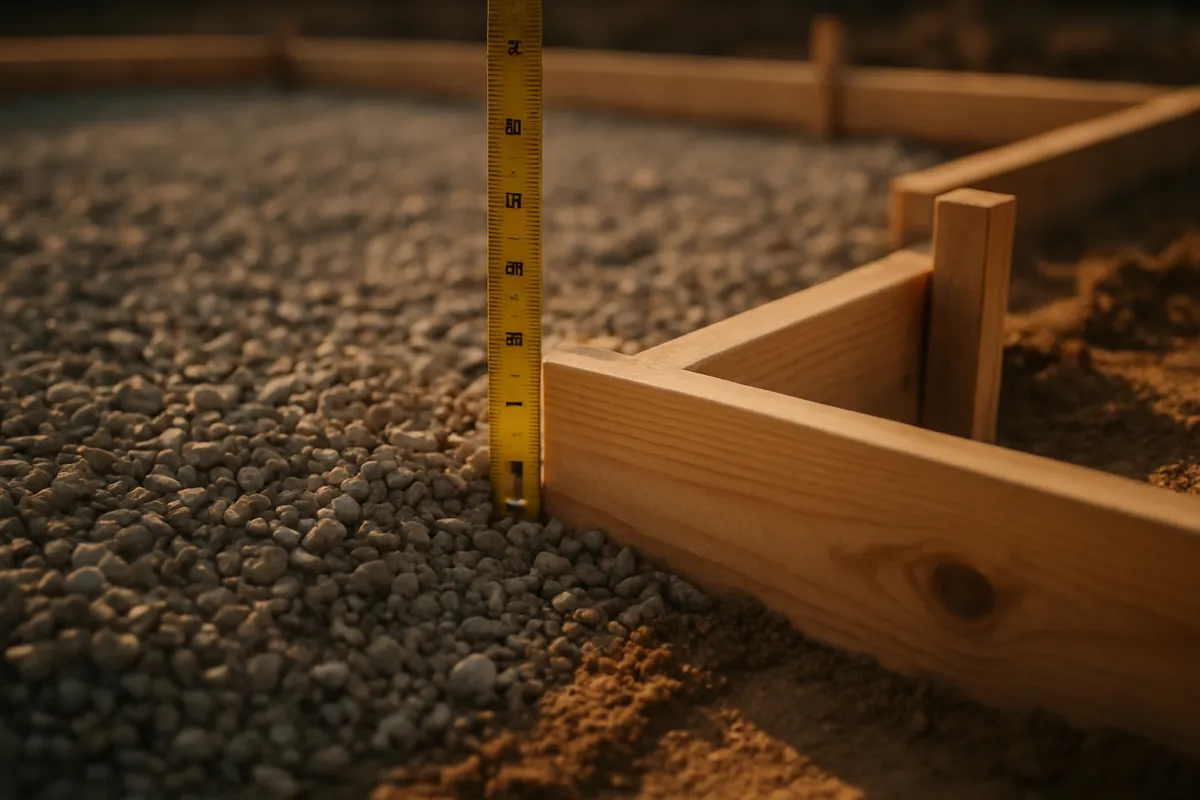
At 4 inches: 12 × 20 × 0.333 = 80 cubic feet, ÷ 27 = 2.96 yards. Now the corrections. Measure the actual formed excavation at several points rather than trusting the plan, subgrades are never perfectly level, and every low spot is extra volume; if your depth readings average 4.25 inches, calculate with that. Add the waste allowance, 5 to 10 percent, covered fully below, bringing the patio to roughly 3.2 yards. Then round to the supplier’s ordering increment, commonly quarter or half yards: order 3.25 or 3.5. That final number, derived in ten minutes with a tape measure, is the difference between a continuous pour and a mid-slab crisis.
Footings and post holes: the other two shapes
Footings are slabs turned on edge and the math is identical: length of the run times width times depth, in feet, over 27. An illustrative 40 foot footing run at 16 inches wide (1.33 ft) and 12 inches deep (1 ft) is 53 cubic feet, just under 2 yards. The footing-specific caution is depth honesty: trenches are dug, not formed, and real trench bottoms undulate, so measure depth every few feet and calculate from the average of the deeper readings, because a trench never errs shallow where it counts.
Post holes are cylinders: radius squared times pi times depth, minus the volume of the post itself. The standard case, a 12 inch diameter hole, 2 feet deep, around a 4x4 post: the hole holds about 1.57 cubic feet, the post displaces about 0.17, leaving 1.4 cubic feet of concrete, about three 60 pound bags per post at a typical 0.45 cubic foot yield. A 20 post fence run therefore wants around 60 bags, a number that surprises everyone the first time and explains why the fence crew’s truck rides low.
Hand-dug holes are never textbook cylinders, they belly out at the bottom exactly where the auger wandered, so per-post margin matters more here than anywhere: an extra bag per five posts is the practical allowance, and unmixed bags return to the store, which makes generous the cheap direction for bagged work.
Cubic yards, made physical
The yard is an abstraction until the first time you move one by hand, so calibrate it. One cubic yard is 27 cubic feet, roughly 4,000 pounds of wet mix, two tons, and it fills about 15 to 18 heaped contractor wheelbarrows. It pours a 4 inch slab of about 80 square feet, a modest shed pad; three yards handle the 240 square foot patio of our example; a two-car driveway at 5 to 6 inches runs eight to twelve yards, firmly truck territory.
What one cubic yard covers at 4 inches thick
Illustrative slab footprints per yard, and the volume cost of going thicker.
Thickness eats coverage fast: the same yard that pours 81 square feet at 4 inches pours only 54 at 6. Confirm the thickness spec before any other number, because it moves the order more than any measuring error will.
The physical sense earns its keep twice. At estimate time it is the sanity check: if the formula says a small walkway needs 9 yards, the units went wrong somewhere, because 9 yards is a driveway. At pour time it sets the labor plan: three yards arriving in one truck is twelve thousand pounds of material that must be placed, screeded, and floated inside the mix’s working time, which is why the crew size and wheelbarrow count belong in the estimate conversation, not just the volume.
The waste allowance: why the formula alone under-orders
Our estimating manual made the general case for waste factors; concrete’s version is specific and asymmetric. The additions: subgrade variation, the compacted base sits a half inch low across a corner and silently swallows a quarter yard; form deflection, wet concrete is heavy and bows long form runs outward; residue, some mix always stays behind in the truck’s drum, the pump, and the wheelbarrows; and spillage, which is not clumsiness but the ordinary physics of moving two-ton batches by chute and barrow.
The asymmetry is what sets the percentage. Over-order by a half yard and you lose the price of a half yard, plus the small chore of a planned disposal spot, a pre-built form for a stepping stone or pad puts it to work. Under-order and the failure is structural: the poured section starts setting while the shortfall is arranged, the seam between pours becomes a cold joint, a permanent plane of weakness that telegraphs through as tomorrow’s crack, and the rescue delivery arrives with its own fee, often at short-load rates, the worst pricing in the industry. Five to ten percent extra, leaning toward ten on hand-graded or irregular sites, is not padding; it is the cheapest structural insurance concrete sells.
Bags or the truck: the real crossover math
Bagged mix and ready-mix are the same product at wildly different scales of effort, and the crossover deserves real numbers. An 80 pound bag yields about 0.6 cubic feet: 45 bags make a yard. Sixty pound bags yield about 0.45: call it 60 per yard. Below roughly a yard, bags win, no delivery fee, no minimum, work at your own pace, unmixed bags return to the store. The patio example, at 3.25 yards, would demand nearly 150 large bags, each carried, mixed, and placed inside the working window; that is not a weekend project, it is a punishment.
Ready-mix flips every term above the line: cheaper per yard, factory-consistent strength, and the mixing labor disappears, replaced by delivery economics. Trucks carry an economical minimum, and orders below a few yards draw a short-load fee that can rival the concrete’s own cost, which creates the gray zone between about one and two yards where neither option is clean: there, a towable mixer rental, batching the job with a neighbor’s project onto one truck, or gritting through the bags are all defensible. Past two yards the decision makes itself. The one false economy to name: hand-mixing inconsistency on structural pours. A slab’s strength is its weakest batch, and batch fifty of a long afternoon is nobody’s best work.
Concrete estimator: from yards to waste factor to bags
A concrete calculator answers one narrow question, how much volume the shape holds. A concrete estimator answers the question actually standing in front of you: what to buy, in what form, with how much margin. The difference is three layers stacked on the same measurement, and the calculator alongside this manual walks all three at once.
Layer one is the yardage, the raw geometry already covered: dimensions in feet, multiplied, divided by 27. It is the only layer the formula alone gives you, and it describes a slab that exists on paper, poured onto a perfectly flat subgrade inside forms that do not bow, with nothing left in the drum. No site has ever matched it.
Layer two is the waste factor, which is where estimating concrete stops being arithmetic and starts being judgment. The allowance covers subgrade variation, form deflection, residue in the truck and barrows, and ordinary spillage, and the reason it leans generous is asymmetry: the surplus costs the price of a partial yard and a pre-built stepping stone form, while the shortfall costs a cold joint and a second delivery at short-load rates. Five percent suits a compacted, laser-checked base; ten suits a hand-dug trench or a curved form. That single percentage is the most consequential number an estimator carries, because it is the only one that is a choice rather than a measurement.
Layer three is the purchase form, and the bags equivalent exists to make that decision visible. Roughly 45 of the 80 pound bags make a cubic yard, so an order under about a yard reads as a manageable pallet and anything past two yards reads as a truck. Between them sits the gray zone where short-load fees, a rented towable mixer, or batching with a neighbor’s pour are all defensible answers, which is why an honest estimator shows you the bag count even when you have already decided to book ready-mix.
What the estimator still cannot do is worth naming, because a number that looks complete invites trust it has not earned. It does not know your supplier’s ordering increment, their delivery minimum, their short-load fee, or the price per yard in your area. It does not set PSI, slump, air entrainment, or the fiber and admixture questions the plant will ask. It does not know that your gate is 8 feet wide and the truck is 9. Treat its output as the quantity you take into the ordering call, then let the supplier, the spec, and your local code finish the order.
Ordering day: the details that make the pour smooth
The order call involves more than a volume, and knowing the vocabulary gets better answers. State the job, not just the yards: slab, footing, or fence, exterior or interior, vehicle load or foot traffic. The supplier will translate that into a mix design, the PSI strength (commonly 2,500 to 4,000 and up, higher for driveways and freeze-thaw exposure), aggregate size, and any admixtures, fiber reinforcement, accelerators for cold weather, retarders for hot. Ask about slump, the wetness of the mix: wetter flows easier and screeds faster but cures weaker, and the crew’s request for “a little more water” at the chute is a strength decision, not a convenience.
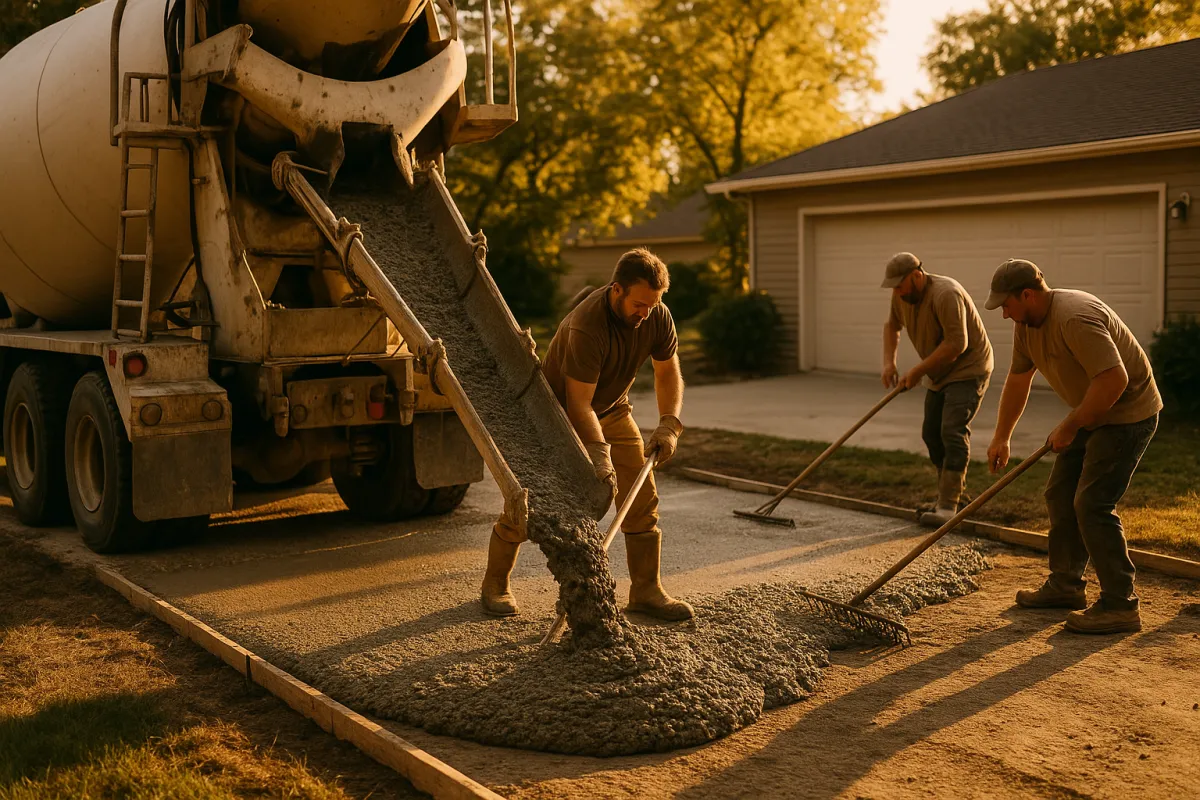
Then prepare for the meter you cannot see: trucks price unloading time, with a free window and per-minute charges past it, so everything slow must happen before arrival. Forms braced and oiled, base compacted and damp, reinforcement placed and chaired, wheelbarrow route cleared, enough hands on site, tools staged, screed board cut to width. Confirm truck access while booking, a loaded mixer weighs as much as a small house and treats soft lawns and thin driveways accordingly, and have the washout spot agreed, a lined pit or barrow for the chute rinse, since cement-laden water cannot legally go down storm drains in most places. Ten minutes of ordering vocabulary and an hour of staging buy the calm, continuous pour every other section of this article is trying to protect.
Odd shapes: L-pours, circles, and curves
Real yards refuse to be rectangles, and the estimating move for every irregular footprint is the same: decompose it into shapes you can already solve. The L-shaped patio is two rectangles sharing an edge; calculate each, sum the volumes, done. The wraparound walkway is a chain of rectangles; the notched slab is a big rectangle minus a small one, and subtraction is as legitimate as addition, compute the full footprint, remove the cutout’s volume, and the forms can be as awkward as the deck posts demand. Sketch the decomposition on paper with dimensions before touching a calculator, because the sketch is where missed sections announce themselves; the arithmetic never fails, only the inventory of pieces does.
Circles and curves need one more formula. A round pad is radius squared times pi times thickness, the same cylinder math as the post holes, at patio scale: an illustrative 10 foot diameter pad, 4 inches thick, is 5 × 5 × 3.14 × 0.333, about 26 cubic feet, just under a yard.
Freeform curved borders resist exact formulas, so estimate them as the rectangle that would contain them and let the overage join the waste allowance, or step the curve into short straight segments and sum those; either way, curves earn a point or two more allowance than straight forms, since curved formwork deflects more and the eye-fitted boundary always encloses more area than the plan promised. Complexity in footprint is never a math problem, only a bookkeeping one, and the sketch is the bookkeeping.
Steps and stairs: small pours that punish guesswork
Poured steps look tiny and estimate badly by eye, because a staircase is solid concrete all the way down, not just the treads you see. The clean method treats the staircase as a stack of horizontal slabs, one per step, each running from that step’s nose to the back of the pour. An illustrative three-step entry, each tread 12 inches deep, each riser 7 inches, 4 feet wide: the top step is a slab 1 foot deep, the middle 2 feet, the bottom 3 feet, each 7 inches thick and 4 feet wide. Summed, roughly 14 cubic feet, over half a yard for what looks like an afternoon’s decoration, which is exactly why step pours are the classic bag-count surprise.
Two adjustments refine the number. Fill is legitimate: the interior of a large step mass can carry compacted rubble or gravel displacing concrete, reducing both cost and cure stress, provided enough thickness remains around it per the job’s spec. And landings count as their own slab at full depth, measured like any other. The general lesson steps teach is worth keeping: any pour with vertical faces contains more volume than the visible surfaces suggest, so estimate solids from the section drawing, never from the finished silhouette. Guess a staircase by eye and the shortfall arrives at the worst geometry in concrete, half-filled forms with a setting batch below.
The quantities around the concrete
The volume line covers the mix, but the pour’s shopping list is longer, and the supporting quantities follow the same footprint math. Base material first: slabs sit on compacted gravel, commonly around 4 inches of it, which is the same length-times-width-times-depth calculation and often rivals the concrete’s own volume; it is sold by the yard or the ton, and your supplier converts between them. Reinforcement next: welded wire mesh is sold in sheets covering stated areas, so divide the slab’s footprint by sheet coverage and add overlap; rebar for footings runs by linear feet along the trench, doubled or tripled by the number of runs the spec calls for, plus chairs to hold everything at height in the pour.
Then the consumables the first-timer forgets and the crew never does: form lumber by the perimeter’s linear feet plus stakes every few feet, form-release oil, a vapor barrier under interior slabs by footprint area, expansion-joint material along any edge meeting existing concrete, and curing compound or sheeting by area. None of these is individually expensive; collectively they are a second store trip on pour morning if unlisted. The habit that catches them all is estimating from the section drawing rather than the plan view: draw the slab in cross-section, label every layer from subgrade to finish, and each label becomes a line on the order sheet with its own quantity, computed from the same three dimensions you already measured.
Weather, timing, and the working window
The estimate has a fourth dimension: when the pour happens, because concrete’s chemistry runs on temperature and the working window sets the labor plan. Hot weather accelerates the set, shrinking the time between chute and final finish; big summer pours want early-morning truck slots, extra hands, and sometimes a retarder in the mix, ordered by name when booking. Cold slows curing and, below freezing, threatens it structurally, fresh concrete that freezes loses strength permanently, so cold-season pours want accelerators, insulating blankets on the order list, and honest respect for the forecast. Rain is simpler: fresh concrete and a downpour do not share a day, and rescheduling a truck beats rinsing a ruined finish.
Timing also gates everything after the screed. The window between placement and each finishing pass, floating, edging, brooming, is set by the mix and the weather, not the crew’s preference, and it shrinks in heat exactly when fatigue peaks. This is why the crew-size question from the yardage section returns here with force: three yards on a mild morning is a different job from the same three yards at noon in July. The scheduling rule that contains all of this: book the truck for the coolest workable slot, stage the site the day before, and let the forecast, not the calendar, pick the date. Concrete never hurries for anyone, and every attempt to hurry it is legible in the surface for the slab’s whole life.
After the truck: curing is part of the estimate
The pour ends the delivery, not the job, and the last quantities on the list serve the week that follows. Concrete does not dry, it cures, a chemical reaction consuming water over weeks, and the surface that dries out early stops strengthening early: the powdery, dusting, hairline-cracked slabs of the world are mostly curing failures, not mix failures. Keeping the surface moist for the first days, commonly about a week for typical residential mixes, is the entire discipline, done with curing compound sprayed after finishing, plastic sheeting, or scheduled misting, each an item and a quantity, by area, on the same order sheet as the mix itself.
Time is the other curing quantity. Typical mixes take foot traffic after a day or two, vehicle loads after about a week, and reach their rated strength around 28 days, the number PSI specs quietly assume; heavy loading before schedule spends strength the slab never recovers. Forms generally strip after a day or two for slabs, longer for structural elements, per the spec. Budget the calendar accordingly: the driveway poured Saturday does not park the car Monday, and the fence posts set this morning want a day or two before the rails load them, details that cost nothing when planned and callbacks when not. A pour is a three-act job, prepare, place, cure, and the estimate that covers all three acts is the one these pages have been building from the first line.
Where the estimate actually goes wrong
The failure patterns repeat so reliably they can be listed in descending order of expense. Unit slips lead: inches used as feet, the divide-by-27 forgotten, a diameter used where the cylinder formula wants radius, each producing answers wrong by multiples, not margins, which is why the physical sanity check, does this number sound like a shed pad or a driveway, catches more disasters than careful re-arithmetic. Thickness assumptions follow: calculating at 4 inches while the form boards say 5.5, or quoting the drawing while the excavation runs deep, both discovered at the bottom of an empty chute.
Where the ordered yards actually go
Illustrative 3.25 yard patio order, by destination.
The formula only predicts the first segment. The other two are real, arrive on every job, and are the reason a formula-exact order runs short a wheelbarrow or two from the finish line.
The subtler failures round out the list. Ordering formula-exact with no allowance, then feeding the shortfall to a short-load fee. Treating the bag count casually, “a few bags” becoming a second store run per fence post. Booking the truck before the site is ready and paying standby minutes while the last form gets braced. And the planning failure that contains all others: running the numbers the night before the pour instead of the week before, leaving no room to re-measure, re-spec, or reschedule when something disagrees. Concrete rewards the boring virtues, early math, checked units, measured reality, and it invoices every shortcut at delivery prices.
The pre-order checklist
The whole manual, compressed to the sheet worth taping to the form boards.
- Confirm the spec first. Thickness and PSI by use: around 4 inches for patios and pads, 5 to 6 for vehicles, strength and details per local code.
- Measure the excavation, not the plan. Depth at several points, average honestly, calculate with reality.
- Run the line. (L ft × W ft × thickness in ÷ 12) ÷ 27 = yards; cylinders for post holes, radius not diameter.
- Sanity-check physically. One yard ≈ 81 square feet at 4 inches; does the answer sound like the job?
- Add 5 to 10 percent. Subgrade, deflection, residue; the shortfall costs a cold joint, the surplus costs a stepping stone form.
- Pick bags or truck by the crossover. Under a yard, bags; past two, truck; between, mind the short-load fee.
- Order in the supplier’s increment, site staged before arrival. Access confirmed, crew ready, washout planned, slump and mix settled on the phone.
Run the list top to bottom and the pour becomes what it should be: heavy work, but no surprises.
A worked driveway pour, from footprint to reinforcement
The patio worked earlier is the small end of the range, so walk the other end: a two-car driveway, because vehicles change both the thickness and the reinforcement, and both change the order. Say the drive is 20 feet wide and 24 feet long, 480 square feet, poured at 5 inches because it carries car loads. Thickness first: 5 inches is 5 divided by 12, about 0.417 feet. Volume is 20 times 24 times 0.417, roughly 200 cubic feet, and 200 over 27 is about 7.4 cubic yards.
Add the corrections the same way as any slab. A driveway that size almost never sits on ground flat enough to trust, so measure the base at several points and calculate from the honest average, then add the 5 to 10 percent allowance, taking the order to roughly 8 yards. That is firmly truck territory, well past any bag crossover, so the only real questions left are the mix strength and the reinforcement.
Both ride alongside the concrete on the order, not inside it. Vehicle slabs commonly call for a stronger mix and either welded wire mesh by the sheet or rebar in a grid, sized from the footprint and the spacing the spec sets, plus the chairs that hold it at mid-depth. None of that shows in the cubic-yard figure, which is why the section-drawing habit matters: draw the slab in cross-section, label the mix, the steel, and the base, and each label becomes its own line with its own quantity. Our general estimating manual frames that habit for every material on a job.
Matching the mix strength to the job
Volume tells you how much concrete to order, but not which concrete, and the strength spec is a decision worth making before the truck is booked rather than at the chute. Strength is measured in PSI, the pressure the cured mix withstands, and it rises with cement content. Common residential figures run from around 2,500 PSI for footings and interior pads up to 4,000 or more for driveways, exterior flatwork, and anything facing freeze-thaw weather. A stronger mix costs modestly more per yard, so the choice is a small line on the bill and a large one on the slab’s life.
The practical move is to let the use pick the number, then confirm it against local code. Foot traffic and light pads sit at the lower end; anything a vehicle parks on, or any surface that will freeze and thaw wet, wants the higher end. Exposure matters as much as load: a mix rated for freeze-thaw, often with air entrainment, resists the surface scaling that ruins exterior slabs in cold climates, and that is a spec you request by name when ordering, not an upgrade the plant assumes.
Slump, the wetness of the mix, is the other spec that travels with strength. A wetter mix flows and screeds more easily but cures weaker, so the crew’s request for a little more water at the chute is a strength decision dressed as a convenience. Settle strength, exposure, and slump on the phone with the plant when you book, because the yardage you calculated only pays off if the mix behind it matches the job.
Ordering in cubic meters and metric bags
Plans and suppliers in metric regions quote concrete by the cubic meter, so it helps to carry the conversion. One cubic yard is about 0.765 cubic meters, and one cubic meter is about 1.31 cubic yards, so a metric quote per cubic meter covers a bit more than a third more material than the same number per cubic yard. To move an estimate across the line, calculate the volume in cubic feet as usual, then divide by 35.3 to reach cubic meters instead of dividing by 27 for cubic yards, because a cubic meter holds about 35.3 cubic feet.
The patio example makes it concrete. The 80 cubic foot pour that came to about 2.96 cubic yards is 80 divided by 35.3, roughly 2.27 cubic meters. Both numbers describe the same slab; only the unit the yard quotes in has changed. Keep the waste allowance and the round-up identical, since the physics of an uneven subgrade does not care which unit you booked in.
Bagged mix abroad follows the same logic with metric sacks, commonly labeled by kilogram and by the liters or cubic meters each bag yields. Divide your volume in cubic meters by the bag’s stated yield to get a bag count, exactly as you would with cubic feet and a domestic bag. The formula never changes shape across the metric line; only the divisor and the label on the sack do, which is worth remembering the first time a plan arrives in millimeters and meters.
Batching several pours into one delivery
Many projects are not one slab but several small ones, a shed pad, a set of footings, a short walkway, and estimating them as a single order rather than three separate ones is where real money is saved. The short-load fee that punishes a small pour is charged per delivery, so combining pours that can share a morning lets one truck clear the plant’s minimum and spreads the fixed cost across all of them. The estimating move is to run each element through the volume line on its own, then sum the yards into one figure to book.
The catch is that batched elements must be pourable in one working window, because concrete does not wait. Add the volumes, but also add the labor: three separate small pours placed back to back need the forms for all three braced and ready before the truck arrives, the crew staged to move from one to the next, and a realistic look at whether the mix’s working time covers the whole sequence in the day’s weather. A batched order that saves a short-load fee but stalls halfway trades a fee for a cold joint, which is the worse bargain.
Sum honestly and the combined order often crosses from bag territory into truck territory, flipping the whole bags-versus-truck decision covered earlier. Two footings and a pad that each looked like a bag job can add up to a yard and a half, at which point one delivery beats a pallet of sacks on both cost and labor. Add first, then decide how to buy, because the sum is a different question than any single piece.
The bottom line
Concrete estimating is one line of arithmetic wearing work boots: length by width by thickness in feet, over 27, plus five to ten percent for the ways real sites disagree with drawings. The craft around the line is knowing which inputs dominate, thickness above all, which direction of error is expensive, short, always short, and where the crossover between a pallet of bags and a booked truck actually sits. Work the example for your own slab with the concrete calculator on this page, read the general method if you want the estimating logic that carries to every other material, and give the math its week of lead time. The pour that follows will be the dull, continuous, single-truck kind, which in concrete is the only kind worth having.
Read this as shop-floor education, not a spec sheet. Every volume, coverage figure, bag yield, fee, and mix number above is a worked example, and your product, your supplier, your region, and your site will each move the real figures. Anything structural, anything load-bearing, and anything a permit touches gets specified against the local building code with a qualified professional in the loop, and the final order gets confirmed with your supplier before the truck is ever booked.
Frequently asked questions
How do I calculate how much concrete I need for a slab?
Multiply length by width by thickness, all in feet, to get cubic feet, then divide by 27 to convert to cubic yards, the unit concrete is sold in. A 12 by 20 foot patio at 4 inches thick (0.333 feet) is about 80 cubic feet, or just under 3 cubic yards. Add roughly 10 percent for uneven subgrade and spillage, and round up to the supplier's ordering increment.
How many bags of concrete make a cubic yard?
Depends on bag size: an 80 pound bag yields roughly 0.6 cubic feet, so about 45 bags make a cubic yard; 60 pound bags yield about 0.45 cubic feet, so roughly 60 bags per yard. Those counts are why bags suit small jobs and become brutal at slab scale: a modest patio can demand well over a hundred bags, each mixed by hand against a setting clock.
When should I use bags versus ordering a ready-mix truck?
A common crossover is around one cubic yard, roughly 45 large bags. Below it, bags win on flexibility and no delivery minimums; above it, ready-mix wins on cost per yard, consistency, and the sheer labor of mixing. Between about one and two yards sits a gray zone where short-load fees argue for bags or a towable mixer, and beyond two yards the truck is almost always the answer.
How much concrete do I need for fence post holes?
Calculate the hole's volume as a cylinder, radius squared times pi times depth, then subtract the post's volume. A common 12 inch diameter hole at 2 feet deep around a 4x4 post needs roughly 1.5 cubic feet, about two to three 60 pound bags per post. Multiply by the post count and add a bag or two of margin, since holes dug by hand are never the textbook shape.
Why do I need to order extra concrete?
Because the formula assumes perfect geometry and real sites never deliver it: subgrades sit slightly low, forms bow a little, some mix stays in the truck and wheelbarrows, and holes are irregular. An allowance of around 5 to 10 percent covers it. Running short mid-pour is the expensive failure, a cold joint weakens the slab and a second truck costs a fresh delivery fee, so the extra is insurance, not waste.
What is a short-load fee?
A surcharge ready-mix suppliers add to deliveries below their economical minimum, often a few yards, because the truck and driver cost the same to dispatch regardless of load. On small orders the fee can rival the concrete's own price. It is the main reason the bags-versus-truck decision is not a straight per-yard comparison and why batching small projects together into one delivery pays.
How thick should a concrete slab be?
Typical residential figures: about 4 inches for patios, walkways, and shed slabs, and commonly 5 to 6 inches for driveways or anywhere vehicles park, with thickened edges for heavier loads. Thickness is the estimate's most sensitive input, going from 4 to 6 inches adds 50 percent to the volume, so confirm the spec before calculating, not after the truck is booked. Local codes and soil conditions can change the answer.
Can a ready-mix concrete calculator size my delivery?
Yes, a ready-mix concrete calculator runs the same volume math a batch plant expects: length times width times thickness in feet, divided by 27 for cubic yards, plus a 5 to 10 percent allowance, then rounded to the yard's ordering increment. It gives you the number to say on the phone, but the plant still sets the mix strength, the slump, and any short-load minimum, so treat the calculated yards as your starting figure rather than the final order. Confirm the quantity and the mix design with the supplier when you book the truck.
What does PSI mean on a concrete mix?
Compressive strength, the pressure the cured concrete withstands, in pounds per square inch. Common residential mixes run from around 2,500 PSI for footings and pads up to 4,000 or more for driveways and slabs facing freeze-thaw weather. Strength rises with cement content and costs modestly more per yard; matching PSI to the job is a spec decision to settle with the supplier or your local code when ordering.
How does this concrete calculator work?
The concrete calculator on this page takes four inputs: length in feet, width in feet, thickness in inches, and a waste allowance in percent. It multiplies the three dimensions after converting thickness to feet, which produces cubic feet, then divides by 27 to reach cubic yards, the unit ready-mix is sold in. It applies your allowance to give the figure worth booking, and converts the same volume at roughly 45 bags per cubic yard so you can see the bagged equivalent. Every number it returns is illustrative and rounds up to your supplier's ordering increment in practice.
What is a concrete estimator?
A concrete estimator is the step past raw volume: it takes the calculated cubic yards, adds the 5 to 10 percent allowance that real subgrades and spillage demand, and then translates the result into something you can actually buy, either a bag count or a truck booking. A calculator answers how much space the pour occupies; an estimator answers what to order, in which form, and with how much margin. Prices, mix strength, and any short-load fee still come from your supplier, so treat an estimator's output as the quantity you take to the phone call rather than a quote.
What is the fastest way to calculate concrete for a slab?
Measure the formed excavation at several points, average the depth honestly, then run length times width times thickness with every figure in feet and divide by 27. For a 12 by 20 foot patio at 4 inches, that is 12 times 20 times 0.333, about 80 cubic feet, or roughly 2.96 cubic yards before any allowance. Add 5 to 10 percent and round up to the supplier's increment. The calculator on this page does the same arithmetic in a few seconds, which mostly matters because it lets you test how thickness and allowance move the order before you book anything.