What's on this page
- The coverage formula every paint estimate runs on
- Measuring a room the way painters measure
- Doors, windows, and what to subtract
- Two coats are the default, not the upgrade
- The worked example: a 12 by 14 room, start to finish
- Primer is separate math
- Texture and porosity: why some walls drink more
- Ceilings are a separate line item
- Trim: different paint, quart-scale math
- Sheen changes touch-up, not coverage
- Gallons versus quarts: the rounding economics
- Color changes: dark to light and back
- Spray versus roll: the waste factor in the method
- Whole-house estimating: the per-room table
- Where a room’s paint money actually goes
- The leftover strategy: label it, store it, use it
- Buying at the right time
- Where paint estimates go wrong
- The pre-purchase checklist
- The bottom line
Paint looks like the easiest material in the store to estimate, and that reputation is exactly why so many jobs stall at nine on a Sunday night with one wall unpainted and the can scraped clean. The coverage number is printed right on the label, the room is right there to measure, and yet the two most common outcomes are a shortfall mid-second-coat or a shelf of mystery gallons that outlive the house. The gap is never the arithmetic; it is the four or five quiet decisions the label cannot make for you: how many coats, what to subtract, whether the surface drinks, and where the gallon boundary falls.
This manual works the whole calculation the way a painter would: the wall-area formula, the openings allowances, the two-coat default, primer as its own line, texture and porosity corrections, and the separate math for ceilings and trim, then scales it from one worked room up to a whole house. It applies the same coverage-plus-waste framework as our general estimating manual, tuned to paint’s particular habits, and our estimator will run your own numbers while you read.
Key takeaways
- The formula is perimeter times ceiling height, minus about 20 square feet per door and 15 per window, times the number of coats, divided by coverage, commonly 350 to 400 square feet per gallon.
- Two coats are the real default; estimating for one is the single most common cause of running short, and color changes or bare surfaces can push the answer to three, or to primer plus two.
- Texture and porosity cut coverage hard: smooth drywall near 400 square feet per gallon, heavy texture near 300, bare brick or new stucco 250 or less.
- Ceilings and trim are separate products with separate math: flat ceiling paint by the room's footprint, trim enamel in quarts by linear feet.
- Round up to the gallon when the color is custom-tinted, because a leftover touches up for years while a second tint run risks a visible mismatch.
The coverage formula every paint estimate runs on
Strip away the color cards and the sheen debate and every paint estimate is one line of arithmetic: the area to be coated, divided by the area a gallon covers. The area side is wall geometry, which the next section measures properly. The coverage side is printed on the can, and for interior wall paint on a smooth, previously painted surface it almost always reads 350 to 400 square feet per gallon. For planning before you have picked a product, 375 is the sensible middle, and it is the figure this manual and our estimator use throughout.
The trap inside the formula is that both sides move. The area is not the wall area; it is the wall area times the number of coats, because a second coat covers the same square footage again and the can does not know the difference. And the coverage figure is a laboratory number earned on smooth drywall; texture, porosity, and application method all pull it down, sometimes by a quarter or more. So the honest version of the formula reads: net wall area, times coats, divided by realistic coverage for your surface, rounded up to units you can buy. Every section that follows is one term of that line, worked properly.
Measuring a room the way painters measure
The measuring method that works is perimeter times height, not wall by wall. Run the tape around the room’s floor line: for a rectangular room, that is twice the length plus twice the width. Multiply by the ceiling height and you have the gross wall area in one move, with no wall accidentally skipped and no corner counted twice. A 12 by 14 room has a 52 foot perimeter; at 8 foot ceilings, 416 square feet of gross wall.
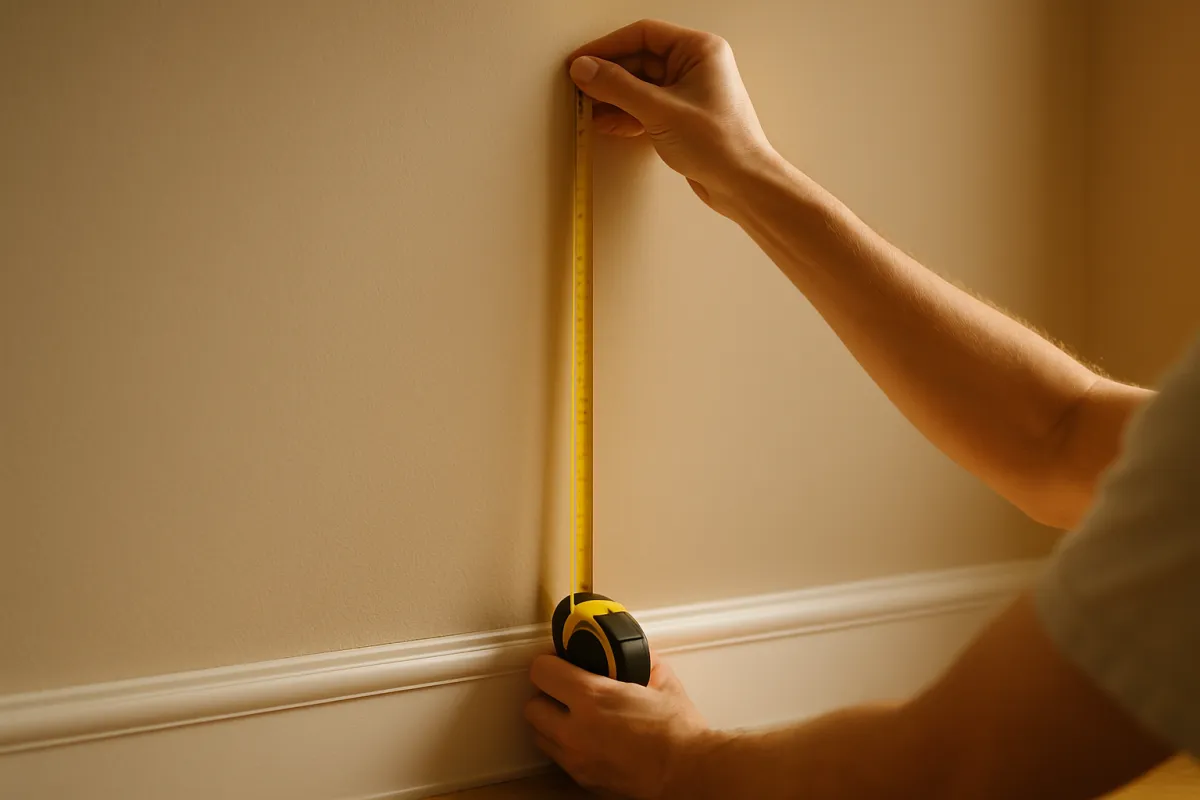
Two measuring habits pay for themselves. First, measure the height for real rather than assuming 8 feet; newer builds run 9 or 10, and each extra foot on a 52 foot perimeter adds 52 square feet, most of a quart per coat. Second, treat irregular rooms the way our estimating manual treats any odd shape: decompose them. An L-shaped room is still one perimeter; a room with a bay is a rectangle plus the bay’s short walls; stairwells are a rectangle with a tall triangle above the stringer, calculated separately. The tape work takes five minutes, and every number downstream inherits its accuracy.
Doors, windows, and what to subtract
Openings are wall you do not paint, and the craft is subtracting them without measuring every jamb. The standard allowances do the job: about 20 square feet for a door and its immediate surround, about 15 for an average window. A typical room with one door and two windows gives back roughly 50 square feet, which sounds trivial until you notice it is more than an eighth of our example room’s gross wall, and at two coats it is 100 square feet of coverage, a real fraction of a gallon.
The judgment call is when to trust the allowance and when to measure. For ordinary doors and windows, use the allowance; the small error it carries in either direction joins the estimate’s natural cushion. For dominant openings, a sliding glass wall, a garage door, a picture window taller than you, measure the actual opening and subtract it honestly, because a 90 square foot glass wall treated as “a window, 15 feet” leaves you buying a gallon the room cannot use. The same logic runs in reverse from the concrete rule in our concrete manual: there, small irregularities add volume you must order; here, small openings remove area you should not. Subtract the big, wave through the small, and write the net number down.
Two coats are the default, not the upgrade
Here is the decision that sinks more paint estimates than every measuring error combined: how many coats. The marketing says one; the wall says two. A second coat is not a redo of a failed first coat, it is how paint is designed to work: the first coat bonds and mostly hides, the second builds the film to full depth, evens the color, and erases the roller lap marks that show in every low-angle light the room will ever have. Estimate every repaint at two coats and let one coat be a pleasant surprise, never a plan.
The genuine exceptions run in both directions. One coat can honestly suffice when you are repainting the same color, in the same sheen, over sound, clean, previously painted walls, a refresh rather than a change. Three coats enter when the color change is dramatic and primer is skipped, when the new color is one of the weak-hiding families, bright reds, yellows, some oranges, whose pigments are translucent by chemistry, or when the surface is a patchwork of repairs flashing through. Each coat is a full pass of the same square footage, so the coats multiplier is the single biggest lever in the estimate: the difference between one coat and two is not a margin, it is double.
The worked example: a 12 by 14 room, start to finish
Run one room end to end, because the worked version is where the method becomes muscle memory. The room: 12 by 14 feet, 8 foot ceilings, one door, two windows, a normal bedroom repaint in a new color, smooth walls in decent condition.
Perimeter: 2 × (12 + 14) = 52 feet. Gross wall area: 52 × 8 = 416 square feet. Openings: one door at 20 plus two windows at 15 each, 50 square feet. Net wall area: 366 square feet. Coats: two, because this is a color change; coated area: 732 square feet. Coverage: smooth previously painted drywall, planning figure 375 square feet per gallon. Divide: 732 ÷ 375 = 1.95 gallons. Round up: two gallons of wall paint, with about 18 square feet of coverage to spare, which is thinner insurance than it sounds and exactly why the rounding rule is up, never down.
Then the separate lines. Ceiling: 12 × 14 = 168 square feet, two coats is 336, one gallon of flat ceiling paint covers it with margin. Trim: 52 feet of baseboard, the door, and two window casings work out to roughly 60 square feet of fiddly area, call it two quarts of enamel for two coats. The whole room, ordered correctly, is two gallons of wall color, one of ceiling white, two quarts of trim enamel, and the receipt tells the story the label never does: the wall color is barely half the shopping list.
Primer is separate math
Primer is not the first coat of paint; it is a different product with a different job and its own line in the estimate. Its four honest use cases: bare surfaces, new drywall, fresh patches and skim coats, raw wood; stain blocking over water marks, smoke, tannin, and marker; drastic color changes, where one coat of primer is cheaper than the extra coats of finish paint it replaces; and adhesion over glossy, chalky, or previously problem surfaces that topcoat alone grips poorly. If none of those describes your wall, a sound previously painted surface taking a similar color, modern self-priming paints genuinely cover the need, and the primer line reads zero.
When primer is in, calculate it like a coat of its own: the same net wall area, divided by the primer’s stated coverage, which often runs a little lower than paint, commonly 225 to 300 square feet per gallon on porous surfaces because that is precisely where primer gets used. One coat of primer is the norm; raw drywall’s joints and patches sometimes ask for two passes locally rather than a second full coat. The budget logic is comfortable: primer is typically cheaper per gallon than good finish paint, illustratively $20 to $35 against $40 to $70, so a primer coat that saves a third finish coat usually pays for itself twice, once in dollars and once in the afternoon it gives back.
Texture and porosity: why some walls drink more
The number on the can was earned on the easiest surface paint ever meets: smooth, sealed, previously painted drywall. Every step away from that surface costs coverage, and the mechanism is simple: texture adds real surface area inside the same measured footprint, and porosity pulls liquid into the substrate before it can form a film. The wall you measured at 366 square feet can be 400-plus square feet of actual paintable surface once orange peel or knockdown texture is counted, and bare masonry drinks besides.
Realistic coverage per gallon by surface
Illustrative planning figures; the label's 350 to 400 assumes the top bar.
Texture adds hidden surface area and porous substrates drink paint into themselves. Estimating a heavy-texture or masonry job at the label's smooth-wall figure is how a two-gallon room becomes a three-trip weekend.
The practical correction is to swap the divisor, not to pad the answer: plan smooth walls at 400, light texture at 350, heavy knockdown or popcorn-adjacent texture at 300, and bare brick, new stucco, or raw masonry at 250 or below, with a primer or block filler coat doing the first drinking. New drywall deserves its own mention: the paper face and joint compound absorb unevenly, which is why the primer coat there is not optional, and why the first finish coat over even primed new drywall covers at the low end. The surface, not the paint, sets the coverage; read the wall before you read the label.
Ceilings are a separate line item
The ceiling is not a fifth wall in the addition; it is a separate product on a separate line. Ceiling paint is its own category for good reasons: dead flat to hide the surface imperfections that raking light exaggerates on the one plane you always see at an angle, formulated for less spatter overhead, and almost always its own white rather than the wall color. Mixing the ceiling’s square footage into the wall gallons therefore double-errs: it inflates the wall color order and leaves you with no ceiling paint at all.
The math, at least, is the easiest in the room: the ceiling is the floor. Length times width, 168 square feet in our 12 by 14 example, no openings to subtract unless a skylight is genuinely large. Coats follow the same logic as walls, and ceilings earn their two-coat estimate more often than people expect, partly because aged ceiling paint yellows and shadows, partly because textured ceilings sit at the thirsty end of the coverage chart. Two coats of 168 is 336 square feet, comfortably one gallon. The scheduling note that saves rework: ceiling first, always, so its overspray and spatter fall on unpainted walls, and the wall color then cuts a clean line against a finished ceiling.
Trim: different paint, quart-scale math
Trim runs on different paint and different units. Baseboard, casings, doors, and window sashes take enamel, a harder, scrubbable film usually in semi-gloss or satin, sold and sensibly bought by the quart, because trim areas are small and enamel is the most touched, most washed, most re-bought paint in the house. Folding trim into the wall gallons fails twice: wrong product, wrong amount.
Estimate trim by linear feet, then convert. Baseboard is the room’s perimeter, 52 feet in our example, and at roughly half a foot of painted face it contributes about 26 square feet. A door with its casing runs near 20 square feet counting one face and the frame; a window casing runs 8 or so. Our room totals about 60 square feet of trim, 120 with two coats, and with a quart covering roughly 100 square feet the answer is two quarts with sensible margin. The margin matters more here than the arithmetic suggests: trim work is cutting in, brushwork, and corners, which waste more per square foot than rolling a wall ever does, and an open quart of the trim enamel is the touch-up kit the household will reach for, for years.
Sheen changes touch-up, not coverage
Sheen is where buyers most often overthink coverage and underthink consequences. Flat, eggshell, satin, semi-gloss: within a given product line, the coverage figures differ barely or not at all, so the gallon math of this manual is sheen-agnostic and no estimate needs correcting for it. What sheen actually changes is everything around the estimate: how the film behaves for the rest of its life.
The trades run a simple gradient. Flat and matte hide surface flaws and touch up nearly invisibly, because there is no light-bounce for a fresh patch to disagree with, which is why ceilings are flat and low-traffic walls love matte; the price is a film that scrubs poorly. Gloss ends run the other way: semi-gloss and gloss shrug off washing and knuckles, which is why trim, doors, kitchens, and baths wear them, but every roller pattern, patch, and touch-up flashes in their reflectivity. The estimating consequence is indirect but real: the flatter the sheen, the more a labeled leftover quart will save you, because touch-ups blend; the glossier the sheen, the more a future scuff means repainting corner to corner, which argues for buying the full two-coat quantity now rather than planning to revisit. Choose sheen by room use, then buy by the same math regardless.
Gallons versus quarts: the rounding economics
Every paint estimate eventually lands between package sizes, and the rounding rule has real money attached. The economics lean hard toward the gallon: illustratively, a gallon of a given line runs $40 to $70 while a quart of the same paint runs $18 to $30, so a quart prices out near double the paint’s per-ounce cost. Two quarts nearly buy a gallon while delivering half of one. The moment your shortfall estimate exceeds one quart, the gallon is usually the rational purchase even though it feels like over-buying.
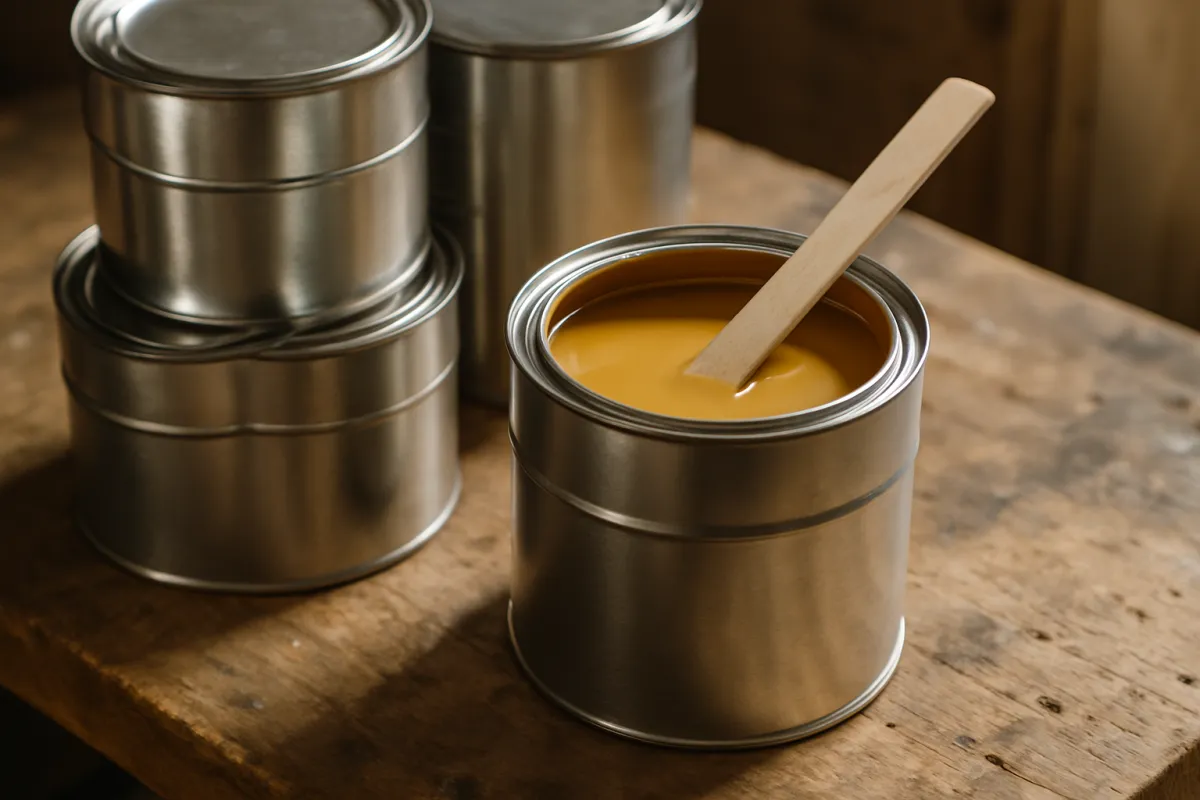
Custom tinting tightens the rule further. A custom-mixed color is generally not returnable, which tempts people to buy lean, and that temptation points exactly the wrong way: the real risk of a tinted color is the second batch. Tint dispensers are good, not perfect, and a gallon mixed Tuesday to rescue Saturday’s shortfall can sit a shade off, on the most visible wall, forever, the same batch problem our estimating manual files under dye lots. So the rounding rules, in order: never round down; round shortfalls past a quart up to the gallon; buy all custom-tinted paint in one batch, waste factor included; and reserve quart purchases for genuinely quart-sized jobs, one door, an accent, a touch-up kit.
Color changes: dark to light and back
Color change is the multiplier people feel but forget to estimate. Paint hides by pigment density, and no single coat fully hides a strong color underneath: paint navy over cream, or cream over navy, and the first coat reads as a tinted shadow of the old wall. The estimate must decide up front which tool buys the hiding: extra finish coats, or a primer coat underneath.
The primer route usually wins on both money and effort. Going dark to light, one coat of white or gray-tinted primer kills the old color for less than half the cost of the finish gallon it replaces, and two finish coats over it land the true color; the alternative is often three finish coats, more expensive and still uncertain. Going light to dark seems easier and mostly is, but deep bases carry less white pigment and hide worse than their drama suggests, and the weak-hiding families, true reds, bright yellows, some oranges, routinely want three coats or a gray-tinted primer engineered for them; paint desks tint primer gray for exactly this. The estimating translation is mechanical: a same-family repaint is area times two; a strong color change is area times two plus a primer line at its own coverage; a red-over-white adventure without primer is honestly area times three, and pretending otherwise is how the last wall gets its second coat from a different batch.
Spray versus roll: the waste factor in the method
How the paint reaches the wall changes how much paint you buy, and the difference is bigger than any measuring error in this manual. Rolling is the efficient baseline: nearly everything on the roller ends up on the wall, and the waste is a film dried in the tray, the cover, and the bucket, a few percent on a normal job. Brushing wastes similarly little and matters only at trim scale. Estimates built on the label’s coverage figure quietly assume this world.
Spraying does not live in that world. An airless sprayer atomizes paint, and a real fraction of the cloud never becomes wall film: overspray drifts past edges, bounce-back mists off the surface, and the hose and pump hold a priming charge that goes to cleanup, not coverage. The working allowance is 20 to 30 percent more material than the rolled estimate, toward the high end outdoors, on breezy days, or on lattice-like targets, railings, shutters, fences, that are mostly air. Spraying still earns its keep on big open walls, ceilings, and detailed profiles like paneled doors, where its speed and film quality are unmatched; the point is not to avoid it but to buy for it. A sprayed version of our two-gallon room is a 2.4 to 2.6 gallon room, which the rounding rule reads as three, and knowing that before the store beats learning it from a dry hopper.
Whole-house estimating: the per-room table
A whole house is not one big room, and the square-footage shortcuts that claim otherwise, multiply the floor area by some factor, gallons per thousand feet, fail exactly where houses vary: ceiling heights, window walls, open plans, and how many colors are in play. The method that works is the boring one: a per-room table. One row per room; columns for dimensions, ceiling height, doors, windows, net wall area, coats, and gallons. Every row is this manual’s worked example run again, and our estimator turns each row into thirty seconds of typing.
The table earns its keep in the summing, where three whole-house effects appear. First, shared color: rooms painted the same color pool their area before the gallon rounding, so the hallway’s half gallon and the landing’s half gallon become one can, not two, and buying that color as a single batch dodges the tint-match risk entirely. Second, the separate products stack: the per-room quarts of trim enamel may sum to a couple of gallons of one white, and the ceilings likewise, each its own batch-buy. Third, the table exposes scale honestly; a modest three-bedroom interior commonly lands around 8 to 12 gallons of wall paint at two coats, plus ceiling and trim lines, and seeing that number in advance is what turns a vague weekend plan into a budget, a schedule, and one correct trip to the counter.
Where a room’s paint money actually goes
Tally the worked example’s receipt and the shape of a room’s paint budget appears, and it surprises most first-timers: the wall color, the entire subject of the color-card agonizing, is barely half the spend. The rest is the supporting cast, ceiling paint, trim enamel, and primer where the job needs it, each a separate product bought in its own units.
Where a room's paint budget goes
Illustrative split for a full one-room repaint, all products included.
The wall color is only about half the paint spend on a full repaint. Estimating the walls and improvising the rest is why paint projects average more store trips than any other line on the job.
The split shifts with the job, a walls-only refresh is nearly all wall paint, a new-drywall job is heavy on primer, but the lesson holds: the estimate is a shopping list, not a number. Write the four lines, walls, ceiling, trim, primer, price each in its own units, and the total stops being a guess. The list is also where the non-paint items get caught, tape, drop cloths, roller covers, a tray liner per color, small money individually and a guaranteed second trip when forgotten.
The leftover strategy: label it, store it, use it
A correct estimate ends with paint left over, on purpose, and the difference between that surplus being an asset or clutter is ten minutes of handling. The touch-up problem is real: walls get scuffed, furniture gets moved, kids happen, and the only paint guaranteed to match your wall is the paint from the same batch that covered it. A quart or so of each color, kept properly, is a repair kit no store can sell you later.
Keeping it properly means three habits. Label the can before it leaves the room: the room and surface it covered, the brand, line, color name and formula code, the sheen, and the date, written on the lid and the side, because lids wander. Seal it honestly, rim cleaned, lid tapped home, and for small amounts decant into a sealed glass jar so less trapped air ages the paint; either way, stored somewhere that does not freeze, since a hard freeze can break latex paint permanently. And use it in the flat-to-matte rooms where touch-ups blend; in glossier sheens, expect the leftover’s job to be repainting a full wall to a corner, which is still a batch-match rescue. Kept this way, latex paint commonly stays usable for years, and the labeled shelf becomes the house’s maintenance manual in can form.
Buying at the right time
Paint is one of the few building materials with a genuine calendar, and timing the purchase is free money for anyone who can plan two weeks ahead. The retail pattern is stable and public: the big paint brands and home centers run their deepest promotions around the long holiday weekends, Memorial Day, the Fourth of July, Labor Day, plus spring painting-season events, and the discounts on premium lines are routinely large enough to move a whole-house order’s total by a meaningful fraction. A per-room table drawn up in advance is what lets you buy the entire batch, waste factor included, the weekend the price drops.
Two quieter timing plays are worth knowing. Mistint racks, cans tinted wrong or returned unopened, sell excellent paint at a steep discount for anyone flexible on color, ideal for primer duty, garages, and closets, though never for a room that needs a second matching gallon later. And climate is a timing input too: exterior work wants the paint bought when the weather window opens, not before the winter that would freeze it in the garage. The one timing mistake to refuse is the reverse: buying paint months early with no frost-free storage plan, then estimating the job twice because the first batch died on a cold shelf.
Where paint estimates go wrong
The failure patterns repeat reliably enough to list in order of frequency. Estimating one coat leads by a wide margin: the area math is done honestly, the coats multiplier is skipped, and the shortfall surfaces halfway through the second pass, when the store is closed and the batch risk is highest. Second is ignoring the surface: a heavy-texture wall estimated at the label’s smooth-drywall coverage runs dry a wall early, precisely the correction the coverage chart above exists for.
The rest of the list: forgetting that ceiling and trim are separate products, and discovering it mid-job as a hard stop; buying custom color lean and gambling the last wall on a second tint batch; skipping primer on a dramatic color change and paying for it in a third and fourth coat of expensive finish; spraying on a rolled estimate and running the hopper dry 20 percent early; and the quiet one, measuring nothing and buying “about three gallons” on vibes, which overshoots small rooms and strands big ones. Every entry traces to the same root: treating paint as a guess because the label made it look easy. The formula takes ten minutes; each failure above costs an evening or a wall.
The pre-purchase checklist
The whole manual, compressed to the list worth taking to the store.
- Measure the perimeter and the real ceiling height. Perimeter times height is the gross wall; decompose odd rooms into rectangles.
- Subtract openings by allowance. About 20 square feet per door, 15 per window; measure only the dominant glass honestly.
- Set the coats multiplier deliberately. Two is the default; one only for same-color refreshes; three, or primer plus two, for strong color changes.
- Pick the coverage figure from the wall, not just the label. Around 400 smooth, 350 light texture, 300 heavy, 250 bare masonry.
- Write the four product lines. Wall gallons, ceiling gallon, trim quarts, primer where the surface or color change demands it.
- Add the spray allowance if spraying. Plan 20 to 30 percent more material than the rolled estimate.
- Round up, buy one batch, label the leftovers. Gallon over quarts past a one-quart gap, all custom tint in one mix, lids labeled for the touch-up shelf.
Run your room through our estimator first and the checklist becomes a two-minute confirmation instead of store-aisle arithmetic.
The bottom line
Paint estimating is the coverage-plus-waste method wearing its friendliest face: perimeter times height, minus the openings, times the coats, divided by what a gallon honestly covers on your wall, rounded up to cans. The craft lives in the multipliers the label cannot see, two coats as the true default, texture and porosity dragging coverage down, primer as its own line rather than a hopeful skip, and spray waste when the gun comes out, and in remembering that a room is four products, not one. Work the 12 by 14 example against your own rooms, build the per-room table for anything bigger than a weekend, and buy the whole batch at once with the leftovers labeled. The paint job that follows is the kind this whole site is built to produce: no second trip, no mismatched wall, and a shelf of touch-up cans that make next year’s scuffs a five-minute repair.
Treat this manual as bench notes, not a bid sheet. Coverage rates, opening allowances, coat counts, and every dollar figure here are illustrative teaching numbers, and the can in your hand, the wall in your house, and the store down your road will each disagree with them somewhere. Read your product’s stated coverage, test your surface, and settle the final quantities with your paint supplier before buying. For anything beyond routine repainting, badly failing surfaces, suspected moisture, or sanding and scraping in homes old enough to carry lead paint, bring in a qualified professional before the first drop cloth goes down.
Frequently asked questions
How much paint do I need for an average room?
A typical bedroom needs about two gallons of wall paint for two coats. The math behind that figure: perimeter times ceiling height gives the gross wall area, subtracting roughly 20 square feet per door and 15 per window gives the net area, and multiplying by two coats gives the total to divide by coverage, commonly 350 to 400 square feet per gallon. A 12 by 14 foot room with 8 foot ceilings lands at roughly 730 square feet of coated area, just under two gallons. Ceiling and trim are separate purchases with their own math.
How many square feet does a gallon of paint cover?
Most manufacturers state 350 to 400 square feet per gallon on smooth, previously painted surfaces, and 375 is a sensible planning figure. Real coverage drops with texture and porosity: lightly textured walls run closer to 350, heavy texture near 300, and thirsty surfaces like bare brick or new stucco can fall to 250 or below. The number printed on your specific can beats any general figure, so read it before dividing.
Do I really need two coats of paint?
For almost every repaint, yes, and estimating for one coat is the most common way people run short. Two coats build an even film, hide the old color, and level out roller marks that a single pass leaves visible in raking light. One coat can suffice when repainting the same color in the same sheen on a well-kept wall, and a third coat enters the picture for dramatic color changes, deep reds and yellows with weak hiding pigments, or badly patched surfaces. Estimate at two and treat one as the exception you confirm, not the default you hope for.
Do I subtract doors and windows when measuring for paint?
Subtract the standard allowances rather than measuring each opening: roughly 20 square feet for a door and 15 for an average window. In a normal room with one door and two windows that removes about 50 square feet, which matters at the gallon boundary where it can be the difference between buying two gallons and three. The exception is a wall dominated by glass or a garage door, where you measure and subtract the real opening because the allowance would understate it badly.
When do I need primer, and how much?
Primer earns its place in four situations: bare or newly patched drywall, stain blocking, a drastic color change such as dark to light, and glossy or chalky surfaces that paint grips poorly. It is a separate product with its own coverage figure, often a bit lower than paint at around 225 to 300 square feet per gallon on porous surfaces, so it gets its own line in the estimate rather than a share of the paint gallons. On a sound, previously painted wall in a similar color, quality self-priming paint usually makes a separate primer coat unnecessary.
How much paint does a whole house interior take?
Estimate it room by room and sum the gallons; whole-house square footage shortcuts hide too much variation in ceiling height, openings, and color changes. As an illustrative anchor, a modest three-bedroom interior often lands somewhere around 8 to 12 gallons of wall paint for two coats, plus ceiling paint and trim paint as separate line items. Building a simple per-room table, dimensions, openings, coats, gallons, takes an evening and produces an order you can defend at the paint counter.
Does spraying use more paint than rolling?
Yes, plan on roughly 20 to 30 percent more material when spraying, because atomized paint drifts, oversprays past edges, and a measurable amount stays in the hose and gun. Rolling wastes far less, mostly what dries in the tray and roller cover. Spraying buys speed and a smooth film on large open areas and detailed surfaces like paneled doors, so the trade can be worth it, but the estimate must carry the waste factor or the sprayer runs dry a wall short of done.
Should I buy an extra gallon or a quart?
Round up to the gallon when the leftover has a job to do, and to the quart only for genuine small-area work like touch-ups or a single door. A gallon typically costs only moderately more than a couple of quarts, illustratively $40 to $70 against $18 to $30 per quart for comparable lines, so quart-based topping up is the expensive way to buy volume. With custom-tinted colors the calculus tightens further: tinted paint is generally not returnable, but a shortfall means a second tint run that may not match perfectly, and most painters accept a deliberate surplus over that risk.