What's on this page
- Why a sod order starts with square feet, not pallets
- The sod quantity formula in one line
- Measuring the lawn: rectangles first
- Triangles, circles and the shapes a rectangle misses
- Deducting beds, paths and the house footprint honestly
- The waste allowance, and why curves cost more than corners
- Setting your own waste percentage from the perimeter
- Converting square feet to pallets, two ways
- Why a pallet of sod is not a standard size
- Slabs, rolls and big rolls: the piece math
- A worked example, measured to ordered
- Cross-checking the order before you place it
- The weight problem: what a pallet of sod actually weighs
- Wet sod, dry sod and the moisture swing
- Delivery access, forklifts and the half ton pickup question
- Perishability: the constraint sod has and gravel does not
- Ordering around the calendar, not around the truck
- How fast you can actually lay it
- The soil underneath: topsoil, grading and why it comes first
- Do not order sod before the ground is ready
- Sod versus seed on the quantity question
- Where a sod estimate goes wrong
- Your sod order checklist
- The bottom line
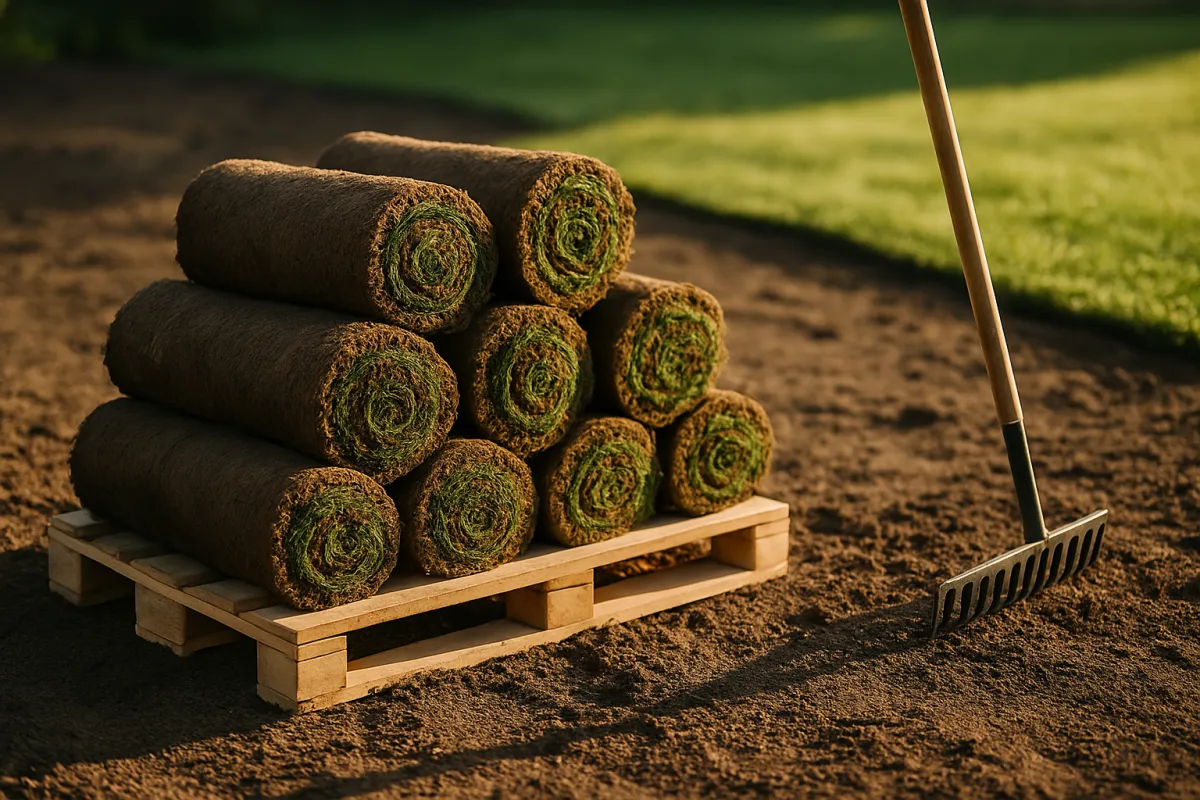
Sod is the only material on this site that will die if you order it too early. Everything else waits: gravel sits in a driveway, drywall leans against a garage wall, pavers stack on a pallet through a rainy fortnight. Cut turf is living tissue with severed roots, stacked airless on a pallet, and it starts spoiling from the day it is harvested. That single fact reshapes the quantity question, because getting the number right matters much more when a surplus cannot be stored and a shortfall cannot wait for next weekend.
The second thing worth knowing before you calculate anything is that the unit sod is sold in has no standard size. Pallet coverage varies by grower and by region, and so does the size of the individual roll or slab on it, which means every remembered pallet figure is a guess about somebody else’s product. This manual therefore works the estimate in the only order that survives that variability: square feet first, waste allowance second, and the pallet conversion last, using the supplier’s own coverage rather than a number from memory. Run your own footprint through the material coverage estimator, and the companion below recomputes every section on your dimensions as you read.
Key takeaways
- Compute square feet first and convert to pallets last. A pallet of sod is not a standard size, and coverage figures from roughly 400 to 700 square feet are all in circulation.
- The conversion is one division: square feet to order divided by that grower's pallet coverage, rounded up. An illustrative 2,602 square foot order is 7 pallets at 400 square feet each and only 4 at 700.
- Cut waste follows the perimeter, not the area, so curved beds and narrow strips cost far more percentage than straight edges. Allow roughly 5, 10 or 15 percent as the shape gets busier.
- Sod is heavy. At an illustrative 4.5 pounds per square foot, a 450 square foot pallet is near 2,025 pounds, so a light pickup rated for 1,500 pounds carries about three quarters of one pallet.
- Prepare and grade the soil before the sod is ordered, not after it arrives, because harvested turf has to go down within roughly a day and cannot be stockpiled.
Why a sod order starts with square feet, not pallets
Almost everyone approaches this backwards. The question people type is how many pallets, because the pallet is what shows up on the truck, and so the first instinct is to find a pallet coverage figure and divide. That instinct fails here for a reason it does not fail for concrete or gravel: a cubic yard is a cubic yard everywhere on earth, but a pallet of sod is whatever a particular farm decides to stack.
Square footage, by contrast, is stable. Your lawn is the size it is regardless of who grows the turf, what width their harvester cuts, or how their forklift loads a truck. So the durable half of the calculation is the half you do with a tape measure, and the fragile half is the conversion at the end. Doing the durable half first means a phone call to a different supplier changes only the last line of your arithmetic instead of the whole thing.
There is a practical payoff too. Suppliers quote in different units, some by the pallet, some by the square foot, some by the square yard, and a few by the piece. If you arrive with a square footage figure you can convert into any of those in one step and compare quotes on the same basis. If you arrive with a pallet count derived from somebody else’s pallet, you cannot. The same divide-to-derive posture runs through our material coverage reference for every product on a project.
The sod quantity formula in one line
The whole calculation reduces to one line: net lawn area in square feet, times one plus the waste fraction, divided by the supplier’s pallet coverage, rounded up to whole pallets. Written with the area step folded in, it reads as gross measured area minus deductions, times the waste multiplier, over pallet coverage.
Every section that follows is either measuring one of those inputs more carefully or explaining a constraint that sits alongside the number. Take the running example this manual returns to: a back yard measuring 2,610 square feet gross across three shapes, with 245 square feet of patio, beds and path deducted. Net area is 2,610 minus 245, or 2,365 square feet. A 10 percent allowance gives 2,365 times 1.10, which is 2,601.5, so you order 2,602 square feet.
Then, and only then, the pallet step. If your grower’s pallet covers 450 square feet, 2,602 divided by 450 is 5.78, so you order 6 pallets and receive 2,700 square feet. If their pallet covers 600, the same order is 2,602 divided by 600, or 4.34, and you buy 5. Nothing about your lawn changed. The only variable that moved was the supplier’s packing convention, and that is exactly why it belongs at the end of the line rather than the start.
Measuring the lawn: rectangles first
Begin by walking the area with a long tape or a measuring wheel and sketching the outline on paper, not by eye from the patio door. A sketch with dimensions written on it is worth more than any single measurement, because it is where a forgotten side return or a strip behind the shed announces itself before it costs you a second delivery.
The decomposition method handles anything. Break the lawn into shapes you can already solve, compute each area, and add. Rectangles do most of the work. In the running example, the main back lawn is 60 feet by 38 feet, which is 2,280 square feet. A side yard strip runs 24 feet by 10 feet, another 240 square feet. Two numbers, one multiplication each, and the bulk of the yard is accounted for.
Measure to the widest point of each rectangle rather than to the average, and record the perimeter of each piece while you are there, because the waste allowance later is a perimeter question rather than an area one. Our square footage manual works the decomposition method in full detail, including how to handle a shape that refuses to split cleanly, and our land area measurement guide covers the larger-lot version of the same problem where a wheel beats a tape.
Triangles, circles and the shapes a rectangle misses
Yards are rarely obliging. Fence lines run at angles, corners get clipped for a driveway, and beds arrive as arcs rather than boxes. Three formulas cover almost everything you will meet, and none of them requires anything beyond a tape.
A triangle is half its base times its height, where the height is measured square to the base rather than along a sloping side. The wedge of lawn beside the drive in the running example has an 18 foot base and stands 10 feet deep, so it is 0.5 times 18 times 10, or 90 square feet. A circle is pi times the radius squared, and the radius is half the diameter, so a round patio 12 feet across is 3.14159 times 6 squared, which is 3.14159 times 36, about 113 square feet. A half circle or a quarter circle is that figure halved or quartered.
Curved lawn edges that are not neat arcs get the pragmatic treatment. Run a straight line through the middle of the curve, measure the rectangle it makes, and accept that the answer errs slightly one way or the other. The error is small compared with the waste allowance you are about to add, and chasing precision on a wandering bed edge with a tape measure is time better spent on the grading underneath. Adding the three pieces gives 2,280 plus 240 plus 90, or 2,610 square feet gross.

Deducting beds, paths and the house footprint honestly
The gross figure is the outline of the yard. The order is for the part of it that gets grass, so everything else comes off. That list is longer than people expect: the house footprint if you measured to the walls, the driveway, the patio, planting beds, tree rings, the shed pad, the stepping stone path, the air conditioning slab, and any hard surface the mower already goes around.
In the running example the deductions are the 113 square foot round patio, two planting beds at 18 feet by 4 feet totalling 72 square feet, and a stepping path 3 feet by 20 feet at 60 square feet. Together that is 113 plus 72 plus 60, or 245 square feet. Net sod area is 2,610 minus 245, which is 2,365 square feet.
The word honestly is doing work in that heading. There is a temptation to skip small deductions on the theory that extra sod never hurts, and with a storable material that reasoning is defensible. With sod it is not, because the surplus cannot be kept. A pallet you do not lay is a pallet that composts on your driveway. Deduct what is genuinely not getting grass, then add the waste allowance deliberately and in one place, where you can see it and reason about it, rather than smuggling it in as sloppy measuring.
Where the measured yard goes
The 2,610 square foot gross measurement in this manual's example, split into what gets sod and what comes off.
Each share is its own area divided by the 2,610 square foot gross, rounded to whole percents that still sum to 100: 2,365 over 2,610 is 90.6 percent, 113 is 4.3, 72 is 2.8 and 60 is 2.3. Your split will differ; the point is that the deductions are worth measuring rather than eyeballing.
The waste allowance, and why curves cost more than corners
Waste in a sod job is almost entirely cutting waste. Turf comes in fixed rectangles, your lawn does not end in fixed rectangles, and the difference gets trimmed off with a knife and thrown in a barrow. A little more goes to pieces that dry out, tear on handling, or come off the pallet in poor condition, but the dominant term is geometry.
That matters because cutting happens along the boundary. A piece in the middle of a lawn is laid whole; a piece meeting the edge gets trimmed, and the offcut is often the wrong shape to use elsewhere. So the waste percentage is not really a property of the area at all, it is a property of the perimeter divided by the area, which is exactly the reasoning our paver manual uses to set a cut allowance on a patio.
Straight edges are kind. A slab cut in half along a fence line leaves a half slab that fits the next gap along that same fence line, so the material mostly gets used. Curves are unkind for the mirror image of that reason: every trimmed piece is a different arc segment, consecutive offcuts do not pair up, and the bin fills fast. A lawn that wraps around three kidney shaped beds and a tree ring has an enormous amount of edge for its area, and its allowance should reflect that rather than defaulting to a comfortable round number.
Setting your own waste percentage from the perimeter
The perimeter to area ratio makes the point in numbers. The main lawn in the running example, 60 feet by 38 feet, has a perimeter of 2 times 60 plus 38, which is 196 feet, against 2,280 square feet of surface. That is 196 divided by 2,280, about 0.086 feet of edge per square foot.
Now take a boulevard strip 3 feet wide and 40 feet long. Its area is 120 square feet and its perimeter is 2 times 3 plus 40, or 86 feet. That is 86 divided by 120, about 0.717 feet of edge per square foot. Divide the two ratios and the strip carries roughly 0.717 over 0.086, about 8.3 times the perimeter per square foot that the open lawn does. The same knife work therefore costs many times the percentage on the strip, which is why narrow shapes get their own allowance rather than the lawn’s.
Illustrative tiers that follow from this reasoning: around 5 percent for a plain rectangle with straight edges and square corners, 10 percent for a lawn mixing straight runs with gentle curves, which is what the running example uses, 15 percent where curved beds, islands and tree rings dominate, and 15 to 20 percent for narrow strips and boulevard bands. These are planning figures, not guarantees. Applying 10 percent gives 2,365 times 1.10, or 2,601.5, so the order is 2,602 square feet, of which 237 square feet is the allowance.
Converting square feet to pallets, two ways
Here is where the arithmetic gets easy and the assumption gets dangerous. The conversion itself is a single division: square feet to order, divided by the coverage of one pallet, rounded up to a whole pallet, because growers do not split them.
Convention A, a pallet quoted at 450 square feet. The order of 2,602 square feet divided by 450 is 5.78 pallets, which rounds up to 6. Six pallets at 450 square feet each deliver 2,700 square feet, which is 98 square feet more than the 2,602 you calculated, and that surplus is fine because it lands inside the waste allowance you already reasoned about.
Convention B, a pallet quoted at 600 square feet. The same 2,602 divided by 600 is 4.34 pallets, which rounds up to 5. Five pallets deliver 3,000 square feet. Same lawn, same waste allowance, same arithmetic, and the answer changed from 6 to 5 because a different farm stacks a different amount of turf on the same wooden frame. Substitute your own supplier’s figure into that division and you have your own answer; the method survives, the number does not. Our estimator will run the area and coverage division for you once you have the grower’s figure in hand.
Why a pallet of sod is not a standard size
It is worth understanding why the variability exists, because knowing the cause tells you what question to ask. Sod is harvested by machines that cut a strip of a set width, commonly around 16 or 24 inches, and roll or fold it into pieces of a set length. Different farms run different harvesters, so the piece size differs. Pieces are then stacked on a pallet to a height and weight the farm’s forklifts and trucks can handle safely, which depends on their equipment and on how wet the turf is that week.
The result is a genuine spread rather than a rounding difference. Pallet coverage figures from roughly 400 to 700 square feet are all in circulation across different growers and regions, and grass type plays a part too, since a thick warm season turf cut deep weighs more per square foot than a thin cool season cut and hits the weight ceiling sooner.
So the question to ask is not what a pallet covers, it is what one of your supplier’s pallets covers, ideally alongside the piece dimensions and an approximate weight. Three numbers, one phone call, and every conversion in this manual becomes exact for your job. Skipping that call is how a 2,602 square foot lawn ends up short by a pallet on a Saturday morning with the ground prepared and nothing to lay on it.
Pallets needed for one 2,602 square foot order
The same lawn converted at five different pallet coverage figures, each rounded up to whole pallets.
Each value is 2,602 divided by the coverage, rounded up: 6.51 becomes 7, 5.78 and 5.20 both become 6, 4.34 becomes 5, and 3.72 becomes 4. Every bar width is that pallet count divided by the largest count, 7, times 100. The 450 and 500 rows landing on the same answer is a rounding coincidence at this area, not a rule.
Slabs, rolls and big rolls: the piece math
Below the pallet sits the piece, and it varies just as much. Three formats cover most residential supply. Rectangular hand slabs, commonly around 16 by 24 inches, are the format most homeowners meet. Small rolls, often around 2 feet by 5 feet, are the same idea rolled rather than folded. Big rolls, which need machinery to place, run 2 feet or wider by many feet long and are a contractor format.
The piece area comes from the same division you use for pavers: multiply the two dimensions in inches and divide by 144. A 16 by 24 inch slab is 384 square inches, and 384 divided by 144 is about 2.67 square feet. A 2 by 5 foot roll is already in feet, so it is 10 square feet flat. A 2 by 30 foot big roll is 60 square feet.
Divide the order by the piece area for the count. The 2,602 square foot order is 2,602 divided by 2.67, about 976 slabs; or 2,602 divided by 10, about 261 small rolls; or 2,602 divided by 60, about 44 big rolls. Pieces per pallet follows the same way: a 450 square foot pallet of 16 by 24 inch slabs holds 450 divided by 2.67, roughly 169 pieces. If a supplier quotes you a piece count instead of coverage, run that division in reverse to get back to square feet before you compare anything.
A worked example, measured to ordered
Pulling the whole thing together in one place makes the sequence obvious. The yard has three pieces of lawn. The main back rectangle is 60 by 38, or 2,280 square feet. A side strip is 24 by 10, or 240. A triangular wedge beside the drive has an 18 foot base and 10 feet of depth, so half of 18 times 10 is 90. Gross measured area is 2,280 plus 240 plus 90, which is 2,610 square feet.
Deductions come off next. The round patio at 12 feet across is pi times 6 squared, about 113 square feet. Two beds at 18 by 4 are 72. A stepping path at 3 by 20 is 60. Total deductions 245, so net area is 2,610 minus 245, or 2,365 square feet.
The lawn mixes straight fence lines with two curved bed edges, so 10 percent is the allowance. That gives 2,365 times 1.10, which is 2,601.5, rounded to 2,602 square feet to order. The grower quotes 450 square feet per pallet, so 2,602 divided by 450 is 5.78 and the order is 6 pallets, delivering 2,700 square feet. In 16 by 24 inch slabs that is roughly 976 pieces needed against roughly 1,012 delivered, since 6 pallets at about 169 slabs each is 1,014 by the piece count and 1,012.5 by the coverage count, a difference that comes purely from where you round.
Cross-checking the order before you place it
Two independent routes to the same answer catch more errors than checking one route twice, and sod gives you a cheap second route. Route one is the pallet path: net area, times the waste multiplier, divided by pallet coverage. Route two is the piece path: net area, times the waste multiplier, divided by piece area, then divided by pieces per pallet.
Run both on the example. Pallet path: 2,365 times 1.10 is 2,602, over 450 is 5.78, call it 6 pallets. Piece path: 2,602 divided by 2.67 is 976 slabs, and 976 divided by 169 slabs per pallet is 5.78, again 6 pallets. The routes agree, which is what you want, and if they had disagreed by a wide margin the culprit is nearly always a piece dimension entered in the wrong unit.
The third check is physical rather than arithmetic. Six pallets each occupy roughly the footprint of a standard shipping pallet, so picture six of those parked on your driveway at once and ask whether that looks like the right amount of turf for the yard you just walked. If the answer feels wrong by a factor rather than a margin, something upstream is wrong by a factor: a depth mistaken for a width, a deduction added instead of subtracted, or an area figure that never had the beds taken out. The same sanity habit runs through our general estimating manual.
The weight problem: what a pallet of sod actually weighs
Sod is soil with grass on top, and soil is heavy. Using an illustrative 4.5 pounds per square foot for moist freshly cut turf with a thin soil layer attached, a 450 square foot pallet works out at 450 times 4.5, about 2,025 pounds. That is just over a ton sitting on a wooden frame roughly four feet square.
The full order in the running example is 6 pallets covering 2,700 square feet, so 2,700 times 4.5 is 12,150 pounds, about 6.1 tons of material arriving at once. That number decides more than it looks like it should. It decides whether the delivery truck can reach the drop point, whether the ground it crosses will rut, whether a forklift can operate on the surface, and whether the pallets can be set where you actually want them rather than at the kerb.
Ask the grower for their own weight per pallet rather than relying on any figure here, including 4.5 pounds per square foot, which is a planning placeholder. Harvest depth is the biggest lever, since a thicker soil cut means a heavier pallet for the same coverage, and different grass types are cut at different depths. The weight-per-unit reasoning is the same one our sand weight manual works through for bulk material, where the density figure and not the volume is what limits the load.
Wet sod, dry sod and the moisture swing
The moisture content of harvested turf is not a rounding detail, it is one of the larger swings in this whole calculation. Freshly cut sod carries water in the soil layer and in the grass itself, and a field irrigated the night before harvest or cut after a storm produces noticeably heavier pallets than the same field in a dry spell.
Put illustrative brackets around it. At 3.5 pounds per square foot, a drier cut, a 450 square foot pallet is 450 times 3.5, about 1,575 pounds. At 6 pounds per square foot, a saturated cut, the same pallet is 450 times 6, about 2,700 pounds. That is a spread of more than a thousand pounds on one identical pallet, which is why the growers themselves quote weights as ranges rather than as a figure.
Two practical consequences follow. First, plan delivery access against the heavy end of the range rather than the average, because the day the truck sinks into a soft verge is the day the sod was wet. Second, do not let a light pallet tempt you into overloading a vehicle on a dry week and then repeating the trip on a wet one. Weigh the decision on the wet number and you will never be caught out; weigh it on the dry number and you will be caught out exactly once, expensively.
Delivery access, forklifts and the half ton pickup question
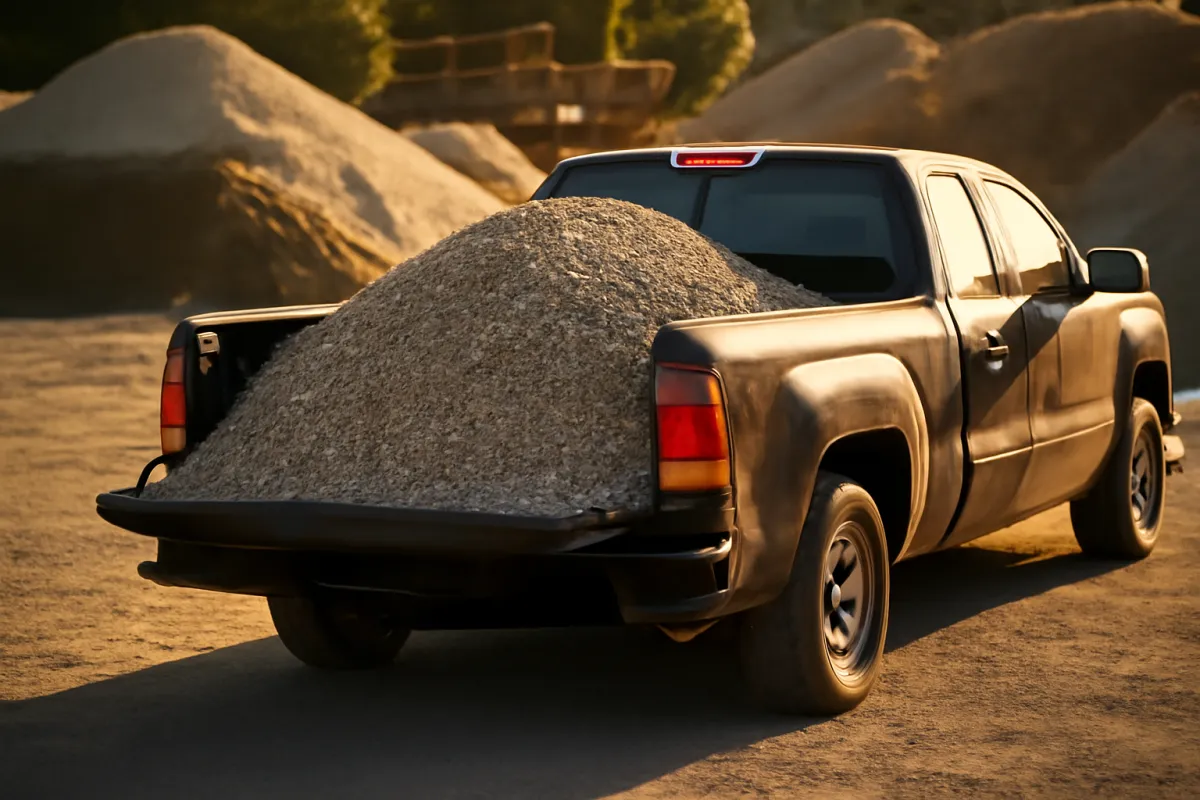
The half ton nickname on a pickup describes an old payload convention and not the truck sitting in your driveway. Real payload ratings vary widely across configurations and are printed on a placard in the driver’s door jamb, so read yours rather than assuming. Whatever it says, do the division against sod’s weight before you plan a self haul.
With an illustrative 1,500 pound rating and moist turf at 4.5 pounds per square foot, the vehicle carries 1,500 divided by 4.5, about 333 square feet. Against a 450 square foot pallet that is roughly three quarters of one pallet, or 74 percent of it. On a wet week at 6 pounds per square foot it is 1,500 divided by 6, about 250 square feet, closer to half a pallet. The 2,602 square foot order in the running example would take eight trips at the dry rate and more than ten at the wet one, which is not a plan, it is a weekend lost.
Delivery is therefore the normal answer for anything past a fraction of a pallet, and the questions to settle with the supplier are where the truck can stop, whether they have a forklift or a boom and what surface it needs, how close to the work the pallets can be set, and whether they will move a pallet a second time. Every extra foot a pallet has to travel by wheelbarrow is a foot moved at 2,000 pounds a load.
Perishability: the constraint sod has and gravel does not
Every other material this site covers is patient. Gravel weathers, concrete blocks sit through a winter, drywall waits in a garage. Sod is on a clock from the moment the harvester lifts it, because it is living plant tissue with its roots cut, stacked into an airless pile where heat builds and light does not reach.
The practical rule in common use is to lay sod within roughly a day of harvest, and sooner when it is hot, windy or the pallets are sitting in full sun. Turf left stacked yellows from the centre of the pallet outward, and the pieces at the middle of the stack are the ones that suffer first because they are the ones that cannot shed heat. Damage of that kind is not always visible when you unroll a piece, which is why it is discovered a fortnight later as a patch that never knitted in.
That constraint inverts the usual ordering advice. With storable materials, over ordering slightly is cheap insurance and under ordering is the expensive mistake. With sod both mistakes cost, because the surplus perishes rather than waiting for the next project. The answer is not to order less, it is to measure more carefully and to make the delivery date the last decision rather than the first.
Ordering around the calendar, not around the truck
Sequence the project backwards from the day the sod hits the ground. That day needs the soil already graded, amended, raked and firmed, enough labour on site to lay the whole delivery, water available and working, and weather that is not a heatwave or a downpour. Fix that day first, then book the delivery to land on it or the morning before it.
Booking the delivery first, which is the natural instinct because delivery slots feel like the scarce resource, puts the pressure in the wrong place. It turns soil preparation into a race, and rushed grading is the leading cause of a lawn that looks fine for a month and then shows every low spot. It also means a weather delay leaves pallets sitting.
Split deliveries deserve a mention for larger jobs. If the area is bigger than a crew can lay in a day, ask whether the grower will deliver in two drops on consecutive days rather than one large drop. It costs more in delivery and it saves the turf, and on a job of several thousand square feet that trade is usually worth making. It also gives you a chance to correct the quantity after the first drop, since laying the first half tells you whether the waste allowance was generous or tight.
How fast you can actually lay it
Quantity and time are the same planning problem here, because the material spoils. An illustrative working rate for one person laying hand slabs on prepared ground, including trimming and butting the joints, is somewhere around 300 square feet an hour, faster on open rectangles and much slower around curves and obstacles.
At that rate the 2,602 square foot order in the running example is 2,602 divided by 300, about 8.7 hours for one person. That is a full day with no margin, in a task that involves lifting roughly 12,150 pounds of turf one piece at a time. Two people bring it to about 4.3 hours, which is a comfortable morning, and that is the honest reason most sod jobs of this size want a second pair of hands rather than the reason usually given, which is company.
Run the division before you book anything. If the hours do not fit the day, the choices are more labour, a split delivery, or a smaller phase this weekend and the rest next. What does not work is starting a job that needs 9 hours at 2pm and leaving a third of a pallet stacked overnight in July. The rate figure here is a planning placeholder, so calibrate it against your own first hour on site and adjust the rest of the day accordingly.
The soil underneath: topsoil, grading and why it comes first
Sod arrives with only a thin skin of soil attached to the roots. Everything the lawn does for the next decade depends on what is under that skin, which means the topsoil layer is not an optional extra to be added later, it is part of the same order.
Volume comes from the standard line our topsoil manual derives: area in square feet times depth in inches divided by 324 equals cubic yards. Over the running example’s 2,365 square feet, a 2 inch layer is 2,365 times 2 divided by 324, about 14.6 cubic yards. At 1 inch it is 7.3, and at 3 inches it is 21.9, because depth is a straight multiplier. At the roughly 1.1 tons per cubic yard that manual uses, 14.6 yards is around 16 tons of soil, which is its own delivery and its own access problem.
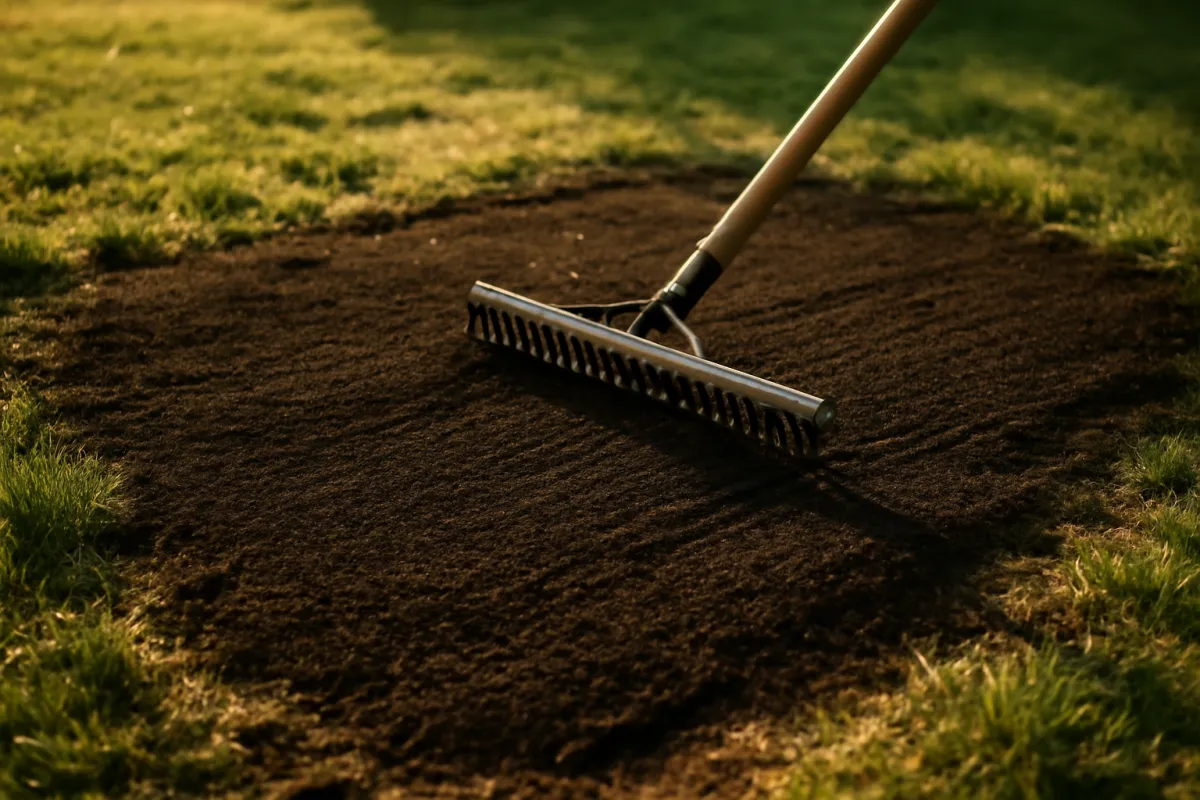
Grading matters as much as depth. Sod is thin and it does not hide anything, so every hollow you leave becomes a hollow in the finished lawn and every high spot gets scalped by the first mow. Rake, firm, water lightly and rake again until the surface is even, then check that it falls away from the house rather than toward it. Doing that work with pallets already on the driveway is how it gets skipped.
Do not order sod before the ground is ready
This is the caution worth repeating on its own, because it is the mistake that turns a well calculated order into wasted money. Book the delivery only when the soil work is finished, not when it is planned, and preferably when you have walked the graded surface and found nothing left to fix.
The failure runs the same way every time. Someone measures the yard, does the arithmetic correctly, books six pallets for Saturday, and then discovers on Thursday that the old lawn is harder to strip than expected, or the grade needs another few yards of soil, or the irrigation heads sit too high. The pallets arrive on schedule into a site that is not ready, and the choice is laying turf on unprepared ground or watching it deteriorate while the ground gets prepared. Both outcomes cost more than the delay would have.
The order that avoids this is: measure, calculate, prepare the soil completely, then call the grower with the square footage and book the earliest slot that suits. Your number does not go stale while the ground work happens, and the pallet coverage question can be asked at booking time. A calculation done in advance costs nothing to hold; a pallet of cut turf costs the whole pallet.
Sod versus seed on the quantity question
The comparison belongs in this manual because the quantity mathematics are so different that people carry habits from one to the other. Seed is sold by weight and applied at a rate per thousand square feet, so the order is area divided by 1,000 times the rate, and a modest overbuy is harmless because sealed seed keeps. Sod is sold by area and the order is area times waste over pallet coverage, and an overbuy perishes.
The waste concept diverges too. Seed has no cut waste at all, because it does not come in rectangles, so a curved bed edge costs nothing extra in seed and a meaningful percentage in sod. That is a genuine cost difference the shape of your yard drives, and on a heavily curved lawn it is one of the real arguments in the comparison rather than a rounding note.
What both share is the soil preparation underneath, and the same square footage figure feeds either decision. So measure once. If you get the net area right, you can price seed and sod against each other on the same basis, and if you switch after pricing, the measuring work carries over intact. Only the last two lines of the arithmetic change.
Where a sod estimate goes wrong
The failure patterns repeat, and they sort neatly by cost. The most expensive is using a remembered pallet coverage instead of the supplier’s, because it is an error of whole pallets rather than percentages. A lawn calculated at 450 square feet a pallet and delivered from a farm that ships 400 arrives short by a pallet, on a day when the ground is open and the labour is booked.
Next is the perimeter blindness: applying a flat 10 percent to a lawn that is mostly edge, such as a set of narrow strips around a driveway, and running out at the last band. Then the deduction errors, which cut both ways, either measuring the outline and forgetting the patio so a pallet is surplus, or deducting a bed that is being removed and turfed over so the order is short.
The softer misses are scheduling rather than arithmetic. Ordering before the grading is finished, booking a delivery on a day nobody can lay it, planning a self haul against a payload the vehicle does not have, and forgetting that a forklift needs somewhere firm to stand. And the quiet one: treating an old measurement as current after a bed was widened or a patio extended. Walk it again before you order, because the tape is free and the pallet is not.
Your sod order checklist
The whole manual compressed into the sheet worth keeping in the car.
- Sketch and measure in pieces. Rectangles as length times width, triangles as half base times height, circles as pi times radius squared, and write the perimeter of each piece down as you go.
- Deduct honestly. Patio, drive, beds, tree rings, paths, pads and the house footprint if you measured to the walls. Sum the deductions and subtract once.
- Set the waste allowance from the shape. Roughly 5 percent for straight edged rectangles, 10 for mixed straight and curved, 15 for heavily curved, and 15 to 20 for narrow strips.
- Call before you convert. Ask the grower three things: pallet coverage in square feet, the piece dimensions, and an approximate weight per pallet.
- Do the division last. Square feet to order divided by their pallet coverage, rounded up to whole pallets, then cross-check by the piece count.
- Plan the weight. Pallet coverage times the weight per square foot gives pounds; compare that against your vehicle placard before assuming a self haul is possible.
- Finish the soil first. Grade, amend, rake and firm, then book the delivery for the day you can lay all of it.
Work the list top to bottom and the truck arrives on the right day with the right number of pallets, onto ground that is ready for them.
The bottom line
The sod question has one reliable answer and one unreliable shortcut. The reliable answer is square footage: measure the lawn in pieces, deduct what is not getting grass, add a waste allowance sized to the perimeter rather than the area, and you have a number that is true regardless of who you buy from. The unreliable shortcut is a remembered pallet figure, because pallet coverage is a farm’s packing decision and it ranges widely enough to move the same 2,602 square foot order between 4 and 7 pallets.
Then respect the two constraints that make sod unlike everything else on this site. It is heavy, so a 450 square foot pallet near 2,025 pounds decides your delivery access and rules out most self hauls. And it is alive, so it goes down within about a day of harvest, which means the soil work comes before the order rather than after it. Run your own dimensions through the estimator, work the ground preparation with our topsoil manual, borrow the perimeter reasoning from our paver manual, and read our material estimating method for the coverage logic that carries across every product. Buy from a measured lawn and a supplier’s own figures, not from a number you half remember.
Treat this as yard-side arithmetic rather than an agronomic or engineering prescription. Every coverage figure, pallet size, piece dimension, weight per square foot, waste percentage and laying rate above is an illustrative worked example chosen to show the method, and your grower, your grass type, your region and the week’s weather will each move the real numbers. Pallet coverage and roll dimensions in particular are supplier-specific and must be confirmed with the farm before you convert anything. Delivery access, vehicle payload and lifting are safety matters, not just logistics, so check your own ratings and get help with the weight. Where drainage, grading against a foundation, irrigation or a retaining structure is involved, have a qualified landscaper or soils professional look at the plan before the turf is cut.
Frequently asked questions
How much sod do I need for my lawn?
Work out the square footage of the area you are turfing, add a waste allowance for cuts, then divide by the coverage of the pallet your grower actually ships. Break the lawn into rectangles, triangles and circles, add those areas, subtract the beds, paths and hard surfaces, and you have the net figure. A yard measuring 2,610 square feet gross with 245 square feet of beds, patio and path deducted is 2,365 square feet net, and a 10 percent allowance takes the order to 2,602 square feet. Only then does the pallet arithmetic begin, because a pallet is not a fixed size.
How many square feet does a pallet of sod cover?
There is no universal answer, which is the single most useful thing to know about ordering sod. Pallet coverage varies by grower and by region, and figures anywhere from roughly 400 to 700 square feet are all in circulation. That spread is not trivial: an illustrative 2,602 square foot order is 7 pallets at 400 square feet each, 6 at 450 or 500, 5 at 600 and 4 at 700. Ask the specific supplier what one of their pallets covers before you convert anything, and treat every remembered number, including the ones in this manual, as a placeholder for theirs.
How many rolls or slabs of sod are on a pallet?
It follows from the piece size and the pallet coverage, so both have to come from the same supplier. A common rectangular slab measures about 16 by 24 inches, which is 384 square inches, or 384 divided by 144, about 2.67 square feet each. A pallet quoted at 450 square feet therefore holds roughly 450 divided by 2.67, about 169 of those slabs. Growers who ship 2 by 5 foot rolls at 10 square feet apiece would put about 45 on the same pallet, and big rolls change the count again.
How much waste should I add to a sod order?
Cut waste happens along the edges, so it tracks the perimeter rather than the area. An illustrative starting point is around 5 percent for a plain rectangle with straight edges, 10 percent for a lawn with a mix of straight runs and gentle curves, and 15 percent where curved beds, tree rings and islands dominate. Narrow strips and boulevard bands deserve 15 to 20 percent, because a 3 by 40 foot strip carries roughly eight times the perimeter per square foot that a 60 by 38 foot lawn does. These are planning figures rather than guarantees, so treat them as a floor.
How much does a pallet of sod weigh?
Enough to change how you take delivery. Using an illustrative 4.5 pounds per square foot for moist freshly cut turf, a 450 square foot pallet works out near 2,025 pounds, just over a ton. Moisture swings that a long way: the same pallet is nearer 1,575 pounds at an illustrative 3.5 pounds per square foot when the soil is on the dry side, and can approach 2,700 pounds at 6 pounds per square foot after heavy irrigation or rain. Ask your grower for their own weight per pallet, because harvest depth and watering practice both move it.
Can I haul sod in a pickup truck?
Far less of it than most people expect. A light pickup with an illustrative 1,500 pound payload rating carries about 1,500 divided by 4.5, roughly 333 square feet of moist sod, which is around three quarters of a single 450 square foot pallet. Wet turf cuts that further, to nearer 250 square feet at 6 pounds per square foot. Check the payload figure on your own vehicle's door placard rather than trusting the half ton nickname, which describes an old rating convention and not the truck in your driveway.
How long can sod sit on the pallet before I lay it?
Not long, and this is what makes sod unlike every other material this site covers. Cut turf is living plant tissue stacked in an airless pile with its roots severed, and it begins heating and yellowing from the inside almost immediately. Common practice is to lay it within about a day of harvest, and sooner in hot or windy weather, which is why the order date and the ground preparation date have to be planned together. Gravel and topsoil can sit in a driveway for a month; sod cannot sit for a weekend.
How much topsoil do I need under new sod?
Sod arrives with only a thin skin of soil attached, so the growing medium underneath is what the roots have to knit into. Using the standard volume line of area times depth in inches divided by 324, an illustrative 2 inch topsoil layer over 2,365 square feet is 2,365 times 2 divided by 324, about 14.6 cubic yards. At 1 inch it is 7.3 and at 3 inches it is 21.9, since depth is a straight multiplier. Grade, amend and firm that soil before the sod is even ordered, because the delivery clock starts the moment the turf is cut.