What's on this page
- Setting versus curing: two different clocks
- What hydration actually does inside a slab
- Initial set: when concrete stops being liquid
- Final set: when it stops being workable
- The finishing window between the two sets
- The first 24 hours, hour by hour
- When can you walk on new concrete?
- When can you drive on a new slab?
- When can you build on it?
- The strength curve a young slab climbs
- Where the strength gain actually arrives
- Why 28 days became the reference age
- Curing is a job, not a wait
- How long to keep concrete moist
- Curing methods and what each one buys
- Temperature: the dial that moves every number
- Cold weather: the clock stretches, then stalls
- Hot weather: fast is not the same as good
- Humidity, wind, and sun on the surface
- Thickness, mix, and admixtures move the dates
- When the forms can come off
- Sealing, painting, and covering: the later dates
- Worked example: a 12 by 20 patio slab, hour by hour
- Curing myths that quietly cost strength
- Signs the cure went wrong
- The cure schedule to write on the plan
- The bottom line
Concrete does not dry into strength, it grows into it, and the two ideas run on completely different clocks. A slab can be firm enough to stand on the morning after a pour and still be a young material with most of its strength ahead of it, and it can look finished, feel cold and hard, and be losing that future strength quietly because someone stopped keeping it damp on day two. The question in the title has four separate answers depending on whether you mean when it stops flowing, when it stops taking a finish, when you can put weight on it, or when the chemistry has done most of what it will ever do.
This manual is the timeline half of our concrete series, and it works through those milestones in order: initial set, final set, the finishing window between them, the first day hour by hour, foot traffic, vehicles, the 28 day reference age, and the long tail after it. It also covers the two things that move every date, temperature and moisture, and explains why curing is an activity rather than a waiting period. The pour itself lives in our slab pouring tutorial, the ordering math lives in our concrete volume manual, and the weather side is worked in detail in the cold and rain rules. Every number below is a commonly cited planning figure, deliberately illustrative, because the mix your supplier sends owns the real schedule. The companion below puts your own slab and temperature against the same timeline as you read.
Key takeaways
- Setting and curing are different events. Initial set is commonly cited at roughly 1 to 3 hours and final set at roughly 4 to 8 hours at moderate temperature, while curing is the deliberate act of holding moisture, normally planned for about 7 days.
- Concrete hardens by hydration, a chemical reaction that consumes water, not by drying. Water leaving early stops the strength gain permanently at whatever level was reached.
- Common planning figures are roughly 24 to 48 hours before careful foot traffic and roughly 7 days before ordinary passenger cars, but real loading dates belong to the mix design and the engineer, not a chart.
- The 28 day mark is a testing convention, not a finish line. Most of the practical strength gain lands in the first week, which is why the first week gets all the protection.
- Temperature is the dial that moves everything: cold stretches every interval and can stall the reaction, heat compresses the finishing window and dries the surface before curing can start.
Setting versus curing: two different clocks
The confusion behind most cure time questions is that one word is doing two jobs. Setting is the short-term change from a placeable, plastic material into a rigid solid, and it happens over hours. Curing is the maintenance of moisture and temperature that lets the chemistry keep running afterward, and it happens over days and weeks. A slab that has set is not a slab that has cured. It has merely stopped being liquid, which is the beginning of the useful part rather than the end.
Reading the two clocks separately fixes almost every practical decision. Questions about finishing, edging, jointing, and covering belong to the setting clock and get answered in hours. Questions about strength, walking, driving, forms, sealing, and cracking belong to the curing clock and get answered in days. When someone asks how long concrete takes to cure and means when can I take the forms off tonight, they are mixing the two, and the answer they get will be wrong in a way that costs either a ruined finish or a chipped edge. Keep the clocks apart and the timeline below reads as a sequence rather than a single mysterious wait.
What hydration actually does inside a slab
Cement is not glue that dries. It is a set of compounds that react with water to grow new crystalline products, and those interlocking crystals are what lock the sand and stone into a solid. Our cement and concrete explainer covers the ingredient side of that relationship, but the timing consequence is the part that matters here: the reaction needs water present to continue, generates heat while it runs, and slows down as the growing crystals make it harder for water to reach the unreacted cement still buried inside each grain.
That last detail explains the shape of every curing chart ever drawn. Early on, water and cement meet easily and the reaction sprints, which is why a slab goes from soup to solid in hours and gains a large share of its strength in days. Later, the remaining unreacted cement is wrapped in reaction product, so water reaches it slowly, and strength gain becomes a long, flattening tail. Nothing switches off. The slab under your feet in a ten year old garage is still, in a small way, hydrating wherever moisture and unreacted cement are in contact. The curve flattens; it does not terminate.
Initial set: when concrete stops being liquid
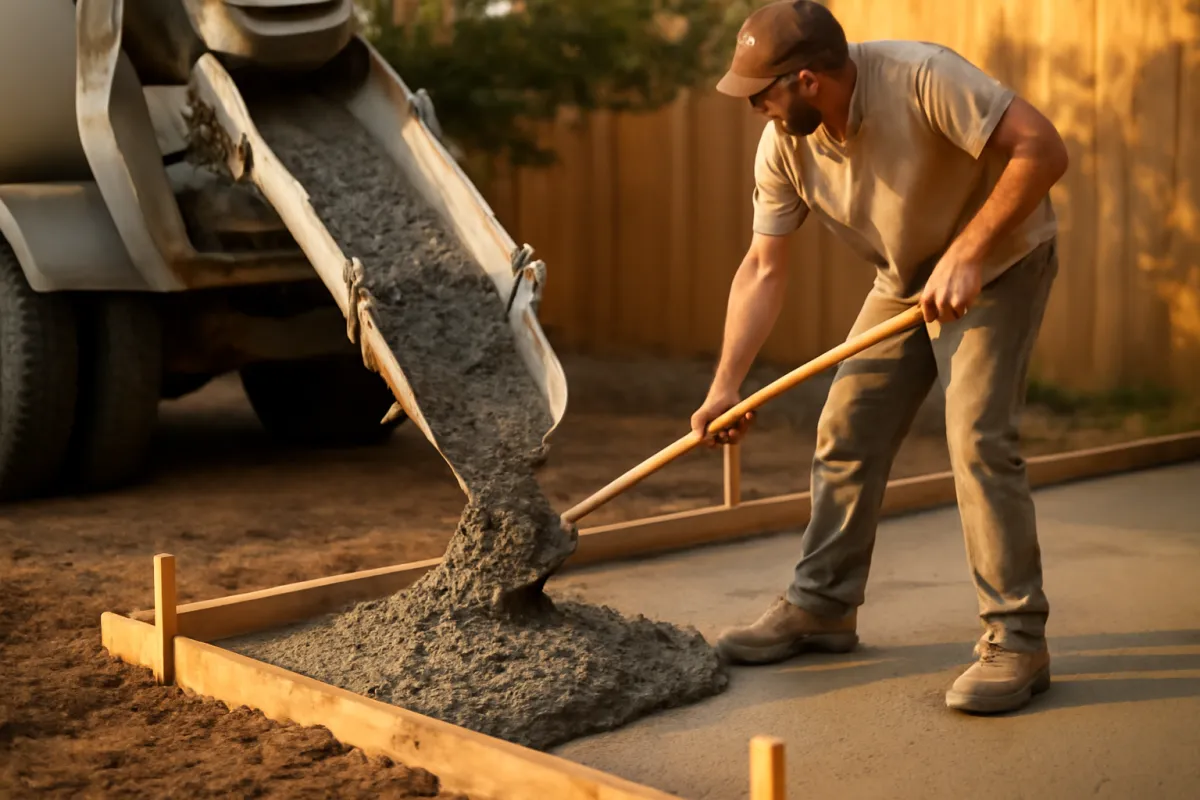
Initial set is the moment the mix stops behaving as a fluid you can place and consolidate. Before it, concrete can be moved, vibrated, screeded, and rearranged. After it, moving the material breaks the structure that has begun to form. The commonly cited window is roughly 1 to 3 hours after mixing at moderate temperature, and the practical signal on a slab is that bleed water has risen and evaporated and a footprint leaves a shallow, firm impression rather than a puddle.
Initial set governs the whole placing sequence. It is why ready-mix trucks have a delivery window rather than a delivery time, why you place the far corner first and work back toward the chute, and why adding water on site to loosen a stiffening load is such a costly habit: it buys workability by permanently lowering strength, a trade our mixing manual argues against in detail. On a hot, windy day this window compresses hard, and crews respond by pouring at dawn, ordering smaller loads, and putting more hands on the placing end. On a cool day it stretches, and the crew stands around waiting for bleed water to leave so floating can start.
Final set: when it stops being workable
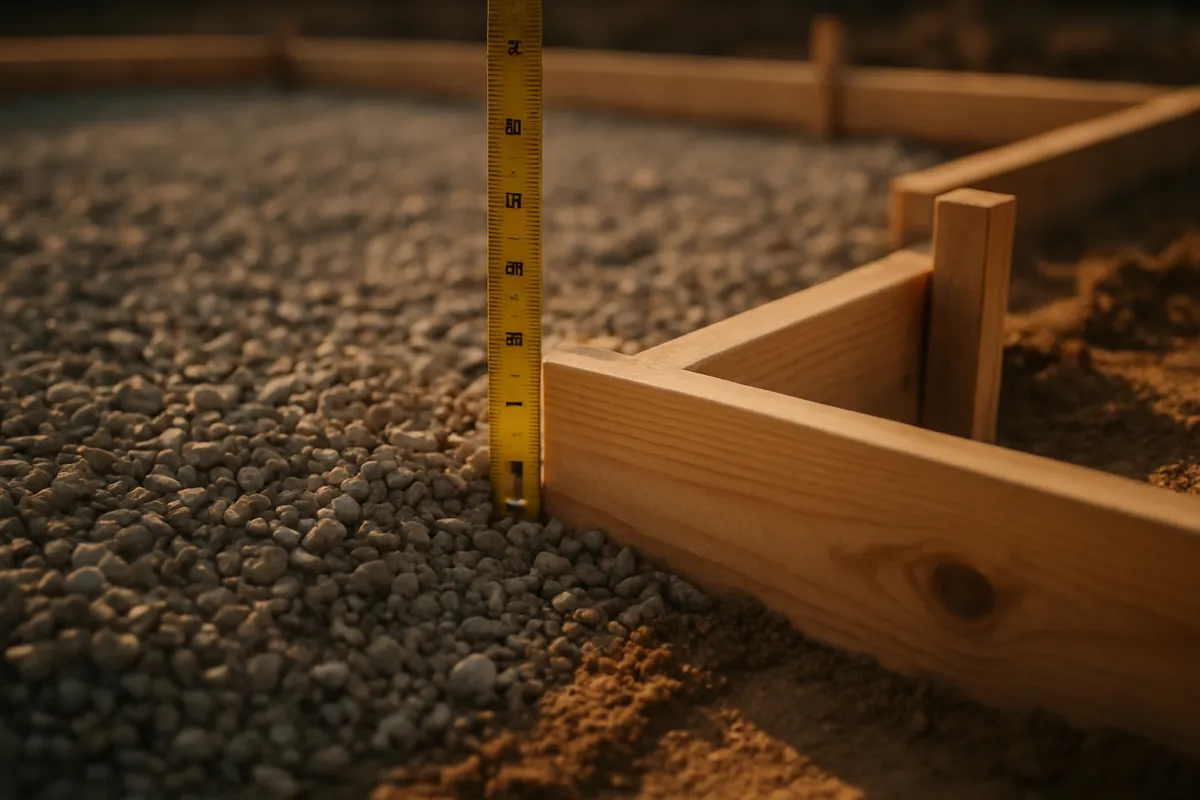
Final set is the point at which the concrete has become a rigid solid throughout and will no longer respond to finishing tools. Commonly cited as roughly 4 to 8 hours after placing at moderate temperature, it is the closing of the door on troweling, edging, jointing, and broom finishing. Everything the surface will ever look like is decided between initial and final set, which is why finishing crews watch the surface rather than the clock and why an under-crewed pour on a hot day produces a slab with a beautiful start and a rough finish.
Final set is also when the concrete starts to be able to support its own weight and hold its shape without formwork help, though not when it can carry anything else. Confusing that with load capacity is a classic mistake: a slab at final set has essentially no strength to its name, in the sense that matters for loads. What it has is rigidity. It will hold a broom mark, hold an edge, and hold water on its surface, and it is now ready for the thing that decides its future, which is curing cover. In practical terms, final set is not a milestone you celebrate, it is the alarm telling you to start protecting the slab.
The finishing window between the two sets
The gap between initial and final set is the entire finishing window, and reading it correctly is the difference between a durable surface and a weak one. The sequence inside it is fixed: screed level while the mix is plastic, wait for bleed water to rise and leave, then float to close the surface, then edge and cut joints, then trowel or broom to the final texture. The waiting step in the middle is the one that gets skipped, and skipping it is how bleed water gets worked back into the top layer, producing exactly the weak, dusty skin our crack causes explainer blames for so much surface failure.
Temperature stretches or squeezes this window without warning. On a cool, overcast day it can run long enough that a crew finishes late into the evening waiting for the surface to be ready. On a hot, windy day the whole window can collapse to a fraction of that, with the surface crusting while the middle is still soft, which forces the awkward choice between finishing too early and finishing too late. This is the practical reason the pour day weather rules matter more than any other scheduling input: weather does not just make the job uncomfortable, it resizes the only window you get.
The first 24 hours, hour by hour
Laying the first day out in sequence makes the timeline concrete. Hour zero is placement, spreading and screeding while the mix is fluid. Somewhere in the first hour or two, bleed water rises to the surface and has to be allowed to evaporate rather than worked in. Around the initial set mark, commonly cited at roughly 1 to 3 hours, the surface firms enough to support floating, and the finishing sequence runs from there. By roughly 4 to 8 hours in, final set has arrived, finishing is over, and the surface should be under curing protection.
The rest of day one is quiet and decisive. The concrete is generating its own heat, gaining strength faster than at any later point, and losing moisture to the air if nothing stops it. This is when a curing blanket, plastic sheet, wet burlap, or curing compound earns most of its value, and when a slab left bare in sun or wind pays a permanent penalty. It is also the window in which a freeze does real structural damage, which the cold weather rules cover in detail. Nothing needs to be done on day one except protecting what was placed, which is precisely why it gets neglected.
When can you walk on new concrete?
Roughly 24 hours is the figure most crews plan around at moderate temperature, with 48 hours the common answer when the weather is cool or the mix is slow. Careful foot traffic means soft-soled shoes, a straight walk rather than a pivot, and nothing dragged, rolled, or dropped. The reason for the caution is not that the slab will break under a person. It is that the top layer is still tender, and a scuff, a heel dent, or a dragged ladder foot in the first day becomes a permanent feature of the surface.
The honest test outranks the clock in both directions. Press a thumb hard into an inconspicuous corner: a mark, a chalky feel, or any give means wait, no matter what hour it is. A cool overnight can easily double the wait, an accelerated mix or a warm day can shorten it, and a slab poured in the afternoon has its critical hours at night when nobody is checking. Since the cost of waiting is a few hours and the cost of walking early is a blemish you look at for twenty years, the tie goes to patience. Route any question about equipment or loads on the surface to the supplier’s mix data rather than to a rule of thumb.
When can you drive on a new slab?
Roughly 7 days is the common planning figure for ordinary passenger cars on a properly designed residential slab at moderate temperature, and plenty of contractors ask for 10 or 14 days in cool weather, because the strength curve runs on maturity rather than on dates. That figure assumes an appropriate thickness, a compacted base, and reinforcement suited to the use, all of which are decided long before the cure clock starts. Our driveway thickness and slab math and the rebar spacing manual cover the design side that this date silently depends on.
Heavy vehicles are a separate question and should be treated as one. A loaded delivery truck, a dumpster on rollers, a concrete pump, a skid steer, or a car hauler applies point loads that can crack a slab which carries a sedan without complaint, and no calendar answer covers that. This manual will not tell you a slab is safe to load at a given hour, because the honest inputs are the mix design, the actual load, the thickness, the reinforcement, the base, and the temperature history, and only your supplier and a qualified engineer can put those together. Ask the plant what strength the mix is designed to reach and when, then ask an engineer whether the slab suits the load.
When can you build on it?
Building on concrete, meaning setting walls, posts, columns, or anything that transfers structural load into it, is where the calendar stops being a useful instrument entirely. The relevant question is not how many days have passed but what strength the concrete has actually reached, which depends on the mix, the curing conditions, and the temperature history, and which is measured rather than assumed. On jobs where it matters, that measurement is exactly what happens: test cylinders are cast from the same load and broken at intervals to certify the strength before anything is loaded.
For residential work, the practical route is short. Footings, piers, and anything holding up a structure belong to the building department’s inspection schedule and to whoever designed the assembly, and the wait between pour and framing is a specification, not a preference. Even a fence post, worked through in our post setting tutorial, benefits from letting the concrete gain real rigidity before the panel loads it in the wind. The generalized answer this page can honestly give is that the 28 day reference age exists because it is when a mix is conventionally expected to have reached its design strength, and that anything structural should be timed by that specification and the inspector, not by feel.
The strength curve a young slab climbs
The whole timeline is really one curve seen from different angles. Here is the commonly cited shape of the climb, expressed as a share of the strength a mix is conventionally expected to reach at 28 days.
Illustrative strength gain by age
Share of the 28 day reference strength for continuously cured concrete at moderate temperature; rules of thumb, not a measurement of any particular mix.
Each bar's width equals its illustrative percentage of the 28 day reference. These are widely used planning conventions rather than values for your mix, and temperature moves them a long way in both directions. The shape is the lesson: almost nothing exists on day 1, half the climb is done by day 3, and the curve is flattening well before the reference age arrives.
Read left to right, the curve explains the milestones. Day 1 has so little strength that foot traffic is a surface question rather than a structural one. By day 3 the slab has real substance, which is why forms usually come off in that neighbourhood. By day 7 it has most of what the first month will give, which is why the driving figure sits there and why curing is planned for that span. After that the gains are real but slow, which is why nothing on a residential job waits for day 28 except coatings and structural loading.
Where the strength gain actually arrives
Flip the same curve around and ask a different question: of all the strength gained in the first 28 days, what share arrives in each stretch? The answer is the reason curing effort is front-loaded.
Share of the 28 day strength gain, by phase
Illustrative split derived from the curve above; the four phases sum to 100 percent of the gain to the reference age.
The segments are the differences between the illustrative percentages in the previous chart, so the two charts tell the same story twice: 20, then 50, then 70, then 100. Seventy percent of the climb happens inside the first week, in the same seven days when a slab is most vulnerable to drying out and freezing. That coincidence is the entire argument for curing.
Why 28 days became the reference age
The 28 day figure is a specification convention rather than a property of concrete. Mixes are ordered and tested against a compressive strength at a stated age, and 28 days became the standard age because it captures most of the practical strength gain while still fitting inside a construction schedule. Test cylinders cast at the truck are cured under controlled conditions and broken at that age to confirm the load delivered what was ordered. That is the entire meaning of the number: it is when the mix is checked.
Two things follow, and both get misread. First, 28 days is not when concrete finishes. Hydration continues for months and years wherever unreacted cement and moisture meet, and a slab kept damp keeps climbing past the reference age along a flattening curve. Second, the reference strength assumes the concrete was cured, so a slab that was allowed to dry out on day two will not reach its rated strength at day 28 or ever, because the reaction stopped when the water left. This manual will not attach a specific strength value to a specific day for your slab, because that number belongs to your mix design and your supplier’s data, but the shape and the mechanism above hold generally.
Curing is a job, not a wait
The most expensive misunderstanding in residential concrete is treating curing as a period rather than a task. Nothing about the passage of time helps a slab. What helps is the presence of water inside it, and the default behaviour of a fresh slab in open air is to lose that water to evaporation from the top surface, which is also the surface that has to survive tires, freeze cycles, and de-icing salt for decades. Every curing method that exists does one of two things: it stops water leaving, or it adds water back.
The practical shape of the job is simple and short. As soon as the finish will not be marked, cover the slab or apply a curing compound, and keep it that way for the planned span. The methods below trade convenience against effectiveness, but the choice matters less than the continuity, and any curing beats a slab left bare. This is also the cheapest quality lever on the entire pour. Ordering the right yardage with our volume manual or the estimator costs money, thickening the slab costs money, and covering the slab costs an afternoon and a roll of plastic while protecting the strength everything else paid for.
How long to keep concrete moist
About 7 days is the standard planning span for ordinary residential flatwork at moderate temperature, and the reason is visible in both charts above: roughly seventy percent of the first month’s strength gain happens inside that week. Curing past it still helps, on a diminishing curve, and stopping short of it costs more than most people imagine, because the loss lands on the surface layer where evaporation is fastest and where durability matters most.
Cool weather argues for a longer span, commonly cited around 14 days, not because the concrete needs more days in principle but because it accumulates maturity more slowly, so more calendar days are required to reach the same point on the curve. Hot, dry, or windy weather does not shorten the span so much as raise the urgency: moisture leaves faster, so covering has to start sooner and be maintained more actively. The one genuinely counterproductive pattern is intermittent curing, wetting a slab in the morning and letting it bake dry by noon, which interrupts the reaction and adds wetting and drying stress to a surface that has none to spare.
Curing methods and what each one buys
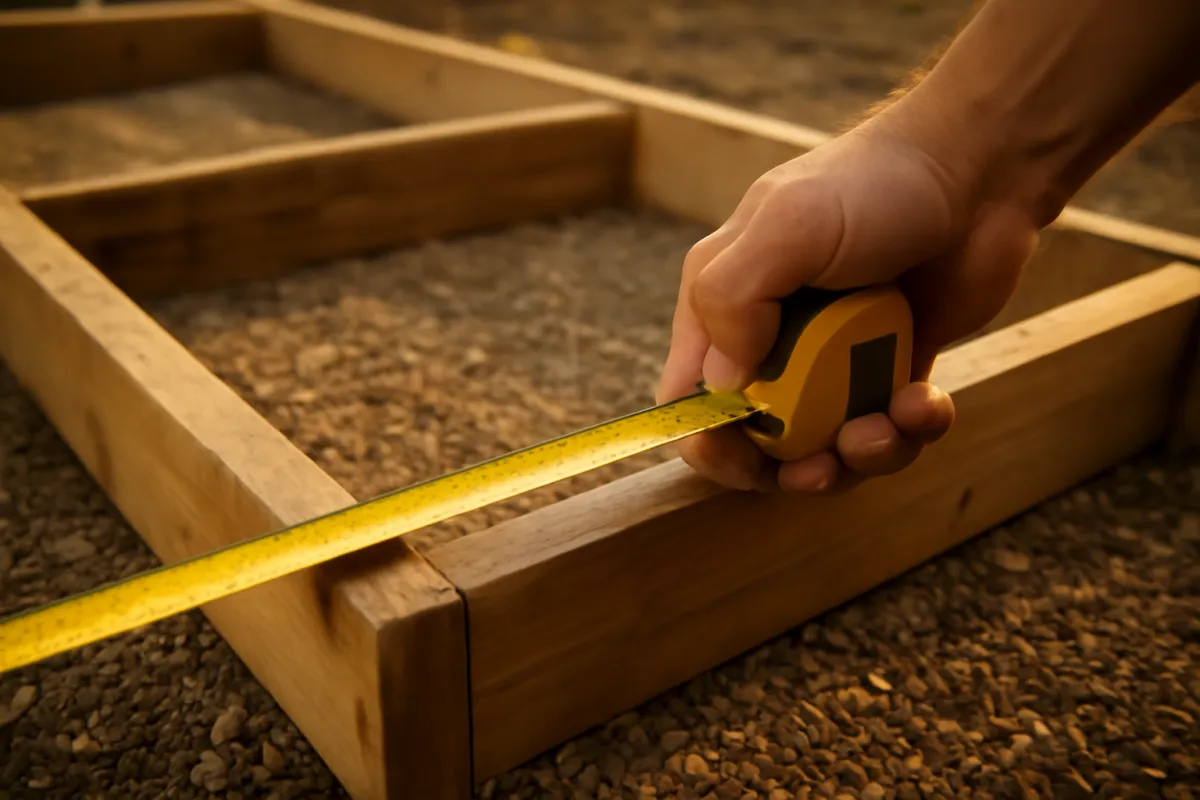
Plastic sheeting is the common residential answer, and it works by trapping evaporating moisture against the surface. Lay it as soon as the finish is hard enough not to mark, overlap seams generously, and weight the edges so wind cannot lift it. The known drawback is mottling: where plastic touches unevenly, the surface can cure to slightly different shades, which matters on decorative work and not at all in a garage. Wet burlap, or any absorbent cover kept damp, avoids the blotching and cures beautifully, at the cost of needing to be rewetted so it never dries out.
Curing compounds are the sprayed alternative, forming a membrane that slows evaporation, and they are the practical choice on large pours where covering is impractical. They are also a compatibility question: some compounds interfere with later coatings and adhesives, so check the product against whatever sealer or floor covering is planned, a point our sealer types explainer picks up. Ponding and continuous sprinkling are the strongest methods and the least convenient. Insulating blankets belong to cold weather, where they hold in the concrete’s own heat as much as its moisture. The ranking matters less than the commitment: pick one and keep it going for the whole span.
Temperature: the dial that moves every number
Every figure in this manual assumes moderate temperature, and temperature is not a minor adjustment to those figures, it is the dial that moves all of them at once. Hydration is a chemical reaction, and chemical reactions run faster when warm and slower when cold. A widely used planning approximation is that the pace roughly doubles for a substantial rise in temperature and roughly halves for the same fall, which is why a slab that reaches final set in an afternoon during summer can still be soft that evening in spring.
The important consequence is that concrete keeps time in maturity, not in days. Two identical slabs poured on the same morning in different climates are at different points on the same curve by nightfall, and the cooler one stays behind for the rest of the schedule. That is why every date on this page has to be read as conditional, why the honest test always beats the clock, and why the commonly cited cool weather figures for foot traffic and driving run roughly double the moderate weather ones. It is also why nobody can give you a real loading date without knowing your temperature history, and why the mix data and an engineer are the correct destination for that question.
Cold weather: the clock stretches, then stalls
Cold does two distinct things, and they are worth separating. The first is benign and merely inconvenient: everything takes longer. Bleed water lingers, finishing runs late, initial and final set drift out, forms stay on longer, and the whole strength curve shifts right. A crew that expected to be home by mid afternoon finishes at dusk. Nothing is damaged; the schedule is just wrong.
The second is not benign. As temperature falls further the reaction slows toward a crawl, which extends the period during which the slab is weak, and if the water inside young concrete freezes it expands inside a material with almost no strength to resist it, breaking the structure as it forms. That damage does not heal with later warm weather. The commonly cited planning threshold, the protection methods, blankets, warm mix water, accelerators, and the rule against pouring on frozen ground are all worked through in our cold weather and rain manual. What belongs here is the timeline consequence: cold does not just delay the dates, it lengthens the window in which a freeze can cause permanent harm. Local practice and your ready-mix supplier own the actual thresholds for your climate, and the building department owns anything structural.
Hot weather: fast is not the same as good
Heat is often assumed to be concrete’s friend because everything happens sooner, and the assumption is half right in a way that causes real damage. Warm concrete does gain early strength faster. It also sets faster, which compresses the finishing window, and it loses surface moisture faster, which is the actual problem. A slab whose surface dries while the interior is still plastic develops plastic shrinkage cracks, the fine random cracking that can appear before the crew has finished the broom pass.
There is also a longer-term trade. Concrete cured hot tends to gain early strength quickly and end up somewhat lower at the reference age than the same mix cured at moderate temperature, because the fast early reaction builds a less uniform structure. The practical hot weather playbook is about buying back time and moisture: pour early in the day, dampen the subgrade so it does not drink from the mix, keep the working face small, put more hands on finishing than the area seems to need, and start curing cover the moment finishing allows. Retarding admixtures exist for exactly this and are a conversation with the plant, not a jobsite improvisation.
Humidity, wind, and sun on the surface
Air temperature gets the attention, but the surface of a slab answers to a combination, and wind is the underrated member of it. Evaporation from a fresh surface rises with air temperature, rises with concrete temperature, rises sharply as relative humidity falls, and rises sharply with wind speed. A dry, breezy day at a comfortable temperature can pull moisture out of a surface faster than a still, humid, hot one, which is why plastic shrinkage cracks turn up on spring pours that felt pleasant to work in.
The practical reading is to treat the four factors as a single risk score rather than checking the thermometer alone. Sun on the surface raises the concrete’s own temperature well above the air’s, wind strips the humid boundary layer that would otherwise slow evaporation, and low humidity gives the water somewhere to go. Windbreaks, temporary shade, fogging above the surface rather than onto it, and simply starting the pour at dawn all attack the same variable. Once curing cover is on, the whole problem largely disappears, which is another argument for getting it on as early as the finish permits.
Thickness, mix, and admixtures move the dates
The concrete itself changes the timeline as much as the weather does. Cement content and cement type set the pace of the reaction, so a mix specified for early strength gets to any given milestone sooner than a general purpose one. Water content matters in the other direction: a wetter mix takes longer to set, bleeds more, and ends up weaker, which is the trade our mixing manual spends its time arguing against. Supplementary materials such as fly ash or slag typically slow early strength gain while improving the long-term result, which is a genuine schedule consideration and not a defect.
Thickness plays a quieter role. A thick element holds the heat its own hydration generates, so it runs warmer inside and reaches milestones faster in the middle than at the surface, while a thin slab in cool air sheds that heat and lags. Admixtures then adjust the whole schedule deliberately: accelerators shorten set and bring early strength forward, retarders stretch the finishing window in heat, and water reducers buy workability without the water penalty. All of these are ordered, not added on site, which is why the timeline conversation belongs at the point where the load is booked. Ask the supplier what their mix does on your date, and size the order with the estimator.
When the forms can come off
Form stripping has its own answer, and for ordinary residential flatwork it usually lands in the first day or two, once the concrete is rigid enough that the edges will not slump or chip when the boards come away. Slab edge forms are the least demanding case because they hold shape rather than weight. Waiting a little longer costs nothing except the boards being tied up, and stripping too early damages exactly the edges that are most visible and most exposed to chipping later.
Anything that supports load while curing is a different category. Formwork and shoring under a suspended slab, beam, or anything spanning is holding the structure up until the concrete can hold itself, and that removal date is a specification set by whoever designed the assembly, timed on strength rather than on the calendar. This page will not offer a figure for it. For flatwork, the useful sequence is to strip the forms, backfill or protect the edges, and get the curing cover back over the slab, because the newly exposed edge is fresh surface that also wants to stay damp for the rest of the span.
Sealing, painting, and covering: the later dates
The last set of dates on the timeline has nothing to do with strength and everything to do with moisture leaving. Sealers, coatings, paints, tile adhesives, and floor coverings all need a surface that is not only hard but dry enough that vapor rising out of the slab will not push their film loose. Fresh concrete keeps releasing moisture long after it carries traffic, so coating products commonly specify a waiting period counted in weeks, often around the 28 day mark for a slab on grade, plus a moisture test before application.
Rushing that wait is the most common cause of peeling, bubbling, and cloudy sealer, and the failure usually shows up months later when the fix is a full strip and reapplication. The product’s own instructions govern, since the number varies by chemistry, and a moisture test governs above the calendar for interior floors and anything over damp ground. Our driveway sealing tutorial covers the application side and our sealer types explainer covers what each chemistry wants from the slab. The short version for a new pour: finish curing first, then wait for drying, then seal, in that order, never overlapped.
Worked example: a 12 by 20 patio slab, hour by hour
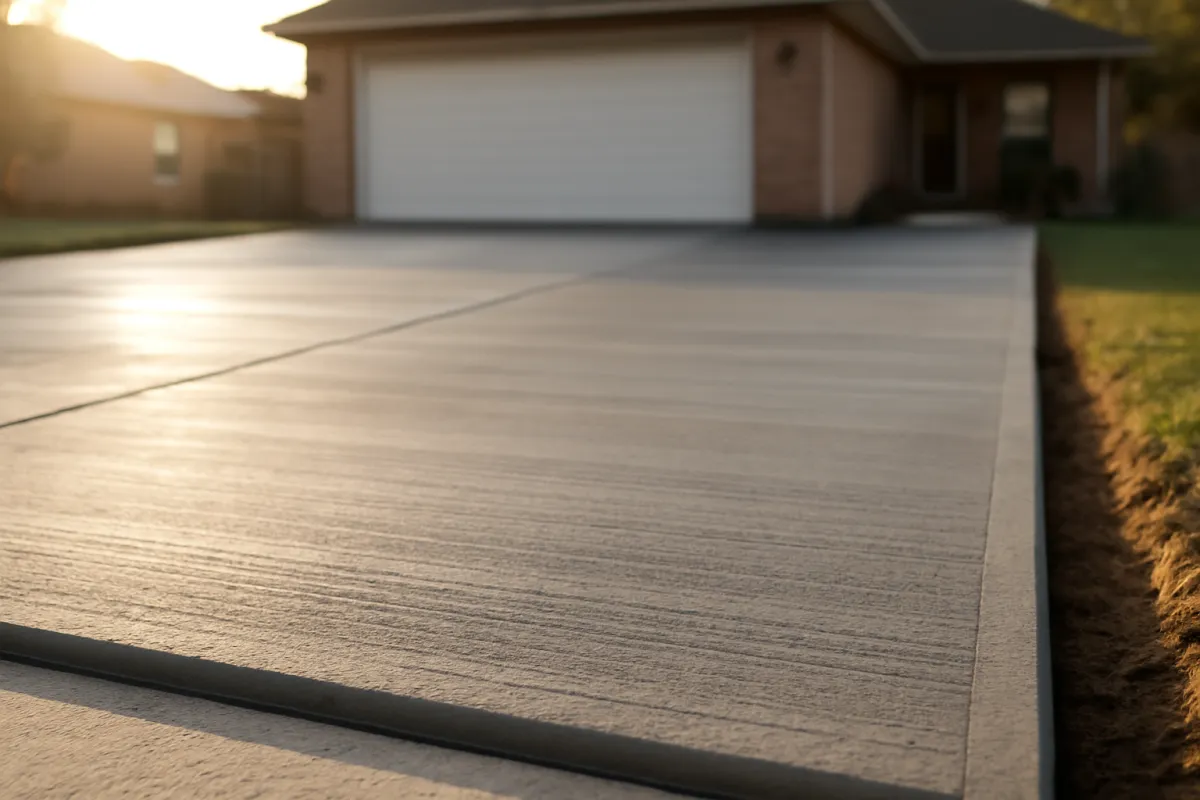
Take a 12 by 20 foot patio at 4 inches thick, placed at 8 in the morning on a moderate day near 70 degrees. The volume math from our slab calculation tutorial gives 240 square feet times 4 inches divided by 324, which is 2.96 cubic yards, so the order goes in at about 3.26 cubic yards with a ten percent allowance. That is the ordering half. The timeline half runs like this, with every figure illustrative.
Placing and screeding fill the first hour. Bleed water rises and is left alone. Around 10, roughly 2 hours in, the surface has firmed to initial set and floating starts, followed by edging, jointing, and the broom pass. By about noon, roughly 4 hours in, final set has arrived and finishing is over. Plastic goes down by early afternoon and stays down. The next morning, about 24 hours in, careful foot traffic is reasonable and the forms come off. The cover goes back on and stays until day 7, which is the point where the slab has climbed to roughly seventy percent of its reference strength and where furniture and ordinary use are commonly planned. The same slab poured at 50 degrees stretches all of that by roughly double: final set toward 8 hours, foot traffic nearer 48, and a curing span closer to 14 days. At 90 degrees the early hours compress to about half, final set nearer 2 hours, but the curing span does not shrink, because the drying risk is higher, not lower. The companion runs these same relationships on your own dimensions and temperature.
Curing myths that quietly cost strength
Four beliefs do most of the damage. The first is that concrete needs to dry, which reverses the actual chemistry and turns the correct action, keeping it damp, into an apparent mistake. The second is that rain on fresh concrete is always bad. Rain during finishing is genuinely destructive, but rain on a day old slab is free curing water, a distinction our weather manual draws carefully.
The third is that a little extra water in the mix is harmless because it evaporates anyway. It does evaporate, and it leaves behind the porosity it occupied, which is why added water is one of the most reliable ways to reduce strength and increase shrinkage cracking. The fourth is that a hard surface means a finished slab. Hardness arrives in hours, strength arrives over weeks, and the gap between those two facts is where premature loading, premature sealing, and abandoned curing all live. Add a fifth if you like: that heaters or fans help a slab cure. They warm and dry, and drying is the one thing a curing slab cannot afford, so they are used to warm the air around protected concrete, never blown across a bare surface.
Signs the cure went wrong
Interrupted curing leaves a recognizable signature, and it turns up weeks to months later rather than immediately. Surface dusting, where a fine powder comes off under a shoe or a broom, points to a weak top layer, usually from a surface that dried early or had bleed water worked into it. Scaling, where thin flakes lift off in patches, tends to show after the first freezing season and comes from the same weak skin. A network of fine random cracks that appeared in the first day is plastic shrinkage cracking, the surface drying and tearing while the concrete beneath was still soft.
Wider cracks that develop over weeks are a different mechanism, drying shrinkage restrained by the base or by the slab’s own geometry, and they belong to the jointing and layout discussion in our crack causes explainer. None of the surface defects are repairable in the sense of getting the lost strength back, though our crack repair tutorial covers stabilizing and sealing what is there. The lesson runs backward into the schedule: the defects you see in year two were mostly decided in the first week, by whether the slab was kept damp and whether it was loaded before it was ready.
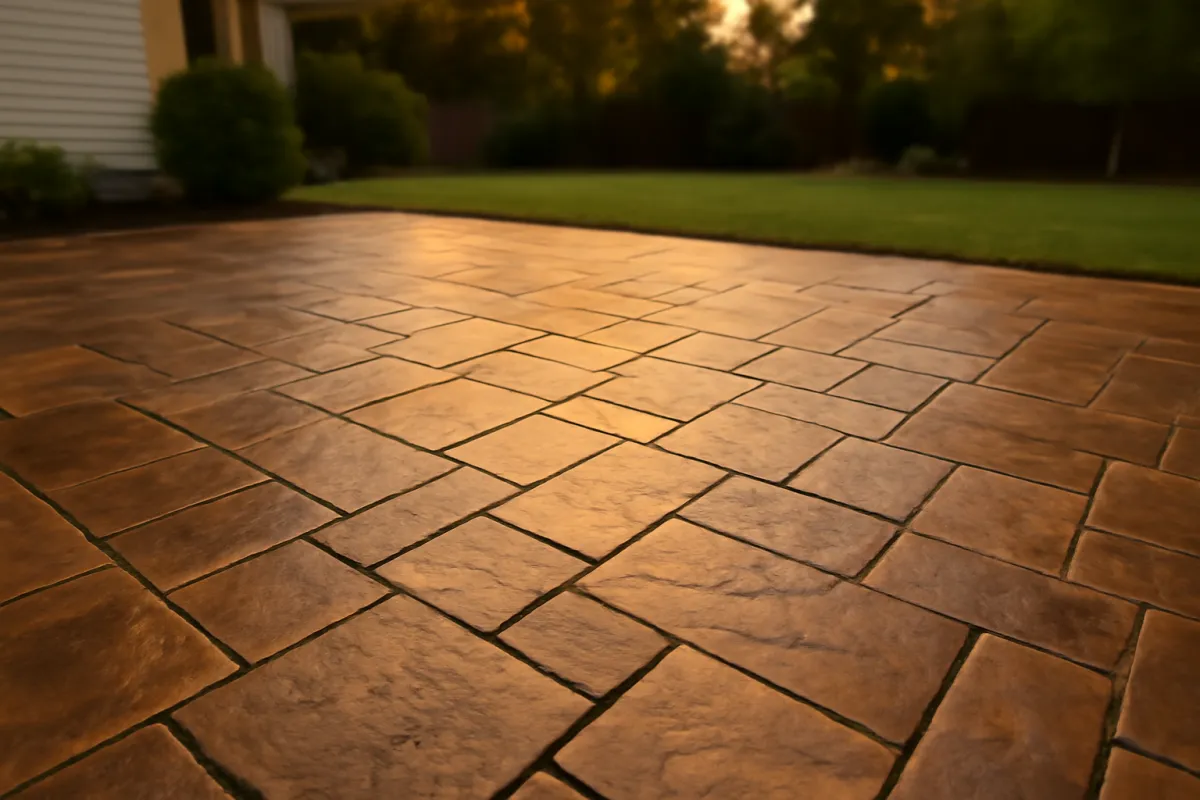
The cure schedule to write on the plan
Written down before the pour, the timeline turns into a short list of dated commitments rather than a series of judgment calls made while tired. Pour day: place, finish inside the window, and get curing cover on the moment the surface will not mark. Day 1: check the surface with a thumb before anyone walks on it, strip flatwork forms if the edges are firm, then put the cover back. Days 2 to 7: keep the cover in place or the compound intact, rewet absorbent covers so they never dry, and keep vehicles and equipment off entirely.
Day 7: the commonly cited point for ordinary passenger cars on a residential slab designed for them, and the end of the standard curing span at moderate temperature, extended to roughly 14 days in cool weather. Beyond that: normal use, with sealing and coatings waiting on their own product instructions, commonly around the 28 day mark plus a moisture test. Two lines belong at the bottom of the schedule as standing exceptions. Anything structural or heavy gets its date from the mix data, the engineer, and the building department rather than from this list. And every date on the list moves with temperature, so the thumb test and the surface itself outrank the calendar every time. Size the order with the estimator and the schedule is the only other page the job needs.
The bottom line
Concrete keeps four clocks and the trouble comes from reading one of them for all four. It stops being liquid at initial set, commonly cited at roughly 1 to 3 hours. It stops taking a finish at final set, roughly 4 to 8 hours. It is usually walkable in roughly 24 to 48 hours and commonly planned for ordinary cars around day 7. And it goes on gaining strength for weeks along a curve conventionally referenced at 28 days, running near 20 percent of that reference at day 1, half by day 3, and roughly seventy percent by day 7. Curing is what makes those numbers real: hydration only continues while water is present, so a slab kept damp for about 7 days climbs the curve and a slab left to dry stops where it stood. Temperature moves every one of those dates, cold stretching the schedule and heat compressing the finishing window while raising the drying risk, so the thumb on the surface always beats the number on the page. For the loads that matter, the mix data and an engineer own the answer, not a chart. The pour itself is the tutorial next door, the volume math sizes the order, and the cracking explainer covers what a lost week looks like later.
This manual explains how concrete gains strength over time and how weather and mix design move that timeline. It is educational reading, not a specification for your pour. The set times, curing spans, walk and drive figures, and strength percentages throughout are commonly cited planning conventions presented as illustrations, and the actual behaviour of the concrete in your forms is governed by its mix design, its thickness, its reinforcement, and the temperature history it experiences. Nothing here establishes that a slab is safe to load at any particular hour or day. Before driving equipment onto new concrete, backfilling against it, stripping structural formwork, or building anything on it, get the strength data from your ready-mix supplier and the loading decision from a qualified engineer, and follow your local building department over anything generalized on this page.
Frequently asked questions
How long does concrete take to cure?
It depends on which question you are really asking, because a slab passes four different milestones. It stops behaving like a liquid at initial set, commonly cited as roughly 1 to 3 hours after placing at moderate temperature. It stops being workable at final set, commonly cited around 4 to 8 hours. It is usually treated as ready for careful foot traffic after roughly 24 to 48 hours. And it keeps gaining strength for weeks, with 28 days serving as the conventional reference age for a mix's design strength. Curing, meaning the deliberate act of keeping the concrete moist and at a workable temperature, is normally planned as about 7 days. Every one of those figures is illustrative and moves with mix design, thickness, and weather, so treat your supplier's mix data as the authority for your pour.
Is curing the same thing as drying?
No, and the difference is the single most useful idea on this page. Concrete does not harden by drying out. It hardens because cement and water react chemically, a process called hydration, which builds interlocking crystals through the paste and glues the sand and stone together. That reaction consumes water and it can only continue while water is present. Concrete that dries early stops gaining strength, permanently, at whatever level it had reached. This is why curing means keeping a slab damp rather than letting it dry, why a sheet of plastic or a curing compound is a strength tool and not a housekeeping habit, and why concrete placed underwater still hardens perfectly well.
How long before you can walk on new concrete?
Around 24 hours is the figure most crews plan around at moderate temperatures, with 48 hours the common answer for cool weather or thicker, slower mixes. Careful foot traffic means soft shoes, no dragging, no pivoting, and no wheelbarrows or ladders. The honest test beats the clock: press a thumb hard into an inconspicuous corner, and if it leaves a mark or the surface feels chalky and soft, wait. A cool overnight low can easily double the wait, and an accelerated mix can shorten it. Since foot traffic on a surface that is still tender causes scuffs and dusting that never fully heal, waiting an extra half day costs nothing and protects the finish you paid for.
How long before you can drive on a new concrete driveway?
Roughly 7 days is the common planning figure for ordinary passenger cars on a properly designed residential slab at moderate temperature, and many contractors ask for 10 or 14 in cool weather. Heavy vehicles are a different question entirely: loaded trucks, dumpsters, concrete pumps, and equipment can crack a slab that would carry a car without complaint, because the load and the slab's thickness, reinforcement, and base matter more than the calendar. Nobody should give you an hour or a day from a chart for a real load. Ask the supplier what the mix is designed to reach and when, and put anything structural or heavy in front of an engineer.
What happens if concrete dries too fast?
Two things, and both are permanent. The chemical reaction stalls where the water left, so the surface layer never reaches the strength the mix was capable of, which shows up later as dusting, scaling, and poor wear resistance on exactly the quarter inch that takes all the traffic. And the surface shrinks while the concrete below it is still plastic, which tears the skin into plastic shrinkage cracks, the short random cracks that appear on windy, sunny pour days sometimes before finishing is even over. Wind is a bigger drying force than heat alone, which surprises people. The defense is the same in every case: get curing cover, moisture, or a curing compound onto the surface as soon as finishing allows.
Does concrete keep curing after 28 days?
Yes. The 28 day mark is a testing and specification convention, not a finish line. It is the age at which a mix's compressive strength is conventionally measured and specified, chosen because it captures most of the practical strength gain within a workable project timeline. Hydration continues for months and years wherever unreacted cement and moisture are still in contact, and concrete kept damp keeps climbing well past its reference age, with the curve flattening out rather than stopping. A slab that was allowed to dry at day 3 stops early and stays there. That is the practical lesson inside the trivia: the 28 day number belongs to the lab, and what your slab actually reaches was mostly decided in its first week.
How long should you keep concrete wet?
About 7 days is the standard planning span for ordinary residential flatwork at moderate temperatures, because the steep part of the strength curve lives in the first week. Cool weather argues for longer, since the reaction runs slower and needs more calendar days to reach the same maturity, and roughly 14 days is a common figure when temperatures are low. Hot, dry, or windy conditions do not shorten the span so much as raise the intensity: the surface loses moisture faster, so covering has to start sooner and be more thorough. The method matters less than the continuity. Wetting a slab in the morning and letting it bake dry by noon is worse than useless, because repeated wet and dry cycling adds surface stress on top of the interrupted cure.
How long until you can seal or paint a concrete slab?
Longer than most people expect, and for a mechanical reason rather than a chemical one. Sealers, coatings, paints, and adhesives need a surface that is not only hard but dry enough that vapor moving up out of the slab will not push the film off. Fresh concrete keeps releasing moisture long after it feels solid underfoot, so most coating products specify a waiting period counted in weeks, commonly around 28 days for a slab on grade, plus a moisture test. Applying early is the most common cause of peeling, blushing, and bubbles. Read the product's own instructions as the governing document, and if the slab is indoors or over damp ground, run the moisture test the manufacturer asks for rather than trusting the calendar.