What's on this page
- The short answer, and why there is no single number
- A cubic yard is a fixed volume, not a fixed weight
- Weight per cubic yard by mulch type
- Moisture, the variable that beats all the others
- Bark, chips and shredded hardwood: what the labels mean
- Compost blends and the heavy end of the range
- Rubber mulch and why it is sold by weight
- Pine straw and the products that skip cubic yards
- Pounds per cubic foot, and the bag cross-check
- Age, decomposition and the weight of an old pile
- Coverage per cubic yard at 2, 3 and 4 inches
- Turning square footage into cubic yards
- Bags versus bulk, and where the crossover sits
- What the weight is really for: payload
- Reading your own payload rating
- Pickup beds: volume against payload
- Trailers, tongue weight and the limits people forget
- Delivery, and why it is usually the sane option
- Moving it once it is on the ground
- A worked example: a 600 square foot bed
- Mulch weight against gravel, sand and topsoil
- How deep mulch should actually go
- Volcano mulching, and the depth mistake to avoid
- A quick reference table
- The bottom line
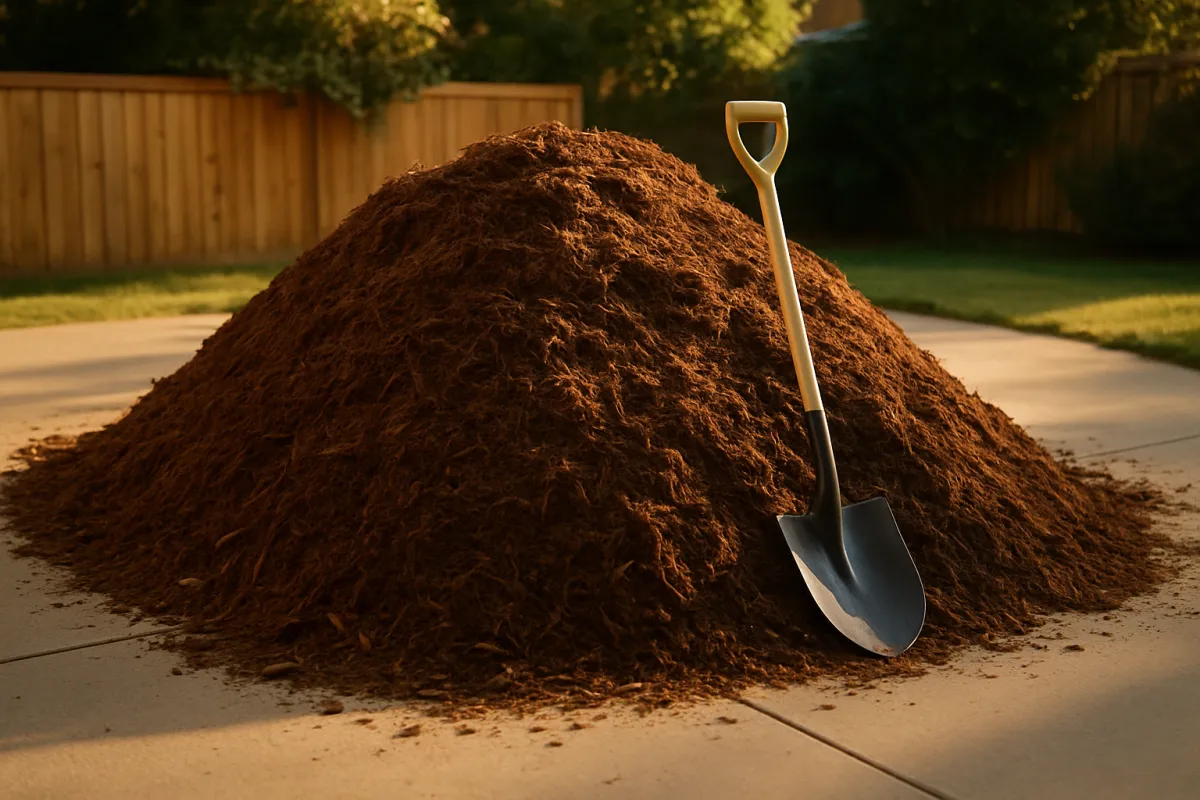
How much does a yard of mulch weigh? A cubic yard of common wood mulch typically runs somewhere around 400 to 800 pounds when dry, with roughly 600 pounds a defensible illustrative figure for shredded hardwood bark, and that same yard can climb to something like 1,000 to 1,500 pounds or more once it has been thoroughly soaked. That is not a range because the question is vague. It is a range because mulch is not one material, and because the single biggest variable, water, changes between the day you order and the day you pick it up.
That honest answer, and how to work with it rather than around it, is what this manual covers. A cubic yard is a fixed volume, exactly 27 cubic feet, but what fills it can be coarse bark nuggets full of air, dense fresh wood chips, a compost blend, or shredded rubber, and each of those weighs a different amount.
This article gives a weight band by material type, works the coverage arithmetic at 2, 3 and 4 inches, converts a bed measurement into cubic yards, prices the bag-against-bulk crossover, and then gets to the reason most people search for the weight at all: whether their truck or trailer can safely carry it. The volume side of a mulch order is worked in full in our mulch manual, and the underlying volume formula lives in our cubic yards manual. Run your own bed through our estimator as you read.
Key takeaways
- A cubic yard of dry wood mulch typically weighs roughly 400 to 800 pounds, with about 600 pounds a workable illustrative figure for shredded hardwood bark.
- Moisture is the largest single variable: a thoroughly soaked yard of the same material can reach roughly 1,000 to 1,500 pounds or more, because wood fiber absorbs water rather than just holding it between pieces.
- Material type sets the baseline, from airy bark nuggets at the light end through wood chips and compost blends to shredded rubber, which is heavier and barely changes in rain.
- Coverage is a volume question, not a weight one: one cubic yard covers about 162 square feet at 2 inches, 108 at 3 inches and 81 at 4 inches.
- Weight matters because of payload, not price. Size the haul from your own door jamb sticker and the wet weight, and let delivery handle anything past a load or two.
The short answer, and why there is no single number
The direct answer is a band. Common wood mulches run roughly 400 to 800 pounds per cubic yard dry, and about 600 pounds is a sensible middle figure to plan a shredded hardwood order around before anyone weighs anything. Soaked, the same yard can land near 1,000 pounds and keep going from there. If you want one number to carry into a conversation with a supplier, use 600 dry and 1,000 wet, then let the yard correct you.
Why no single figure exists comes down to four things stacked on top of each other. The material itself varies: bark, chips, shredded hardwood, compost blends and rubber are different substances that happen to share a shelf. The grind varies, since coarse nuggets trap more air than a fine shred. The age varies, because a pile that has been decomposing for a season has broken down and settled. And moisture varies most of all, day to day, with the weather.
None of those are knowable from a search result, which is the honest reason this manual gives you a band and the arithmetic instead of a confident constant. The band is enough to plan a load. The supplier’s own material, weighed on their scale on the day, is the only figure that is actually true.
A cubic yard is a fixed volume, not a fixed weight
The confusion in this question usually starts with the unit. A cubic yard is a volume: a cube three feet on each side, which works out to 27 cubic feet. That number never changes. What changes is what you put in it, and mulch is one of the most variable things a landscape supplier sells by the scoop.
Compare it to the materials sitting in the next bay. A cubic yard of crushed gravel commonly weighs somewhere near 2,700 pounds, as our gravel weight manual works through, because stone is dense and the only air is in the gaps between pieces. A cubic yard of mulch might weigh a fifth of that, because most of what fills the space is air trapped inside and between light wood fibers. Same box, wildly different contents.
That is also why the mulch answer swings more than the gravel answer. Stone does not absorb water; it only holds a film on the surface and some water in the voids, so a wet yard of gravel gains a modest percentage. Wood absorbs water into itself, so a wet yard of mulch can gain a large fraction of its own dry weight. The fixed volume is the constant. Everything else about the number is a property of the material and the weather.
Weight per cubic yard by mulch type
Material type sets the baseline the moisture then moves. Coarse bark nuggets are large, chunky pieces that stack with a lot of open space between them, so they sit at the light end of the range. Shredded hardwood bark, the double or triple ground product most people picture when they say mulch, sits in the middle. Fresh arborist wood chips, which include green wood and leaf material, run heavier because the pieces are denser and still carry sap moisture. Compost-blend mulches, which mix finer organic material into the product, are heavier again because the fine particles pack tightly. Shredded rubber is the outlier at the top.
Illustrative dry weight per cubic yard by mulch type
Typical planning figures in pounds for a dry cubic yard; the real weight belongs to the specific product and its moisture on the day.
Bar widths track each figure against the heaviest case shown, shredded rubber at about 1,400 pounds per cubic yard. The spread from roughly 450 to 1,400 is more than threefold, which is why naming the exact product comes before reaching for a weight, and why every figure here is illustrative rather than measured.
The lesson in the chart is the spread. A threefold difference between the lightest and heaviest thing sold as mulch means that a weight figure without a product name attached is close to useless for planning a haul. Decide what you are buying first, from what the bed needs and how it should look, then apply the band for that product. The supplier can usually tell you what their scoop weighs, and that answer beats any table.
Moisture, the variable that beats all the others
If you only remember one thing from this manual, make it this: water is the biggest single mover of mulch weight, and it is the one you have no control over. Wood fiber is absorbent by design, which is part of why mulch works as a moisture blanket in the first place. A pile sitting uncovered at a supply yard through a wet week takes water into the fibers, not just into the gaps between them, and the weight of that water is real and is on the truck with you.
A soaked cubic yard of wood mulch, split by weight
Illustrative breakdown of a thoroughly wet yard near 1,000 pounds, against a dry weight near 600.
The two segments sum to 100 percent of a soaked yard near 1,000 pounds. Nearly half of what you are lifting after a heavy rain is water, and it evaporates over the following weeks, which is why a pile that was delivered heavy gets noticeably easier to move by the second weekend.
Two practical consequences follow. First, plan any self-hauled trip around the wet figure, because you order days ahead and cannot promise the weather. Second, if a supplier prices by weight rather than by the scoop, a soaked pile delivers fewer cubic yards per ton than a dry one, so it is fair to ask whether the material has been under cover. Neither is a scam. The scale is honest. The effective density has simply shifted.
Bark, chips and shredded hardwood: what the labels mean
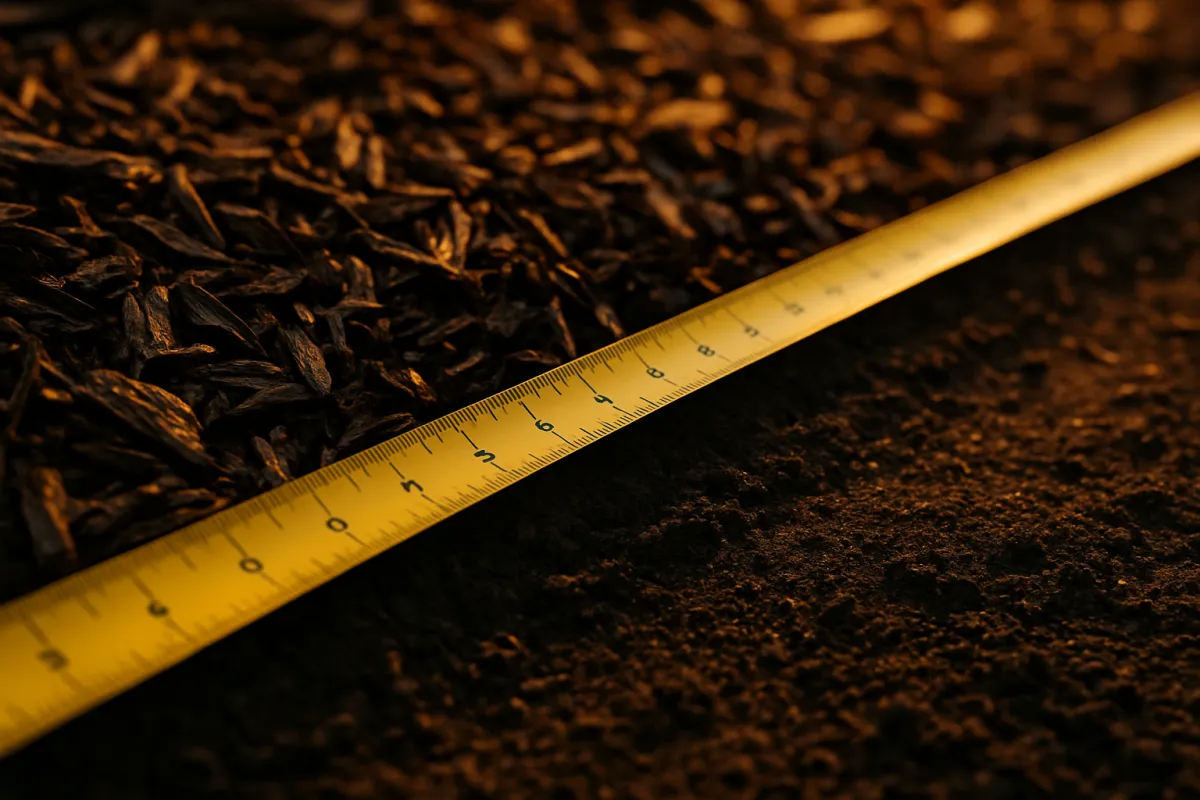
The words on the sign at a supply yard are not standardized, which is part of why weight figures drift. Bark mulch is the outer bark of trees, screened to a size, and it comes as nuggets, as a shred, or as a fine grind. Nuggets are chunky and hold their shape, so they trap the most air and weigh the least per yard. A shred of the same bark packs tighter and weighs more. A fine grind packs tighter still.
Wood chips are a different product: the whole chipped material from tree work, including sapwood and often some leaf and needle content. Because they include dense wood rather than only bark, and because fresh chips carry moisture from the living tree, they sit toward the heavy end even before rain. Some suppliers give this material away, and the tradeoff you are accepting is variability in size, color and, relevantly here, weight.
Shredded hardwood is the middle product most homeowners buy: bark and wood ground to a fibrous shred that knits together on a slope and resists blowing around. That knitting behavior is why it is popular and also why it settles: a shredded hardwood bed compacts over a season, which is a coverage issue as much as a weight one. Our mulch manual works that settling into the volume side of the order.
Compost blends and the heavy end of the range
Compost-blend mulches, sometimes sold as a soil conditioner mulch or a garden blend, mix finished compost or fine organic material into the wood product. They are heavier per cubic yard for a straightforward reason: the fine particles fill the spaces that would otherwise be air, and finished compost holds moisture readily. A yard of a compost blend can run substantially above a yard of bark nuggets, which is why the same scoop from two different bays can feel like two different jobs.
The weight consequence shows up in the loading. If you have hauled bark nuggets before and are now buying a compost blend, the volume that fit comfortably last time may not be the volume to take this time. Half the load can be the right call, and the scoop operator will not necessarily flag it, because they are filling the order you placed.
There is a coverage consequence too, though it runs the other way. Compost blends are typically applied thinner than a coarse bark, because a thick layer of fine material can crust and shed water rather than let it through. So the heavier product is often ordered in a smaller volume for the same bed. Settle the depth for the specific material before converting to cubic yards, and the weight follows from there rather than surprising you at the yard. Our topsoil manual covers the same tension for soil products, which are heavier again.
Rubber mulch and why it is sold by weight
Shredded rubber mulch, usually made from recycled tire material, is the outlier on every axis. It is heavier per cubic yard than wood, it does not decompose, and it barely absorbs water, so the rain multiplier that dominates the wood mulch question mostly does not apply. A yard of rubber that weighed a certain amount dry weighs close to the same amount wet, which makes it the one mulch product whose weight you can predict with any confidence.
That predictability is exactly why rubber mulch is commonly sold by the bag or by weight rather than by the loose scoop. Weight is a stable measure for a material that does not change with the weather, and it protects both sides of the transaction. If you are comparing a rubber product priced by the pound against a wood product priced by the yard, convert to a common unit before deciding: use the coverage math to find your cubic yards, then apply the weight per yard to get the pounds the rubber seller will quote against.
The other planning difference is the haul. Because rubber runs heavy per yard, a volume of rubber that looks modest in a bed can be a meaningful load in a truck. Do not carry over a mental rule you built hauling bark. Recalculate from the weight figure for the actual product, and check it against your rated payload the same way you would for stone.
Pine straw and the products that skip cubic yards
Pine straw is worth a note precisely because it breaks the framing of this question. It is sold in bales, not cubic yards, and a bale is a compressed unit whose coverage depends on how it fluffs out when you break it apart. Asking what a yard of pine straw weighs is a bit like asking what a yard of hay weighs: you can construct an answer, but it is not how anyone buys or sells it, and the number would be very light because the material is mostly air once spread.
The same is true for some specialty products: cocoa hulls, certain nut shells and some decorative products come bagged in fixed volumes with a stated weight on the bag, which is the most reliable weight figure you will ever get for any mulch. If the bag says what it weighs, believe the bag over any table, including the one in this manual.
The practical takeaway is to notice which unit a product is sold in before you start converting. Bales, bags and scoops are three different purchase units, and a lot of confused mulch arithmetic comes from mixing them mid-calculation. Pick the unit the supplier actually uses, do all your math in that unit, and convert once at the end if you need to compare across products.
Pounds per cubic foot, and the bag cross-check
Dropping to the smaller unit makes the numbers easier to feel. A cubic yard is 27 cubic feet, so a 600 pound yard of shredded hardwood is about 22 pounds per cubic foot, and a soaked yard near 1,000 pounds is about 37 pounds per cubic foot. A bark nugget product near 450 pounds per yard is roughly 17 pounds per cubic foot. Those are numbers you can hold in your hand and check against reality.
Which brings the best free sanity check available: the bag on the shelf. The common bagged size is 2 cubic feet, so 13.5 bags make a cubic yard. Bagged mulch is generally drier than an uncovered bulk pile, and a 2 cubic foot bag commonly lands somewhere around 30 to 40 pounds. Run that backwards, multiplying by 13.5, and you get roughly 400 to 540 pounds per cubic yard, which lines up neatly with the light end of the dry band this manual has been quoting.
If you want a real figure rather than an illustrative one, put a bag on a bathroom scale before you buy in bulk. Divide the bag weight by its cubic feet, multiply by 27, and you have the per-yard weight for that exact product at that exact moisture. It takes a minute and beats every published table, this one included.
Age, decomposition and the weight of an old pile
Mulch is organic material in the middle of breaking down, and the stage it has reached changes its weight. Fresh product is at its bulkiest: large pieces, plenty of air, and whatever moisture the wood came with. Over months, the pieces fragment, the fine material sifts down into the gaps, and the whole pile settles. Volume goes down and density goes up, so a yard scooped from the bottom of an old pile is not the same thing as a yard scooped from a fresh delivery.
Decomposition also generates heat and holds moisture, which is why a large pile can steam on a cold morning. The interior of a big pile tends to be wetter than the surface, so where the loader digs affects what lands in your truck. None of this is worth worrying about for a single yard. It is worth knowing when a big order comes in noticeably heavier or lighter than the last one from the same yard.
The bed-side version of the same effect is that mulch you applied last year has partly become soil. That is the point of it. When you measure an existing bed to plan a top up, you are measuring what is left of the layer, not what you put down, which is why the honest way to size a refresh is a tape at the edge rather than a memory of last year’s order.
Coverage per cubic yard at 2, 3 and 4 inches
Coverage is where most people actually start, and it is a volume question that has nothing to do with weight. One cubic yard spread exactly one inch deep covers 324 square feet. That single number generates all the others by division, because depth and coverage are a straight inverse.
- 2 inches deep: about 162 square feet per cubic yard. The common depth for a top up on an established bed.
- 3 inches deep: about 108 square feet per cubic yard. The common depth for a fresh bed or a full reset.
- 4 inches deep: about 81 square feet per cubic yard. Deeper than most beds want, though it appears on new installations with wide spacing between plants.
The reason to keep coverage and weight in separate mental boxes is that they answer different questions. Coverage tells you how much to buy. Weight tells you how to get it home. A light bark nugget and a heavy compost blend cover exactly the same ground at the same depth, because the bed consumes volume, but the two loads are nothing alike in the truck. Our material coverage reference collects the coverage figures for the whole range of landscape products in one place, and our estimator will run your own area and depth.
Turning square footage into cubic yards
The conversion from a measured bed to an order is one line: square feet times depth in inches, divided by 324, gives cubic yards. The 324 folds two conversions into one step, turning inches into feet and cubic feet into cubic yards, so you never have to handle either separately. A 600 square foot bed at 3 inches is 600 times 3 divided by 324, which is about 5.6 cubic yards.
Getting the square footage right is the part that goes wrong most often, because real beds are not rectangles. Break a curved bed into rectangles and half circles, measure each, and add them, or pace the outline and treat it as a rough rectangle if the stakes are low. Our square footage manual works through the shapes properly, including the irregular ones, and our cubic yards manual covers the volume formula underneath the 324 shortcut.
Then round the way the supplier sells. Most bulk yards deal in half or quarter yard increments off a loader bucket, so a 5.6 yard answer becomes a 6 yard order in practice. Round up rather than down: running short by a fraction of a yard means a second trip that costs more in time and delivery fee than the extra material ever would. Once you have the rounded volume, multiply by the weight band for your material, and you have the number that decides the vehicle.
Bags versus bulk, and where the crossover sits
The crossover between bags and bulk is usually decided by handling rather than by price. It takes about 13.5 of the standard 2 cubic foot bags to make a cubic yard, so a one yard job is roughly 14 bags, a three yard job is roughly 41, and a six yard job is around 81. Every one of those bags is a unit to lift into a vehicle, lift out, carry to the bed, cut open, empty, and flatten for recycling. The shelf price does not include that afternoon.
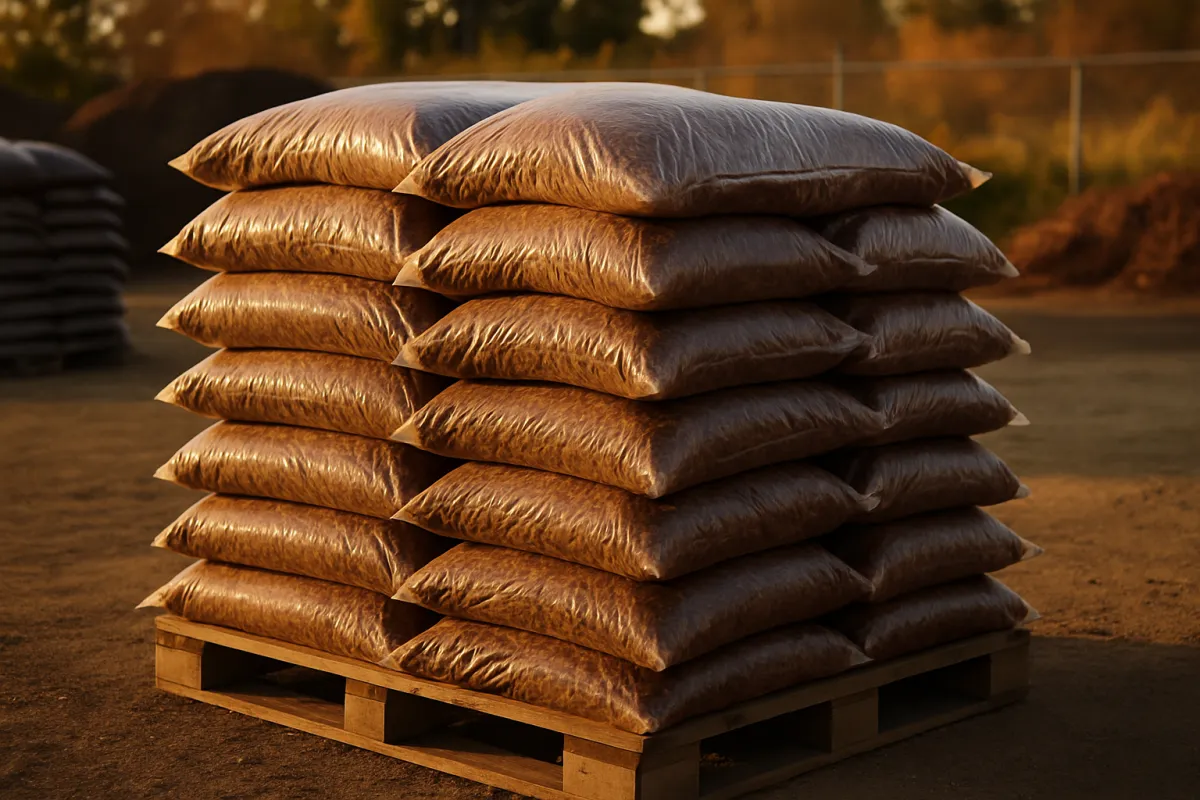
Bags do win in specific cases. They win when the job is genuinely small, under a yard, where a bulk delivery fee would dwarf the material. They win when you have nowhere to dump a pile, which is a real constraint on a tight urban lot with no driveway to spare. They win when you want a very specific product or color that the local bulk yard does not stock. And they win when you can only move material a little at a time.
Bulk wins on everything else past a yard or two: lower cost per cubic foot, no packaging, no handling per unit, and a single delivery. The weight figures in this manual are what tell you whether you can collect that bulk order yourself or should pay for the delivery, which is the decision the next few sections work through. Run the volume in our estimator first, then apply the weight band.
What the weight is really for: payload
Almost nobody looks up mulch weight out of curiosity. They look it up because a truck or trailer is involved, and they are trying to work out whether the load is sensible. That makes payload, not price, the practical point of the whole question.
Payload is the maximum weight a vehicle is rated to carry, and it includes everything: the driver, the passengers, the fuel beyond what was in the tank at rating, the toolbox, the bed liner, the dog, and the mulch. It is not a suggestion about comfort. It is the number the vehicle’s brakes, tires, springs and frame were engineered around, and exceeding it makes stopping distances longer and handling worse, particularly with a high load that raises the center of gravity.
Work an example with the figures from this manual. A 6 cubic yard order of shredded hardwood at an illustrative 600 pounds per yard dry is about 3,600 pounds. The same order after a heavy rain, at roughly 1,000 pounds per yard, is about 6,000 pounds. Those are pallet-jack numbers, not pickup numbers. Even a single yard, dry, is a few hundred pounds and entirely reasonable for most trucks, while three yards wet is around 3,000 pounds and is past what many light trucks are rated to carry. The weight band, applied to your rounded volume, is what turns an abstract order into a yes or no about the vehicle.
Reading your own payload rating
This manual will not tell you what your truck can carry, and you should be skeptical of anything that does. Payload varies enormously between vehicles that share a nickname, because it depends on cab configuration, bed length, drivetrain, engine, axle ratio and factory options. Two trucks parked side by side, both called half tons, can have payload ratings hundreds of pounds apart.
The number you want is on a sticker in the driver’s door jamb, usually on a yellow or white label, and it typically reads along the lines of the combined weight of occupants and cargo never exceeding a stated figure. That figure is yours. Read it yourself rather than trusting a forum post about your model, because options change it. Then do the subtraction that people skip: take the sticker number, subtract the weight of everyone riding along and everything already in the vehicle, and what is left is what you can put in the bed.
Trailers have their own set of numbers, and a hitch has a rating too. If a trailer is involved, you are dealing with the trailer’s gross rating, the tow rating of the vehicle, the hitch and ball ratings, and the tongue weight all at once, and the lowest number in that chain is the one that governs. Nothing about mulch is worth exceeding any of them.
Pickup beds: volume against payload
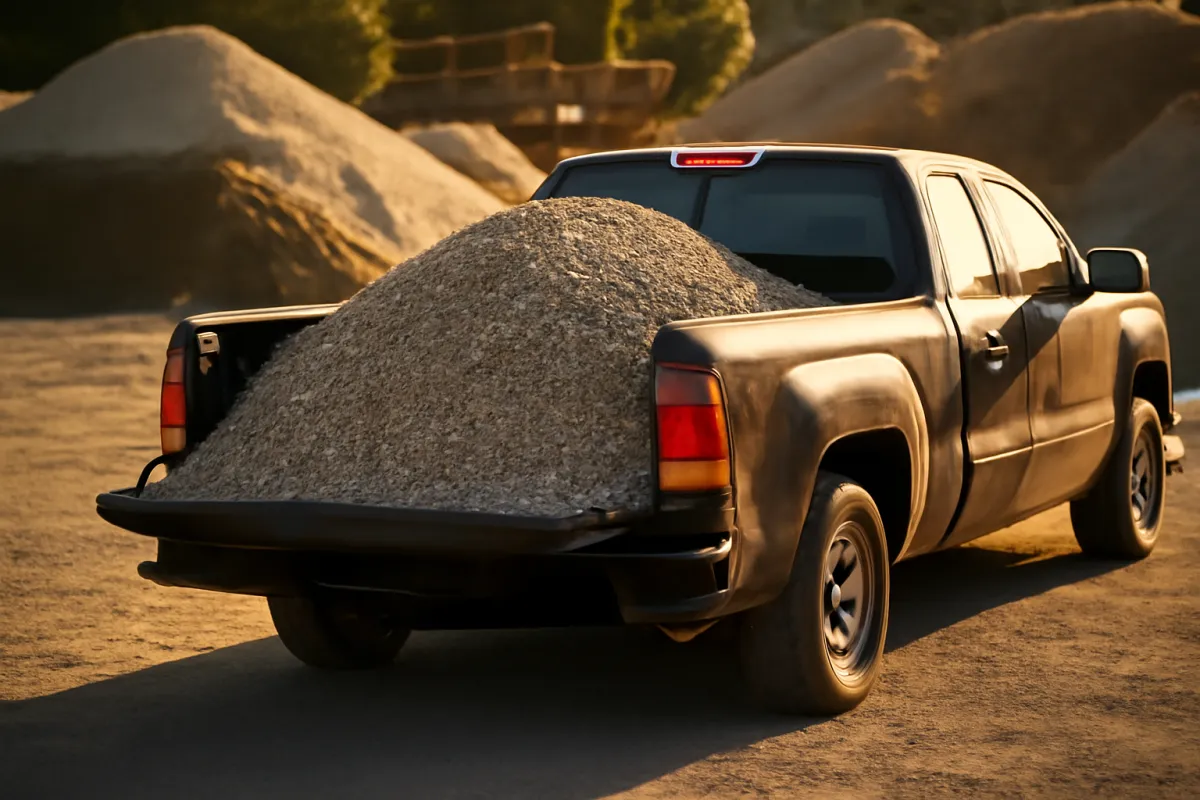
Here is where mulch gets genuinely interesting compared to stone, and it is worth understanding rather than memorizing. A typical full size pickup bed, loaded level with the rails, holds somewhere in the region of two to two and a half cubic yards, depending on bed length and depth. With gravel at roughly 2,700 pounds a yard, that bed volume is completely irrelevant, because a single yard already approaches or exceeds many payload ratings. Weight binds long before volume does.
With mulch, the two limits land in the same neighborhood, which is why the answer feels ambiguous. Two and a half yards of dry bark nuggets at an illustrative 450 pounds per yard is a little over 1,100 pounds, which many trucks handle. The same volume of shredded hardwood, dry, is around 1,500 pounds. The same volume soaked is around 2,500 pounds, which is past a lot of light truck ratings. So for mulch, and almost uniquely for mulch, the question of whether volume or weight binds first is decided by the weather.
That is the practical rule to carry: with stone, plan by weight and ignore the bed volume. With mulch, check both, and assume wet unless the pile has been under cover. A heaped load also sits high and catches wind on the highway, so tarp it and drive accordingly regardless of what the scale says.
Trailers, tongue weight and the limits people forget
A utility trailer looks like the obvious answer for a bigger mulch order, and it often is, but it introduces limits that people routinely overlook. A common 5 by 8 trailer with 2 foot sides encloses about 80 cubic feet, which is roughly 3 cubic yards. At dry shredded hardwood weights that is around 1,800 pounds of material. Soaked, it is around 3,000 pounds, plus the trailer’s own weight, and that combined figure has to sit inside the trailer’s gross rating and the tow vehicle’s tow rating at the same time.
Then there is tongue weight, the downward force the loaded trailer puts on the hitch ball. For conventional trailers, a commonly cited target is something in the range of 10 to 15 percent of the loaded trailer weight, achieved by loading with slightly more of the material forward of the axle. Too little tongue weight and the trailer can sway dangerously at speed. Too much and it overloads the hitch and lifts the tow vehicle’s front end, which costs steering and braking authority. Loose material shifts in transit, so how you load matters as much as how much.
Check the ratings on the trailer’s own plate and in your vehicle’s manual before you load, and remember that tongue weight also counts against the tow vehicle’s payload, since it presses down on the vehicle. The chain of limits is only as strong as its lowest link.
Delivery, and why it is usually the sane option
Past a load or two, delivery stops being an indulgence and starts being the obvious answer. A bulk supplier’s truck is built for the weight, insured for the trip, and gets the whole order to your driveway in one movement. The fee is typically a flat charge for a radius, sometimes waived above a minimum order, which means the cost per cubic yard falls the more you order. Two yards delivered can look expensive per yard. Six yards delivered rarely does.
Run the comparison honestly, because self-hauling has costs that do not appear anywhere. Multiple round trips consume fuel and an afternoon. Loading and unloading by hand is real labor. A load that exceeds the rating is a risk you are quietly accepting on public roads. And there is wear on a vehicle that was not bought for this. Against that, a delivery fee is often the cheapest line in the whole project.
When you book a delivery, tell them where you want the pile and clear that spot first, because the driver will usually dump where they can reach and the material becomes your problem the moment it lands. A driveway is the standard choice, since it is firm, close, and cleans up. Put a tarp down if you care about staining, and be honest about overhead wires and low branches. The truck is large and the driver cannot see everything.
Moving it once it is on the ground
The delivery solves the road problem and hands you the yard problem. A cubic yard of mulch is 27 cubic feet, and a standard contractor wheelbarrow holds something like 5 to 6 cubic feet heaped, while a smaller homeowner barrow is closer to 3 or 4. Doing the division, one cubic yard is roughly 5 to 9 barrow loads depending on the barrow and how honestly you fill it, so a 6 yard delivery is somewhere in the region of 30 to 55 trips.

Weight per trip is what decides whether that is a pleasant morning or an injury. At an illustrative 22 pounds per cubic foot for dry shredded hardwood, a 5 cubic foot barrow load is around 110 pounds, which is manageable on flat ground. Soaked, at roughly 37 pounds per cubic foot, the same load is close to 185 pounds, which is a lot to control on a slope or over a lawn. Fill the barrow less when the material is wet. The trips go faster than the physiotherapy.
Plan the route before the truck arrives. A pile dumped 40 feet from the beds with a step in between is a different job than one dumped alongside. Boards laid over a soft lawn keep the wheel from rutting, and a plastic tarp under the pile makes the last, most annoying part of the cleanup into a single lift.
A worked example: a 600 square foot bed
Take the numbers end to end so every step is visible. A front bed measures roughly 600 square feet after you break the curved outline into rectangles and half circles. It is an established bed getting a full refresh, so you settle on 3 inches of shredded hardwood.
Volume first. 600 times 3, divided by 324, is about 5.6 cubic yards. The supply yard sells in half yard scoops, so you order 6 yards, accepting a little extra rather than risking a second trip. Cross-check with coverage: at 3 inches a yard covers about 108 square feet, and 600 divided by 108 is 5.6, the same answer from the other direction.
Weight second. At an illustrative 600 pounds per cubic yard dry, 6 yards is about 3,600 pounds, which is 1.8 tons. If the pile has been rained on and runs nearer 1,000 pounds per yard, the same order is about 6,000 pounds, or 3 tons. Either figure is a delivery, not a pickup trip, unless you are prepared to make many runs.
Then the labor. Six yards is 162 cubic feet, so at roughly 4 cubic feet a barrow load that is around 40 trips, each one carrying about 90 pounds dry or 150 pounds wet. In bags, the same job would be about 81 of the 2 cubic foot bags. Written out like that, the delivery fee stops looking like an expense. Run your own bed through our estimator and the same chain of numbers falls out.
Mulch weight against gravel, sand and topsoil
Putting mulch next to the other bulk landscape materials is the fastest way to build intuition, and it explains why mulch is the one material most homeowners can actually haul. Common wood mulch at roughly 600 pounds per cubic yard is a fraction of what the mineral materials weigh. Crushed gravel commonly runs near 2,700 pounds per yard, sand is in the same general neighborhood, and screened topsoil typically lands somewhere around 2,000 to 2,200 pounds depending on moisture and organic content.
So a cubic yard of mulch is roughly a quarter of a cubic yard of gravel by weight, and roughly a third of a yard of topsoil. That ratio is why the same trailer that can only take a fraction of a yard of stone can take a couple of yards of mulch, and why mulch delivery minimums are often stated in larger volumes than stone deliveries. Our gravel weight manual and sand weight manual work those materials in the same format, and our tons to cubic yards manual is the conversion that bridges volume and weight for any of them.
The comparison also flags the mixed-load trap. If a project needs both mulch and soil, do not assume that a vehicle that handled the mulch order will handle the soil order at the same volume. Recalculate. Volume intuition built on a light material is actively misleading when applied to a heavy one, which is the same reason our material coverage reference keeps every product on its own line.
How deep mulch should actually go
Depth deserves its own section because it drives the order more than anything else and because more is not better. For most established planting beds, 2 to 3 inches is the range commonly recommended, and a bed that has never been mulched usually gets the full 3. On a refresh, measure what is already there first: often an inch of top up restores the color and the function without adding to a layer that is already deep enough.
The reason to hold the line at 3 inches or so is that mulch is doing a specific job. It is moderating soil temperature, holding moisture, suppressing weed germination and slowly feeding the soil as it breaks down. A layer that is too thin does none of those well. A layer that is too thick can shed light rain before it reaches the root zone, hold excessive moisture against the soil surface, and in some cases encourage roots to grow up into the mulch instead of down into the soil where they belong.
The arithmetic consequence is worth stating plainly. Going from 2 inches to 3 adds fifty percent to the volume you buy and therefore fifty percent to the weight you have to move. Depth is the single most expensive decision in a mulch order, in both money and labor, so make it deliberately and measure the existing layer before you assume you need a full application.
Volcano mulching, and the depth mistake to avoid
The most common mulch mistake is not a quantity error. It is piling mulch up against a trunk in a cone, a practice known as volcano mulching, and it is worth ending the depth discussion on because it is both widespread and avoidable. Trees are meant to have a visible flare where the trunk meets the ground. Burying that flare keeps bark constantly damp, which invites decay, gives rodents cover to chew at the bark, and can encourage roots to circle in the mulch rather than spread into the soil.
The fix is simple and free: keep mulch pulled back several inches from the trunk so you can see the flare, and taper the layer down as it approaches, rather than up. The shape you want is a shallow ring or a doughnut, not a cone. The same applies at a smaller scale to shrubs and perennials, where mulch heaped against stems holds moisture where the plant does not want it.
Applied over a bed, this also slightly reduces the volume you need, since the area right around each trunk is not getting a full layer. On a bed with several mature trees that is not nothing, though the honest advice is to order from the full area anyway and spread the surplus rather than cut it fine. A little extra mulch has a use. A short order has a second trip.
A quick reference table
The manual compresses to a short table worth keeping open when you place the order. Every figure is an illustrative planning number for a dry cubic yard, with a rough wet figure alongside, and the real value belongs to the specific product and the moisture in the pile on the day you buy it.
| Material | Typical dry weight per cubic yard | Roughly, after heavy rain | Equivalent 2 cu ft bag |
|---|---|---|---|
| Bark nuggets | ~450 lb | ~750 lb | ~33 lb |
| Shredded hardwood | ~600 lb | ~1,000 lb | ~44 lb |
| Fresh wood chips | ~800 lb | ~1,350 lb | ~59 lb |
| Compost blend | ~1,100 lb | ~1,850 lb | ~81 lb |
| Shredded rubber | ~1,400 lb | little change | ~104 lb |
Two patterns are worth reading off it. The wet column is not a small adjustment for the wood products, it is a large fraction added on, which is the argument for planning any haul from the wet figure. And the bag column is a reality check you can perform in a shop: bagged product is usually drier and lighter than the bulk equivalent, so bags tend to sit at the low end of every band. That round-up-and-verify habit is the same one our deck boards manual, our stair manual and our tile manual apply to their own materials: derive the number, then check it against something physical before you buy.
The bottom line
A cubic yard of mulch weighs roughly 400 to 800 pounds dry for common wood products, with about 600 pounds a workable planning figure for shredded hardwood, and something like 1,000 to 1,500 pounds or more once it has been thoroughly soaked. There is no single answer because a cubic yard is a fixed volume filled with a highly variable material, and because moisture, the largest variable of all, changes between the order and the pickup.
Work with the band rather than against it: pick the depth, convert your square footage to cubic yards through the 324 line, round to the supplier’s increment, then multiply by the band for your material and assume wet unless the pile has been under cover. Use that weight for one purpose, which is deciding how the material gets home, and read your own door jamb sticker rather than any published payload claim. Keep the layer at 2 to 3 inches, keep it off the trunks, and let a delivery handle anything past a load or two. Work the volume side in our mulch manual, compare against the heavier materials in our gravel weight manual, and put your own bed through our estimator.
Read this as yard-side orientation rather than a specification or a safety certification. Every weight, coverage and capacity figure printed here is an illustrative planning number, and the species, grind, age and above all the moisture of the product your supplier scoops will move the real value, sometimes considerably. Nothing in this article states the payload, towing or tongue weight rating of any vehicle or trailer: those belong to the door jamb sticker, the trailer plate and the owner manual for the equipment you actually own, and they are the only figures to load against. For a large order, a heavily planted bed, or any question about trees already showing stress, ask the supplier for their measured weight and consult a qualified arborist or landscape professional before you buy.
Frequently asked questions
How much does a yard of mulch weigh?
A cubic yard of common wood mulch typically weighs somewhere around 400 to 800 pounds when it is dry, and a figure near 600 pounds is a reasonable illustrative planning number for shredded hardwood bark. Once the pile has taken a heavy rain, that same cubic yard can climb to roughly 1,000 to 1,500 pounds or more, because the fibers hold water the way a sponge does. The material type matters too: bark nuggets sit at the light end, fresh wood chips and compost blends at the heavy end, and shredded rubber is heavier still. Every figure here is illustrative, and the supplier's own product and its moisture on the day decide the real weight.
How much does wet mulch weigh compared to dry?
Wet mulch weighs far more than dry mulch of the same volume, and the gap is much wider than it is for stone or sand. Wood fiber absorbs water into the material itself rather than only into the gaps between pieces, so a soaked cubic yard can weigh substantially more than the dry figure predicts, often on the order of half again as much or more. That is why a load that felt manageable on a dry Saturday feels alarming after a rainy week. If you are hauling yourself, plan the trip around the wet weight, not the dry one, because you do not control the weather between the order and the pickup.
How many bags of mulch are in a cubic yard, and what do they weigh?
A cubic yard is 27 cubic feet, so it takes about 13.5 of the common 2 cubic foot bags to equal one yard, and roughly 18 of the smaller 1.5 cubic foot bags. Bagged mulch is usually drier than a bulk pile that has been sitting outside, which is why a 2 cubic foot bag commonly lands somewhere around 30 to 40 pounds. Running that backwards gives roughly 400 to 540 pounds per cubic yard, which is a useful sanity check on the light end of the range. Weigh a bag on a bathroom scale if you want a real number for the product you actually buy.
Can a half-ton pickup carry a yard of mulch?
One cubic yard of dry wood mulch is often light enough for a pickup to carry, but the only number that settles it is the payload rating on your own door jamb sticker, minus the weight of you, your passengers and anything already in the bed. Payload ratings vary widely between trucks that share the same half-ton nickname, so no article can tell you yours. Two or three yards of soaked mulch is a different question entirely, because at wet weights that load can run past what many light trucks are rated to carry. Read the sticker, subtract what is already aboard, and size the trip from the wet weight rather than the dry one.
How much area does a cubic yard of mulch cover?
One cubic yard spread one inch deep covers 324 square feet, which is the number every other coverage figure comes from. At 2 inches deep that halves to about 162 square feet, at 3 inches it is about 108 square feet, and at 4 inches about 81 square feet. Coverage is a volume question, not a weight question, so a light bark nugget and a heavy compost blend cover the same ground at the same depth even though they weigh very differently. Use coverage to size the order and weight to size the vehicle.
Why do some suppliers sell mulch by weight instead of by the yard?
Most bulk landscape suppliers sell mulch by the cubic yard because volume is what a bed actually consumes and because mulch is light enough that a scoop is a practical unit. Some yards, and most rubber mulch sellers, price by weight instead, since a truck scale settles the quantity without any argument about how heaped a bucket was. The catch with weight-based pricing on an absorbent material is that a soaked pile delivers fewer cubic yards per ton than a dry one, so on a by-the-ton buy it is worth asking whether the pile has been rained on. Carry both numbers, your cubic yards and the expected weight, so the two units reconcile.
Does the type of mulch really change the weight that much?
Yes, and the spread is wide enough to matter on any load you plan to haul yourself. Coarse bark nuggets have large pieces with a lot of air between them and sit at the light end, shredded hardwood bark sits in the middle, and fresh arborist wood chips or a compost-blend mulch run heavier because the pieces are denser and hold more moisture. Shredded rubber mulch is heavier again per cubic yard and behaves differently in rain, since rubber absorbs very little water. Name the specific product before reaching for any weight figure, because the category word on the sign is not enough to predict it.
How deep should mulch be in a planting bed?
Two to three inches is the range most often recommended for established planting beds, with a fresh bed that has never been mulched usually getting the full three. Deeper is not better: a thick blanket can keep water from reaching the root zone, hold too much moisture against stems, and encourage roots to grow up into the mulch layer. Keep mulch pulled back several inches from trunks and stems rather than piling it against them, which is the mistake commonly called volcano mulching. Depth is also the input that moves your order most, so settle it before you calculate anything else.