What's on this page
- What a paver patio costs per square foot
- Paver patio cost by size
- Patio quote vs a bare paver delivery
- Paver patio cost by material
- Concrete pavers: the baseline
- Clay brick pavers
- Porcelain pavers
- Natural stone pavers
- What drives paver patio cost
- Site prep, excavation, and the base
- Bedding sand, paver thickness, and pattern
- Edge restraint and joint sand
- Access and the install itself
- Where the money goes
- Paver patio vs poured concrete, gravel, and a deck
- Removing an old surface first
- Extras: steps, borders, and drainage
- Sealing and maintenance cost
- DIY paver patio cost
- From price per foot to your total
- Ways to keep paver patio cost down
- A worked example: a 14 by 10 patio priced
- The bottom line
Short answer: A concrete paver patio commonly runs an illustrative 14 to 25 dollars per square foot installed, with a working midpoint near 18 dollars, so a 14 by 10 foot patio of 140 square feet lands near 2,520 dollars. Clay brick runs a step above near 20, porcelain near 24, and natural stone the highest at roughly 25 to 45. Labor and the paver units themselves are usually the largest shares, so material, site, and region set the real number; collect written bids.
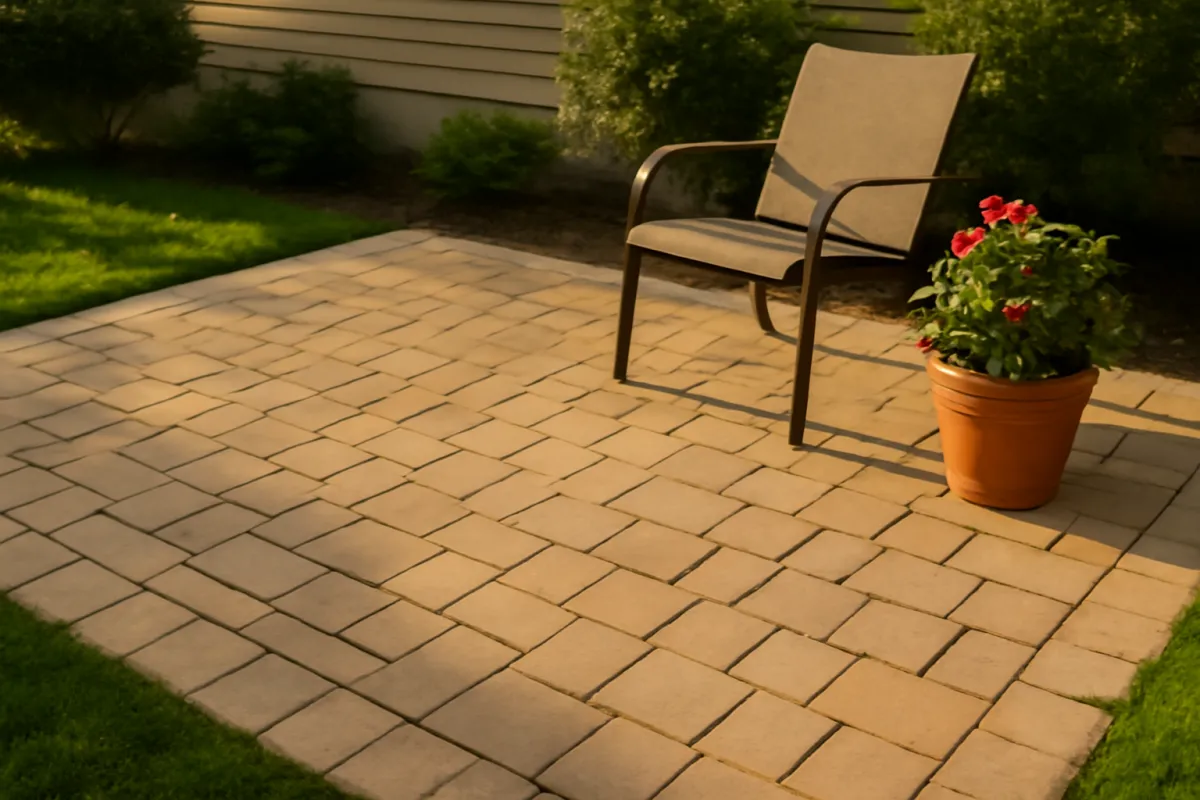
Paver patio cost looks like one number and behaves like four, because the material underfoot forks the price before anything else does. Ask what a paver patio costs and the honest answer starts with a question back: concrete, clay brick, porcelain, or natural stone, because those four families sit at genuinely different price points for the same square footage. Add in size, pattern, base depth, and access, and two patios that look similar in a photo can land thousands of dollars apart on a real bid. The pavers themselves are the part everyone sees and prices first; the compacted base and sand underneath them are what actually decide whether the patio stays flat, and both show up on the invoice.
This cost brief prices a paver patio the way installers bid it: per square foot installed, scaled to whole-project totals by size, and broken out by the four common paver materials from concrete up to natural stone. It separates a finished patio quote from the bare cost of the paver units, walks the base, sand, edge restraint, and pattern factors that move the figure, compares pavers against a poured concrete patio, gravel, and a deck, and prices the extras, the maintenance, and the DIY path. It sits alongside our paver patio walkthrough for the build sequence and our paver count manual for sizing the order itself. Run your own dimensions through the estimator or the companion below as you read, and the rates here become your numbers.
Key takeaways
- A concrete paver patio commonly runs an illustrative 14 to 25 dollars per square foot installed, with a working midpoint near 18 dollars; clay brick, porcelain, and natural stone each step up from there.
- Total cost scales with area, so a 10 by 10 pad, a 14 by 10 patio, and a 500 square foot entertaining surface land in very different budgets even at the same rate.
- An installed quote prices a finished surface, base, sand, edge restraint, pavers, and jointing together, which is why it reads far higher than the bare per-piece price a yard quotes.
- Labor and the paver units together are usually the two largest shares of an installed patio, so material choice, pattern, and site access move a real bid more than the base materials do.
- Every dollar figure here is illustrative and local: your soil, slope, access, material, and region set the real number, so measure your area and collect written bids.
What a paver patio costs per square foot
The cleanest unit for a paver patio is dollars per square foot installed, because that is how installers estimate the job and how differently sized projects compare fairly. As an illustrative planning range, a concrete paver patio commonly runs somewhere around 14 to 25 dollars per square foot, with a working midpoint near 18 dollars. That figure is not the pavers alone: it bundles the excavation, the compacted gravel base, the bedding sand, the units themselves, the cutting at the edges, the edge restraint, the jointing, and usually the joint sand. It is the whole finished surface, priced by its area.
The reason the installed figure beats every other unit is that the per-piece paver price alone is misleading. A pallet of pavers has its own cost, covered by paver count in our pavers-needed manual, but a typical patio’s material bill is only part of what an installer charges. On a 140 square foot patio, the pavers themselves might be a large minority of the installed price, maybe two-fifths, with the rest split between the base work and the hand labor of setting each unit. Quoting a patio from the pallet price is how people end up shocked by bids. Start from the per-square-foot installed rate for the material you want, multiply by your area, and you have a defensible planning number before a single installer visits. The rest of this brief is about what moves you inside that range, and the companion below runs the math on your own dimensions as you go.
Paver patio cost by size
Size is the first multiplier, because every square foot carries the full installed rate. The table below prices common patio footprints at the illustrative concrete-paver midpoint of 18 dollars per square foot, purely as planning bands. Small pads are cheap in absolute terms but often cost a little more per foot, since the fixed costs of mobilizing a crew spread over less area. Large patios are the reverse: the total climbs fast, but the per-foot rate can soften as the same setup covers more surface.
| Patio size | Area | Illustrative total at ~$18/sq ft |
|---|---|---|
| 10 x 10 ft | 100 sq ft | ~$1,800 |
| 12 x 14 ft | 168 sq ft | ~$3,025 |
| 16 x 20 ft | 320 sq ft | ~$5,760 |
| 20 x 20 ft | 400 sq ft | ~$7,200 |
| 20 x 25 ft | 500 sq ft | ~$9,000 |
| 24 x 30 ft | 720 sq ft | ~$12,960 |
Read every row as a starting point, not a quote. Swap the material and the whole column shifts: the same 400 square foot patio at a natural stone rate near 32 dollars reads about 12,800 dollars. Add a sloped yard, poor soil, or an old surface to remove and each row climbs further. The useful habit is to price your real measured area, not a nominal size; a patio drawn as 14 by 10 on a napkin often becomes 15 by 11 once it meets the house and the yard, and at installed rates those extra feet are real money. Our square footage manual covers measuring, including L-shapes and curves, and the estimator turns a length and width into area in seconds.
Patio quote vs a bare paver delivery
A paver patio quote is not the same thing as a pallet of pavers dropped in the driveway, and confusing the two is the most common way this comparison goes wrong. A bare paver delivery covers exactly what it says, the units themselves, sometimes with freight, and nothing else. A patio price covers a finished outdoor living surface: the excavation and grading, the compacted gravel base, the bedding sand screeded level, the pavers set in pattern, the cuts at every edge, an edge restraint around the perimeter, and joint sand swept and compacted into the gaps. Same units, very different product, and the patio scope is the one that actually becomes a surface you can stand on.
The distinction matters in both directions. If you are pricing a patio from the pallet cost alone, you will badly underestimate the job, since the base and labor commonly outweigh the paver material itself. If you are comparing installer bids, confirm each covers the same scope: one bid’s low number may exclude the edge restraint or assume a thinner base than another includes. For the build sequence itself, our paver patio walkthrough carries the full eight steps from layout to joint sand, and our paver count manual does the unit math. This brief prices the finished patio those pages help you build. When a bid arrives, read it as a scope list first and a price second; the number only means something once you know what is inside it.
Paver patio cost by material
Material is the second fork in a paver estimate, and it moves the rate more than almost any site factor does. Concrete pavers anchor the bottom of the range, clay brick sits a step above, porcelain a step above that, and natural stone reaches the top, with a plain poured concrete patio included as the reference point most people already compare against. The chart below places the common options side by side on illustrative installed cost per square foot, and the sections that follow take each paver material in turn.
Illustrative installed cost per square foot, by patio surface
Poured concrete against the four common paver materials; local labor, site prep, and access move every bar.
Poured concrete sits at the bottom because a monolithic slab needs far less placing labor than individual units. Within pavers, the climb from concrete to natural stone tracks the unit cost of the material itself as much as the labor to set it.
The structure under every one of these materials is essentially the same: the same excavation, the same compacted base, the same bedding sand. What you buy as you climb the chart is the paver unit itself, its manufacturing process or its quarrying, and in some cases the extra sorting and cutting that natural variation demands. That is worth keeping in mind when a budget tightens, because it means the material is a choice you can trade without touching the structure underneath it. It also means a low bid that saves money on the base rather than the material is saving in exactly the wrong place, since the base is what keeps any paver material from settling.
Concrete pavers: the baseline
Concrete pavers are the baseline of the range, an illustrative 14 to 25 dollars per square foot installed with a midpoint near 18, and they are what a paver patio means when nobody specifies otherwise. They are manufactured in molds from a dense concrete mix, cured under controlled conditions, and sold in consistent sizes, shapes, and colors that make both ordering and cutting predictable. For a patio that will live under furniture, a grill, and foot traffic, concrete pavers are not a compromise so much as the standard, and the uniform units are part of why installation labor is more predictable than it is with a quarried material.
Because the units are manufactured to a spec, a concrete paver bid is one of the cleaner ones to compare across installers: the differences come down to the base work, the pattern, and local labor, not sorting through natural variation in the stone. It is also the material that leaves the most budget for the parts of the job that determine lifespan, the compacted base and the edge restraint. A common range worth knowing: thinner concrete pavers suit overlays and light foot traffic, while thicker units are rated for driveways and anything carrying a vehicle, so match the paver to the load rather than to the price per piece, a point our paver count manual covers alongside the ordering math.
Clay brick pavers
Clay brick pavers are the first step up, an illustrative 16 to 28 dollars per square foot installed with a midpoint near 20, and they trade a little manufacturing uniformity for a traditional, warm look that many owners want specifically. They are fired from clay rather than cast from concrete, which gives them a color that runs through the whole unit rather than sitting on the surface, so the color does not fade or wear off the way a surface tint can. The classic reddish brick tone is the common choice, though clay pavers come in a range of fired colors.
The modest premium over concrete buys a material with genuine historical pedigree and a color that stays honest for the life of the unit. A few practical notes keep the cost honest. Clay pavers are typically a touch smaller and more dimensionally consistent than cast concrete, which some installers find speeds the laying in a running bond pattern. They are also slightly more prone to chipping at the edges during cutting than a denser concrete paver, which is a labor consideration on a patio with a lot of perimeter cuts. Confirm the specific clay paver’s rated thickness and intended use, foot traffic versus vehicle load, before ordering, since the family covers a range of duty ratings just as concrete does.
Porcelain pavers
Porcelain pavers sit in the upper-middle of the range, an illustrative 20 to 35 dollars per square foot installed with a midpoint near 24. They are manufactured from dense, kiln-fired clay-based material at very high temperatures, which gives them exceptional density, very low water absorption, and strong resistance to staining and fading in direct sun. Porcelain is typically sold in large format slabs rather than small brick-sized units, which changes the look of a patio toward a more contemporary, fewer-joints appearance and can actually reduce joint sand needs compared with a small-unit pattern.
The premium over concrete and clay brick reflects both the manufacturing process and the precision cutting porcelain demands, since it is a harder, more brittle material to cut cleanly than concrete or clay. Installers commonly need specialized blades and more careful handling, which is labor the bid reflects. Porcelain’s dense surface also means it resists staining better than a porous paver without needing a sealer for that purpose, though a sealer can still help with slip resistance and joint stabilization, our paver sealer guide sorts those options. For a contemporary look with very low long-term staining risk, porcelain is often worth its premium; for a smaller budget, it is usually the first material to reconsider.
Natural stone pavers
Natural stone pavers sit at the top of the range, an illustrative 25 to 45 dollars per square foot installed with a common midpoint near 32, and the premium reflects a material that is quarried and shaped rather than manufactured to a uniform spec. Common stone types for patios include irregular flagstone-style units and more regular cut stone in geometric patterns, and the installed rate moves with how much of that stone is naturally irregular versus precisely cut, since irregular stone demands more layout and fitting labor per square foot even though the raw material can sometimes cost less per ton.
Natural stone’s case for the premium is that no two patios look alike, and the material ages by weathering gracefully rather than wearing out. The trade-offs are real: stone is typically heavier, which can affect base requirements and handling cost, color and thickness vary piece to piece in a way manufactured pavers do not, and sourcing a specific stone can be slower than ordering a standard concrete product. For a patio where the natural, one-of-a-kind look is the whole point, stone is often worth it; for a straightforward backyard sitting area on a working budget, the three materials below it on the chart deliver most of the durability for meaningfully less.
What drives paver patio cost
Beyond size and material, a handful of factors decide where a real bid lands inside the illustrative ranges, and knowing them explains why two quotes for the same drawing can differ by thousands. The ground comes first: a flat, well-drained yard with decent soil is the cheap case, while slope, clay, organic soil, or standing water means more excavation, more base material, and sometimes drainage work before a single paver goes down. Access is next, and it is underrated: a backyard a skid loader or wheelbarrow can reach directly moves base material quickly, while a patio behind a fence, down a slope, or around a house may need many small trips by hand, all of which is labor.
Then come the installation choices, pattern, cut waste, and edge restraint, which later sections cover, and the long tail of site specifics: demolition of an old surface, tree roots, utility lines, permits where required, and haul-away of spoil. Finally there is the market itself. Hardscape crews are priced by the same seasonal calendar as concrete crews, so the same patio can bid differently in spring than in late fall, and regional labor rates move the largest line on every bid. None of this is padding; each factor is real work or real risk. The practical response is to walk your site honestly before you collect bids, flag the hard parts yourself, and treat any quote that seems blind to them as incomplete rather than lucky.
Site prep, excavation, and the base
The part of a paver patio nobody sees is the part that decides how long it lasts, and it is real money inside every installed rate. Before a single paver is set, the area is stripped of sod and topsoil, excavated to depth, graded to fall slightly away from the house so water sheds off the finished surface, and built back up with a compacted gravel base. That base does two jobs: it spreads loads into the soil evenly, and it drains water away from underneath the pavers so freezing and soaking cannot heave them out of level. A patio laid on soft, wet, or uncompacted ground will settle unevenly no matter how good the pavers on top are.
Base depth follows the soil and the load: a common walk-on patio base runs roughly 4 to 6 inches of compacted gravel over firm subgrade, deeper where soil is soft, frost runs deep, or the surface will carry more than foot traffic. This is also the stage where drainage problems get solved or inherited. If the yard already collects water where the patio will sit, paving over the problem entombs it; a regraded swale or a drain line belongs in the plan first, and our french drain cost brief prices that fix. When you compare bids, ask each installer what excavation depth, what base material and thickness, and what compaction the number includes. A bid that is vague about the base is not cheaper, it is unfinished.
Bedding sand, paver thickness, and pattern
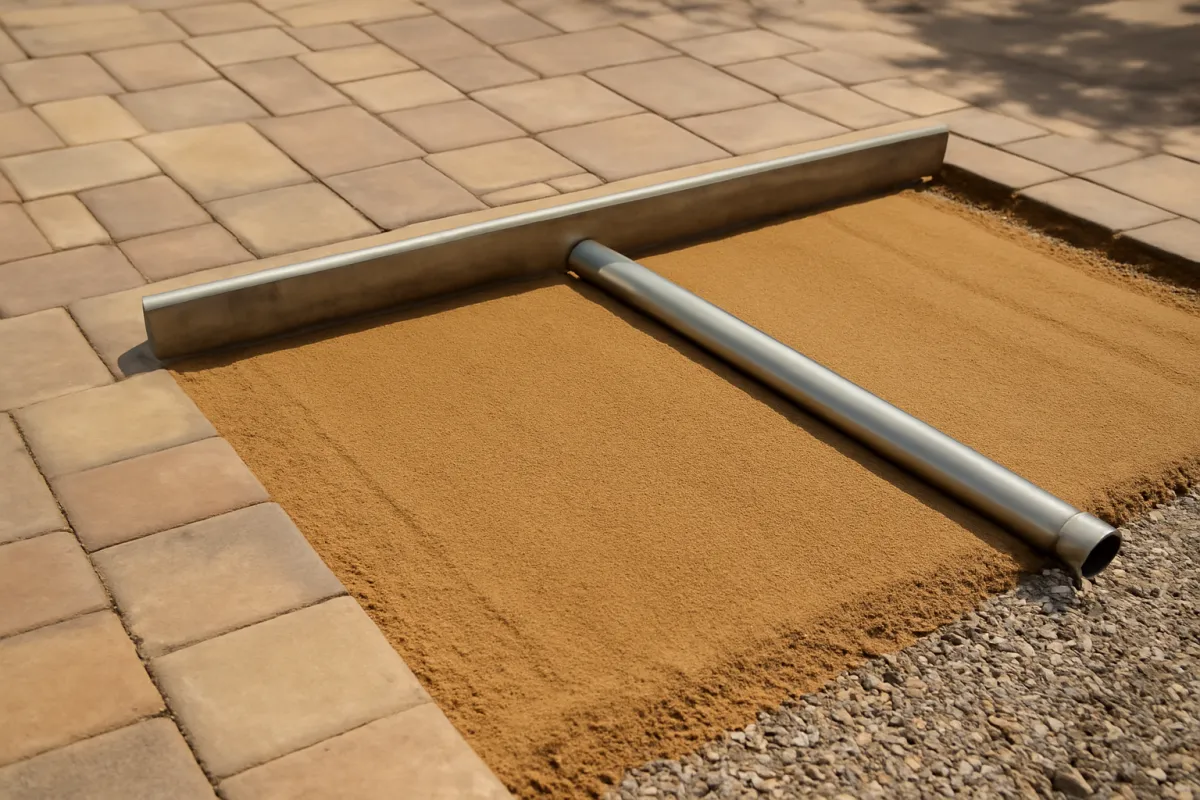
On top of the compacted base sits a thin, screeded layer of coarse bedding sand, commonly about 1 inch deep, which seats the pavers evenly and lets them be tapped into final position. It is a small volume next to the gravel base, but it is a precision layer: screeded too thick or unevenly and the pavers sit proud or rock underfoot. Paver thickness itself commonly runs 2 to 2.4 inches for a standard patio unit, and that dimension feeds directly into the excavation depth, since the dig has to account for base plus sand plus the actual paver thickness at the yard, not a nominal figure.
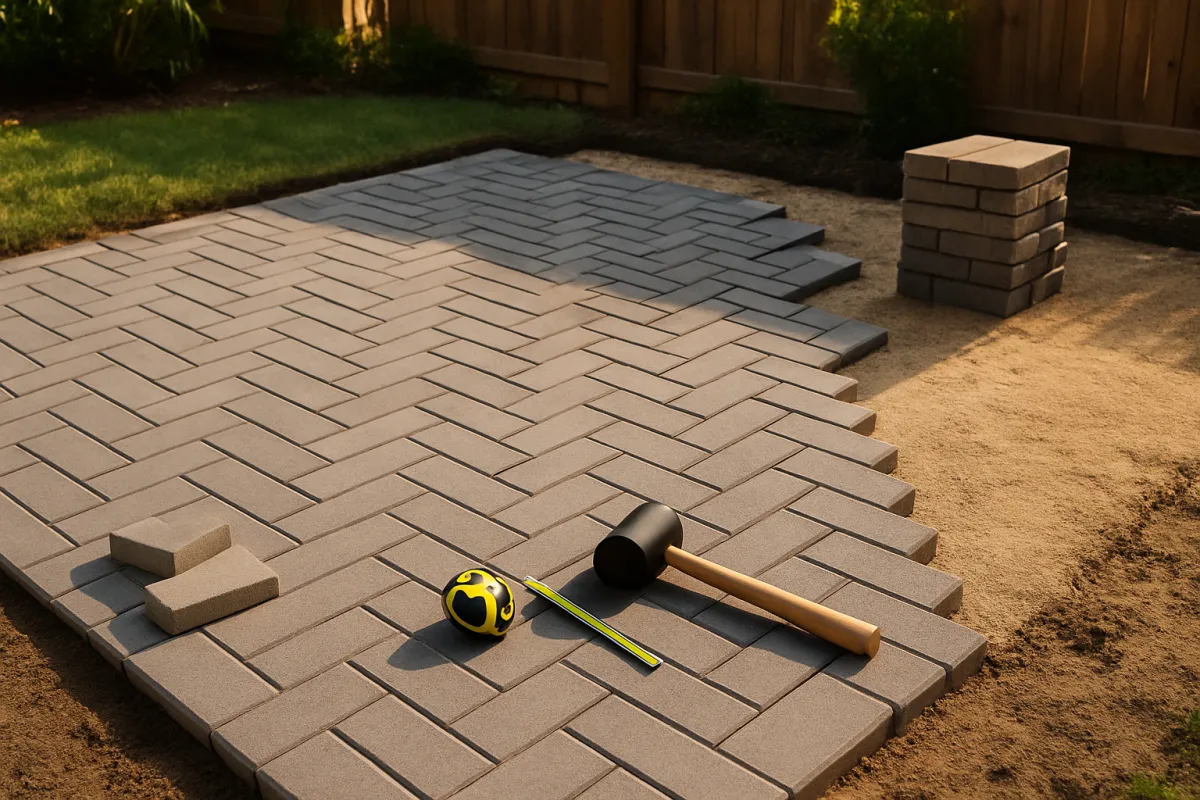
Pattern is the other input that quietly sets labor cost within any one material. A straightforward running bond, where rectangular units are offset like brickwork, is the fastest to lay and typically carries the lowest waste allowance, commonly around 10 percent. A herringbone pattern set at 45 degrees looks more intricate and reads as a premium choice, but every paver meeting the perimeter needs a diagonal cut, which pushes waste toward 15 percent and adds real cutting labor across the whole job. Curved beds and circular inserts push waste and labor higher still. Our paver count manual derives pavers per square foot from the unit’s own face dimensions and sets the waste allowance by pattern in full, so a pattern decision here should be checked against that math before it is final.
Edge restraint and joint sand
Edge restraint is the border that keeps the outer ring of pavers from creeping outward over time, and skipping it is one of the most common reasons a paver patio loses its shape years after it was installed. It can be plastic paver edging staked into the base, a poured concrete haunch, or a solid border course of pavers set differently from the field, and it runs around every open side of the patio. It is a small share of the material order, commonly a modest line item next to the base and the pavers, but it is a large share of whether the pattern stays tight.
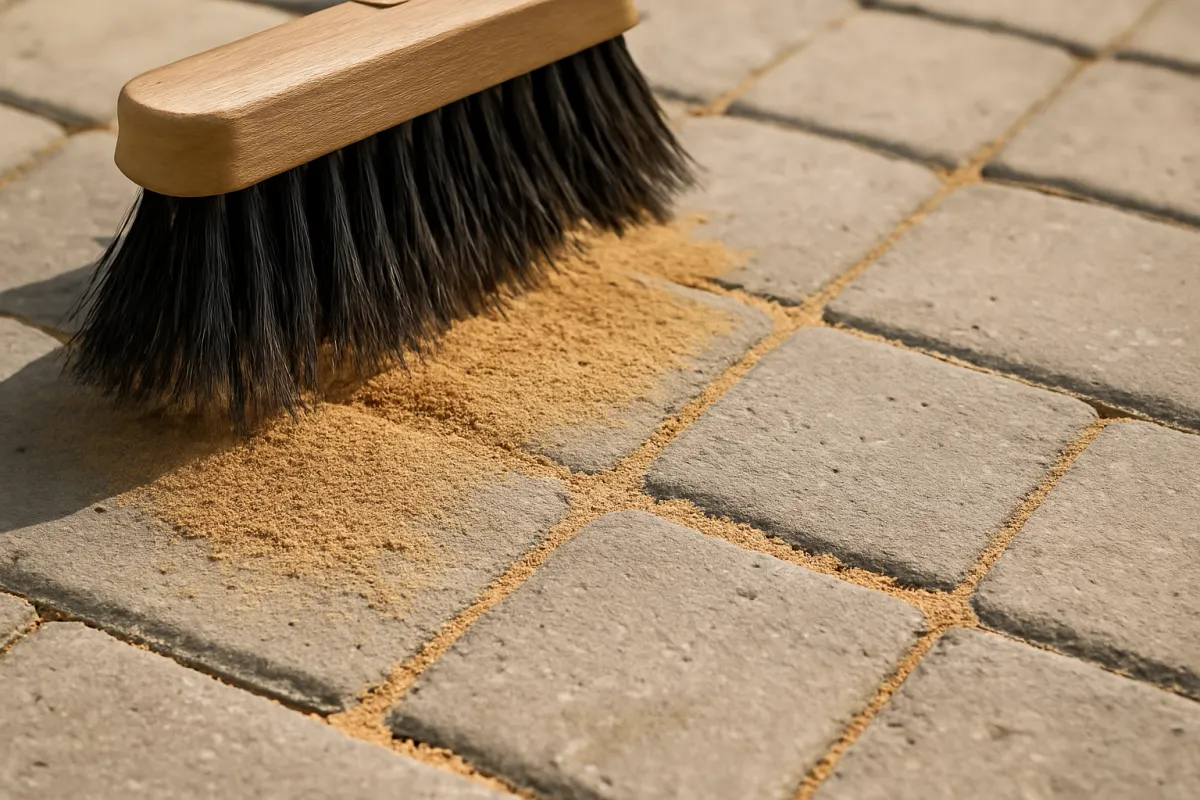
Joint sand is the material swept into the gaps between set pavers at the end of the job, and it is a separate product from the bedding sand underneath, priced by coverage per bag rather than by depth over the whole area. Plain sand works but washes out and invites weeds over time; polymeric joint sand contains a binder that hardens when wetted and resists both problems meaningfully better, which is why it has become the common default on a professionally installed patio. Neither the edge restraint nor the joint sand is where an installed bid saves real money, but both are exactly the sort of quiet line a stripped-down quote sometimes omits, so confirm them explicitly when comparing bids.
Access and the install itself
Paver installation is slower, more methodical work than a concrete pour, and access decides how efficiently a crew can move through it. The best case is a yard a small skid loader or wheelbarrow can reach directly with base material and pallets of pavers staged close to the work, letting a crew set units at a steady pace without wasted trips. Every obstacle between the material and the patio converts that into labor: a narrow gate, a steep slope, or a long carry from the driveway means hand-trucking gravel and sand and hauling pavers by hand pallet by pallet, all of which is time a bid prices.
Because pavers are set unit by unit rather than poured in one operation, a paver patio does not carry the same single-day urgency a concrete pour does; there is no wet material setting on a clock. That cuts both ways on cost. It means weather and timing pressure a paver crew less than a concrete crew, but it also means the job itself simply takes longer in skilled hours, since every paver is placed, checked, and tapped to level individually rather than screeded as one continuous surface. A crew’s daily production rate, how many square feet they can realistically set in a day, is one of the quieter numbers behind a bid, and it is worth asking an installer directly rather than assuming pavers go down as fast as concrete pours.
Where the money goes
Understanding the split inside an installed price is what makes bids legible, and on a paver patio the split runs differently than it does on poured concrete, because the pavers themselves are a finished product rather than a raw material. The chart below splits an illustrative concrete-paver patio into rough shares.
Where the cost of an installed paver patio goes
Illustrative split for a concrete paver patio; shares shift with material, pattern, and access.
Unlike a poured slab, where labor dominates because the raw concrete is cheap, a paver patio splits more evenly between labor and material because the pavers themselves are a manufactured or quarried product with real unit cost. Upgrading the material moves this split toward the paver segment; upgrading the pattern moves it toward labor.
Two conclusions follow from the split. First, material choice moves cost in this job more than it does on poured concrete, because stepping up from concrete to natural stone raises a real material line, not just a finishing touch. Second, labor still matters enormously, and the levers you control map onto the segments: DIY effort attacks the labor share, a simpler pattern attacks the cutting labor inside it, and material choice attacks the pavers share directly. When a bid arrives high, ask which segment is carrying the weight, a premium stone, hard access, or a complex pattern, before assuming margin. An installer who can walk you through the split is usually one whose number you can trust.
Paver patio vs poured concrete, gravel, and a deck
A paver patio competes with three common alternatives, and the honest comparison is installed cost against how each surface lives. A plain poured concrete patio runs an illustrative 8 dollars per square foot against a concrete paver patio’s 18, because a monolithic pour needs far less placing labor than individual hand-set units; our concrete patio cost brief prices the poured side in full. What pavers buy for the premium is repairability, a damaged unit lifts out and swaps in, and a settled corner can be reset without touching the rest of the patio, while a crack across concrete is permanent and hard to hide. Over decades, pavers also want joint sand and occasional resetting, so neither surface is maintenance-free; they just age differently.
Gravel is the budget floor: a compacted gravel sitting area can be built for a small fraction of any hard surface, though it stays loose underfoot, migrates, and wants topping up; the same material logic as our gravel driveway brief applies at patio scale. A wood or composite deck is the other direction, commonly costing more per square foot than concrete pavers once framing, decking, and railings are counted, and carrying a heavier maintenance schedule, but it wins where the yard slopes or the door sits high above grade, places where a ground-level patio would need serious fill. The right answer is site-shaped: on flat ground with a budget, poured concrete is hard to beat; on a slope, a deck earns its structure; where repairability, pattern, and material variety lead, pavers make their case.
Removing an old surface first
If a cracked patio, a tired deck, or an old gravel bed already occupies the spot, demolition and haul-away come first, and it is a real line: an illustrative 2 to 4 dollars per square foot to break out, load, and dispose of an old hard surface, moving with material, thickness, access, and local disposal fees. A failed concrete slab is heavy work to break and haul, an old deck is faster to tear out but generates volume rather than weight, and an existing gravel bed is often the easiest removal of the three since it can sometimes be regraded and reused as part of the new base rather than hauled away entirely.
Three notes keep this line honest. First, get the demolition inside the same bid as the new patio where you can; a crew already mobilized prices the breakout better than a separate job would. Second, ask where the old material goes, because clean concrete and gravel are both widely recycled, sometimes at lower disposal cost than mixed debris. Third, resist the temptation to pave directly over a failing old surface without addressing why it failed. Setting new pavers over a settled old base inherits the same drainage and settlement problem that caused the original failure, which is why the excavation and fresh base belong in every removal bid, not an optional add.
Extras: steps, borders, and drainage
The base rate prices a rectangle of finished pavers, and real patios accumulate extras around it. Steps are the most common: a door that sits above patio grade needs one or more paver or masonry steps, each built as its own small structure with its own base, and stepwork is labor-dense for its size, so even a short run adds a real line to the bid. Borders are often built in rather than added on with pavers, a soldier course or a contrasting color framing the field, which is also one of the better value moves, buying a custom, finished look mostly through layout rather than a more expensive material across the whole area.
Drainage is the extra that pays for itself: if the yard sheds water toward the patio, or the patio will sit against the house, plan the grading and any drain line before the base goes in. A patio built across a wet spot becomes a dam for standing water that works into the joints and undermines the base from below, and the fix afterward costs more than the prevention would have; our french drain cost brief prices that work per foot. Circular inserts or curved beds are their own extra too, since curved cutting and a purpose-made circle kit both carry a premium over a straight rectangle. List the extras your site actually needs before you collect bids, so every installer prices the same project and the low bid is not simply the shortest scope.
Sealing and maintenance cost
A paver patio’s pitch is that ownership is manageable, and it mostly is, though not entirely passive. The recurring line, for owners who choose to seal, is the sealer itself. A paver sealer can lock joint sand against weeds and washout, deepen color, and add stain resistance, and as an illustrative, typical range it runs around 0.20 to 0.75 dollars per square foot in product cost, with a penetrating sealer near the lower end and a film-forming or joint-stabilizing product near the upper end. Our paver sealer guide sorts the families in full, including why the cheaper gallon sometimes costs more across a decade once repeat applications are counted.
The rest of the maintenance schedule is chores more than cost: resweep joint sand where it has thinned, pull weeds before they establish, rinse the surface, and watch drainage over the years, since a downspout redirected onto a patio or soil built up against its edge can undo the grading the base was built with. Individual pavers rarely need replacing on their own, but when one does, oil-stained, cracked, or sunk, it lifts out and a spare or matching unit drops in, a repair a poured slab cannot offer. Kept jointed and drained, a paver patio’s decades of service cost relatively little per year once the install is paid for.
DIY paver patio cost
Installing your own paver patio attacks the largest share of the price, the labor, and on a small patio the saving is real. The DIY bill is materials plus rentals: the pavers themselves at their per-square-foot material cost, base gravel, bedding sand, edge restraint, joint sand, and a day or two of plate compactor rental. A 10 by 12 pad needs roughly a cubic yard and a half of base gravel and well under a cubic yard of bedding sand, so its material bill can land meaningfully under an installed quote several times the size, especially with concrete pavers, the material family with the most widely available DIY-friendly product. The sequence, layout, excavation, base, sand, laying, cutting, edging, jointing, is exactly what our paver patio walkthrough carries step by step, and our paver count manual does the ordering math.
The honest caution is patience and precision rather than brute labor. Unlike a concrete pour, there is no setting clock forcing the pace, which is forgiving, but every paver has to be set level and tight against its neighbors, and a base that is under-compacted will not announce the mistake until months later when the surface starts to dip. Natural stone and porcelain are harder DIY materials than concrete or clay brick, since irregular stone demands more layout judgment and porcelain demands more careful cutting; a first paver project is usually easier and more forgiving with concrete units. The popular middle path is to self-perform the excavation and base, the slow, physical, forgiving work, then hire out the paver setting itself, or the reverse. Whichever path you take, spend your effort on the base, because that is where DIY quality actually shows up years later.
From price per foot to your total
Turning the rates in this brief into your own planning number is three steps. First, measure the real area: length times width in feet for a rectangle, added in pieces for an L-shape or a wrapped corner, as our square footage manual shows. Measure the patio you will actually build, against the house and the yard, not the round number in your head. Second, pick the installed rate for your material: an illustrative 18 dollars for concrete pavers, 20 clay brick, 24 porcelain, 32 natural stone. Multiply, and you have the base figure; a 14 by 10 patio at 18 dollars is 140 square feet and about 2,520 dollars.
Third, adjust for what the base rate cannot see. Add for demolition if an old surface must go, for steps and a built-in border, for hard access or a sloped site, for drainage work, and for a premium sealer if you plan one. Nudge upward for a herringbone or curved pattern over a plain running bond, and in a high-cost region, and for a small pad where fixed costs spread thin. The result is not a quote, it is a defensible expectation, and that is its whole job: it tells you which bids deserve questions, which seem to be pricing a different scope, and whether the project fits the budget before anyone visits. The estimator turns your dimensions into area with a waste allowance in seconds, and the companion below runs this entire method live on your numbers, material and all, as you read the rest of the brief.
Ways to keep paver patio cost down
A paver patio budget has real levers, and the material is the biggest one: the same footprint in concrete pavers at an illustrative 18 dollars versus natural stone at 32 is nearly double for the same base and the same footprint, so choosing concrete or clay brick captures most of what a paver surface offers for meaningfully less. Pattern is the next lever: a plain running bond cuts waste and cutting labor compared with herringbone or a curved layout, and a contrasting border built into the field is the value version of a premium look, paying the extra only at the perimeter. Size matters too, since every square foot carries the full rate: trimming a plan from 500 to 400 square feet saves real money without changing how the space lives.
Timing and labor round out the list. Bids soften when crews are hungry, so pricing the job for shoulder season rather than peak spring can find better numbers. Self-performing the slow, forgiving parts, excavation and base work, converts labor lines into your own effort while leaving the precision setting to professionals, or the reverse if cutting and layout feel more approachable than moving gravel. What should never be cut is the structure: the base depth, the compaction, and the edge restraint are what keep the patio flat and in shape, and savings there are borrowed at bad interest. Cut the material, the pattern, the size, and the schedule, never the ground the pavers sit on. A concrete paver patio on a good base outlives a stone one on a bad base every time.
A worked example: a 14 by 10 patio priced
Take the common case end to end: a 14 by 10 foot concrete paver patio behind a house, flat yard, decent soil, direct access for staging material. The area is 140 square feet. At the illustrative 18 dollar midpoint the planning figure is about 2,520 dollars installed. Inside that number sits the physical job: excavation and grading, a compacted gravel base at roughly a 5 inch depth working out to about 2.6 cubic yards with a compaction allowance, about 12 cubic feet of screeded bedding sand, the pavers themselves set in pattern, edge restraint around the open sides, and joint sand swept and compacted into the gaps. The paver material itself, following the illustrative 40 percent material share, is roughly 1,000 dollars of that total, which is the point worth staring at: the pavers are a real cost, but labor and base together still carry the majority of the bid.
Now flex the levers. The same footprint in clay brick runs near 2,800 dollars, porcelain near 3,360, natural stone near 4,480. Compare the same area poured in plain concrete instead and it reads near 1,120 dollars, a useful anchor for how much of the paver premium is buying repairability and look rather than a bigger structural job underneath. Add an old surface to remove at an illustrative 3 dollars per square foot and any of those figures climbs about 420 dollars. Give the yard bad access, hand-carried material instead of a direct staging area, and the labor line grows; give it a herringbone pattern instead of running bond and the cutting labor does too. The footprint never changed: every swing came from material, pattern, and access, which is the entire lesson of this brief. Price your own version in the companion below and watch the same levers move your number.
The bottom line
Paver patio cost comes down to a short list in a fixed order: the area, the material, the ground, and the pattern. Carry the illustrative rates, 14 to 25 dollars per square foot installed for concrete pavers with a midpoint near 18, roughly 20 for clay brick, 24 for porcelain, and 25 to 45 for natural stone, then multiply by your measured square footage for the base figure. Remember that a patio quote prices a finished surface, base, sand, edge restraint, and jointing included, not a pallet of loose units, and that labor and the pavers themselves together carry most of the bid, so your material choice and your site move the real number more than any table. Pavers cost more than plain poured concrete on flat ground while offering something concrete cannot, individual units that lift out and reset when something goes wrong; their honest weakness is a higher up-front price for that repairability, which is why the base and edge restraint are sacred and the low bid that skimps on either is expensive later. Measure with the estimator, price your material in the companion below, read our paver patio walkthrough for the build itself, then collect written bids that all cover the same scope. A patio priced that way arrives as a decision, not a surprise.
This cost brief is workbench education for planning a paver patio budget, not a quote, a design, or a construction specification. Every dollar figure in it, per square foot, per material, and per project, is an illustrative planning number, and your soil, slope, drainage, access, pattern, local labor market, and season will each move a real bid, sometimes substantially. A paver patio still has structural requirements, base depth, compaction, edge restraint, and drainage, that depend on your ground and climate and may be governed by local codes or permit rules, so have them specified by a qualified installer for your site rather than borrowed from a general article. Pavers shift and settle without a proper base, and outcomes ride on prep work you cannot inspect once the joints are swept, which is one more reason to hire on scope and reputation rather than price alone. Build your actual budget on current written bids from local installers, not on any single figure printed here.
Frequently asked questions
How much does a paver patio cost per square foot?
As an illustrative planning range, a concrete paver patio commonly runs somewhere around 14 to 25 dollars per square foot installed, with a working midpoint near 18 dollars. That installed figure bundles the excavation, the compacted gravel base, the bedding sand, the pavers themselves, the edge restraint, the cutting, and the joint sand, which is why it reads well above the per-piece price a yard quotes for the pavers alone. Clay brick pavers run a bit above concrete, near an illustrative 20 dollars, porcelain pavers nearer 24, and natural stone pavers commonly the highest at roughly 25 to 45 dollars per square foot. Site conditions, access, pattern, and regional labor rates all move the figure, so treat any single number as a starting point and collect written local bids.
How much does a 200 square foot paver patio cost?
At an illustrative 18 dollars per square foot for concrete pavers, a 200 square foot patio lands near 3,600 dollars as a planning figure. Step the same footprint up to clay brick near 20 dollars and it reads about 4,000 dollars, to porcelain near 24 it is about 4,800 dollars, and to natural stone near 32 it climbs to roughly 6,400 dollars. The area math is simple, multiply length by width, then multiply by the installed rate for the material you want, but what it cannot see is your site, so a sloped yard, poor soil, tight access, or an old surface that has to come out first will each add to the base figure. Use the area method for a defensible starting number, then let local bids set the real one.
Is a paver patio cheaper than a concrete patio?
No, usually the reverse, and often by a meaningful margin. As illustrative installed figures, a plain concrete patio runs near 8 dollars per square foot while a concrete paver patio runs near 18, because pavers are individual units set by hand on a screeded base and that hand labor is expensive. The trade-off runs the other direction in ownership: a damaged paver lifts out and swaps in, while a crack across a poured patio is permanent and hard to hide invisibly. If the up-front budget rules, concrete usually wins; if long-term repairability and a wider look matters more, pavers earn their premium. Our concrete patio cost brief prices the poured side of this comparison in full.
What is the cheapest paver patio material?
Concrete pavers are typically the least expensive paver option, commonly an illustrative 14 to 25 dollars per square foot installed with a midpoint near 18, because they are manufactured in high volume and set in regular, predictable units. Clay brick pavers sit a step above, porcelain pavers a step above that, and natural stone pavers are usually the most expensive because every unit is cut or split from quarried material with far more size and color variation to sort through. Within any one material, the cheapest path is still a plain color in a simple running bond pattern on a straightforward rectangle, since pattern, cut waste, and a border all add labor regardless of which paver sits on top.
How much does paver patio base and sand cost?
Base and bedding sand are a modest share of an installed paver patio, commonly well under a fifth of the total, but they are not free and they are never the place to cut corners. A compacted gravel base is typically 4 to 6 inches deep, ordered by volume with roughly a 20 percent allowance for compaction, and a bedding sand layer is only about 1 inch on top of it. On a 140 square foot patio at a 5 inch base depth, that works out to roughly 2.6 cubic yards of gravel and about 12 cubic feet of bedding sand, which our gravel and sand manuals price by the yard and bag. Joint sand swept into the gaps at the end is a separate, smaller product line priced by coverage per bag.
Can I install a paver patio myself to save money?
A paver patio is one of the more realistic do-it-yourself hardscape projects, and the saving is real because labor and markup are a large share of an installed price. The sequence, excavation, base, sand, laying, cutting, edging, and jointing, is methodical rather than technically demanding, and our paver patio walkthrough carries all eight steps with a worked example. The honest caution is scale and patience: a 140 square foot patio is several hundred individual units to set level and tight, the base compaction has to be right before a single paver goes down, and rushing the layers underneath is the most common way a DIY patio fails early. Many owners self-perform the excavation and base, then hire out the paver setting itself, or the reverse, hiring the base work and doing the paving themselves.
How much does it cost to seal a paver patio?
As an illustrative, typical range, sealing a paver patio commonly runs around 0.20 to 0.75 dollars per square foot in product cost, with a penetrating sealer near the lower end and a film-forming or joint-stabilizing sealer near the upper end. On a 140 square foot patio that is roughly 30 to 100 dollars per application in materials alone, before any professional labor. Our paver sealer guide sorts the sealer families and explains why a cheaper film-forming product that reseals every 2 to 3 years can cost more over a decade than a pricier penetrating sealer that lasts longer between coats.
How long does a paver patio last, and what maintenance does it need?
A well-built paver patio commonly lasts an illustrative 25 to 50 years, and the range is wide because the individual pavers themselves rarely wear out; what ages a paver patio is the base underneath and the joints between the units. Maintenance is light but steady: resweep joint sand as it settles or washes out, pull occasional weeds before they root, rinse the surface, and reseal on a multi-year cycle if the look matters to you. The structural advantage over a poured surface is repair: a settled or stained paver lifts out individually and resets or swaps, which a cracked concrete slab cannot do. Keep the joints full and the drainage working and a paver patio holds its shape for decades.