What's on this page
- Why the paver count starts with the paver, not the patio
- The paver quantity formula in one line
- Pavers per square foot, derived from the paver’s own size
- Nominal size, actual size, and the joint in between
- Measuring the patio area, including irregular shapes
- Measuring a walkway, and why narrow shapes waste more
- What the laying pattern does and does not change
- Running bond versus herringbone at 45 degrees
- The cut waste allowance, derived from the perimeter
- Border courses and soldier rows: counting the edge separately
- Edge restraint: a linear foot quantity, not an area
- The gravel base underneath, in cubic yards
- Bedding sand: the one inch screed layer
- Joint sand, and why the paver size sets it
- Excavation: the spoil you have to move
- A worked example: a 14 by 10 foot patio, cross-checked two ways
- Cross-checking a count by rows and columns
- Circles, curves, and fan patterns
- Steps, landings, and a patio that meets a house
- Buying by the piece, the square foot, or the pallet
- Where a paver estimate goes wrong
- Your paver order checklist
- The bottom line
Every paver estimate that goes wrong goes wrong in the same place: someone looks up a pavers-per-square-foot number instead of working it out from the paver in front of them. Paver sizes vary more than almost any other material this site covers, and the difference between 4.5 pavers per square foot and 2.25 is a factor of two on an order that arrives by the pallet. The good news is that the figure is not something you have to look up at all. It falls straight out of the paver’s own dimensions with one division, and once you can do that division the rest of the count is ordinary area math.
This manual works a paver order end to end, from a tape measure on the lawn to a list you can hand a yard. It derives pavers per square foot from the paver’s face, measures irregular and curved footprints, sets the cut waste allowance from the pattern and the perimeter, counts a border course separately, and prices the three quantities underneath the pavers that people forget: the gravel base, the bedding sand, and the joint sand. For the build itself, our paver patio walkthrough carries the eight steps in order, so nothing here repeats them. Run your own footprint through the material coverage estimator, and the companion below recalculates every section on your dimensions as you read.
Key takeaways
- Pavers per square foot is a division, not a table: 144 square inches divided by the paver's face area in square inches. A 4 by 8 inch paver gives 144 over 32, or 4.5 per square foot.
- The pattern does not change the field count, only the waste. Running bond runs near 10 percent, herringbone at 45 degrees near 15 percent, and curves or circles higher still.
- Cut waste tracks the perimeter, not the area, so narrow walkways waste roughly twice the percentage a wide patio does for the same cut band.
- A border or soldier course is counted from the band's centerline perimeter divided by the paver's short side, and the field inside shrinks by twice the band width each way.
- Three quantities sit under the pavers: gravel base and bedding sand by the cubic yard, joint sand by the bag, plus edge restraint measured in linear feet.
Why the paver count starts with the paver, not the patio
Most material estimates on this site start with the space. You measure a driveway and the gravel follows, you measure a slab and the concrete follows, because those materials pour to fill whatever shape you give them. Pavers behave differently. They are discrete units with a fixed face, so the space tells you only half the story and the paver tells you the other half. Two patios of identical size can want 630 pavers or 140 pavers depending on nothing but which unit sits on the pallet.
That is why the first number to settle is not the patio dimensions but the paver’s face dimensions in inches. Concrete pavers are sold in a genuinely wide range: small rectangles around 4 by 8 inches, squares at 6, 8, or 12 inches, plank shapes running 6 by 12 or 12 by 18, and large format slabs at 16 by 16 or 24 by 24. Some ranges mix three or four sizes in a single pallet to produce a random pattern, which turns the count into a per-size problem rather than a single figure.
The practical consequence is that any paver calculator that asks only for length and width is hiding an assumption about your paver. Ours does not, and neither should your hand math. Get the paver’s real face dimensions from the product spec sheet or by laying a tape across a sample, and the whole calculation becomes reliable. Everything after this section assumes you have that one measurement, in inches, for the specific unit you intend to buy.
The paver quantity formula in one line
The entire calculation reduces to one line: patio area in square feet, times pavers per square foot, times a waste multiplier, rounded up. Written out with the derivation folded in, it reads as area times (144 divided by the paver face area in square inches) times (1 plus the waste fraction). Every other section in this manual is either measuring one of those inputs more carefully or adding a material that rides alongside the pavers.
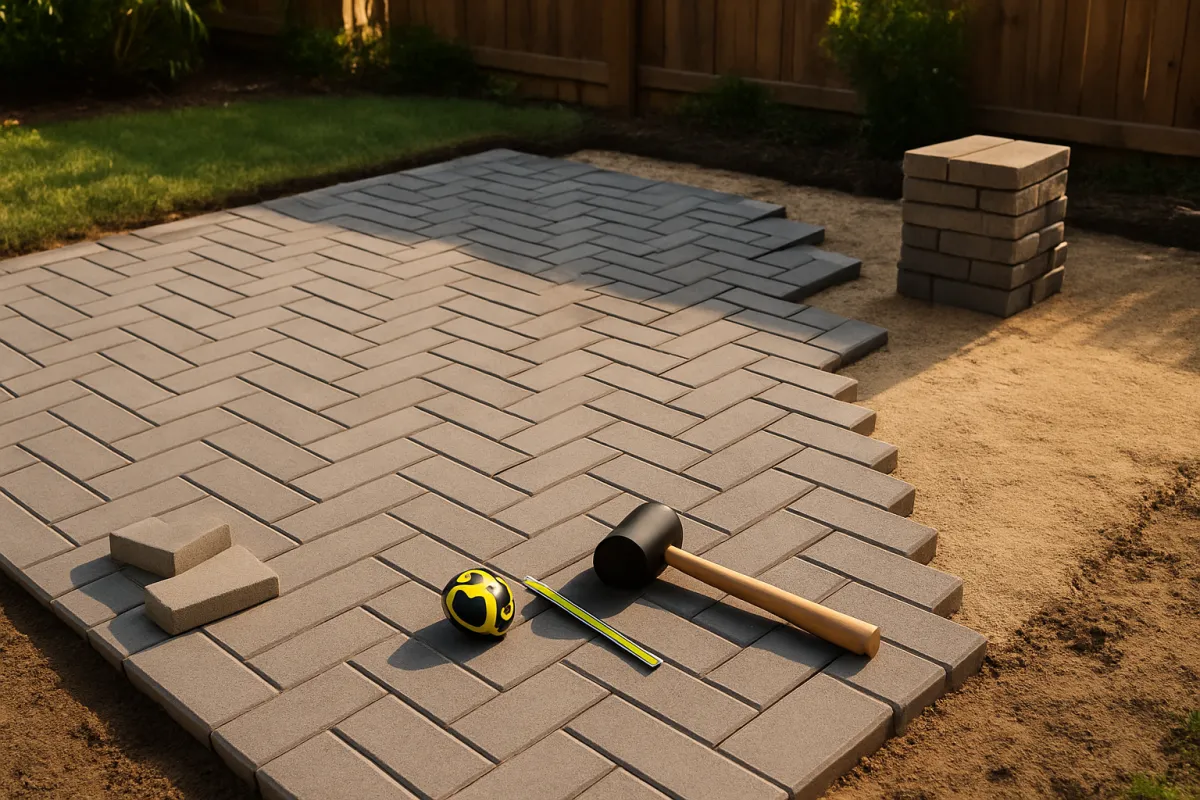
Take the running example this manual returns to: a patio 14 feet by 10 feet, laid in 4 by 8 inch pavers, in a herringbone pattern set at 45 degrees. The area is 14 times 10, or 140 square feet. The paver face is 4 times 8, or 32 square inches, so pavers per square foot is 144 divided by 32, which is exactly 4.5. The field count is 140 times 4.5, or 630 pavers. The herringbone waste allowance is 15 percent, so 630 times 1.15 is 724.5, and you order 725.
That is the whole formula. Notice that no step required looking anything up. The 144 is the number of square inches in a square foot, the 32 came off the paver, and the 15 percent came from the pattern. The only judgement call in the line is the waste percentage, which is why several sections below are devoted to setting it honestly rather than picking a round number and hoping.
Pavers per square foot, derived from the paver’s own size
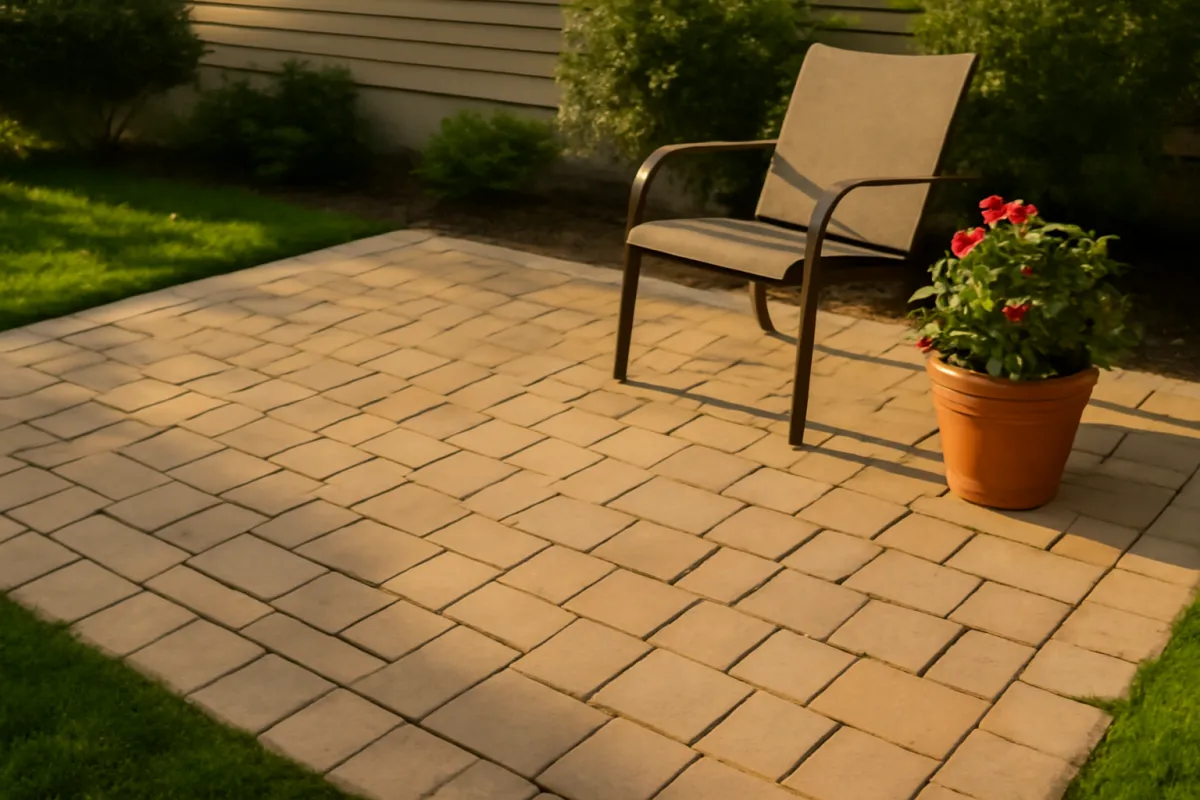
This is the section worth reading twice, because it replaces a memorised table with a method that never goes stale. A square foot is 12 inches by 12 inches, which is 144 square inches. A paver’s face covers some number of those square inches. Divide 144 by that face area and you have how many of that paver it takes to cover one square foot. There is no rounding, no product-specific fudge, and no need to trust a chart someone else typed.
Run it on the common sizes and the spread is immediately obvious. A 4 by 8 inch paver has a 32 square inch face, so 144 over 32 is 4.5 per square foot. A 6 by 6 inch square is 36 square inches, so 144 over 36 is exactly 4. A 6 by 9 inch is 54 square inches, giving 2.667. An 8 by 8 inch square is 64, giving 2.25. A 12 by 12 inch is 144 square inches, which lands on a satisfying 1 paver per square foot. A 16 by 16 inch slab is 256 square inches, giving 0.5625, or a bit over half a paver per square foot.
Pavers per square foot by paver face size
Each figure is 144 square inches divided by the paver's face area, computed from the nominal dimensions.
Every value is 144 divided by the face area in square inches, and every bar width is that value divided by the largest, 4.5, times 100. The eightfold spread between the smallest and largest unit is exactly why a paver count cannot start from a generic figure.
Two habits make the division safe. Multiply the two face dimensions in inches before dividing, never mix units, and keep the decimal rather than rounding to a neat number, because on a large patio a rounded 2.7 instead of 2.667 drifts by several pavers. If a range mixes sizes on one pallet, work out each size’s own figure and apply it to the share of the surface that size covers, then sum. Our material coverage reference keeps the same divide-to-derive posture for the other materials on a project.
Nominal size, actual size, and the joint in between
There is a wrinkle worth knowing before you trust the division, and it is the same wrinkle that appears in block and brick work. Many pavers are sold under a nominal size that is slightly larger than the unit you can measure. A paver described as 4 by 8 inches frequently measures closer to 3 and seven eighths by 7 and seven eighths, with the missing eighth of an inch reserved for the joint between units. Sand-set pavers are laid tight, so that joint is narrow, but it is not zero.
Which size should the calculation use? The nominal one, because the nominal size describes the space one paver occupies on the finished surface, joint included. Using the actual size instead makes the count run high, since it assumes the pavers touch with no gap at all. On our running example, the actual 3.875 by 7.875 face is 30.52 square inches, which would give 4.72 pavers per square foot rather than 4.5, inflating a 140 square foot patio by about 31 pavers you would not use.
The practical rule is to take the size the manufacturer lists, run the division on that, and let the waste allowance absorb the difference between nominal and reality. If the spec sheet lists only the actual dimensions, add the intended joint width to each dimension before dividing, which reconstructs the nominal figure. And if you have a sample on hand, the most honest check of all is to lay ten pavers in a line the way they will sit, measure the run, and divide, which captures the real joint your hand and your sand produce.
Measuring the patio area, including irregular shapes
For a plain rectangle the area is length times width and there is nothing more to say, but real patios are rarely plain rectangles. The method that handles everything else is decomposition: break the footprint into shapes you can measure, calculate each one’s area, and sum them. Our square footage manual works this in full, and the same discipline applies here with one addition, which is that you should also record each piece’s perimeter for the waste calculation later.
An L shaped patio is two rectangles. Draw the outline, choose the cut line, measure both pieces, and add: a 12 by 10 foot main area plus an 8 by 6 foot return is 120 plus 48, or 168 square feet. A patio with an angled corner is a rectangle minus a triangle, and a triangle’s area is half its base times its height, so a corner cut 4 feet by 3 feet removes 6 square feet. A curved edge is best handled by treating the curve as a straight line through its midpoint, which errs slightly high, then letting the waste allowance carry the rest.
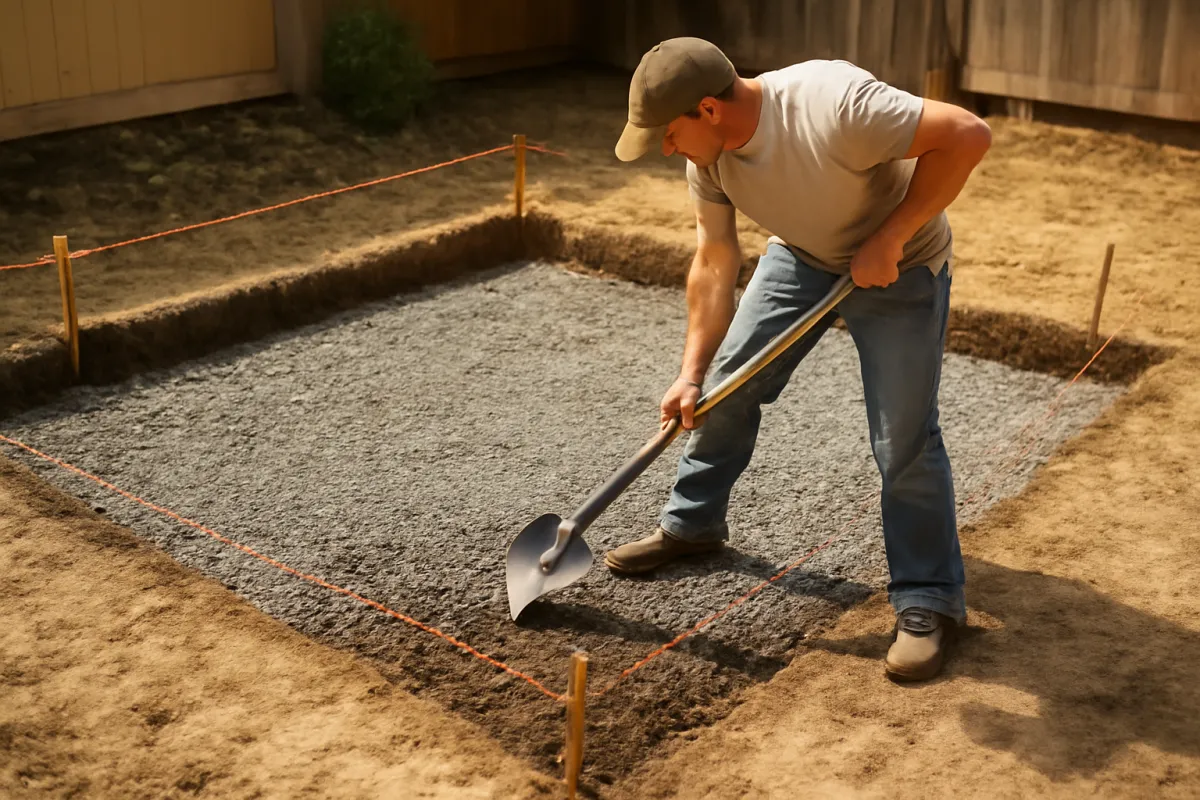
Two measuring habits save more pavers than any formula. First, measure the footprint you intend to build, not the lawn you intend to dig up, because those differ by the excavation overcut on every side. Second, sketch the shape with every dimension written on it before you touch a calculator. A sketch is where a forgotten step landing, a return along the side of the house, or a curved corner announces itself, and it is the document you will want again when the border course and the edge restraint need counting.
Measuring a walkway, and why narrow shapes waste more
A walkway is measured exactly the way a patio is, length times width in feet, times pavers per square foot. A path 3 feet wide and 40 feet long is 120 square feet, and at 4.5 pavers per square foot that is 540 pavers before waste. If the path runs 8 inch pavers along its length, the row check confirms it: 40 feet is 480 inches, which is 60 pavers per row, and 3 feet is 36 inches, which is 9 rows of 4 inch width, giving 540 exactly.
The interesting part is what happens to the waste allowance. That 120 square foot walkway has a perimeter of 2 times 3 plus 40, or 86 feet. The 14 by 10 foot patio in the running example is larger at 140 square feet but has a perimeter of only 48 feet. Cutting happens along the perimeter, not across the area, so the walkway carries nearly twice the cut length for slightly less surface. The next section turns that observation into a number, but the direction is worth internalising now: the narrower the shape, the higher the waste percentage.
The same logic applies to any long thin element in a project. A 2 foot wide border strip along a driveway, a stepping stone path, a narrow side return between a house and a fence, all of them punch above their area in cuts. If a project mixes a wide patio with a narrow path, resist the temptation to add the areas and apply one blanket percentage. Calculate the wide part and the narrow part separately, give each its own allowance, and add the results, which is both more accurate and easier to check.
What the laying pattern does and does not change
Pattern is the input people most often expect to change the count, and it is worth being precise about what it actually moves. A square foot of finished surface takes 4.5 of your 4 by 8 inch pavers whether they are laid in running bond, stack bond, basketweave, or herringbone, because the pavers do not change size when you rotate them. The field count is a property of the area and the unit, and the pattern has no effect on it whatsoever.
What the pattern changes is the cutting. A pattern determines how the units meet the boundary of the surface, and the boundary is where every cut happens. Some patterns meet a straight edge with a full paver or with a clean half that pairs with its own offcut, which produces almost no waste. Others meet the edge at an angle that leaves a triangle, and the triangle’s mate is usually the wrong shape for the next gap along, which means the offcut goes in the skip.
Where a paver order goes on a bordered patio
Illustrative split of the 712 paver order in this manual's worked example.
Every share is its count divided by the 712 paver order: 494 field pavers, 136 border pavers, the 15 percent field cut allowance of 75, and 7 for the border cuts and spares, rounded to whole percents that still sum to 100. The border earns a smaller allowance than the field because its pieces are cut square.
There is a second, quieter pattern effect on ordering rather than counting. Patterns that mix two or three paver sizes need each size in the right proportion, and buying the wrong ratio leaves you with a pallet of one size and a shortage of another. If your pattern is a multi-size modular layout, take the ratio from the pattern’s repeat unit, apply it to the field count, and order to those shares rather than to a single lump total.
Running bond versus herringbone at 45 degrees
These two are the comparison that matters most, because they bracket the realistic range of cut waste on a rectangular patio. Running bond lays rectangular pavers in straight courses, each course offset by half a paver from the one before. Where a course meets a straight edge it needs a half paver, and the offcut from that cut is itself a half paver that fits the next course that needs one. Waste in a plain running bond is genuinely small, and 10 percent is a comfortable allowance that mostly covers breakage and human error.
A herringbone laid at 45 degrees to the patio edges is the other end. Every paver that reaches the boundary meets it diagonally, so every edge piece is cut at an angle, and because the herringbone alternates direction, consecutive edge gaps are mirror images rather than repeats. The triangle you cut off to fill one gap is usually the wrong hand for the next. That is the whole mechanism behind the higher allowance, and it is why 15 percent is the common starting figure for a 45 degree herringbone rather than 10.
The middle ground is a herringbone rotated to 90 degrees, running parallel with the edges. It keeps the interlocking strength that makes herringbone popular for driveways while meeting the boundary squarely, so its offcuts behave much more like running bond and an allowance nearer 10 to 12 percent is reasonable. Basketweave and stack bond also meet straight edges cleanly. If you have a choice and the budget is tight, the pattern orientation is the cheapest lever you have: rotating a herringbone from 45 to 90 degrees can save roughly a twentieth of the order on a plain rectangle.
The cut waste allowance, derived from the perimeter
Rather than treating the waste percentage as folklore, it can be derived, and doing so explains why the standard figures are what they are. Cutting happens in a band along the perimeter of the surface, and the band is roughly as wide as one paver. So the area that gets cut is approximately the perimeter in feet times the band width in feet. Of that cut area, roughly half typically ends up as unusable offcut, though a pattern with reusable halves does better and a diagonal pattern does worse.
Apply it to the running example. A 14 by 10 foot patio has a 48 foot perimeter. With a 4 inch band, which is 0.333 feet, the cut area is 48 times 0.333, or 16 square feet, and half of that is 8 square feet wasted. Against the 140 square foot patio, that is 5.7 percent. Now the 3 by 40 foot walkway: 86 foot perimeter times 0.333 is 28.7 square feet cut, half wasted is 14.3 square feet, and against 120 square feet that is 11.9 percent. Same band, same method, roughly double the percentage.
That model produces the baseline, and the pattern multiplies it. A square-meeting pattern recovers many offcuts and lands below the model’s half-wasted assumption, while a 45 degree layout recovers almost none and lands above it. This is why the published allowances range from about 5 percent for a plain rectangle in stack bond up to 20 percent or more for circles and fans. Treat all of those as illustrative planning figures, use the perimeter model to sanity check whether your shape deserves the low end or the high end, and lean high when the pavers are expensive to reorder in a matching batch.
Border courses and soldier rows: counting the edge separately
Many patios finish with a border, a course of pavers around the perimeter laid differently from the field to frame it. The most common is a soldier course, where rectangular pavers are turned so their long dimension runs across the band, giving an 8 inch wide border from a 4 by 8 inch paver. A border is worth counting on its own, because it changes both the field area and the waste allowance, and because the two counts give you a cross-check that costs nothing.
The border count comes from the band’s centerline perimeter divided by the paver’s short dimension. For the 14 by 10 foot patio with an 8 inch soldier border, the band centerline sits 4 inches in from each edge, so the centerline rectangle is 14 minus 0.667 by 10 minus 0.667, which is 13.333 by 9.333 feet, a perimeter of 45.333 feet. Divide by the 4 inch paver width, which is 0.333 feet, and the border needs 136 pavers.
The field shrinks by twice the band width in each direction: 14 minus 1.333 by 10 minus 1.333, which is 12.667 by 8.667 feet, or 109.78 square feet. At 4.5 pavers per square foot that is 494 field pavers. Add the two and you get 494 plus 136, which is 630, exactly the whole-patio count from the plain formula. That agreement is the cross-check: if your border and field counts do not sum back to the undivided count, one of the two is wrong. Borders also earn a lower allowance, around 5 percent, because soldier pieces are cut square.
Edge restraint: a linear foot quantity, not an area
Edge restraint is the one paver-project quantity that is neither an area nor a volume, and it gets forgotten precisely because it does not fit the pattern of the others. It is measured in linear feet along every open edge of the surface, the edges that are not already contained by a wall, a house, a kerb, or an existing hard surface. Without it the outer courses creep outward over a few seasons and the joints open, which no amount of extra sand fixes.
Count it from the sketch. A freestanding 14 by 10 foot patio has all four sides open, so the restraint run is the full 48 foot perimeter. The same patio built against a house along one 14 foot side has 14 plus 10 plus 10, or 34 linear feet of open edge. A walkway 3 feet wide and 40 feet long usually needs restraint down both long sides and often across the two ends, so 86 feet if fully contained, or 80 feet if the ends butt into a step and a driveway.
Restraint is typically sold in fixed length sections and fixed with spikes at intervals, so convert the linear feet into whole sections by dividing by the section length and rounding up, then read the spike spacing off the product rather than assuming one. Curves need more spikes than straight runs because the material is being held against its own springback, and outside corners often want an extra fixing on each side. Confirm the section length and the recommended spacing on the specific restraint you buy, since both vary by product and neither is safe to guess.
The gravel base underneath, in cubic yards
The gravel base is the largest quantity on the whole job by volume and the one most likely to be under-ordered. It is a volume calculation, so the method is area times depth in feet, divided by 27 for cubic yards, exactly as our gravel manual works it for any other stone job. The trap, every single time, is that depth arrives in inches and has to be divided by 12 before it multiplies the area.
An illustrative walk-on patio base is about 4 inches of compacted angular gravel, deeper on soft or clay ground and considerably deeper for anything that carries a vehicle. Four inches is 0.333 feet, so the 140 square foot patio needs 140 times 0.333, about 46.7 cubic feet. Divide by 27 and that is 1.73 cubic yards from the formula. Then add the compaction allowance, because loose gravel settles substantially when it is placed and plate compacted: about 20 percent more, taking the order to roughly 2.07 cubic yards, which you would round to 2.1 or simply ask for 2 and a quarter.
Two cautions on the depth. It is the single most sensitive input in the calculation, because doubling it doubles the order, so settle the base spec before you calculate rather than after. And the base normally extends past the paver footprint by several inches on each open side, to give the edge restraint something firm to sit on, which adds area you should include. Extending a 14 by 10 foot base by 6 inches all round makes it 15 by 11, or 165 square feet rather than 140, close to a fifth more gravel.
Bedding sand: the one inch screed layer
Bedding sand is the thin, uniform layer the pavers are set into, and it is also a volume, computed the same way as the base. The standard is a screeded layer about 1 inch deep, which is 0.0833 feet. On the 140 square foot patio that is 140 times 0.0833, about 11.7 cubic feet, or 0.43 cubic yards. Bagged sand commonly holds around half a cubic foot per 50 pound bag, so that is roughly 24 bags, and past about a cubic yard a bulk delivery usually beats bagging on both price and lifting.
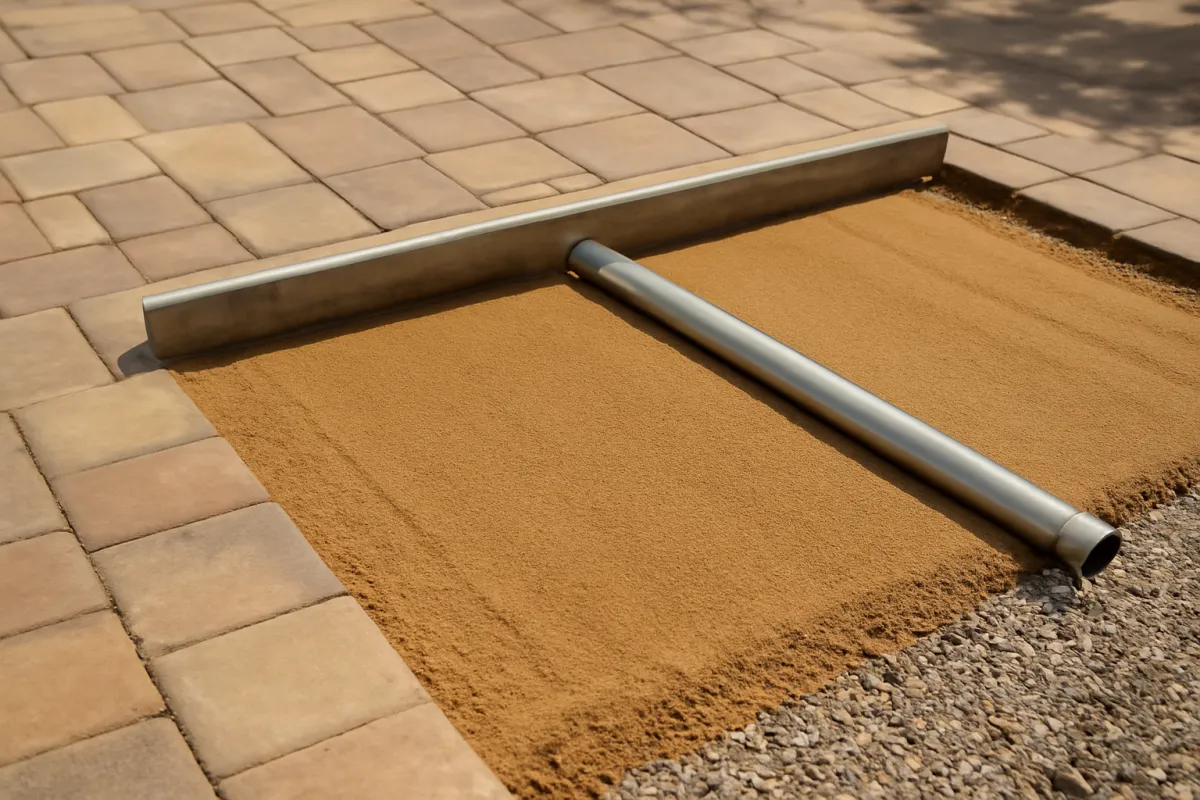
The depth deserves one honest caveat. The bedding layer is meant to be thin and consistent, because sand is not a levelling compound and a thick bed settles unevenly under load. That means the 1 inch figure is a specification, not a variable you should inflate to smooth out a bad base. If your calculation for bedding sand is running large, the usual reason is that the base is not flat enough and someone is planning to make up the difference in sand, which is a decision worth reversing rather than budgeting for.
Bedding sand should be a coarse, angular, washed concrete sand rather than a fine builder’s or play sand, because the angular grains lock and resist the migration that causes settling. That is a material specification, not an estimating one, but it belongs in the order because the yard needs to know which product to load. Our sand manual works the bedding sand and joint sand split in more detail, including how each is sold.
Joint sand, and why the paver size sets it
Joint sand is the smallest quantity on the job and the most commonly guessed at, which is a shame because it derives cleanly. The joints are a fraction of the surface area, and that fraction depends on the paver size and the joint width. Work out the fraction, multiply by the surface area and the paver thickness, and you have the joint volume.
For a nominal 4 by 8 inch paver with an eighth inch joint, each paver occupies a 4 by 8 inch cell of 32 square inches, while the paver itself is 3.875 by 7.875, or 30.52 square inches. The joint is the difference, 1.48 square inches, which is 4.64 percent of the cell. Multiply that fraction by the surface area and the paver depth: 140 square feet is 20,160 square inches, times 4.64 percent is 935 square inches of joint, times a 2.375 inch paver depth is about 2,221 cubic inches, or 1.29 cubic feet. At half a cubic foot per bag, that is three bags.
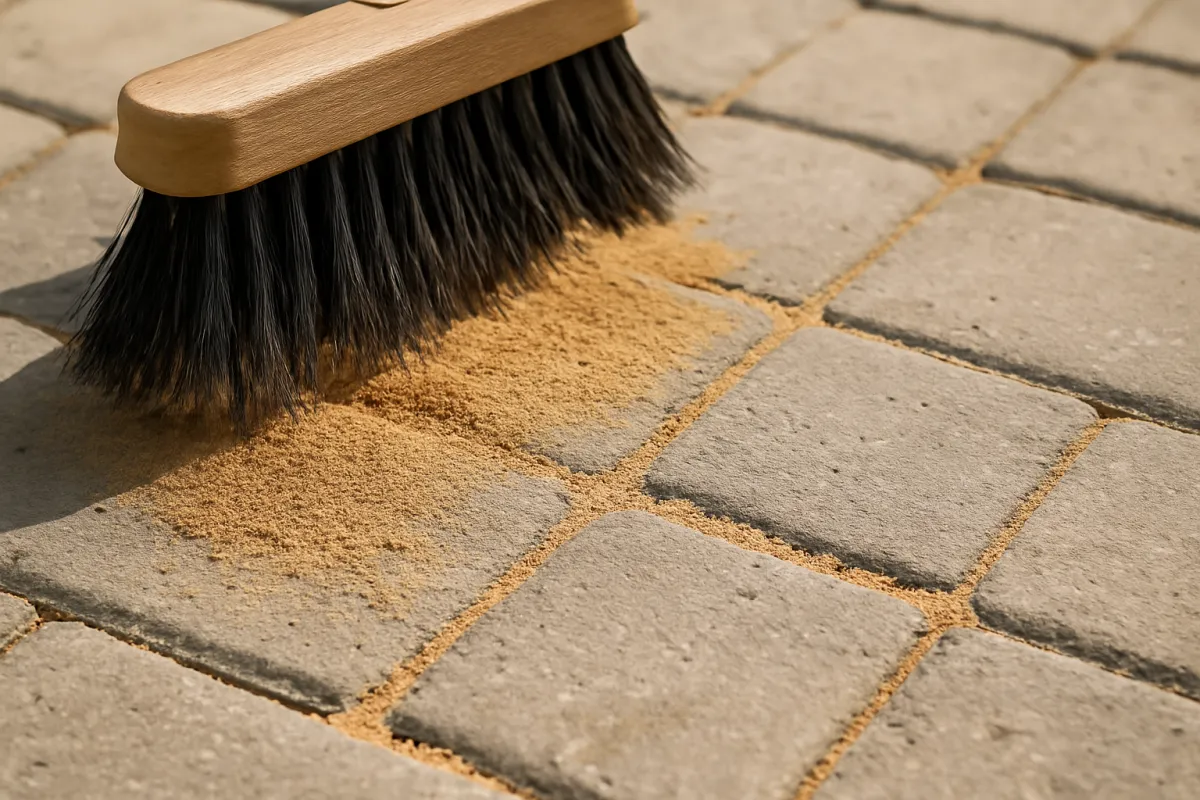
The size effect falls straight out of the same arithmetic. A 12 by 12 inch paver with the same eighth inch joint has a cell of 144 square inches and a paver of 141.02, so the joint is only 2.07 percent of the area, less than half the 4 by 8 figure. Large format pavers need far less joint sand than small ones for the same patio, which is the opposite of most people’s intuition. The derived number also runs slightly high in practice, because bedding sand rises into the bottom of the joint and the paver’s chamfered top edge is not full depth, so treat it as a comfortable upper bound rather than a tight order.
Excavation: the spoil you have to move
The quantity nobody puts on the order is the one you have to get rid of, and it is bigger than the materials going in. Excavation depth is the sum of the layers: base depth plus bedding depth plus paver thickness. On the running example that is 4 plus 1 plus 2.375, or 7.375 inches, which is 0.6146 feet. Times 140 square feet, the excavation is about 86 cubic feet, or 3.19 cubic yards of soil in the ground.
Soil swells when it is dug, because the dig breaks up the compacted structure and introduces air. A swell allowance of about 25 percent is an illustrative planning figure for ordinary garden soil, and it takes the 3.19 cubic yards in the ground to roughly 4 cubic yards loose. That is what has to be barrowed, piled, skipped, or spread, and 4 cubic yards is a substantial heap that will not fit unnoticed behind a shed. Clay and stony ground swell differently, so treat the figure as a planning number and look at the pile before assuming it will fit.
Planning for the spoil early changes decisions. If it can be spread on site, raising a bed or filling a low corner, the volume is a resource rather than a cost, and our topsoil arithmetic tells you how far it goes. If it has to leave, the volume sets the skip size and the access route, and access is the constraint that turns a weekend into two. Either way, calculating the spoil at the same time as the pavers keeps it from being a surprise on the morning the digging starts.
A worked example: a 14 by 10 foot patio, cross-checked two ways
Pull all of it together on one patio. The design is 14 feet by 10 feet, freestanding, laid in 4 by 8 inch concrete pavers, with a herringbone field set at 45 degrees inside a soldier course border, on a 4 inch compacted base with a 1 inch bedding layer, using a paver 2 and three eighths inches thick.
Step one, area and rate. The footprint is 14 times 10, or 140 square feet. The paver face is 4 times 8, or 32 square inches, so pavers per square foot is 144 divided by 32, which is 4.5. The whole-patio field count is 140 times 4.5, or 630 pavers. Step two, the first cross-check by rows: 14 feet is 168 inches, which is 21 pavers at 8 inches long, and 10 feet is 120 inches, which is 30 rows at 4 inches wide. Multiply 21 by 30 and you get 630, matching the area method exactly.
Step three, split the border out. The soldier band is 8 inches wide, so its centerline rectangle is 13.333 by 9.333 feet, a 45.333 foot perimeter, and dividing by the 0.333 foot paver width gives 136 border pavers. The field inside is 12.667 by 8.667 feet, or 109.78 square feet, which at 4.5 per square foot is 494 pavers. Step four, the second cross-check: that inner field is 152 inches by 104 inches, which is 19 pavers by 26 rows, or 494 exactly, and 494 plus 136 is 630, agreeing with both earlier numbers.
Step five, waste by zone. The diagonal field takes 15 percent, so 494 times 1.15 is 568, rounded to 569. The border takes 5 percent, so 136 times 1.05 is 143. The order is 712 pavers, about 158 square feet of coverage. Treating the whole patio as a single 15 percent herringbone instead gives 630 times 1.15, or 725 pavers, which is what the companion returns on these inputs. The 13 paver difference is the value of splitting the border out, and either answer is defensible.
Step six, everything underneath. Base gravel is 140 times 0.333 feet, 46.7 cubic feet, 1.73 cubic yards, plus 20 percent for compaction, so about 2.1 cubic yards. Bedding sand is 140 times 0.0833 feet, 11.7 cubic feet, near 24 half-cubic-foot bags. Joint sand is about 1.29 cubic feet, or 3 bags. Edge restraint is the full 48 foot perimeter since the patio is freestanding. Excavation is 7.375 inches deep across 140 square feet, about 3.19 cubic yards in the ground and near 4 loose.
Cross-checking a count by rows and columns
The row check used twice above deserves its own section, because it is the single most useful habit in unit-material estimating and it takes thirty seconds. Convert each patio dimension to inches, divide by the paver dimension that runs in that direction, and multiply the two results. If the answer matches your area calculation, both are almost certainly right. If it does not, one of them has an error and you now know to look.
The check catches the errors area math cannot see. A dimension entered in inches instead of feet produces an absurd row count that jumps off the page, while it produces a merely wrong area that looks plausible. A paver dimension read the wrong way round, 8 by 4 instead of 4 by 8, gives the same area and the same pavers per square foot, so the area method never notices, but the row check notices immediately because the row counts stop being whole numbers.
The check also tells you something the area method cannot: whether the pavers fit the space cleanly. When 168 inches divides by 8 to give exactly 21, the run needs no cut at all. When it divides to give 21.4, you know before you dig that every course ends in a cut piece, and you can either accept the waste or nudge the patio dimension by a few inches to land on a whole paver. That single insight, discovered on paper rather than on the third course, is worth more than the arithmetic that produced it.
Circles, curves, and fan patterns
Round shapes are the same calculation with a different area formula and a much larger waste allowance. A circle’s area is pi times the radius squared, so a 12 foot diameter round patio has a 6 foot radius, and pi times 36 is about 113 square feet. At 4.5 pavers per square foot that is 509 pavers before waste. A half circle or a quarter circle is that number halved or quartered, and a curved patio edge is usually a rectangle plus or minus a segment you can approximate as a triangle or a half circle.
The waste is where curves genuinely cost. A curved boundary means every perimeter paver is cut to a slightly different angle, so essentially no offcut is reusable, and the cut band is longer than a straight edge enclosing the same area because a circle has the least perimeter for its area only among smooth shapes, not among the rectilinear layouts pavers prefer. An allowance of 20 percent is a reasonable starting point for a circular or heavily curved layout, which on the 12 foot circle takes 509 pavers to about 611.
Purpose-made circle kits change the problem entirely. They are sold as a complete ring set or full circle covering a stated diameter, with the pavers already tapered so the joints stay even, and the right way to estimate them is by the kit rather than by square footage. If a circle kit sits inside a rectangular field, calculate the rectangle’s area, subtract the circle’s area, apply pavers per square foot only to the remainder, and add the kit as its own line. The perimeter where the field meets the circle is all diagonal cutting, so give that remainder the higher allowance.
Steps, landings, and a patio that meets a house
A step is a small patio with an awkward shape, and it is estimated as one. The tread is an area: a step 4 feet wide with a 12 inch tread is 4 square feet, needing 18 of the 4 by 8 inch pavers before waste. The riser is a separate face, often built from a different unit or from wall block, and it is measured as width times riser height, so a 4 foot wide step with a 7 inch riser is about 2.33 square feet of vertical face. Count the treads and risers as separate lines rather than folding them into the patio total.
A patio that meets a house has its own quirks. The contained edge needs no restraint, which saves linear feet, but it usually needs the most careful cutting, because a wall is rarely perfectly straight or perfectly square to the patio, and the last course against it absorbs the discrepancy. Allow for that with a slightly higher waste on the courses that run along the building, and plan the layout so the cut courses land against the house rather than at the visible outer edge.
Obstacles inside the surface follow the same rule as openings in a wall. A tree well, a downpipe, a utility cover, or a fire pit is area the pavers do not have to cover, so subtract it, but the pavers around it all need shaping, so the cut allowance goes up. As a working approach, subtract the obstacle’s area from the field and add its perimeter to the perimeter you use in the cut band model. A round fire pit 3 feet across removes about 7 square feet and adds about 9.4 feet of cutting perimeter, which is a net loss on a small patio rather than a saving.
Buying by the piece, the square foot, or the pallet
Pavers are sold three ways and the unit you order in decides how the count gets rounded. Loose by the piece is the most direct, and it is what the count naturally produces. By the square foot means dividing your paver count back by the pavers per square foot, so 712 pavers at 4.5 per square foot is about 158 square feet of coverage. By the pallet is the cheapest per unit on any real patio, and a pallet is stated either as a piece count or as a coverage in square feet, both of which are product specific and worth confirming with the yard rather than assuming.
Round up to whole pallets where it makes sense, because a broken bundle usually carries a premium and the surplus becomes your spares in one step. Spares matter more with pavers than with most materials for a reason that has nothing to do with quantity: concrete pavers are pigmented, and pigment lots vary. A replacement paver bought next season for a cracked unit can be visibly a different shade from the ones around it, so a dozen leftovers stacked behind the shed are genuinely useful insurance.
That colour behaviour also argues for ordering the whole job at once rather than in stages. Pavers from a single delivery are normally from the same production run, while a top-up order weeks later may not be, and the difference shows most on a large open surface. If a project will be built in phases, buy the pavers in one order even if the delivery has to be split, and blend from multiple pallets as you lay rather than working one pallet dry before opening the next. Sealing, if you plan on it later, is its own calculation covered in our paver sealer article.
Where a paver estimate goes wrong
A handful of errors account for nearly every wrong paver order, and each has a specific tell. Run the list against your own numbers before you call the yard.
- Using a memorised pavers-per-square-foot figure. The number is 144 divided by your paver’s face area, and paver faces vary by a factor of eight. Do the division on the unit you are buying, every time.
- Mixing inches and feet. Area is calculated in feet, pavers per square foot in inches. Base and bedding depths arrive in inches and must be divided by 12 before they multiply an area, or the volume runs twelve times high.
- Applying one waste percentage to a mixed layout. A wide patio and a narrow path have very different perimeter-to-area ratios. Calculate them separately and give each its own allowance.
- Forgetting the border shrinks the field. A soldier course takes twice the band width out of each field dimension. Counting a full-size field plus a border double-counts the band.
- Leaving the base and sand off the order. The gravel base is the largest volume on the job and the bedding sand is not optional. Calculate both from the same footprint at the same time as the pavers.
- Ignoring the base overhang. The base usually extends several inches past the pavers on open sides to support the restraint, which can add close to a fifth to the gravel volume.
- Treating edge restraint as an afterthought. It is a linear foot quantity measured along open edges only, and it needs spikes counted from the product’s own spacing.
Every one of these is a bookkeeping slip rather than a failure of arithmetic, which is exactly why the sketch and the row check catch almost all of them. Draw the patio, write every dimension on it, mark the border band and the open edges, and the order writes itself from the drawing instead of from memory.
Your paver order checklist
Before the order goes in, walk this list top to bottom. It is the save-this asset of the whole calculation.
- Measured the footprint in feet and sketched it with every dimension, curve, obstacle, and open edge marked.
- Broke any irregular shape into rectangles, triangles, and circle segments, and summed the areas.
- Took the paver’s nominal face dimensions in inches from the spec sheet or a measured sample.
- Divided 144 by the face area in square inches to get pavers per square foot, keeping the decimal.
- Multiplied area by pavers per square foot for the bare field count, and cross-checked it by rows and columns.
- Split out any border or soldier course, confirming the border and field counts sum back to the whole-patio count.
- Set the waste allowance from the pattern and the perimeter, higher for 45 degree herringbone, curves, and narrow shapes.
- Converted the final count into whatever unit the supplier sells in, and confirmed the pallet coverage with the yard.
- Calculated the gravel base as area times depth over 27, plus about 20 percent for compaction, including the base overhang.
- Calculated bedding sand at roughly 1 inch deep, and joint sand from the joint’s share of the surface times the paver depth.
- Counted edge restraint in linear feet along open edges only, then converted to whole sections and spikes.
- Worked out the excavation volume and decided where the spoil is going before anyone starts digging.
- Ordered the whole job in one delivery so the colour lot matches, and kept a dozen spares for future repairs.
Work through it in order and the pallets that arrive are the count the patio actually needs, with the base, the sand, and the restraint already on the same order rather than discovered halfway through the weekend. The companion below runs the same chain on your own dimensions so you can check your hand math before you buy.
The bottom line
Counting pavers is one line of area math with a derived rate and an honest waste allowance: patio area in square feet, times 144 divided by the paver’s face area in square inches, times one plus the waste fraction. The part people get wrong is the middle term, because they look it up instead of dividing, and paver faces vary enough that the lookup is often wrong by a factor of two. Derive the rate, cross-check the count by rows and columns, split any border out and confirm the two halves sum back to the whole, and set the waste from the pattern and the perimeter rather than from habit. Then add the three quantities underneath, the gravel base and bedding sand by the cubic yard and the joint sand by the bag, plus edge restraint in linear feet along the open edges. Run your own footprint through the material coverage estimator, read the paver patio walkthrough for the build sequence those numbers feed, and confirm the paver’s real dimensions and the pallet coverage with your supplier before the truck loads.
Treat this manual as workshop arithmetic meant to make the method legible, not a specification for a surface you can build without checking. The paver sizes, joint widths, base and bedding depths, waste percentages, compaction and swell allowances, and bag volumes used here are typical illustrative values chosen to make the worked example follow, and yours will move with the specific product, the ground you are building on, the pattern you choose, and how your supplier packages and sells. Measure your own footprint, confirm the paver’s nominal dimensions and the pallet coverage with the yard, check the base spec against local practice for the load the surface will carry, and involve a qualified professional for anything structural, load bearing, close to a building, or affecting how water drains across a property.
Frequently asked questions
How many pavers do I need for a patio?
Multiply the patio area in square feet by the pavers per square foot for your paver size, then add a waste allowance for cuts. Pavers per square foot comes from the paver itself: divide 144 square inches by the paver's face area in square inches. A 4 by 8 inch paver has a 32 square inch face, so 144 divided by 32 is 4.5 pavers per square foot, and a 14 by 10 foot patio at 140 square feet needs 630 pavers before waste. Add 10 to 15 percent depending on the pattern and round up to whole pavers or whole pallets.
How many pavers are in a square foot?
There is no single answer, because it depends entirely on the paver's face dimensions, which is why quoting a memorised table gets people into trouble. Divide 144 square inches by the paver's length times width in inches and you have the figure for your specific paver. A 4 by 8 inch paver gives 4.5 per square foot, a 6 by 6 inch gives 4, an 8 by 8 inch gives 2.25, and a 12 by 12 inch gives exactly 1. Do the division once with the real dimensions from the product spec and the number is yours.
How much extra should I order for paver cuts?
A common starting point is around 5 percent for a plain rectangle laid square, 10 percent for a running bond with a border, and 15 percent for a herringbone laid at 45 degrees, with 20 percent or more for curves, circles, and fan patterns. The reason a 45 degree layout costs more is that every paver meeting the edge needs a diagonal cut, and the offcut triangle rarely fits the next gap. Narrow shapes such as walkways also waste a higher percentage than wide patios, because they have far more perimeter for the same area. These allowances are illustrative planning figures, so treat them as a floor rather than a guarantee.
Does the laying pattern change how many pavers I need?
The field count does not change, because a square foot of surface takes the same number of pavers whichever way you turn them, but the waste allowance changes a great deal. Running bond, stack bond, and a 90 degree herringbone all meet a straight edge squarely, so many offcuts are reusable in the next row. A 45 degree herringbone meets every edge on the diagonal, so the cut pieces are triangles that usually cannot be paired, which is why that pattern carries the largest allowance. Pick the pattern first, then set the waste percentage to match it.
How much gravel base do I need under pavers?
Base gravel is a volume, not an area, so multiply the patio area by the base depth in feet and divide by 27 for cubic yards. An illustrative walk-on patio uses about 4 inches of compacted base, which is 0.333 feet, so a 140 square foot patio is 140 times 0.333, about 46.7 cubic feet, or roughly 1.73 cubic yards. Loose gravel compacts when it is placed, so add about 20 percent and order near 2.1 cubic yards. Soft ground, clay, or anything carrying vehicles wants a deeper base, and the depth is the most sensitive input in the whole calculation.
How much sand do I need for a paver patio?
There are two sand quantities and they are not the same. Bedding sand is a screeded layer roughly 1 inch deep under the pavers, so a 140 square foot patio needs about 11.7 cubic feet, near 24 of the 0.5 cubic foot bags or a small bulk order. Joint sand fills the gaps between pavers and is far smaller, because the joints are only a few percent of the surface area: the same patio works out near 1.3 cubic feet, roughly 3 bags. Buy them as separate products, because bedding sand and joint sand are different materials.
How do I calculate pavers for a walkway?
The area math is identical, length times width in feet, then times the pavers per square foot, but the waste allowance should be higher. A 3 foot by 40 foot walkway is 120 square feet, and at 4.5 pavers per square foot that is 540 pavers before waste. The reason to allow more is geometry: that walkway has 86 feet of perimeter for 120 square feet of surface, while a 14 by 10 foot patio has only 48 feet of perimeter for 140 square feet. Since cutting happens along the perimeter, the same cut band costs roughly twice the percentage on a narrow path.
Should I count the border course separately?
Yes, if the design has one, because a border changes both the count and the waste. A soldier course, with the pavers turned so their long side runs across the border band, is counted from the band's centerline perimeter divided by the paver's short dimension, and the field inside shrinks by twice the band width in each direction. The two numbers must still add up to the whole-patio count, which makes it a useful cross-check. The border also earns a smaller waste allowance than a diagonal field, because border pieces are cut square.