
What's on this page
- How to read every figure on this page
- The constant behind every volume row
- Coverage per cubic yard, by spread depth
- Concrete bag yields and bags per cubic yard
- Concrete coverage by slab thickness
- Gravel and crushed stone coverage
- Mulch coverage, by the yard and by the bag
- Topsoil and compost coverage
- Sand coverage by job
- Weight per cubic yard
- Paint coverage per gallon
- Primer, stain and sealer coverage
- Mortar coverage for brick and block
- Thinset coverage by trowel notch
- Grout coverage by tile size and joint
- Drywall and joint compound coverage
- Sheet goods and what one panel covers
- Roofing coverage, the square and the bundle
- Sod and seed coverage per unit
- Insulation and cladding coverage
- Waste margins by material family
- What moves a coverage figure
- A worked example, one lookup at a time
- Common coverage lookup mistakes
- The coverage lookup checklist
- The bottom line
This is a lookup page rather than a method page, and the one-line version of the question it answers most often is simple: a yard of concrete coverage runs about 81 square feet at a standard 4 inch slab, with the full depth-by-depth table a few sections down. From there it gathers every other coverage and yield figure a material order leans on, how much finished volume a bag makes, how far one cubic yard spreads at a given depth, how much wall a gallon of paint covers, into one place you can check in a few seconds. Every section hands the method off to the manual that works it end to end, so the material estimation manual handles takeoff, the yardage manual handles volume, and the square footage manual handles area. Run your own dimensions through the coverage estimator first, then use the charts below to sanity check what came back.
Read every figure here as an illustrative planning value, never as a specification. Coverage varies by product, profile, substrate and application, and the number printed on the bag, can or bundle you actually buy is the one that governs your order.
Key takeaways
- One cubic yard is 27 cubic feet and covers about 324 square feet an inch deep, so coverage at any depth is 324 divided by the depth in inches: roughly 162 square feet at 2 inches, 108 at 3, 81 at 4.
- Bagged concrete yields are the other half of the reference: commonly near 0.60 cubic feet for an 80 pound bag, 0.45 for a 60, 0.30 for a 40, which is about 45, 60 and 90 bags per cubic yard.
- Volume rows are arithmetic and hold exactly; product rows such as paint, mortar, thinset and grout are typical bands that formulation and substrate can move by half or more.
- Where a figure genuinely depends on something, the dependency sits beside it: paint on bare versus primed, mortar on joint width and bond, thinset on trowel notch, grout on tile size and joint.
- Coverage figures size an order; they do not place it. Add a waste margin, round to whole units, and confirm every figure against the label on your own product.
How to read every figure on this page
The rows on this page are not all the same kind of number, and treating them as if they were is the fastest way to a wrong order. Three tiers run through every table below, and each section says which tier it is in.
The first tier is arithmetic. A cubic yard contains 27 cubic feet, a 4 by 8 sheet covers 32 square feet, a roofing square is 100 square feet. No product changes those, so the coverage that falls out of them is exact for the volume or area involved. What arithmetic cannot include is anything physical: settlement, compaction, breakage and offcuts all sit outside it.
The second tier is a typical product value with a narrow spread, such as bagged concrete yield. Mixes differ, but not wildly, so a chart figure gets you within a bag or two on a small job.
The third tier is a typical value with a wide spread, and paint, mortar, thinset and grout all live here. Their coverage depends on things the chart cannot see, so the number beside them is a starting point with its dependency named alongside.
The constant behind every volume row
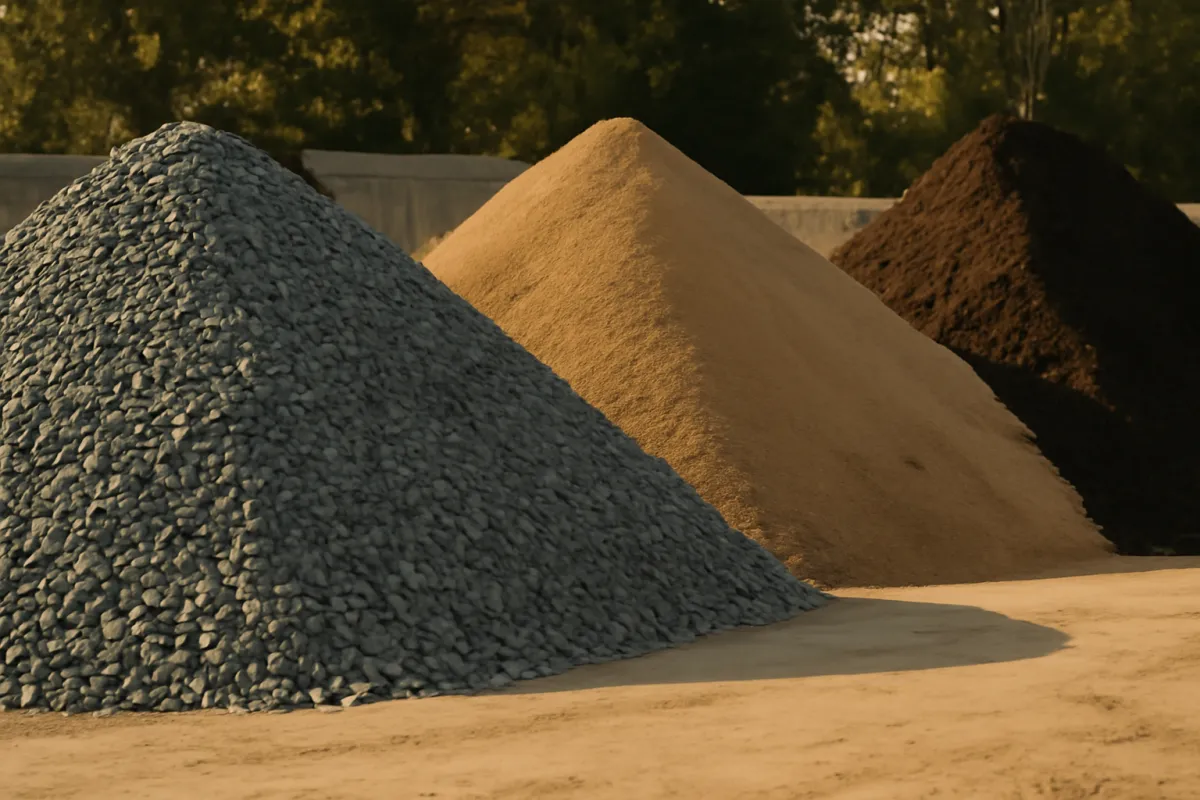
One number generates most of this page. A cubic yard is 27 cubic feet. Because depth on a spreading job is measured in inches while area is measured in feet, the useful form of that fact is this: 27 cubic feet spread one inch thick covers about 324 square feet, since 27 times 12 is 324.
Everything in the volume tables follows from dividing 324 by a depth in inches. That is why the gravel table, the mulch table, the topsoil table and the concrete slab table all share the same column of numbers. They are not four findings about four materials, they are one piece of arithmetic applied four times.
Turning your own job into a volume is a method question rather than a lookup question, and our yardage manual works it on your dimensions, including the shortcut that folds inches to feet and cubic feet to yards into a single step. Our square footage manual covers the area half. This page stays on the coverage side: what one unit gives you once the dimensions are settled.
Coverage per cubic yard, by spread depth
This is the master table for any loose material sold by volume, gravel, crushed stone, sand, mulch, topsoil, compost or decorative rock. It is tier one arithmetic, so it is exact for volume. The only variable in it is the depth you choose to spread at.
| Spread depth | Area one cubic yard covers | Area one cubic foot covers |
|---|---|---|
| 1 in | about 324 sq ft | about 12 sq ft |
| 2 in | about 162 sq ft | about 6 sq ft |
| 3 in | about 108 sq ft | about 4 sq ft |
| 4 in | about 81 sq ft | about 3 sq ft |
| 6 in | about 54 sq ft | about 2 sq ft |
| 12 in | about 27 sq ft | about 1 sq ft |
Two rules of thumb fall straight out of the table and are worth memorising, because they cover a large share of residential jobs. A yard of gravel covers roughly 100 square feet at a typical 3 inch surface depth, and a yard of mulch covers roughly 100 square feet at a 3 inch bed depth. Same number, same reason, different material.
Area one cubic yard covers, by spread depth
Arithmetic from 27 cubic feet per yard; excludes settlement and compaction.
Each bar is that depth's coverage as a share of the 324 square foot one inch row, so 162 draws at 50 percent, 108 at 33 and 81 at 25. Coverage halves when depth doubles, which is why depth moves an order harder than area does.
Concrete bag yields and bags per cubic yard
Bagged mix is sold by the dry weight in the bag but ordered by the volume of finished concrete it makes, so yield is the number that matters. These are tier two figures: common across standard mixes, but printed on every bag for a reason.
| Bag size | Typical yield of finished concrete | Bags per cubic yard | Area at 4 in deep |
|---|---|---|---|
| 80 lb | about 0.60 cu ft | about 45 | about 1.8 sq ft |
| 60 lb | about 0.45 cu ft | about 60 | about 1.35 sq ft |
| 50 lb | about 0.375 cu ft | about 72 | about 1.1 sq ft |
| 40 lb | about 0.30 cu ft | about 90 | about 0.9 sq ft |
The bags per yard column is simply 27 divided by the yield, and the area column is the yield times 12, divided by the depth in inches. Fast setting mixes, high strength mixes, sand mixes and mortar mixes all carry their own yields, and some differ enough from the table to change a bag count noticeably, so check the label rather than the weight.
Our bags of concrete manual runs the count for a real pour, and the concrete slab manual does the volume side for slabs, footings and pads. For the threshold where hand mixing bags stops being practical, that is a job condition rather than a coverage figure, and both manuals treat it directly.
Concrete coverage by slab thickness
The same 324 constant works for concrete, so slab coverage is a lookup rather than a calculation. The left column is the finished thickness, the middle is what one cubic yard covers, and the right is what one 80 pound bag covers at that thickness.
| Slab thickness | Area per cubic yard | Area per 80 lb bag |
|---|---|---|
| 2 in | about 162 sq ft | about 3.6 sq ft |
| 3 in | about 108 sq ft | about 2.4 sq ft |
| 4 in | about 81 sq ft | about 1.8 sq ft |
| 5 in | about 65 sq ft | about 1.44 sq ft |
| 6 in | about 54 sq ft | about 1.2 sq ft |
Two cautions belong beside this table. Thickness is a design decision driven by what the slab carries, the ground under it and local practice, so nothing here should be read as a recommendation about how thick to pour. And a poured slab rarely uses exactly the calculated volume, because subgrade is never perfectly flat and forms deflect slightly, which is why concrete orders routinely carry a margin.
Reinforcement sits outside coverage entirely and has its own arithmetic; our rebar manual covers spacing and quantity for slabs and footings.
Gravel and crushed stone coverage
Gravel coverage uses the master volume table without modification, so a yard covers about 162 square feet at 2 inches, 108 at 3 and 81 at 4. What gravel adds is a compaction gap between the volume you calculate and the volume you order.
| Depth | Coverage per cubic yard | Approximate coverage per ton |
|---|---|---|
| 2 in | about 162 sq ft | about 115 sq ft |
| 3 in | about 108 sq ft | about 77 sq ft |
| 4 in | about 81 sq ft | about 58 sq ft |
| 6 in | about 54 sq ft | about 39 sq ft |
The per ton column assumes roughly 1.4 tons to the cubic yard, which is a common working density for dry crushed stone and not a property of any specific product. Change the density and every figure in that column changes with it, so confirm the actual density with your supplier when a yard sells by weight. Our tons to cubic yards manual handles that conversion properly, and our gravel weight reference covers the density side.
Choosing the depth itself is a separate question with its own table, use by use, in our gravel depth reference, and the ordering workflow lives in the gravel quantity manual.
Mulch coverage, by the yard and by the bag
Mulch is the material most often bought both ways, so both units belong in one table. Bag volume is printed on the bag and comes in several sizes, so scale the row that matches yours.
| Unit | Coverage at 2 in | Coverage at 3 in | Coverage at 4 in |
|---|---|---|---|
| 2 cu ft bag | about 12 sq ft | about 8 sq ft | about 6 sq ft |
| 3 cu ft bag | about 18 sq ft | about 12 sq ft | about 9 sq ft |
| 1 cubic yard | about 162 sq ft | about 108 sq ft | about 81 sq ft |
It takes about 13.5 of the 2 cubic foot bags to make a cubic yard, or about 9 of the 3 cubic foot size, which is the conversion most people need when they are deciding between a bagged trip and a bulk delivery. That decision also involves handling, storage and access rather than coverage alone, and our mulch quantity manual works through it, along with depth by mulch type and how to top up an existing bed without over piling.
One coverage caveat is specific to mulch: coarse, chunky products settle less than fine shredded ones, so a fine mulch delivered loose can lose noticeable depth within weeks of spreading.
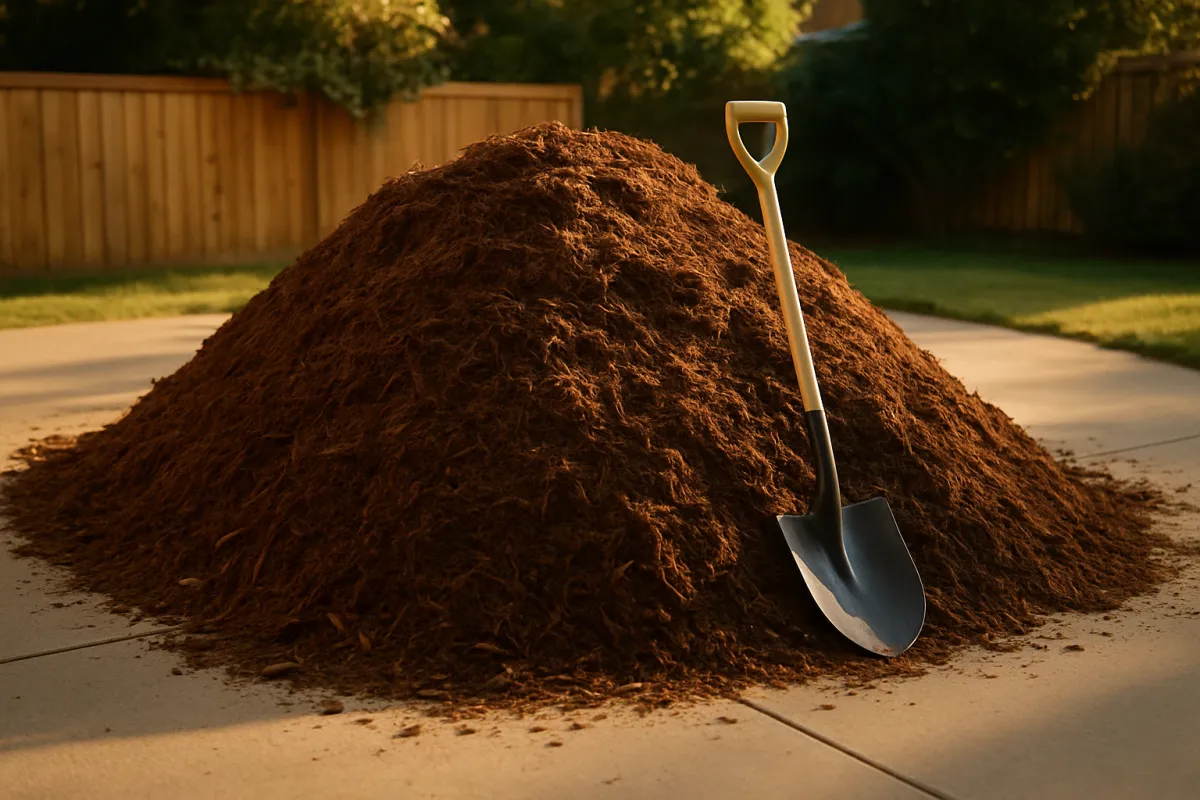
Where one cubic yard of mulch goes on a three part bed job
Illustrative split of 27 cubic feet across three areas at three different depths.
The three areas take 12, 10 and 5 cubic feet, which sums to the 27 cubic feet in one yard, so the segments sum to 100 percent. The border is the largest area yet takes less than the main bed, because depth and area multiply rather than compete.
Topsoil and compost coverage
Topsoil, garden soil and compost all use the master volume table, and their most common depths are shallower than gravel or mulch, because these materials are usually spread as a dressing or a fill layer rather than a surface.
| Unit | At 1 in | At 2 in | At 3 in |
|---|---|---|---|
| 1 cu ft bag | about 12 sq ft | about 6 sq ft | about 4 sq ft |
| 1.5 cu ft bag | about 18 sq ft | about 9 sq ft | about 6 sq ft |
| 1 cubic yard | about 324 sq ft | about 162 sq ft | about 108 sq ft |
Bagged soil is where the bag versus bulk gap is widest, because it takes about 27 of the 1 cubic foot bags to make a single cubic yard. A lawn top dressing at a quarter to a half inch across a few thousand square feet consumes yards quickly, and a raised bed fill at 10 or 12 inches consumes them faster still.
Soil also carries a settlement caveat the arithmetic ignores. Screened topsoil and compost settle noticeably after watering and after a season of weather, so a bed filled level on day one commonly sits lower later. Our topsoil quantity manual covers beds, lawns and grade repair with that allowance built in.
Sand coverage by job
Sand is the material where the job sets the depth so strongly that a single coverage figure would be misleading. The table gives the depth each use commonly runs at, then the coverage that falls out of it.
| Use | Common depth | Coverage per cubic yard |
|---|---|---|
| Paver bedding layer | about 1 in | about 324 sq ft |
| Levelling under a small slab or shed base | about 2 in | about 162 sq ft |
| Sandbox or play area fill | about 6 to 12 in | about 27 to 54 sq ft |
The depths above are common practice rather than requirements, and the bedding depth in particular is a specification set by the paving system rather than by preference. Joint sand is a different problem again: it fills the gaps between units rather than covering an area, so its consumption depends on joint width, paver thickness and how tight the pattern is, which is why joint sand coverage is quoted per bag by the product and not derived from a depth.
Our sand quantity manual works these through, the paver manual covers the units themselves, and the sand weight reference handles the delivery side.
Weight per cubic yard
Weight is not coverage, but it decides delivery, hauling and whether a yard sells by the ton, so it belongs on the same page. Unlike the volume rows, these are genuinely variable: material type and moisture both move them, and wet material can be far heavier than the same product dry.
| Material | Illustrative weight per cubic yard |
|---|---|
| Dry gravel or crushed stone | about 2,400 to 2,900 lb, roughly 1.2 to 1.45 tons |
| Sand | about 2,600 to 3,000 lb, higher when wet |
| Topsoil | about 1,800 to 2,700 lb, higher when wet |
| Wood mulch | about 400 to 1,000 lb, considerably higher when soaked |
| Mixed concrete | roughly 3,700 to 4,000 lb, near 2 tons |
Confirm the figure for your specific product with your supplier before hauling anything yourself, and check your vehicle’s rated capacity rather than its bed volume, because a single yard of wet aggregate can exceed what a light pickup should carry. Dedicated references cover each material: gravel, sand, mulch and concrete.
Paint coverage per gallon
Paint is the clearest case of a coverage figure that depends on what it is going onto. The headline number assumes the best case, a smooth, primed, sealed surface, and every departure from that reduces it.
| Surface | Illustrative coverage per gallon, one coat | Why it moves |
|---|---|---|
| Smooth, primed, previously painted | about 350 to 400 sq ft | The benchmark case: nothing absorbed, minimal texture |
| Bare drywall or fresh joint compound | about 200 to 300 sq ft | Porous, so the first coat soaks in |
| Bare or weathered wood | about 200 to 300 sq ft | Absorbs unevenly along the grain |
| Rough masonry, stucco, split block | about 100 to 200 sq ft | Real surface area far exceeds measured area |
| 1 quart, smooth primed | about 90 to 100 sq ft | A quarter of the gallon figure |
Two more multipliers sit on top of the table. Most colour changes need two coats, which doubles consumption, and dark to light changes sometimes need three. Application method matters too, since spraying loses material to overspray while rolling loses less. The practical planning line most people use is area divided by 350, then doubled for two coats, then rounded up to whole cans.
Read the coverage on the can you buy, because sheen and formulation move it. Our paint quantity manual works through rooms, ceilings, doors, windows and trim deductions.

Primer, stain and sealer coverage
Coatings that are designed to soak in cover less than coatings designed to sit on top, so primers, stains and sealers all read lower than finish paint on the same surface.
| Coating | Illustrative coverage per gallon | Main dependency |
|---|---|---|
| Interior primer on drywall | about 200 to 300 sq ft | How porous the board and compound are |
| Sealing primer on bare masonry | about 100 to 200 sq ft | Surface texture and absorbency |
| Semi transparent deck or fence stain | about 200 to 300 sq ft | Smooth versus rough sawn timber |
| Solid colour stain | about 200 to 350 sq ft | Behaves closer to paint on smooth surfaces |
| Concrete or paver sealer | about 200 to 400 sq ft | Porosity, sealer type, and first versus second coat |
The first versus second coat effect is strongest for sealers and stains. The opening coat fills the surface, so it consumes far more than the closing coat, and a two coat job is rarely twice the first coat’s quantity. Rough sawn timber can absorb roughly double what a planed board takes, so a fence estimated from smooth surface figures runs short reliably.
Our concrete sealer reference covers how sealer types differ, the paver sealer reference does the same for paving, and our driveway sealing walkthrough covers application. Coverage for these products is always printed on the container.
Mortar coverage for brick and block
Mortar is the classic case where a bare figure would be close to useless, because the mortar volume in a wall is set by the joints, not by the units.
| Unit being laid | Illustrative units per 80 lb bag of mortar mix |
|---|---|
| Standard concrete block, face shell bedding | roughly 10 to 14 |
| Standard brick | roughly 25 to 40 |
Four things move those ranges, and they move them a long way. Joint width comes first, because mortar volume scales directly with joint thickness across every joint in the wall, so a wall built to a wider joint consumes noticeably more from the same unit count. Bedding method comes second: blocks bedded on the full surface take more mortar than blocks bedded only on the face shells. Unit size is third, since larger units mean fewer joints per square foot of wall. Waste is fourth, and mortar waste is higher than most materials because board losses and stiffened batches are normal.
Use the range to plan a delivery, then confirm against the coverage table published for the specific mortar. Our brick quantity manual and block quantity manual handle the unit counts, and our retaining wall walkthrough covers block wall assembly.
Thinset coverage by trowel notch
Thinset coverage is set by the trowel, because the notch size determines how thick a bed the mortar is combed into. Bag weight tells you how much material you bought; notch size tells you how far it goes.
| Trowel notch | Illustrative coverage per 50 lb bag | Typical use |
|---|---|---|
| 1/4 x 1/4 in square | about 85 to 95 sq ft | Small format tile and mosaics |
| 1/4 x 3/8 in | about 60 to 70 sq ft | Common floor tile |
| 1/2 x 1/2 in square | about 35 to 45 sq ft | Larger tile, less flat substrates |
| 3/4 in and larger | about 20 to 30 sq ft | Large format tile and slabs |
Three factors pull real coverage below the chart. Back buttering the tile, which large format tile normally requires for full support, adds mortar the notch figure never counted. An uneven substrate absorbs extra mortar in every low spot. And larger tiles demand a higher percentage of contact, which in practice means a heavier bed.
Every mortar bag carries its own coverage chart indexed by notch size, and that chart is the one to work from. Our tile quantity manual covers the tile count itself for floors and walls.
Grout coverage by tile size and joint
Grout has no single coverage number at all, because grout fills a volume defined by four dimensions of your own layout: tile length, tile width, tile thickness and joint width. Change any one and consumption changes.
The direction of each effect is easy to reason about. Small tiles mean more linear feet of joint per square foot of floor, so mosaics consume far more grout than large format tile of the same thickness. Thicker tile means deeper joints, so a thick porcelain floor takes more than a thin wall tile at the same joint width. Wider joints multiply the whole thing, so a rustic layout with a wide joint can take several times what a tight modern joint takes.
That is why no responsible chart publishes a bare figure. Grout manufacturers publish coverage tables indexed to exactly those four inputs, and reading the correct cell in that table beats any general rule. As a planning band only, a single bag might stretch across a large floor of big format tile with narrow joints, or cover a small mosaic area, and both can be true of the same bag. Estimate from the maker’s table, then add margin, because running out mid floor risks a visible colour break between batches.
Drywall and joint compound coverage
Drywall splits neatly into a tier one row and a tier three row. Sheet coverage is exact geometry. Compound is a wide typical band.
| Item | Coverage | Tier |
|---|---|---|
| 4 x 8 ft sheet | 32 sq ft | Exact |
| 4 x 10 ft sheet | 40 sq ft | Exact |
| 4 x 12 ft sheet | 48 sq ft | Exact |
| Joint compound, full three coat finish | roughly 1 to 1.5 gallons per 100 sq ft of board | Typical, wide |
The compound row moves with the number of joints, which means it moves with sheet size and room shape. A room broken up by windows, doors and short walls has far more joint per square foot than a long clear wall, so the same board area can need noticeably more compound. Finish level matters too, since a smooth level finish takes more coats and more sanding than a textured one, and sanding turns some of what you bought into dust rather than wall.
Tape comes on rolls whose length is printed on the roll, and fastener spacing is set by the assembly and by local practice rather than by a coverage table. Our drywall quantity manual does the sheet count including openings.
Sheet goods and what one panel covers
Panel coverage is pure geometry, which makes this the most reliable table on the page. What it does not tell you is how many panels a job needs, because that depends on how the cuts fall.
| Panel | Area covered |
|---|---|
| 4 x 8 ft plywood, OSB or drywall | 32 sq ft |
| 4 x 9 ft | 36 sq ft |
| 4 x 10 ft | 40 sq ft |
| 4 x 12 ft | 48 sq ft |
Dividing a floor area by 32 gives a floor of the panel count, never the real one. Panels have to break on framing members, which produces offcuts that cannot always be reused, and a room whose dimensions are not friendly multiples of 4 feet wastes more than one that is. That is a layout problem rather than a coverage problem, and the material estimation manual treats it properly.
Linear materials work the same way in one dimension. Boards are ordered by length and lost to end cuts, framing is counted by spacing rather than by area, and lumber sold by volume has its own unit; our board feet manual, deck board manual and stud count manual cover those three cases.
Roofing coverage, the square and the bundle
Roofing has its own unit, and knowing it removes most of the confusion. One roofing square is 100 square feet of roof surface. That is a definition, so it never varies.
| Item | Coverage | Tier |
|---|---|---|
| 1 roofing square | 100 sq ft of roof area | Exact by definition |
| Three tab shingle bundles | commonly 3 bundles per square | Typical, product specific |
| Laminated or architectural bundles | commonly 3 to 5 bundles per square | Typical, product specific |
| Underlayment roll | varies widely by type and weight | Read the wrapper |
Bundles per square is a product decision, printed on the wrapper, because heavier and thicker shingles need more bundles to cover the same square. Underlayment varies even more between felt weights and synthetic products, so a roll’s stated coverage is the only figure worth using.
Roof area is also not the same as building footprint, since pitch adds surface area that a plan view never shows. That conversion belongs to the roof pitch manual, and the shingle count itself to the shingle quantity manual. Starter courses, hip and ridge caps and valley material are counted in linear feet rather than squares.
Sod and seed coverage per unit
Turf products are sold by units that vary between suppliers more than almost anything else on this page, so this section is mostly a warning about which figure to trust.
| Unit | Illustrative coverage | What moves it |
|---|---|---|
| Sod pallet | commonly around 400 to 500 sq ft | Farm, slab size, and how the pallet is stacked |
| Individual sod slab | often around 2 to 2.5 sq ft | Cut dimensions differ by supplier |
| Grass seed | stated as pounds per 1,000 sq ft on the bag | Species, and new lawn versus overseeding |
Pallet coverage is the figure people most often assume is standard and most often is not, so ask your supplier for the coverage of their own pallet before ordering. Seed rates are genuinely species dependent and differ between establishing a new lawn and overseeding an existing one, which is why the bag states its own rate for both cases and no general table should override it.
Sod also needs a cutting allowance for curves and edges beyond the plain area figure. Our sod quantity manual works through pallets, rolls and that allowance.
Insulation and cladding coverage
Insulation is sold with its coverage already computed for you, and the way it is computed is worth understanding. Blown in products state square feet per bag at each target thermal performance, so one bag covers a large area thinly or a small area deeply, and the bag chart is the whole answer. Batts state the square footage in the bag along with the cavity width and stud spacing they suit, so the useful check is whether the bag matches your framing rather than whether it matches an area.
Nothing on this page should be read as a requirement about how much insulation a building needs. Thermal requirements are set by the applicable building rules for your location and climate, and those are the source to work from.
Cladding follows a different logic again. Siding is sold in squares like roofing on some products and in linear coverage on others, and the exposure of the profile, meaning how much of each piece stays visible after overlap, decides the real coverage. Our siding quantity manual covers that, and our fence material manual does the same for fencing runs.
Waste margins by material family
Coverage figures describe perfect material use. Real jobs cut, break, spill and offcut, so the number you order sits above the number the chart gives. These are common planning allowances rather than rules.
| Material family | Common allowance | Why |
|---|---|---|
| Loose bulk material | about 5 to 10 percent | Settlement, uneven subgrade, spillage in handling |
| Concrete | about 5 to 10 percent | Subgrade variation and form deflection |
| Straight lay tile | about 10 percent | Perimeter cuts and breakage |
| Diagonal or patterned tile | about 15 percent or more | Every perimeter tile is cut |
| Sheet goods and flooring | about 10 percent | Cuts falling on framing rather than on the grid |
Two rules make the allowance more useful than a flat percentage. Small jobs need a larger proportional margin than big ones, because a single broken unit is a bigger share of a small order. And materials with batch variation, such as tile and shingles, are worth over ordering slightly on the first purchase, because a later top up may not match.
The full takeoff workflow, measurement through waste through rounding, lives in our material estimation manual, and turning a takeoff into a priced document belongs to our contractor estimate manual.
What moves a coverage figure
When a real result misses a chart badly, it is nearly always one of five causes, and naming them makes the miss predictable in advance.
- Substrate absorbency. Porous surfaces drink the first coat. This is the single biggest factor for paint, primer, stain and sealer, and it is why a bare surface figure and a primed surface figure can differ by half.
- Texture and true surface area. Rough, corrugated and profiled surfaces have more area than their measured area, so anything applied over them covers less than the tape suggests.
- Application thickness. Trowel notch for thinset, joint width for mortar and grout, spread depth for loose material. Thickness is chosen, and it multiplies straight into consumption.
- Product formulation. Solids content, aggregate size, mix design and moisture all shift yield. Two products with the same unit size can differ by a wide margin.
- Method and losses. Spraying loses material to overspray, sanding removes compound, mortar falls off the board, and offcuts leave the job. None of these appear in any coverage figure.
Check those five before deciding a chart was wrong. The chart usually described a condition that your job did not meet.
A worked example, one lookup at a time
Take a 200 square foot planting bed to be topped up with mulch at 3 inches. This is the same arithmetic the calculator on this page runs, so you can follow it in either direction.
Start with the coverage row. At 3 inches deep, one cubic yard covers about 108 square feet. Divide the 200 square foot bed by 108 and the job needs about 1.85 cubic yards. Confirm it from the other side: 200 square feet times 3 inches, divided by 12, is 50 cubic feet, and 50 divided by 27 is 1.85 cubic yards. Both routes agree because both are the same constant.
Now convert to the unit you will buy in. At 2 cubic feet per bag, 50 cubic feet is 25 bags. At 3 cubic feet per bag, it is about 17 bags. In bulk it is 1.85 cubic yards.
Add the margin. A 10 percent allowance takes 1.85 cubic yards to about 2.04, or 25 bags to 28. Round to whole units in the direction the supplier sells, which for bulk usually means 2 yards.
The same three steps run for any row on this page. Look up coverage per unit, divide your area by it, add the allowance, round up. Swap the calculator to bagged concrete and it reads 45 bags per yard instead of 108 square feet per yard; swap it to paint and it reads 350 square feet per gallon per coat. The lookup changes, the procedure does not.
Common coverage lookup mistakes
The same handful of errors account for most short and over orders, and every one is avoidable at the chart stage.
- Using a smooth surface paint figure on a rough or bare surface. The most common single cause of a second trip to the store, and the fix is one line: pick the substrate row, not the headline row.
- Forgetting the second coat. The gallon figure is one coat. A two coat job needs double, and a strong colour change sometimes more.
- Reading bag weight as bag yield. Weight tells you what you are lifting. Only the printed yield tells you what it makes, and fast set and specialty mixes often differ from standard ones.
- Quoting thinset per bag with no notch. The notch is the coverage. A figure without one is unusable.
- Treating a pallet or a bundle as a standard unit. Sod pallets and shingle bundles vary by supplier and product, so the supplier’s own figure is the one to use.
- Ordering the calculated volume with no allowance. Loose material settles, sheets get cut, tiles break. The chart figure is a floor, not an order.
- Assuming a bulk pile is a full unit. Coverage arithmetic starts from the volume that was sold, not from how big the heap looks in the driveway.
Each mistake is the same underlying error: taking a figure that described a specific condition and applying it to a job that does not match.
The coverage lookup checklist
The whole page compressed into the check to run before an order goes in.
- Identify the unit you will actually buy in. Cubic yard, bag, gallon, bundle, pallet or sheet. Coverage is meaningless until the unit is fixed.
- Find the tier. Arithmetic, narrow product band, or wide product band. That tells you how much margin the figure itself deserves.
- Name the dependency. Depth, substrate, notch, joint width, exposure or thickness. If a figure has one and you have not set it, you do not have a coverage figure yet.
- Look up coverage per unit in the section for that material, and take the row that matches your condition rather than the headline row.
- Divide your area or volume by it to get the raw unit count.
- Add the allowance from the waste table, sized for the material family and the size of the job.
- Round to whole units in the increments your supplier sells.
- Check the label. Read the coverage printed on the actual bag, can, bundle or wrapper, and let it override anything here.
Run those eight and the vague question, how far does this go, becomes an order you can defend line by line.
The bottom line
A coverage reference does one job well and should not pretend to do more. It gives you the figure per unit, tells you honestly how solid that figure is, and names the thing it depends on. The volume side of this page is arithmetic you can rely on: 27 cubic feet per cubic yard, about 324 square feet at an inch deep, and coverage that halves every time the depth doubles. The product side is a set of typical bands with their dependencies attached, because paint on bare drywall, mortar at a wider joint and thinset under a bigger notch are genuinely different numbers and no single figure covers them.
Use these charts to size an order and sanity check a quote, then let the printed coverage on your own product decide the final count. When you need the method rather than the number, the material estimation manual runs takeoff end to end, the yardage manual works volume on your dimensions, and the calculator on this page chains coverage, quantity and margin from figures you already have.
Treat every figure on this page as an illustrative planning value rather than a product specification or a requirement. Coverage and yield vary by formulation, profile, substrate, moisture and application method, and any single product can sit well outside the typical bands shown here by design. Nothing here states a code, standard or building requirement, and no product or manufacturer is named or endorsed. Confirm the coverage printed on the bag, can, bundle or wrapper you are buying, confirm bulk densities and delivery weights with your supplier, and involve a qualified contractor or engineer for structural, drainage or water management work.
Frequently asked questions
How many 80 lb bags of concrete are in a cubic yard?
About 45, as a planning figure. An 80 pound bag of standard concrete mix commonly yields somewhere around 0.60 cubic feet of finished concrete, and a cubic yard is 27 cubic feet, so 27 divided by 0.60 is 45 bags. A 60 pound bag commonly yields about 0.45 cubic feet, which works out near 60 bags per yard, and a 40 pound bag about 0.30 cubic feet, or roughly 90 bags per yard. Yield varies by mix type and by maker, so read the yield printed on the bag you are actually buying and treat the chart as a first pass. Add a bag or two of margin so a short count never stops a pour.
How much area does a cubic yard cover?
A cubic yard is 27 cubic feet, and 27 cubic feet spread one inch thick covers about 324 square feet. From there the coverage is 324 divided by the depth in inches, so one yard covers roughly 162 square feet at 2 inches, 108 at 3 inches, 81 at 4 inches and 54 at 6 inches. That row is pure arithmetic rather than a product property, so it holds for any material sold by the cubic yard, poured concrete included, not only loose fill such as gravel, crushed stone, sand, mulch, topsoil or compost. What it does not include is settlement and compaction on loose material, or subgrade variation on a slab, which is why an ordered volume normally sits above the calculated one.
How much does 1 yard of concrete cover?
It depends only on the slab thickness, because a cubic yard of concrete is 27 cubic feet no matter what it fills. At a 4 inch slab, the thickness most driveways and patios use, one yard covers about 81 square feet. At 3 inches it stretches to about 108 square feet, at 5 inches it falls to about 65, and at 6 inches to about 54. The full concrete coverage table above carries that same depth-by-depth math further, alongside the matching bag count if you are buying 80 pound bags instead of ordering by the yard. Use the thickness your project actually specifies rather than a single headline figure, since coverage swings by a third or more across that range.
How much does a bag of mulch cover?
A 2 cubic foot bag covers about 12 square feet at 2 inches deep and about 8 square feet at 3 inches, because coverage is the bag volume divided by the depth in feet. A 3 cubic foot bag covers roughly 18 square feet at 2 inches and 12 at 3 inches. It takes about 13.5 of the 2 cubic foot bags to equal one cubic yard, or about 9 of the 3 cubic foot size. Bag volume is printed on the bag, so check it before you scale the chart, since bagged mulch is sold in several sizes and the label is the figure that governs your order.
How much does a yard of gravel or sand weigh?
It depends on the material and its moisture content, so treat any single number as illustrative rather than a specification. Dry gravel commonly runs somewhere around 2,400 to 2,900 pounds per cubic yard, roughly 1.2 to 1.45 tons, and sand often lands in a similar band. Wet material weighs more, sometimes substantially more after rain. This matters for delivery, for the tons-versus-yards conversion when a yard sells by weight, and for whether your vehicle can safely carry a load, so confirm the density of the specific product with your supplier before hauling anything yourself.
How much does a gallon of paint cover?
Around 350 to 400 square feet for one coat on a smooth, primed, sealed surface is the usual planning figure, and the substrate moves it a long way. Bare drywall, fresh joint compound, raw wood and porous masonry absorb the first coat, so coverage can fall to somewhere in the 150 to 250 square foot range on the first pass. Rough textures such as stucco, split block and heavy knockdown have more surface area than their measured area suggests and cover less again. Most jobs also need two coats. Read the coverage printed on the can you buy, since it varies by product and sheen.
How many blocks or bricks does a bag of mortar lay?
Common planning figures put an 80 pound bag of mortar mix somewhere around 10 to 14 standard concrete blocks, or roughly 25 to 40 standard bricks, but the spread on those ranges is real and it is not sloppiness. Joint width is the biggest driver, because mortar volume scales with joint thickness across the whole wall. Unit size, the bond pattern, whether blocks are bedded on the full surface or only on the face shells, and how much waste falls off the trowel all move it further. Use the figure to plan a delivery, then confirm against the mortar maker's own coverage table.
How much floor does a bag of thinset cover?
Trowel notch is the answer, not the bag weight, because the notch sets how thick the mortar bed is. As illustrative figures for a 50 pound bag, a quarter inch square notch might cover somewhere near 90 square feet, a quarter by three eighths notch near 65, a half inch square notch near 40, and the large notches used under big format tile closer to 25. Back buttering, an uneven substrate and large tiles that demand fuller coverage all reduce those numbers. Every mortar bag carries a coverage chart by notch size, and that chart outranks any general table.
Why do the figures on the bag differ from the ones in this chart?
Because a chart like this one describes a category and the bag describes a product. Some rows here are exact arithmetic that no product can change, such as the 27 cubic feet in a cubic yard or the 32 square feet in a 4 by 8 sheet. Others are typical values for a family of products, and any single mix, paint, mortar or shingle can sit outside the typical band by design. Formulation, sheen, aggregate size, moisture and application method all move real coverage. Use these charts to size an order and sanity check a quote, then let the printed figure on your own product set the final count.