What's on this page
- What a gravel driveway costs per square foot
- What a gravel driveway costs per ton
- Gravel driveway cost by size
- Gravel parking lot cost
- How much gravel you need: the layer math
- Base, middle, and top: the three layers
- From cubic yards to tons
- Gravel types and what each costs
- Crushed stone #57
- Crusher run
- Pea gravel
- What drives gravel driveway cost
- Depth and the number of layers
- Grading, fabric, and drainage
- Delivery distance and load size
- Where the money goes
- Gravel versus concrete and asphalt
- DIY versus hiring a pro
- From price to your total
- Maintenance cost: regrading and refresh
- Ways to keep gravel driveway cost down
- A worked example: a two-car gravel driveway priced
- The bottom line
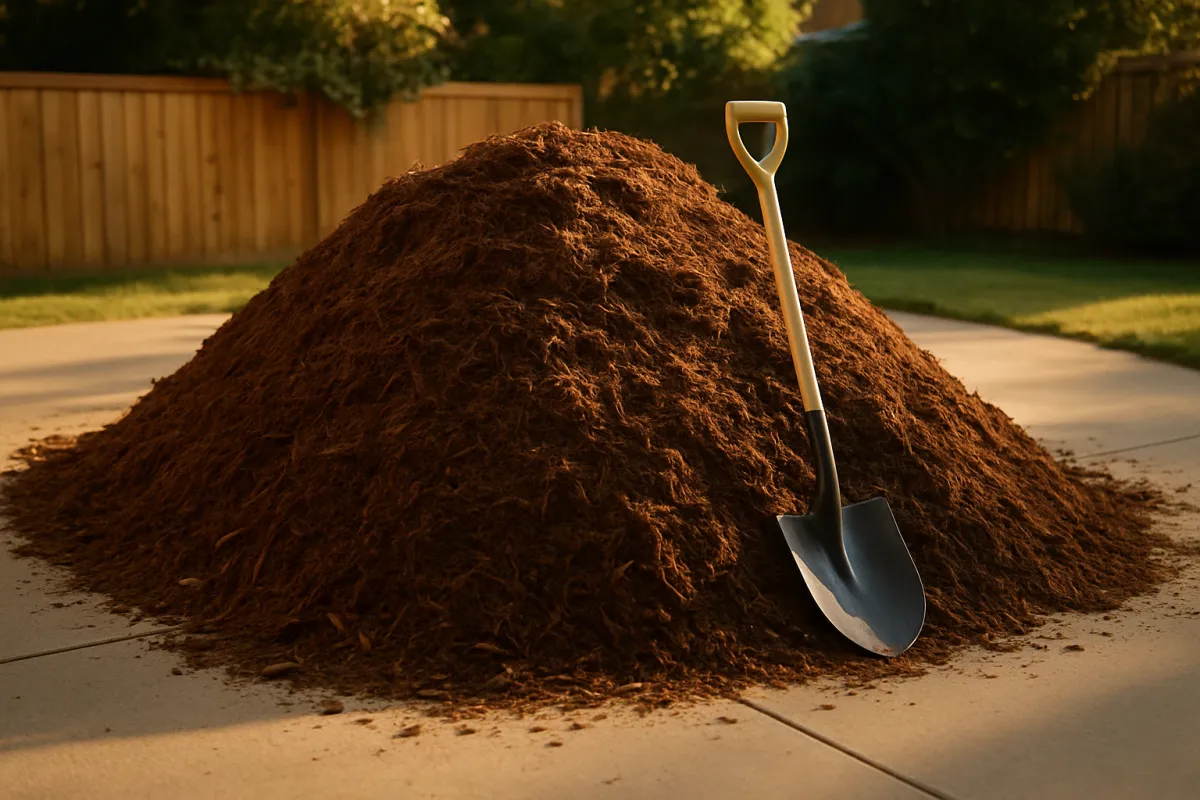
Short answer: A gravel driveway commonly runs an illustrative 1 to 3 dollars per square foot installed, with a working midpoint near 2 dollars, the cheapest common driveway surface to build. Stone runs an illustrative 25 to 55 dollars per ton delivered, and the tonnage follows depth: a typical drive is two or three stacked layers totaling 8 to 12 inches, plus roughly 20 percent for compaction. Get delivered stone prices and written bids.
Gravel driveway cost is one of those numbers that looks simple and turns out to have several inputs hiding behind it. Ask what a gravel driveway costs and the honest answer starts with questions back: how long and how wide is it, how deep does it need to be, how many layers of stone are you stacking, which gravel types go where, and how far does the truck have to haul the load. A short drive with a thin surface course and a long drive built to a full base, middle, and top depth can quote a wide margin apart, even at the same width, because the stone is sold by weight and depth multiplies the tonnage. The rest is delivery, grading, fabric, and the labor to spread and compact, and any one of them can move the total.
This cost brief prices a gravel driveway the way a supplier and a contractor actually estimate one: per ton of stone delivered, and per square foot of surface installed, then scaled up to a whole-project total by size. It works out how much gravel you actually need across the layers, breaks the common gravel types down by what each costs and does, covers what drives the number, compares gravel to concrete and asphalt, weighs doing it yourself against hiring out, and prices the ongoing maintenance that gravel asks for. This article is the cost-focused companion to our gravel driveway build manual, which walks the construction steps, and our gravel quantity manual, which sizes any gravel job in general. Run your own driveway through the estimator or the companion below to turn a length and a width into an illustrative tonnage and total as you read.
Key takeaways
- A gravel driveway commonly runs an illustrative 1 to 3 dollars per square foot installed, with a working midpoint near 2 dollars, which makes it the cheapest of the common driveway surfaces to build.
- Stone is priced by the ton delivered, an illustrative 25 to 55 dollars depending on the type, so the cost follows the tonnage, and the tonnage follows the depth and the number of layers, not just the surface area.
- A driveway is usually two or three stacked layers, a total depth near 8 to 12 inches, so you order far more stone than the finished top course suggests, plus roughly 20 percent for compaction.
- Depth and layers, gravel type, delivery distance, grading, and geotextile fabric are the levers that move a quote past the base rate; site access and haul distance surprise people most.
- Every dollar figure here is illustrative and local: your depth, your stone, your haul distance, and whether you supply the labor move a real quote more than any rule of thumb, so get delivered stone prices and written bids.
What a gravel driveway costs per square foot
The friendliest way to compare a gravel driveway against other surfaces is per square foot of surface installed, because that is how the finished job lines up fairly against asphalt, concrete, and pavers. As an illustrative planning range, a gravel driveway commonly runs somewhere around 1 to 3 dollars per square foot, with a working midpoint near 2 dollars. That figure is not the stone alone: it bundles the gravel across every layer, the delivery, the base prep and grading, and the labor to spread and compact the surface, which is exactly why it is more useful than a single per-ton material price when you are weighing one surface against another.
The reason the per-square-foot figure swings so much for gravel, more than it does for a poured surface, is that gravel cost is driven by depth as much as by area. A concrete slab is a fixed thickness, but a gravel driveway can be a thin single course or a deep three-layer build, and the deeper build is several times the stone. So the low end of the range is a shallow drive on firm ground that a truck can reach, and the high end is a deep, multi-layer drive on soft soil that needs fabric, heavy grading, and a long haul. Keep the per-square-foot number as a rough headline for comparison, then price the tonnage properly, which is where a gravel estimate actually lives.
What a gravel driveway costs per ton
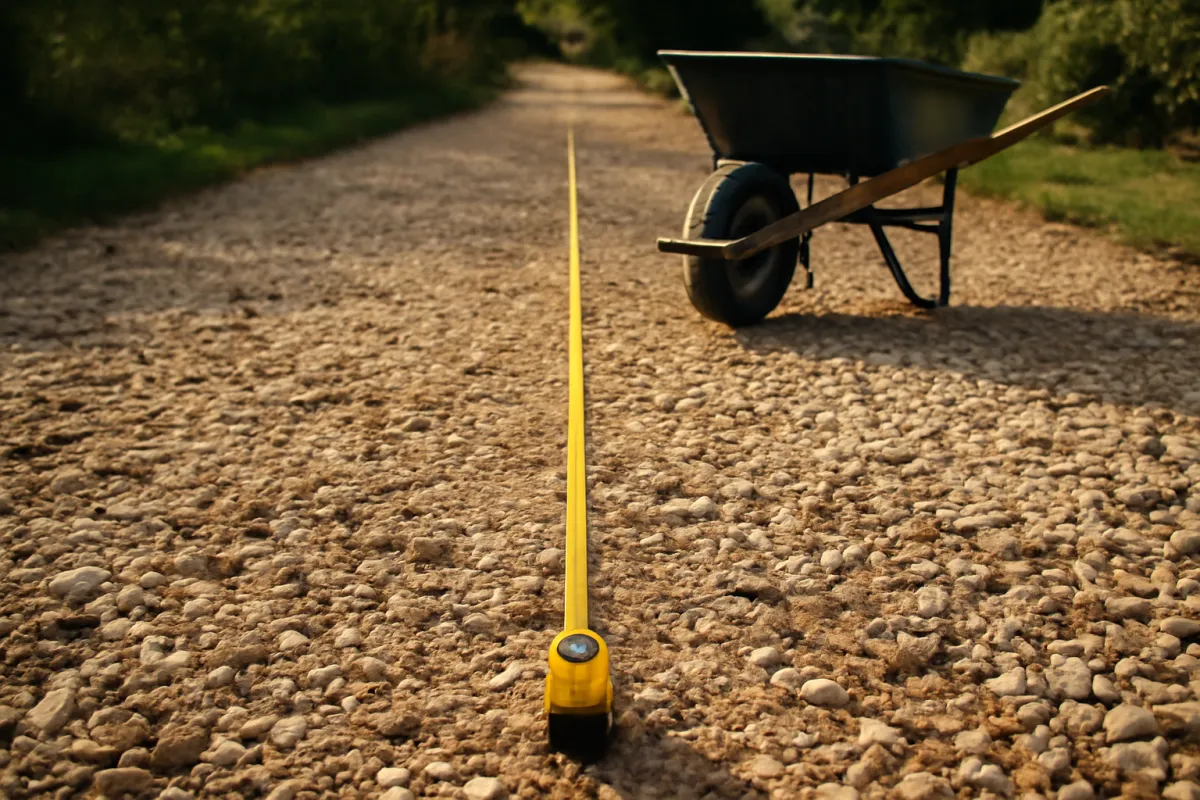
The unit a gravel driveway is actually priced in is the ton, because that is how a quarry or a landscape-supply yard sells bulk stone off a truck scale. As an illustrative range, common driveway gravels run somewhere around 25 to 55 dollars per ton delivered, with the workhorse crusher run and base stone at the lower end and decorative options like pea gravel at the top. That delivered figure bundles two things a beginner often separates by mistake: the stone itself, priced by weight at the yard, and the delivery, priced by the load and the haul distance. On a full driveway the delivery can be a meaningful share, which is why ordering fewer, fuller loads almost always beats several small ones.
The per-ton price is the number to carry to a supplier, but it only becomes a total once you know how many tons the driveway needs, and that comes from the volume math in the next few sections. The key mental shift is that gravel cost is tonnage times a per-ton rate, so anything that raises the tonnage, more depth, more layers, a wider drive, raises the bill directly and in proportion. Two drives of the same surface area can differ by many tons and many dollars purely on how deep they are built. Price the per-ton rate for the stone you want, then size the tonnage honestly, and the total follows.
Gravel driveway cost by size
Scaling the rate up to whole-project totals is where the numbers become real, so here are a few common driveways priced illustratively at a mid-range build, roughly 8 to 10 inches of total depth across the layers. A single-car driveway, about 12 feet wide by 24 feet long, is roughly 288 square feet, an illustrative 600 to 1,500 dollars depending on depth, stone, and whether you hire the labor. A two-car driveway, about 20 feet wide by 24 feet long, is roughly 480 square feet, in the illustrative 1,000 to 2,500 dollar range at a similar depth. A long rural drive of 800 square feet or more, a longer approach to a house set back from the road, climbs past that, often several thousand dollars once the tonnage and any grading are counted.
The pattern is that totals climb with both the area and the depth, and because depth multiplies the tonnage, a deeper build costs more than a wider one of the same footprint. Change the build and the whole range shifts: a shallow refresh over an existing base is a fraction of a full excavate-and-build on bare soil. Add a geotextile fabric, heavy grading, or a long delivery haul, and every figure moves up. Treat these as starting points, not quotes: measure your own area with our square-footage manual, pick a depth and a stone, and get delivered prices, because your haul distance and site conditions will move the total more than any table can predict.
Gravel parking lot cost
A gravel parking lot is priced with the identical method as a gravel driveway, area times depth for the tonnage, then a per-ton rate for the stone, because the material and the math do not change with the use. What does change is scale and traffic. A lot is commonly a much larger footprint than a driveway, so the same per-square-foot range applies, but the total climbs fast simply because the area is larger, and a bigger job usually earns a better delivered per-ton rate on the fuller loads it can order. Run the actual footprint through the estimator rather than guessing from a driveway-sized example, since the tonnage scales directly with area.
Traffic is the other difference, and it argues for building heavier than a driveway would need. A lot that carries frequent vehicles, or occasional trucks and deliveries, wants a deeper, better-compacted base and often a geotextile fabric as a default rather than an option, because repeated turning and braking loads work a thin base harder than a driveway’s straight-in, straight-out traffic. Many jurisdictions also regulate commercial and shared parking areas for drainage and stormwater runoff in a way a private driveway is not, so a lot serving a business, a rental property, or shared parking is worth checking against local code and, on anything beyond a small private lot, a site contractor’s read on the soil before you order stone. Treat the driveway math here as the starting arithmetic, and scale the depth and the base up for the traffic and the rules your lot actually carries.
How much gravel you need: the layer math
The heart of a gravel driveway estimate is the tonnage, and the tonnage comes from a short volume calculation that trips up beginners in one place: depth. A driveway is not the finished surface you see, it is a stack of layers, so the number that goes into the math is the total depth of all the stone, commonly 8 to 12 inches, not the couple of inches of top course. To find the volume, multiply the length by the width for the area in square feet, multiply that by the total depth expressed in feet, and divide by 27 to get cubic yards. A two-car drive of 20 by 24 feet is 480 square feet, and at 10 inches, or 0.83 feet, that is about 400 cubic feet, or roughly 15 cubic yards before any allowance.
Two adjustments turn that raw figure into an order. First, add roughly 20 percent for compaction, because loose stone settles under its own weight and the first passes of a wheel, so the volume that fills the space is more than the finished depth suggests. Our gravel quantity manual works this allowance in full. Second, convert to tons if the yard sells by weight, which most do. That takes the compacted volume from cubic yards to tons, the subject of the next section. Run your own length, width, and depth through the estimator or the companion below to get the tonnage without doing the arithmetic by hand.
Base, middle, and top: the three layers
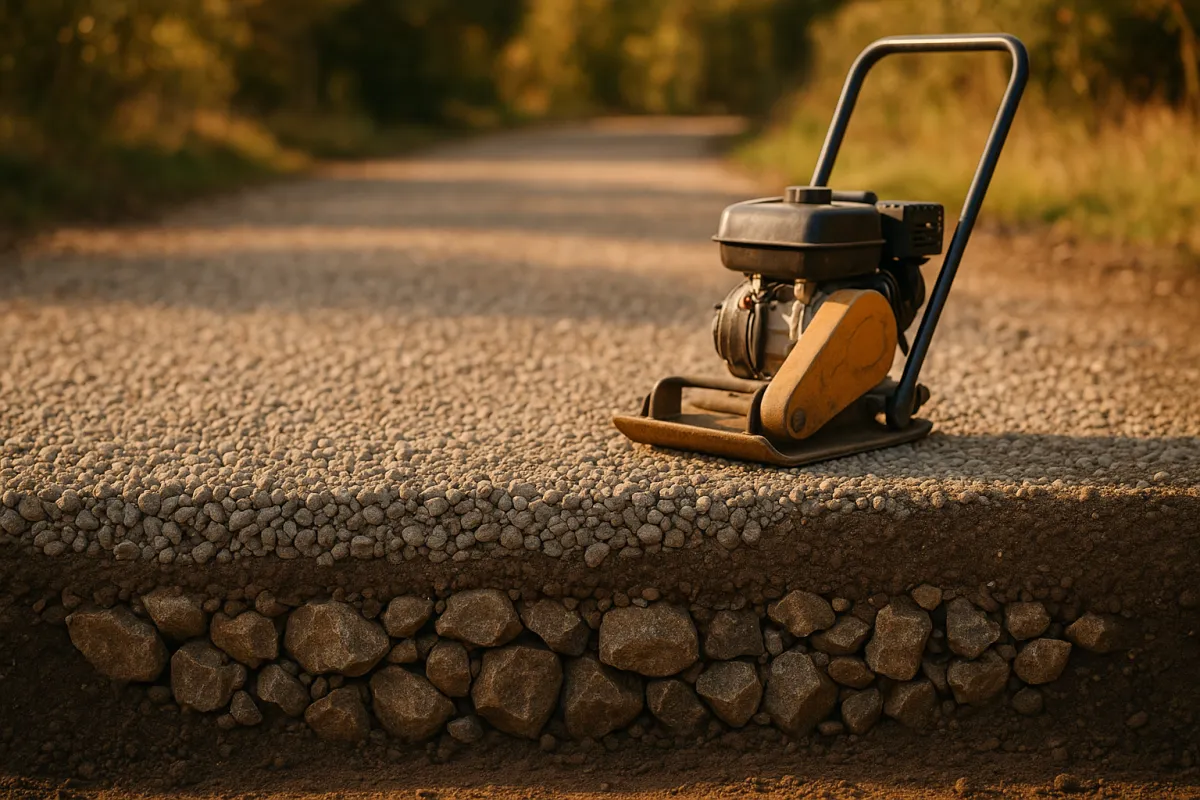
Understanding why a driveway needs so much stone means understanding the three layers, because each one does a different job and none of them is optional on a drive built to last. The base is the deepest, commonly 4 to 6 inches of large, angular stone or a coarse crusher run that locks together and spreads vehicle loads across soft soil below. The middle, where a drive uses three layers, is often 3 to 4 inches of a mid-size crushed stone that bridges the coarse base and the fine top. The top is the surface you drive on, commonly 3 to 4 inches of crushed stone number 57 or crusher run that packs into a firm, shed-water surface. Stacked, that is the 8 to 12 inches the tonnage math is built on.
The reason this matters to cost is that each layer is its own tonnage at its own per-ton rate, and skipping or thinning a layer to save money usually costs more later. A drive built straight onto soft soil without an adequate base pumps stone down into the ground and ruts, so the saving on stone is spent again on repairs within a season or two. The right move on a budget is to build the base properly and economize on the decorative appeal of the top, not the other way around. Our build manual covers how the layers go down and compact; this brief is about what each one adds to the bill.
From cubic yards to tons
Because most suppliers price bulk gravel by the ton off a truck scale, the last step before you can spend a number is converting your compacted cubic yards to tons. A cubic yard of common driveway gravel weighs roughly 1.4 tons, so multiplying the compacted cubic yards by about 1.4 gives the tonnage to order. The two-car example, at roughly 18 compacted cubic yards, works out to about 25 tons. That is the figure a yard quotes against, and carrying both units, your cubic yards and your tons, to the counter is the surest way to avoid a shift by the 1.4 factor when the supplier prices it one way and you calculated it the other.
The conversion is not exact, because different gravels weigh different amounts: a dense, fines-packed base gravel sits heavier per yard than a clean, rounded pea gravel, so the tons-per-yard figure drifts a little by type. For planning, 1.4 tons per cubic yard is a safe working number across common driveway stone, and our gravel weight manual breaks the density down type by type if you want to tighten it. The practical point is that you cannot skip this step: guessing a tonnage by eye rather than converting from a measured volume is how orders arrive short or long. Size the volume, apply the compaction allowance, convert to tons, then price it.
Gravel types and what each costs
The stone you choose sets both the per-ton price and the job each layer can do, so it pays to know the common driveway gravels before you order. The table below lays out the workhorses with an illustrative delivered cost per ton and a short note on where each one belongs in the build. Read the figures as planning bands, not quotes, because the delivered price moves with your region, your haul distance, and what a given yard calls its products, since names vary from one supplier to the next.
| Gravel type | Typical use in a driveway | Illustrative cost per ton delivered |
|---|---|---|
| Crusher run (crush and run) | Base and top course; compacts hard from stone plus dust | ~$28 |
| Large crushed stone (#3 / coarse base) | Deep base layer over soft soil for strength and drainage | ~$30 |
| Crushed stone #57 | Middle or top course; clean 3/4 inch stone that drains and packs | ~$38 |
| Road base / dense-graded aggregate | All-in base and surface where a firm, bound layer is wanted | ~$32 |
| Pea gravel | Decorative top over a compacted base; rounded and loose underfoot | ~$50 |
The pattern in the table is that the compactable workhorses, crusher run and base stone, are the least expensive and do the structural work, while the decorative and cleaner-graded options cost more per ton. That is convenient, because the layers that need the most tonnage, the base and middle, are exactly the cheaper stone, and the pricier decorative stone is only ever a thin top course if you use it at all. The next three sections take the most common choices in turn, and the companion below prices your own driveway at whichever top stone you pick.
Crushed stone #57
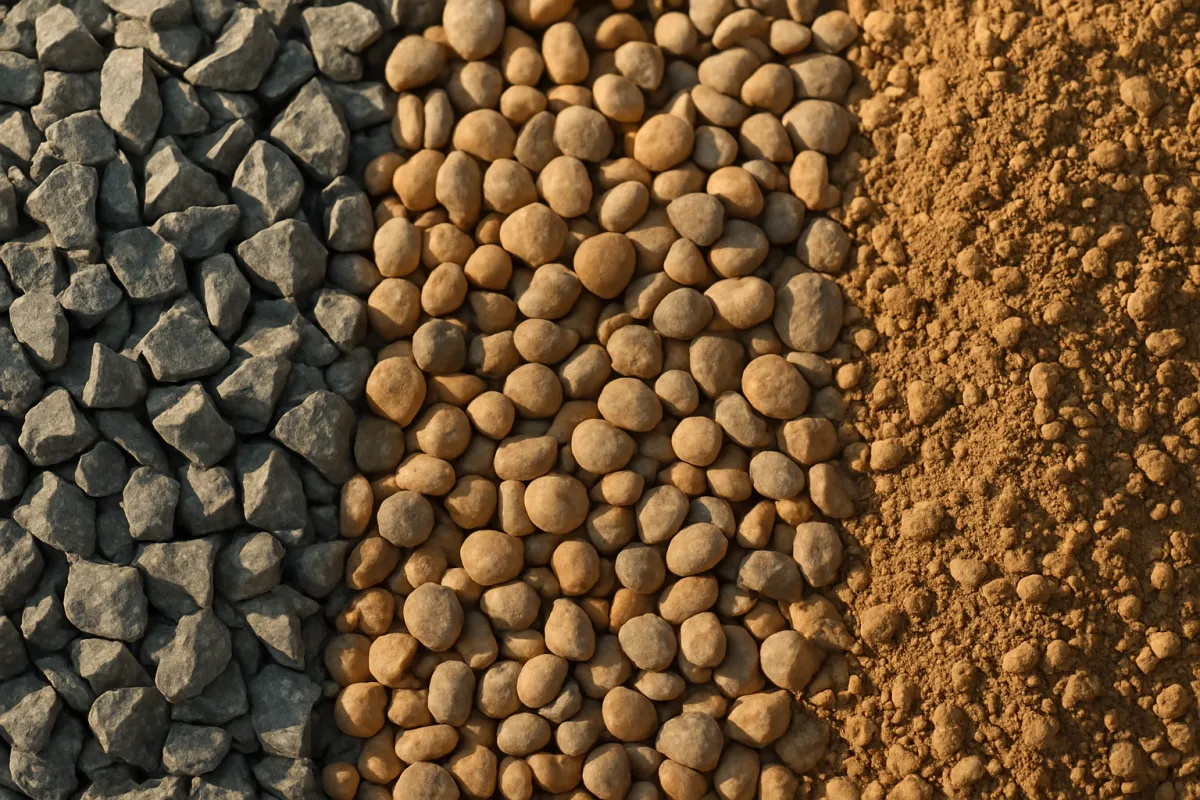
Crushed stone number 57 is one of the most common driveway gravels, an illustrative 38 dollars or so per ton delivered, and it is a clean, angular stone roughly three-quarters of an inch across with the fine dust screened out. The clean grading is its strength and its limit at once: with no fines to bind it, number 57 drains freely and does not hold water or turn to mud, which makes it an excellent middle layer and a good top for a drive that prioritizes drainage. The angular faces lock together better than rounded stone, so it stays put on a firm base reasonably well for a clean gravel.
The trade-off is that, because it lacks fines, number 57 does not compact into a hard, bound surface the way crusher run does, so on its own as a top course it stays a touch looser underfoot and can migrate more under turning tires. Many drives use it as the middle layer under a crusher-run top, or as the top where free drainage matters more than a tightly packed surface. It is a versatile, widely stocked stone that most yards carry, which keeps its price competitive. If you want a clean, drainable stone and do not mind a slightly looser surface, number 57 is a dependable middle-of-the-range choice.
Crusher run
Crusher run, also sold as crush and run or dense-graded aggregate, is often the least expensive driveway stone, an illustrative 28 dollars or so per ton delivered, and it is a mix of crushed stone and the stone dust that a clean gravel screens out. Those fines are the point: when crusher run is spread and compacted, the dust fills the gaps between the stones and binds into a firm, nearly solid surface that sheds water and resists rutting far better than a clean stone. That combination of low price and hard-packing behavior is why crusher run is the default choice for both the base and the top course on many driveways.
The trade-off is drainage and dust. Because the fines bind the surface, crusher run does not drain as freely as a clean stone, so it depends on a proper crown and grading to shed water off the top rather than through it, and it can be dusty when dry and a little muddy at the surface when very wet. For most driveways those are minor next to the strength and the price. Crusher run is the economical, hard-wearing workhorse of gravel driveways, and building the bulk of a drive from it, with a cleaner stone only where drainage demands, is a common way to keep the tonnage cost down without weakening the build.
Pea gravel
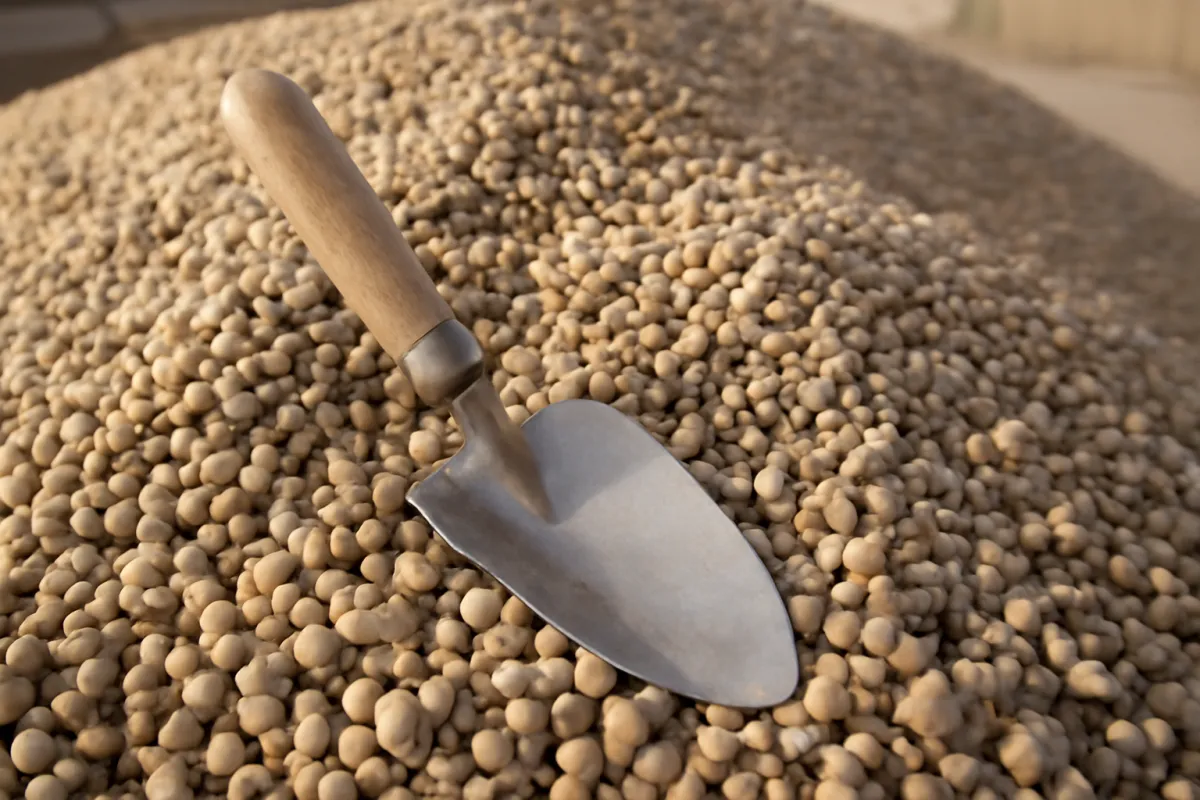
Pea gravel is the decorative end of the driveway range, an illustrative 50 dollars or so per ton delivered, and it is a small, rounded, smooth stone, often screened and sometimes color-sorted, that reads as a finished landscape surface rather than a raw construction gravel. Its appeal is entirely appearance and comfort: the rounded stones are pleasant underfoot and easy on the eye, which is why it is popular for courtyards, borders, and driveways where looks matter. The higher price reflects the screening and sorting that produce that uniform, rounded product.
The catch is structural, and it is a big one for a driveway. Because pea gravel is rounded and smooth, the stones roll past each other rather than locking together, so pea gravel does not compact into a firm surface and tends to migrate under tires, scattering toward the edges and needing frequent raking back. For that reason it is best used as a thin decorative top course over a properly compacted base of crusher run or crushed stone, never as the whole driveway, and it pairs well with edging that holds it in place. Priced as a top course over a compacted base, pea gravel buys a softer look for a modest premium; priced as the entire drive, it is both expensive and prone to spreading.
What drives gravel driveway cost
Beyond the stone itself, a handful of factors move a gravel driveway quote, and knowing them explains why two bids for the same-size drive can differ by a wide margin. Depth and the number of layers come first, because a deep three-layer build is several times the tonnage of a thin surface course, and stone is sold by weight. The gravel types are next: a decorative top over a workhorse base costs more per ton than an all-crusher-run build, so the mix of stone shifts the material bill. Delivery distance is the quiet multiplier, since stone is heavy and hauling it far raises the delivered price and can force smaller, less efficient loads.
The site work is where the rest of the money goes, and it is the part a beginner underestimates most. Excavating to depth on bare soil, grading the base to drain, laying a geotextile fabric under the stone where the soil is soft, and the labor to spread and compact each layer all add real cost that never shows in the finished gravel. A drive built over an existing base as a refresh skips most of that, while a full excavate-and-build on soft, sloped ground carries all of it. The rest of this brief takes these drivers one at a time, starting with the depth and layers that set the tonnage.
Depth and the number of layers
Depth is the single biggest lever on a gravel driveway’s cost, because it multiplies the tonnage directly, and tonnage is what you pay for. A drive built to 12 inches across three layers is half again as much stone as one built to 8 inches, for the identical footprint, and that difference flows straight through to the bill. This is why a gravel estimate can never be read off the surface area alone the way a paving estimate can: the same 480-square-foot drive is a modest order at a shallow refresh depth and a substantial one at a full base-middle-top build. Deciding the depth honestly, for your soil and your traffic, is the first cost decision you make.
The number of layers is the related choice, and it is driven by the ground and the loads, not by preference. A drive on firm, well-draining soil that carries light passenger traffic can sometimes do with a base and a top, two layers, while a drive on soft or clay soil, or one that will see heavy vehicles, wants the full three-layer stack for strength and drainage. Cutting a layer to save stone on ground that needs it is a false economy, because the drive ruts and needs rebuilding. The right move on a tight budget is to match the depth and layers to the ground, then trim cost on the stone type and by supplying labor, not by starving the structure. The companion below lets you set the total depth and watch the tonnage and total move with it.
Grading, fabric, and drainage
The parts of a gravel driveway that decide whether it survives are largely invisible once the stone is down, and they are real cost. Grading comes first: the base has to be shaped so the finished drive sheds water off a slight crown or cross-slope rather than letting it pool and soften the stone. A drive that does not drain holds water, and water is what turns a gravel surface to ruts and potholes, so the grading labor is not a frill, it is what protects every ton of stone above it. On a long or sloped drive, grading with a machine is a meaningful line on a contractor’s bid, and it is one of the first things to confirm a quote includes.
Geotextile fabric is the other hidden line, and it earns its cost on soft ground. A layer of woven fabric laid over the soil before the base stone stops the two from mixing, so the gravel does not sink into the soil and the soil does not pump up into the gravel, which keeps the base intact and the drive from disappearing over the years. On firm, well-draining ground fabric may be optional, but on clay or soft soil it is cheap insurance against a drive that swallows its own base. Drainage features, a culvert where the drive crosses a ditch or a swale to carry water away, add cost where the site demands them. None of this shows in the finished gravel, which is exactly why a cheap bid may have quietly left it out.
Delivery distance and load size
Delivery is a larger share of a gravel driveway’s cost than most people expect, because stone is heavy and heavy freight is priced by distance and by the load. A yard close to your site delivers cheaply, while stone hauled from a distant quarry carries a delivery charge that can rival a chunk of the stone’s own price on a small order. This is the quiet reason two identical drives can quote apart on material: not the stone, but how far the truck travels and how many trips it takes. Asking a supplier for the delivered price to your address, not the price at the yard, is the only way to compare bids honestly.
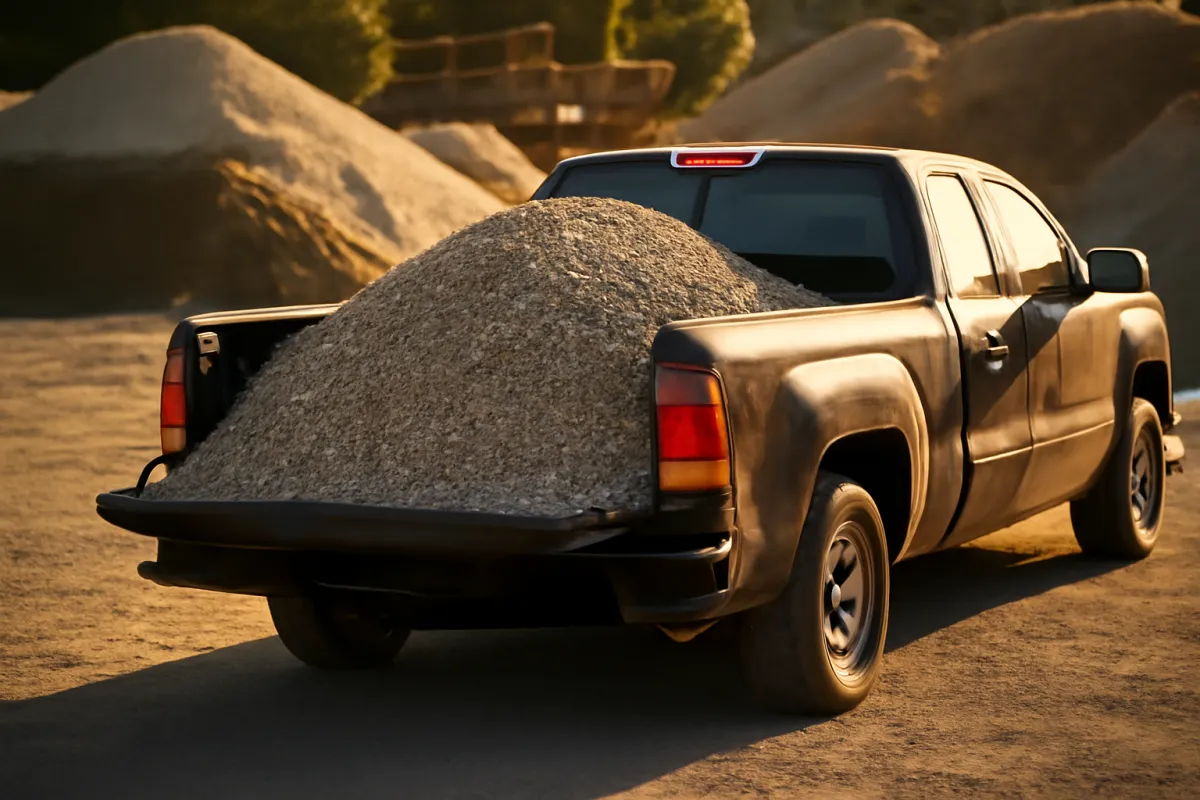
Load size is the lever you control, and it favors ordering in fewer, fuller loads. A delivery truck charges much the same to bring a partial load as a full one, so the delivery cost per ton drops as the load grows, which is why splitting a driveway into several small deliveries wastes money. Where the tonnage is large enough, a single full truck, or the fewest full loads that carry the order, spreads the delivery fee across the most stone. For a small drive within reach of a pickup, self-hauling a few loads can undercut a delivery on a tiny order, but past a fraction of the tonnage the delivery wins on both cost and your back. Our gravel weight manual covers what a load actually weighs and what a vehicle can safely carry.
Where the money goes
Splitting a built gravel driveway into roughly where the money goes makes the estimate easier to reason about, because it shows why the stone, though it is what you picture, is only part of the total. On a pro-installed drive, the material, the stone itself across all the layers, is commonly the largest single share but rarely a majority once everything else is counted. Delivery is its own slice, the freight to bring that heavy stone to the site. And the site work, the excavation, the grading to drain, any geotextile fabric, and the labor to spread and compact each layer, is the balance, the part that never shows in the finished gravel.
The chart below shows an illustrative split for a hired, built gravel driveway, and the point of the picture is that supplying your own labor is where the real saving lives. Because a gravel driveway does not carry the unforgiving timing of a concrete pour, the spreading, raking, and much of the grading are within reach of a capable owner, which converts the site-work slice into your own time. The stone and the delivery are a fixed cost either way, so the honest saving from doing it yourself is roughly the labor share, not the whole bill. That is a different calculus from a concrete driveway, where the skilled pour makes DIY far less realistic.
Where the cost of a built gravel driveway goes
Illustrative split of a hired, multi-layer gravel driveway; shares vary by depth, haul distance, and site.
The stone is under half of a built drive; delivery and the hidden site work make up the rest. Supplying your own labor converts most of that site-work slice into time, which is why a gravel driveway is the most realistic of the surfaces to build yourself.
Gravel versus concrete and asphalt
Gravel is one of several driveway surfaces, and on up-front installed cost it is the cheapest of the common group by a clear margin. As illustrative installed figures, gravel might run a couple of dollars per square foot, asphalt around 5 dollars, plain concrete around 8 dollars, and pavers 15 dollars or more because each unit is set by hand. The chart below places them side by side, and gravel’s position at the bottom is the whole reason it is chosen: for the price of one concrete driveway, you could build several gravel ones, which matters most on a long rural drive where a paved surface would be a large project. Our concrete driveway cost brief prices the poured alternative in full.
Illustrative installed cost per square foot, by driveway surface
Gravel against the common alternatives; local rates, depth, and site prep move every bar.
Gravel is the cheapest surface to install by a wide margin, but installed cost is only half the story. Gravel asks for the most ongoing maintenance of the group, while concrete and asphalt last longer between major work, so the lifetime comparison is closer than the sticker.
What the chart cannot show is the other half of the decision: lifespan and maintenance. Gravel is cheap to install but needs the most ongoing upkeep, regular regrading and a fresh top layer every few years, while asphalt and concrete last longer between major work. Gravel also drains well, handles freeze-thaw without cracking, and repairs cheaply in patches, which are real advantages in some climates and on long drives. The right surface is the one whose installed cost and lifetime upkeep together fit your budget, your climate, and your patience, not simply the one with the lowest number to build. For a long, rural, or budget-driven drive, gravel’s low cost and easy repair often win; for a short, high-traffic city drive, the lower upkeep of a paved surface can be worth the higher install.
DIY versus hiring a pro
Whether to build a gravel driveway yourself is a more open question than it is for concrete, because gravel forgives what concrete does not: time. A concrete pour sets within hours and punishes any delay, but spreading and raking gravel can happen at your own pace over a weekend or two, which puts a short gravel drive genuinely within reach of a capable do-it-yourselfer. The material arrives by delivery truck the same way whether you or a crew spread it, so the stone and the delivery are a fixed cost, and the labor to spread, rake, and compact is the part you can supply yourself to trim the bill.
The parts that argue for hiring out are the heavy and the skilled ones. Excavating to depth, grading the base so the drive drains correctly, and compacting each layer with a plate compactor are where a machine and an experienced operator earn their cost, especially on a long, sloped, or soft-soil drive where getting the grade and the base right is what separates a drive that lasts from one that ruts. A short, flat drive on firm ground is a realistic self-build with rented compaction; a long approach on clay that needs machine grading and fabric is where a contractor pays off. Match the decision to the drive in front of you, and remember the honest saving from doing it yourself is the labor share, not the whole quote, since the stone costs the same either way. Our build manual walks the self-build sequence.
From price to your total
Turning a per-ton rate into a real total is a short chain, and it starts with the volume. Measure the length and the width in feet and multiply for the area, then multiply by the total depth of all the layers in feet and divide by 27 for cubic yards. Add roughly 20 percent for compaction, then multiply the compacted cubic yards by about 1.4 to get tons. Multiply the tons by the delivered per-ton rate for your stone, and you have the material and delivery cost. A two-car drive of 480 square feet at 10 inches works out to roughly 25 tons, which at an illustrative 32 dollars a ton is around 800 dollars of stone delivered, a defensible planning figure for the material before any hired labor.
Two adjustments make the total honest. First, if you are hiring the work out rather than spreading it yourself, add the site labor: excavation, grading, any fabric, and the spreading and compaction, which for gravel is a smaller share than concrete’s finishing labor but still real. Second, check the delivery assumption, because a long haul or several small loads raises the freight above the illustrative rate baked into the per-ton figure. Run your own length, width, and depth through the estimator to get the area, then apply a local delivered rate and these adjustments, and you have a number you can take to a supplier. The companion below does the same math on your own driveway and lets you switch the top stone and the DIY-or-pro choice to see each move the total.
Maintenance cost: regrading and refresh
The cost of a gravel driveway does not end at installation, and being honest about the upkeep is part of comparing it fairly to a paved surface. Gravel trades the lowest install cost for the most ongoing maintenance of the common surfaces, though each job is modest. The first recurring task is regrading, which pulls the stone back from the edges where tires push it, fills the ruts and potholes that form, and restores the crown so the drive keeps shedding water. On a short drive that is a rake-and-tamp afternoon once or twice a year; on a long one it is a quick pass with a box blade behind a tractor or a hired grading visit. Keeping up with it early is what stops small ruts from becoming the deep ones that need a rebuild.
The second recurring cost is the refresh: adding a fresh top layer of gravel every few years as the surface stone works down into the base, scatters to the edges, or simply wears. A refresh is not another full driveway, it is a partial load of top-course stone, an illustrative fraction of the original tonnage, spread and compacted over the existing base. How often depends on traffic, climate, and how well the drainage holds, and a drive with a good crown and intact fabric refreshes far less often than one where water sits. Budgeted across the years, the upkeep is a small annual figure next to the install saving, but unlike a concrete driveway, which mostly wants occasional sealing, a gravel drive asks for this attention continuously. Factor it in, and gravel is still usually the cheapest surface to own on a long drive, just not a zero-maintenance one.
Ways to keep gravel driveway cost down
A gravel driveway cost has real levers, and pulling them before you order beats regretting a thin build later. The largest saving is your own labor: because gravel forgives timing, spreading, raking, and much of the grading are within reach of a capable owner, and supplying that labor on an otherwise hired job converts the site-work share into your time. Ordering in fewer, fuller loads is the next lever, since delivery is priced by the load and the freight per ton drops as the load grows, so consolidating deliveries beats splitting them. Choosing a nearby supplier over a distant quarry cuts the haul that inflates a delivered price.
More savings hide in the stone choice and the design. Building the bulk of the drive from an economical crusher run or base stone, and reserving any pricier decorative stone for a thin top course, keeps the tonnage cost down where the tonnage is largest. Right-sizing the width and the length to what you actually need, rather than an oversized drive, cuts tonnage directly, since cost follows volume. What you should never cut is the structure that the ground demands: skimping on the base depth, the number of layers, the grading, or the fabric on soft soil saves a little now and risks a drive that ruts and needs rebuilding, which spends the saving several times over. Cut on the stone type, the size, the delivery, and your own labor, never on the depth, drainage, or base the site needs.
A worked example: a two-car gravel driveway priced
Nothing clarifies the method like one driveway costed end to end, so take a two-car drive, 20 feet wide by 24 feet long, built to a total of 10 inches across a base and a top course on reasonably firm, accessible ground. The area is 20 times 24, or 480 square feet. At 10 inches, or 0.83 feet, the loose volume is about 400 cubic feet, which is roughly 15 cubic yards, and adding 20 percent for compaction takes the order to about 18 cubic yards. Converting at 1.4 tons per yard gives roughly 25 tons. At an illustrative 32 dollars per ton delivered for crusher run, the stone and delivery come to around 800 dollars, the material planning figure before any hired labor.
Now flex the inputs to see the levers. Swap the top course to pea gravel at an illustrative 50 dollars a ton and the material bill climbs, even though the tonnage is unchanged, purely on the pricier stone. Build to 12 inches instead of 10 and the tonnage rises with the depth, and so does the bill, for the identical footprint. Hire the spreading, grading, and compaction rather than doing it yourself, and the site labor adds to the total, taking a roughly 800-dollar material job toward an illustrative 1,200 to 1,500 dollars installed. The 480 square feet of area is fixed by the dimensions in every case; what moves the total is the depth, the stone, the delivery, and whether you supply the labor, which is the whole lesson of this brief. Run your own driveway through the companion below and watch each lever move the number.
The bottom line
Gravel driveway cost is set by a short list of things in roughly this order: the size, the depth and layers, the stone types, the delivery, and whether you hire the labor. As an illustrative planning range, a gravel driveway runs about 1 to 3 dollars per square foot installed, near 2 at the midpoint, which makes it the cheapest of the common driveway surfaces to build. You turn that into a total not from the area alone but from the tonnage: area times total depth over 27 for cubic yards, plus about 20 percent for compaction, times 1.4 for tons, times a delivered per-ton rate. Depth is the biggest lever because it multiplies the tonnage, the stone type shifts the per-ton price, and delivery and site work fill out the rest. Size the tonnage with our estimator or the companion below, price the stone delivered to your address, read our build manual for the construction and our concrete driveway cost brief if you are weighing a paved surface, then get local quotes. Do that and the number you build a budget on is one you can defend rather than one that surprises you.
Treat this as workbench education, not a price quote or a construction specification. Every dollar figure here, per ton, per square foot, and per project, is an illustrative planning range, and your depth, your stone types, your soil and drainage, your haul distance, whether you supply the labor, your region, and the season will each move the real numbers, often significantly. A driveway carries vehicle loads and must be built with an adequate base, depth, layers, and drainage for your soil and climate, which are ground-condition decisions before they are cost decisions, and some places require a permit or a culvert where a drive meets a public road. Confirm your local requirements with your municipality, size the stone from a measured area and depth rather than a remembered figure, and build a budget only on live, delivered stone prices and written bids for your driveway in your area.
Frequently asked questions
How much does a gravel driveway cost per square foot?
As an illustrative planning range, a gravel driveway commonly runs somewhere around 1 to 3 dollars per square foot installed, with a working midpoint near 2 dollars, which makes it the cheapest of the common driveway surfaces to build. That figure bundles the stone across all the layers, the delivery, the grading and base prep, and the labor to spread and compact it. It swings with how deep you build, how many layers you stack, the gravel types you choose, and whether a truck can reach the site easily. A short single-car drive built shallow lands at the low end, while a long drive built to a full base, middle, and top depth climbs toward the top. Treat any single number as a starting point and get local delivery quotes and, if you are hiring it out, written bids.
How much does a gravel driveway cost in total?
Total cost scales with area and depth, so it depends heavily on the size of the drive and how many layers you build. A single-car driveway, roughly 12 by 24 feet or about 288 square feet built around 8 to 10 inches deep, might land somewhere near an illustrative 600 to 1,500 dollars. A two-car driveway, roughly 20 by 24 feet or about 480 square feet at a similar depth, often runs near an illustrative 1,000 to 2,500 dollars, and a long rural drive climbs well past that. Doing the spreading and grading yourself trims the labor share, while hiring a contractor to excavate, lay fabric, and compact adds it back. These are planning ranges, not quotes, so measure your own area and get delivered stone prices before you budget.
How much gravel do I need for a driveway?
A driveway is not one layer of gravel but usually two or three stacked layers, so the total depth is commonly around 8 to 12 inches rather than the few inches you see on top. To find the volume, multiply the length by the width for the area in square feet, multiply by the total depth in feet, and divide by 27 for cubic yards, then add roughly 20 percent because loose stone compacts under traffic. Most suppliers sell by the ton rather than the yard, and a cubic yard of driveway gravel weighs roughly 1.4 tons, so multiply your compacted cubic yards by about 1.4 for the tonnage to order. A two-car drive of 480 square feet built 10 inches deep works out to roughly 25 tons as an illustrative figure. Our tonnage manual walks the full math.
What type of gravel is best and cheapest for a driveway?
A driveway is usually built from more than one type of stone, because each layer does a different job. The base wants a large, angular stone or a coarse crusher run that locks together for strength, the middle is often a mid-size crushed stone, and the top is commonly crushed stone number 57 or crusher run that packs into a firm, drivable surface. Crusher run, a mix of crushed stone and stone dust, is among the least expensive and compacts hardest, which is why it is a common base and top choice. Pea gravel is the most expensive common option and, because it is rounded and does not lock together, it is better as a decorative top over a compacted base than as the whole driveway. Choose the stone by the job each layer does, not by price alone, and confirm local names since yards label the same product differently.
Is a gravel driveway cheaper than concrete or asphalt?
Yes, gravel is usually the cheapest of the common driveway surfaces to install up front. As illustrative installed figures, gravel might run a couple of dollars per square foot, asphalt around 5 dollars, plain concrete around 8 dollars, and pavers 15 dollars or more because each unit is set by hand. The saving is real, but up-front price is only half the picture, since a gravel driveway asks for the most ongoing maintenance of the group, regular regrading and a fresh top layer every few years, while concrete and asphalt last longer between major work. Gravel also handles drainage and freeze-thaw well and can be repaired cheaply in patches. Weigh the low installed cost against the upkeep and how the surface suits your climate and traffic before you choose on the sticker alone.
Can I install a gravel driveway myself to save money?
A gravel driveway is one of the more realistic driveway projects to tackle yourself, which is a large part of why it is the cheapest surface. The material arrives by delivery truck, and spreading and raking gravel does not carry the unforgiving timing of a concrete pour that sets within hours, so a capable person with a rake, a tamper or a rented plate compactor, and some patience can build a short drive over a weekend or two. The heavy, skilled parts are the excavation, the grading to drain, and the compaction between layers, and those are where hiring a machine or a crew earns its cost on a longer or sloped drive. Supplying your own labor is where the saving lives, since the stone and delivery are a fixed cost either way. Match the decision to the size and slope of the drive in front of you.
What ongoing maintenance does a gravel driveway cost?
A gravel driveway trades a low install cost for the most ongoing upkeep of the common surfaces, though the upkeep itself is modest. The two recurring jobs are regrading, which pulls the stone back from the edges and fills ruts and potholes, commonly once or twice a year, and adding a fresh top layer of gravel every few years as the surface stone works down into the base or scatters. Regrading can be a rake-and-tamp afternoon for a short drive or a quick pass with a box blade for a long one, and a refresh is a partial load of top-course stone, an illustrative fraction of the original tonnage. Keeping the crown and the drainage intact so water sheds off rather than sitting is what stretches the interval between refreshes. Budgeted across the years, the upkeep is small, but it is real and continuous in a way a concrete driveway's is not.
What makes a gravel driveway more expensive?
A handful of factors move a gravel driveway quote beyond the base per-square-foot rate. Depth and the number of layers come first, since a full base, middle, and top stack is far more stone than a single thin surface course, and stone is sold by weight. The gravel types matter, because a decorative top like pea gravel costs more per ton than a workhorse crusher run. Delivery distance is a quiet multiplier, as stone is heavy and hauling it far raises the delivered price and can force smaller, less efficient loads. Site work adds the rest: excavation, grading to drain, a geotextile fabric under the stone to stop it sinking into soft soil, and the labor to spread and compact each layer. Ask each supplier and contractor what depth, stone types, fabric, and compaction a quote includes so you are comparing like for like.