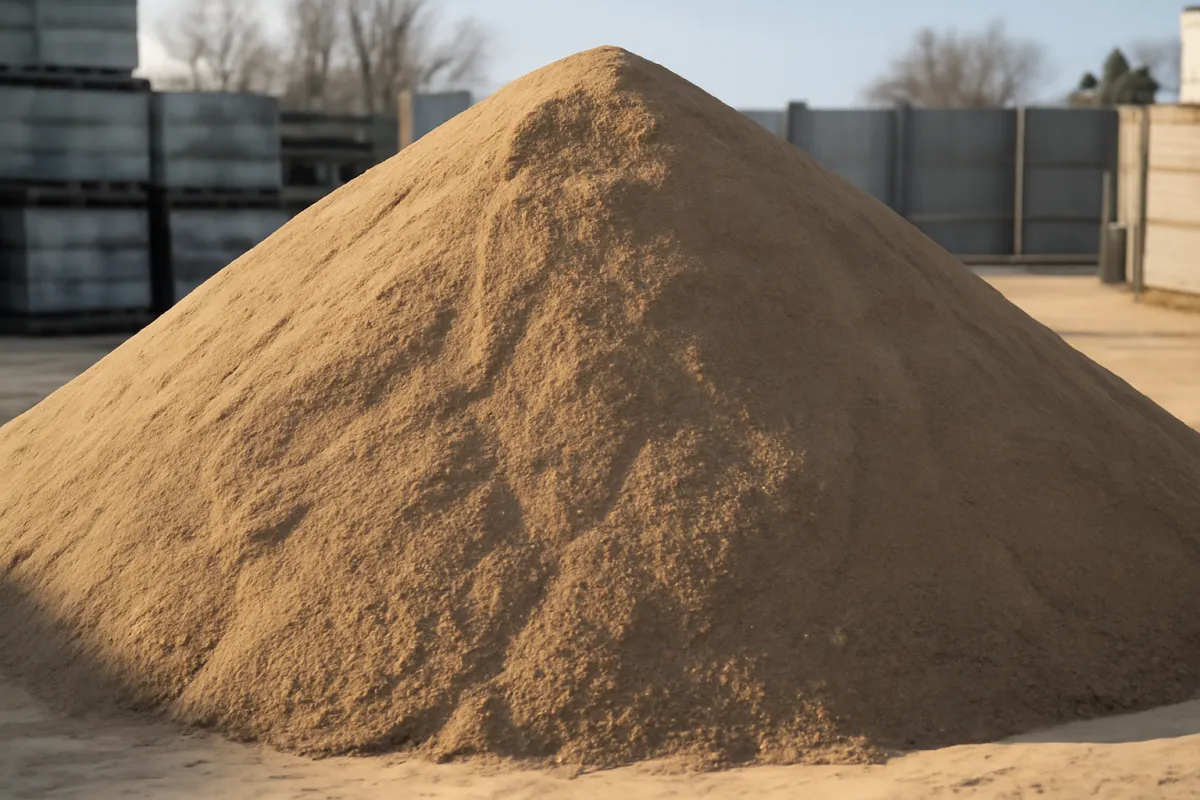
What's on this page
- The formula: area times depth, then convert
- The inches trap, and the divide by 27
- From cubic yards to tons: how the yard sells sand by weight
- Bags or bulk: where the crossover sits
- Paver base: bedding sand and how deep it goes
- Joint sand and polymeric sand for paver gaps
- Sandbox sand: how much for a sandbox by dimensions
- Sand under a pool
- Sand for a concrete mix: the ratio question
- Leveling and bedding depth guidance
- The weight of sand, and why delivery matters
- Dry versus wet sand: the weight swing
- The compaction and waste allowance: order extra
- Measuring an irregular area
- Working a paver patio base end to end
- Working a sandbox end to end
- Where the estimate goes wrong
- The pre-order checklist
- The bottom line
Short answer: Multiply the area in square feet by the depth in feet, then divide by 27 to get cubic yards; convert the depth from inches to feet first. A 200 square foot paver bed at 1 inch is about 16.7 cubic feet, or 0.62 cubic yards, and dry sand runs roughly 1.35 tons per cubic yard if the yard sells by weight. Add about 10 to 15 percent for compaction and waste.
Sand is the material where the answer hides in a single unit conversion, and then splits into two different products that do not share the same math. You measure a patio or a sandbox in feet and inches, the supply yard prices sand by the cubic yard or, more often, by the ton off a truck scale, and the sand that beds your pavers is a completely separate order from the finer sand you sweep into the joints between them. Miss the conversion and the delivery arrives twelve times too big or too small; confuse the two products and you bed a patio in the sand that was meant for the gaps, or try to fill joints with the coarse stuff that will never pack tight.
The core math is short and familiar: area times depth in feet, divided by 27 for cubic yards, plus a small allowance, then a conversion to tons if that is how your yard sells it. It is the same line our gravel manual runs for the sibling material a driveway sits on, and the same coverage-plus-waste method our general estimating manual lays out underneath every material you buy by volume. This manual works that line end to end for the jobs that cover almost every sand order, a paver base, a sandbox, and a pool pad, then handles what the volume formula alone will not tell you: the difference between bedding sand and joint sand, the weight that makes delivery worth it, the dry-versus-wet swing, and where bagged sand stops making sense. For a first pass on your own numbers, our estimator does the arithmetic in seconds.
Key takeaways
- The core formula is area in square feet times depth in feet, divided by 27 for cubic yards; convert depth from inches to feet first, the single most common error.
- Bulk sand is often sold by the ton, and dry sand runs roughly 1.35 tons per cubic yard, so multiply your yards by about 1.35 to speak the supplier's language; wet sand weighs more.
- Paver bedding sand is a roughly 1 inch volume layer estimated like any bulk material; joint sand for the gaps is a separate product bought by coverage per bag, not by the bedding volume.
- A 50 pound bag of sand holds about half a cubic foot, so it takes roughly 54 bags to equal a cubic yard; past a half yard, bulk delivery is cheaper and far less lifting.
- Add about 10 to 15 percent for compaction and waste; short leaves thin spots that telegraph through pavers or a liner, and leftover sand is easy to use up.
The formula: area times depth, then convert
Every sand estimate is the same calculation as every other bulk-material estimate: the volume of the space you are filling, converted into the unit the yard sells in. For the flat jobs that dominate sand work, a paver bed, a leveling layer, a pool pad, that volume is area times depth. Measure the area in square feet, decide the depth the layer needs, and the raw volume is those two numbers multiplied, with depth expressed in feet so the units agree. A 200 square foot patio bedded at 1 inch of sand is 200 times 0.083 feet, about 16.7 cubic feet.
The volume in cubic feet is only halfway to an order, because the yard does not sell sand by the cubic foot. The unit that matters is the cubic yard for bulk, or the bag for small jobs, and getting from cubic feet to either is the second step every estimate runs through. This is the identical shape of math our gravel manual uses for the coarse material under a driveway, and the general estimating method frames why the same area-times-depth line carries across every material you buy by volume. Fix the area, fix the depth, and the rest is unit conversion. Our estimator runs that conversion for you once you have the two measurements.
The inches trap, and the divide by 27
The trap that swallows more sand estimates than any other is units, specifically depth left in inches. Your dimensions arrive mixed: a 200 square foot area, 1 inch of bedding. The formula demands one unit throughout, so depth has to become feet before it multiplies. One inch is 1/12, about 0.083 feet; two inches is 0.167; a 10 inch sandbox fill is 0.833. Skip that division and the arithmetic returns an answer twelve times too large, an order for cubic yards where you needed a fraction of one.
The second conversion is the one first-timers skip entirely: bulk sand is measured by the cubic yard, and a cubic yard is 27 cubic feet, three feet in each of three dimensions. Divide your cubic feet by 27 and you have cubic yards. The 16.7 cubic foot paver bed is 16.7 over 27, about 0.62 cubic yards. Written as one line: (area in sq ft times depth in inches divided by 12) divided by 27 equals cubic yards. Forget the divide-by-27 and you are left with a number in cubic feet that no bulk yard will recognize; leave depth in inches and you order a dump truck for a wheelbarrow job. Every project in this manual, the paver base, the sandbox, the pool pad, runs through that one line, and everything after it is adjustment. The line itself has its own manual, with a cubic yard calculator on the page that runs your dimensions through it, worked examples included, when you want the general method rather than the sand-specific one.
From cubic yards to tons: how the yard sells sand by weight
Sand adds a conversion that a bagged material does not, because the yard usually does not sell it by volume at all. Trucks are weighed at a scale on the way out, so the delivery ticket comes in tons, and your cubic-yard figure has to cross over. Dry sand weighs roughly 1.3 to 1.4 tons per cubic yard, so a 1 cubic yard order is a little over a ton, and a 0.62 yard paver bed is close to 0.85 tons. That 1.35 figure is an illustrative planning number, not a physical constant: wet sand and compacted sand weigh more per yard, very dry sand a little less, so the exact number belongs to the specific product, and a quick check with the yard settles it.
The practical move is to carry both numbers. Calculate in cubic yards, because volume is what fills a measured space and what your tape produces, then multiply by about 1.35 to get the tonnage the supplier quotes and the truck delivers. When you call, you can state either and let them translate, but knowing both means the conversation, and the invoice, make sense. This is exactly the yards-to-tons step our gravel manual walks through for the coarser sibling material, where the same weight-on-a-scale logic decides how the order is priced, and it is the reason a heavy material like sand or gravel feels different at the yard than a light one sold purely by the yard.
Bags or bulk: where the crossover sits
Bagged sand and bulk sand are the same material at wildly different scales of effort and cost, and the crossover comes fast. A 50 pound bag of sand typically holds only about half a cubic foot, which means it takes roughly 54 bags to equal a single cubic yard. Below a handful of bags, for a small repair, a paver touch-up, or a modest sandbox, bags win on convenience: no delivery minimum, no truck to schedule, buy exactly what you need and carry it home. The store sells 50 pound bags of play sand, all-purpose sand, and paver sand off the same shelf, and for a job that needs three or four of them, that is the entire decision.
Past a half yard or so, bulk wins decisively on both price and labor. Bulk sand by the ton or the yard costs a small fraction per unit of what bagged sand does, because you are not paying for the bag or the handling, and a single delivery replaces dozens of lifts. The gray zone is narrow: somewhere between a fraction of a yard and a yard, a delivery fee can make a small bulk order and a bag pile close on total cost, and there the decision turns on whether you have a way to receive and move loose sand. Above a yard, as our estimating manual frames for materials generally, bulk is simply the answer, and the only real question is delivery versus pickup. Run your own volume through our estimator and the bag count and yardage both drop out, so the crossover is visible before you choose.
Paver base: bedding sand and how deep it goes
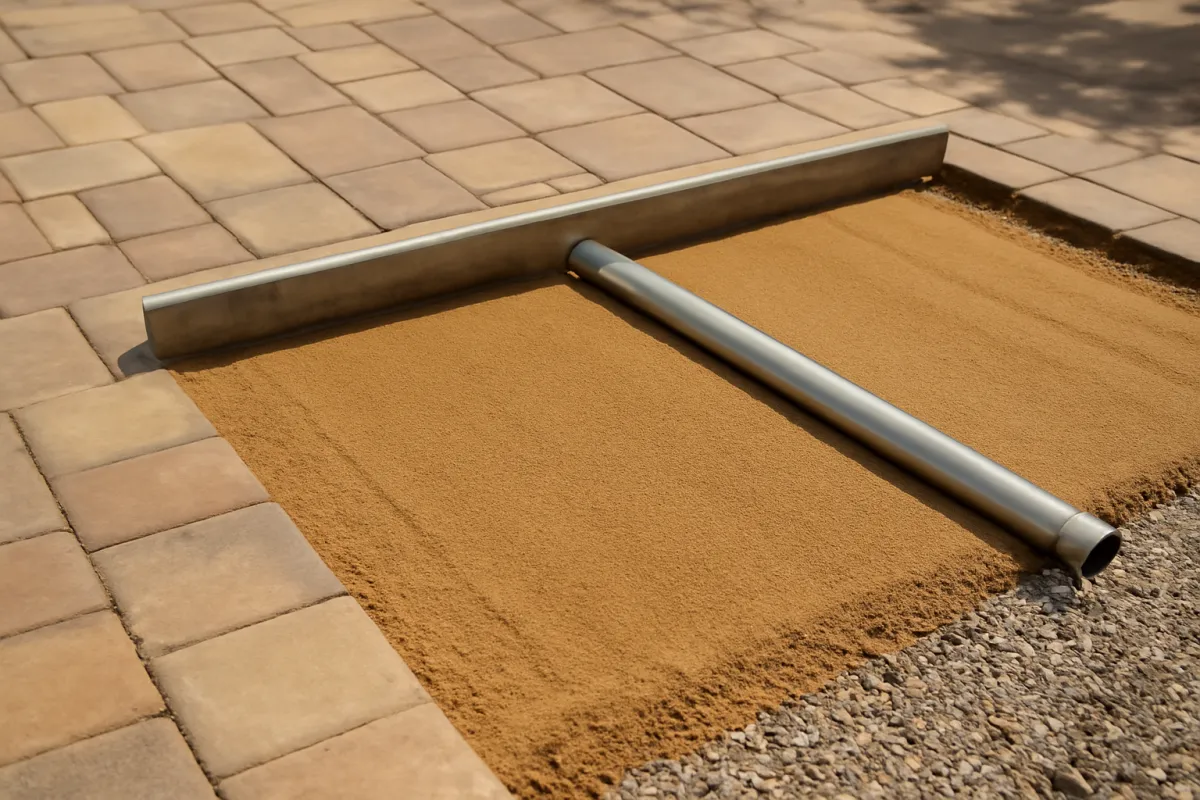
Paver sand is the single biggest reason people search for a sand number, and it is worth being precise about which sand and which depth. The bedding layer, sometimes called leveling sand or paver sand, is the roughly 1 inch cushion of coarse, angular sand the pavers are set into and screeded level on top of the compacted gravel base. One inch is the common target because it is thick enough to seat each paver and absorb minor base irregularities, but thin enough that it will not rut or wave under load the way a deep sand bed would. Use a coarse, sharp bedding sand, often labeled concrete sand or ASTM C33, rather than fine mason’s sand, because the angular grains lock and stay put where fine sand migrates.
For the estimate, that 1 inch bed is an ordinary area-times-depth calculation: paver area in square feet times 0.083 feet, over 27, for cubic yards. A 200 square foot patio is about 0.62 cubic yards of bedding sand, and a 400 square foot patio doubles that to roughly 1.2 yards. The depth is the sensitive input: bed at 1.5 inches instead of 1 and the order jumps by half, so confirm the bedding spec before ordering. What this volume does not include is the sand that goes between the pavers, which is a different product on a different math, and the next section covers it. Keep the two separate on your list, because ordering only the bedding sand leaves the joints empty on install day.
Joint sand and polymeric sand for paver gaps
Once the pavers are laid, the gaps between them get filled with joint sand, and this is where the volume math stops applying. Joint sand is estimated by coverage per bag, not by an area-times-depth calculation, because what fills the joints is a thin ribbon of sand around each paver whose total volume depends on the paver size, the joint width, and the paver thickness, not on the flat area alone. A bag of joint sand states the square footage it covers for a given paver and joint width, and that coverage figure is what you estimate against: divide your paver area by the bag’s stated coverage and round up.
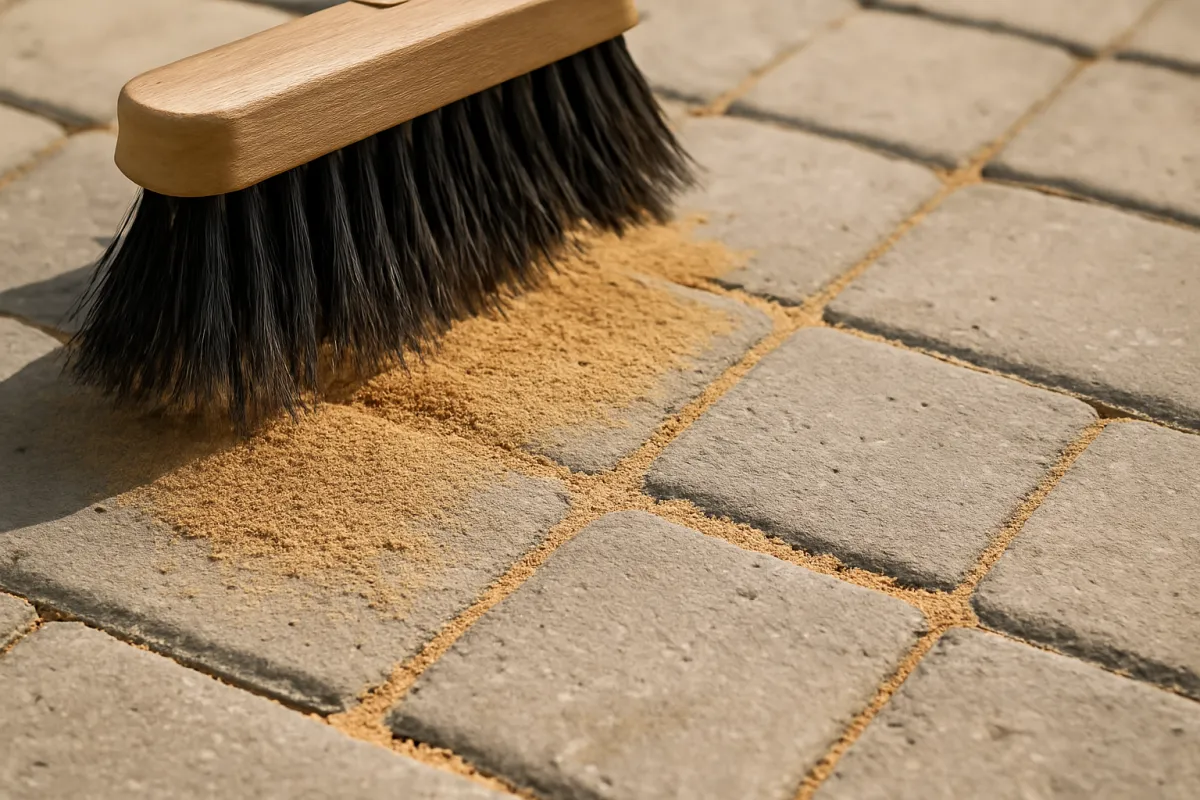
Polymeric joint sand is the common upgrade: it contains a binder that hardens when wetted, locking the joints, resisting weeds and ants, and holding the sand in place against rain and blowers. It costs more per bag than plain joint sand and covers a smaller area, because the coverage drops with wider or deeper joints, so read the bag’s coverage chart for your specific paver and joint. As a rough planning sense, a bag of polymeric sand commonly covers a modest patch of standard pavers with narrow joints and much less with wide ones, so buy from the coverage chart, not a guess, and add a bag for the inevitable topping-up as the joints settle. This coverage-per-unit thinking is exactly what our general estimating manual calls buying by coverage rather than by the unit, and joint sand is the textbook case.
Sandbox sand: how much for a sandbox by dimensions
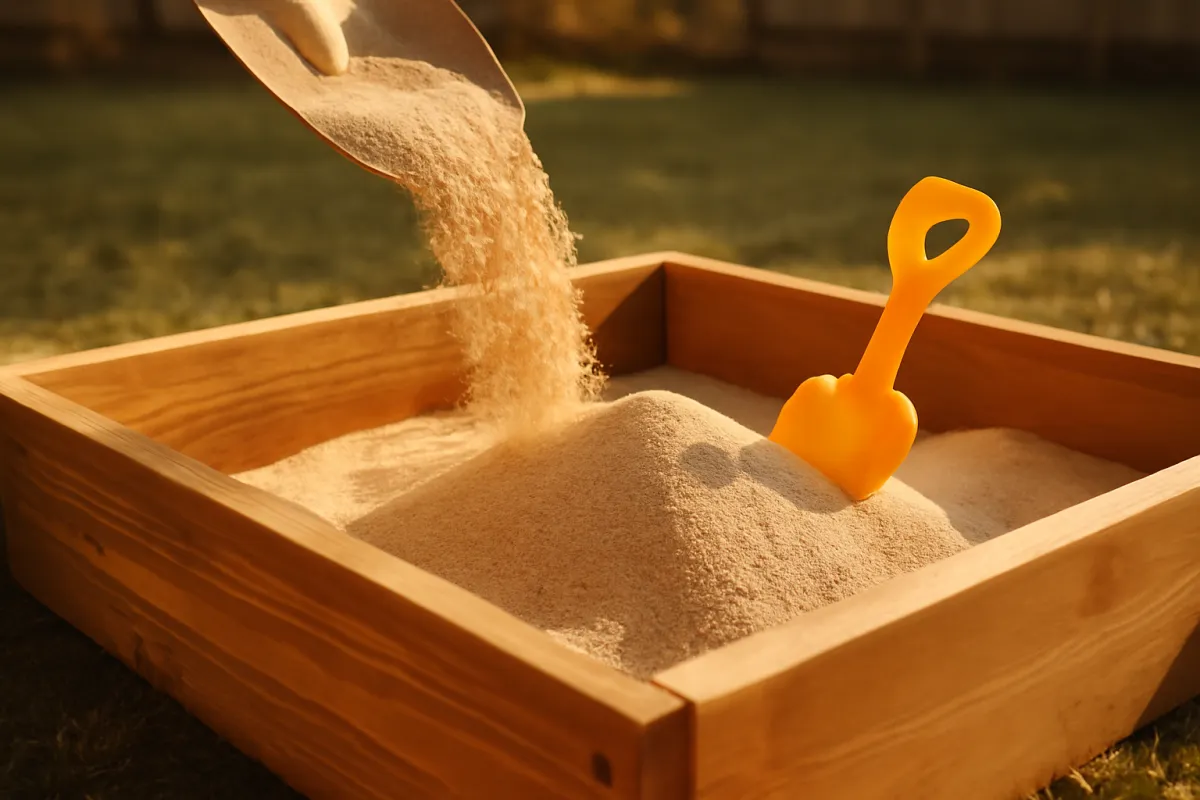
A sandbox is a pure volume-fill job, and it is the friendliest sand math there is because the box gives you clean dimensions. Multiply the box length by its width by the sand depth you want, all in feet, and you have the cubic feet directly; divide by 27 for cubic yards or by about 0.5 for the number of 50 pound play sand bags. A 5 by 5 foot sandbox filled to 10 inches deep is 5 times 5 times 0.833, about 20.8 cubic feet, which is roughly 42 of the 50 pound bags, or about 0.77 cubic yards in bulk. The depth is a choice, not a spec: pick it from how deep the children will actually dig, commonly somewhere around 8 to 12 inches for a box they can build in.
The product matters as much as the quantity. Use washed, screened play sand rather than sharp construction or bedding sand, because play sand is cleaned and sized to be safe and comfortable for small hands, where builder’s sand is dusty, angular, and not intended for that use. Round sandboxes use the circle area, radius squared times pi, times the depth: a 4 foot radius round box at 10 inches is about 41 cubic feet, twice the square box because the area is larger. For most home sandboxes the answer lands in the range where bags and a small bulk order are close, so the choice comes down to whether hauling forty-odd bags or receiving a loose half-yard suits your site better. Our estimator will turn the box dimensions into both the bag count and the yardage.
Sand under a pool
A leveling layer of sand under an above ground pool is a common job with one firm rule: the pool manufacturer’s instructions are the depth and sand type that matter, and they should be followed over any general figure in this manual. With that said, a leveling layer of roughly 2 inches of sand across the pool footprint is a widely cited starting point, laid and screeded smooth so the liner sits on an even, stone-free bed. For a round pool, the footprint is the radius squared times pi, so a 15 foot diameter pool has a 7.5 foot radius and an area of about 177 square feet, which at 2 inches deep is roughly 29 cubic feet, or just over 1 cubic yard.
Use a sand that levels and compacts smoothly, commonly masonry or paver sand, and screed it dead flat because any high spot or buried stone telegraphs through the liner and becomes a wear point underfoot. The estimate is the same area-times-depth line as everything else, with the round-pool area being the only wrinkle, and the compaction allowance matters here because a settled low spot under a full pool is not something you fix after the water is in. Confirm the depth and the sand type against the pool maker’s guidance before ordering, treat the 2 inch figure as illustrative, and add the standard allowance so the screeded, compacted layer still reaches the depth the instructions call for.
Sand for a concrete mix: the ratio question
Sand also shows up as an ingredient rather than a layer, in concrete and mortar mixes, and there the question is a ratio, not a depth. A traditional concrete mix is commonly described by proportion, along the lines of one part cement to two parts sand to three parts gravel by volume, with mortar and other mixes using their own ratios, so the sand you need is a fraction of the total mix volume rather than a layer you screed. If you know the finished volume of concrete you need, the sand portion is that volume scaled by the sand fraction of the mix, though real mixes are not perfectly additive because the sand and cement fill the voids between the larger aggregate.
For most people the practical answer is to buy a pre-blended bag mix and skip the ratio entirely, and our gravel manual and the wider set of concrete manuals on this site handle the from-scratch volume math for slabs and footings in detail. If you are mixing from raw materials, estimate the total concrete volume first with the area-times-depth line, then apply the mix ratio to split that volume into cement, sand, and gravel, and add a margin because the proportions are approximate and some material is always lost to the mixer and the wheelbarrow. Treat any specific ratio as illustrative and match it to the mix design your project actually calls for, because structural work has requirements a general rule does not capture.
Leveling and bedding depth guidance
Depth is the input that moves a sand order more than any measuring error will, and unlike area it is not something you read off the ground: it is a spec you choose from the job. The depths below are illustrative starting points, and manufacturer instructions, local practice, and the specific product all move them, but they anchor the estimate. Paver bedding sand commonly runs about 1 inch, thick enough to seat the pavers and no thicker. A general leveling layer under a patio, shed floor, or walkway often runs 1 to 2 inches. A pool base is frequently around 2 inches. A sandbox is the outlier, a deep fill of 8 to 12 inches or more, because the whole point is a volume to dig in rather than a thin layer to build on.
Sand depth by project
Illustrative depths; manufacturer instructions and local practice move the real figures.
Bar widths track the depth figures: a sandbox holds roughly ten times the sand per square foot of a paver bed, which is why a small sandbox footprint can want more sand than a much larger patio. Confirm the depth spec before any other number, because it scales the whole order one for one.
The lesson the chart carries is that square footage alone tells you almost nothing about the order until depth is fixed. A large paver patio at 1 inch and a small sandbox at 10 inches can want the same volume of sand, so the first question on any sand job is not how big but how deep, and the answer comes from what the sand has to do, cushion a paver, level a pool, or fill a box.
The weight of sand, and why delivery matters
Sand is heavy, and its weight is the practical reason the yard sells it by the ton and the reason delivery beats self-hauling faster than you expect. A cubic foot of dry sand weighs on the order of 100 pounds, so a cubic yard, 27 of those cubic feet, weighs roughly 2,700 pounds, well over a ton. That single number reframes every order: a modest 1 cubic yard paver bed is more than a ton of material to move, and a full sandbox is not far behind. This is why the bag count matters as a labor plan and not just a shopping figure, because 42 fifty-pound bags is over a ton lifted twice, once into the car and once into the box.
At the scale of a bulk delivery, the weight decides the logistics. A half-ton pickup safely carries only a fraction of a cubic yard of sand, since a single yard already outweighs the truck’s rating, so self-hauling a multi-yard order means many round trips and real wear on the vehicle. Delivery adds a fee, sometimes flat, sometimes by distance, but it drops the full order in one trip where you want it, and the fee spreads across the whole load so the bigger the order, the smaller the fee looks per yard. This is the same delivery-versus-pickup logic our gravel manual works through for the coarser material, and sand’s weight makes the case even harder to argue with.
Dry versus wet sand: the weight swing
The one number that shifts under you is weight, because sand holds water and water is heavy. Dry sand runs around 1.3 tons per cubic yard, but the same sand saturated with water can weigh noticeably more per yard, because the water fills the voids between grains and adds its own mass. This matters in two places. First, if your yard sells by the ton and the sand is wet from rain or a hosed-down stockpile, you pay for the water weight, receiving slightly less actual sand per ton than the dry figure implies. Second, wet sand also bulks up in volume, occupying more space loose than the same sand dry or compacted, which confuses a by-eye volume estimate.
The practical response is not to over-engineer it but to know the direction of the error and lean on the allowance. If you calculate in cubic yards and buy by volume, moisture affects you less, because a yard is a yard however wet. If you buy by the ton, treat the 1.35 tons per yard figure as the dry planning number and expect a wet load to weigh more for the same volume, so the tonnage that matches your calculated yardage may run a little high. Either way, the 10 to 15 percent allowance the next section covers absorbs the small swing, and the only precise number is the one your specific supplier’s specific stockpile gives on the day, which is another reason to confirm the conversion at order time rather than trusting a table.
The compaction and waste allowance: order extra
Here is where sand departs from a tidy volume formula, and the departure is partly physics and partly handling. Loose sand poured out occupies more space than the same sand once it has been screeded level and compacted under pavers, a pool, or foot traffic, because the air gaps between grains close as it settles. So the volume that fills your measured depth is a little more than the finished depth implies, and on top of that a bulk order always loses a bit to spillage, the last shovelfuls that never leave the pile, and the sand that works into the base below. A common allowance is around 10 to 15 percent over the raw formula volume, a touch higher on jobs that compact hard or sit on a base that swallows the first pass.
A paver sand order, by destination
Illustrative split of a paver project's sand order, bedding plus joint sand plus the waste and compaction allowance.
The bedding layer is the bulk of a paver sand order because it is the thickest continuous layer; the joint sand is a separate coverage-based buy, and the allowance rides on both. Order the bedding and joint sand as separate products, then add the allowance across the whole.
The direction of the error is what sets the number. Order 10 to 15 percent long and the surplus is cheap: it tops up settled joints, fills a low spot, feeds a play pile, or sits in a corner for next season, because dry sand does not spoil. Order formula-exact and the shortfall is expensive in a slow way, the finished layer comes up thin where it settled most, those thin spots telegraph through pavers as low, ponding patches or through a pool liner as a soft dip, and the fix is a second small delivery at the yard’s least favorable pricing for a partial load. The allowance is not padding, it is the difference between a layer that holds its level and one that dishes out early.
Measuring an irregular area
Real patios, pool pads, and beds refuse to be clean rectangles, and the estimating move for every irregular footprint is the same one the sibling manuals use: decompose the shape into pieces you can already solve, calculate each, and sum. An L-shaped patio is two rectangles sharing an edge. A patio that widens into a walkway is a rectangle plus a second rectangle. A round pool or a circular pad is radius squared times pi. A rough or wandering boundary gets approximated as the rectangle that would contain it, with the overage joining the allowance. Sketch the decomposition on paper with dimensions before touching a calculator, because the sketch is where a forgotten section announces itself.
The arithmetic never fails; only the inventory of pieces does, so the whole skill is bookkeeping. Add the piece areas into one total square footage, multiply by the single depth the layer needs, and divide by 27, exactly as if the shape had been a rectangle all along. Curved and irregular jobs earn a point or two more allowance than clean rectangles, because an eye-fitted boundary always encloses a little more area than the plan promised, so let the extra ride in the waste allowance rather than trying to compute a curve exactly. This is the identical decompose-and-sum method our general estimating manual applies to every awkward footprint, and it turns complexity of shape into a list of simple multiplications.
Working a paver patio base end to end
Walk a paver patio through completely, because the worked version surfaces every decision the formula hides. The plan: a 200 square foot patio, bedded on 1 inch of coarse sand over a compacted base. Area is given, 200 square feet. Depth in feet: 1 inch is 0.083. Volume: 200 times 0.083 is about 16.7 cubic feet. Over 27, that is roughly 0.62 cubic yards from the formula, the bedding number before any adjustment. Add the compaction and waste allowance, about 15 percent, and 0.62 becomes roughly 0.71 cubic yards, the loose volume you actually buy so the screeded bed still holds its inch.
Now the second product. The joints between the pavers need joint sand, and that is a coverage buy, not part of the 0.71 yard bedding figure: divide the 200 square foot area by the bag’s stated coverage for your paver and joint width and round up, adding a bag for topping up as the joints settle. Convert the bedding to the unit the yard delivers in: at about 1.35 tons per cubic yard, 0.71 yards is roughly 0.96 tons, close enough that this job sits right at the bags-or-bulk crossover, a stack of fifty-pound bags or a small bulk drop both work. As an illustrative figure, a small bulk sand order lands in the low tens of dollars for the material before delivery, with the joint sand priced separately by the bag, and the only reliable number is a local quote. Run your own patio through our estimator to get the same chain in seconds.
Working a sandbox end to end
The sandbox is the clean counterexample, a pure volume fill with no second product and no coverage math. The plan: a 5 by 5 foot square sandbox, filled to 10 inches of play sand. Area: 5 times 5 is 25 square feet. Depth in feet: 10 inches is 0.833. Volume: 25 times 0.833 is about 20.8 cubic feet. That is the whole calculation, because a sandbox has nothing to screed level and nothing to compact hard, so the allowance is small, mostly for the sand that spills and the depth the children scoop out and scatter.
Convert 20.8 cubic feet to the buying unit. In 50 pound bags at half a cubic foot each, that is 20.8 over 0.5, about 42 bags, a real afternoon of lifting at over a ton total. In bulk, 20.8 over 27 is about 0.77 cubic yards, which a yard can drop as a small pile. The sandbox is the job that best shows why the depth question dominates: the footprint is only 25 square feet, smaller than a single parking space, yet the 10 inch fill makes it want more sand than a 200 square foot patio bedded at an inch. Same formula, opposite geometry, and the reminder that with sand you always ask how deep before how big. Our estimator returns both the bag count and the yardage from the box dimensions.
Where the estimate goes wrong
Sand’s failure patterns repeat reliably enough to list in descending order of expense. Unit slips lead: depth left in inches instead of converted to feet, the divide-by-27 forgotten, or cubic yards and tons confused so the order is off by the 1.35 factor. Each produces an answer wrong by a multiple, not a margin, which is why the physical sanity check, does this sound like a thin bed or a deep box, catches more disasters than careful re-arithmetic. Product confusion follows: ordering bedding sand for the joints or joint sand for the bed, or buying dusty builder’s sand for a sandbox that wanted washed play sand, each discovered on install day when the wrong material will not do the job.
The subtler failures round out the list. Skipping the allowance entirely, then watching the screeded layer settle thin and pond. Treating joint sand as part of the bedding volume and arriving with empty joints. Buying by the ton without accounting for wet sand’s water weight. Forgetting that the pool maker’s instructions, not a general rule, set the base depth. And the planning failure that contains the others: eyeballing the order the day the truck is booked instead of measuring the week before, leaving no room to re-measure, re-spec the depth, or split the bedding and joint products correctly. Sand rewards the boring virtues, early measurement, checked units, the right product for each layer, and a real allowance.
The pre-order checklist
The whole manual, compressed to the sheet worth keeping in the truck.
- Fix the depth spec first. Paver bedding about 1 inch, leveling 1 to 2 inches, pool base about 2 inches per the maker’s instructions, sandbox 8 to 12 inches, all illustrative.
- Measure the footprint, decompose odd shapes. Sum the piece areas into one square footage; circles are radius squared times pi.
- Run the line. (area in sq ft times depth in inches divided by 12) divided by 27 equals cubic yards.
- Split the paver order. Bedding sand by volume, joint or polymeric sand by the bag’s coverage chart; they are two different products.
- Add about 10 to 15 percent for compaction and waste; the shortfall telegraphs through the finished surface, the surplus is easy to use up.
- Convert to tons if the yard sells by weight. Cubic yards times roughly 1.35 for dry sand; expect wet sand to weigh more, and confirm the product’s own figure.
- Pick bags or bulk by the crossover. Under a half yard, bags; past it, bulk delivery almost always wins on price and lifting.
Run the list top to bottom and the delivery becomes what it should be: the right sand, the right amount, and a layer that holds its level.
The bottom line
Sand estimating is one line of arithmetic with two twists bolted on: area times depth in feet, over 27, plus about 10 to 15 percent for the way sand packs and spills, then times roughly 1.35 if the yard sells by the ton. The twists are the two that catch people, that bedding sand and joint sand are different products on different math, and that sand’s weight makes delivery worth it faster than for almost anything else you buy loose. Work your own patio, sandbox, or pool pad through our estimator, read the gravel manual for the same volume-and-tonnage logic on the coarse sibling material, or the general estimating method for the coverage-plus-waste thinking underneath all of it, and give the order its lead time. The delivery that follows will be the dull, correct kind, which with sand is the only kind worth having.
Treat this as shop-floor education, not a specification. Every depth, coverage figure, weight, conversion, and cost above is an illustrative worked example, and your sand type, your supplier, your region, and your moisture conditions will each move the real numbers. Pool base depth and sand type should follow the pool manufacturer’s own instructions, concrete and mortar ratios should match the mix design your project calls for, and joint sand coverage should be read from the product’s chart for your specific pavers, so confirm depths, the yards-to-tons conversion, and any structural detail against local practice and a qualified professional before you order, and settle the final quantity with your supplier when you book the delivery.
Frequently asked questions
How do I calculate how much sand I need?
Multiply the area in square feet by the depth in feet to get cubic feet, then divide by 27 to convert to cubic yards, the unit bulk sand is sold in. A 200 square foot area at 1 inch deep works out to about 16.7 cubic feet, or roughly 0.62 cubic yards. Convert the depth from inches to feet first by dividing by 12, because leaving it in inches is the single most common error, and it makes the answer twelve times too large.
How much sand do I need for pavers?
Paver bedding sand is usually laid about 1 inch deep over the compacted base, so multiply your paver area by 1 inch, or 0.083 feet, to get the bedding volume, then divide by 27 for cubic yards. A 200 square foot patio at a 1 inch bed is roughly 0.6 cubic yards before any allowance. That covers the bedding layer only; the joint sand that fills the gaps between pavers is a separate product bought by the bag and estimated by coverage, not by the same volume math.
How many tons of sand are in a cubic yard?
Sand weighs roughly 1.3 to 1.4 tons per cubic yard when dry, though wet or compacted sand weighs more, so treat 1.35 tons as an illustrative planning figure rather than a fixed constant. Many suppliers sell and deliver sand by the ton because trucks are weighed at a scale, so once you have your cubic yards you often multiply by about 1.35 to speak the same language as the yard. Confirm the specific conversion for the product and moisture content you are buying when you place the order.
How much sand do I need for a sandbox?
A sandbox is a volume-fill job, so multiply the box length by its width by the sand depth you want, all in feet, then divide by 27 for cubic yards or by about 0.5 for the number of 50 pound bags. A 5 by 5 foot sandbox filled to 10 inches deep is about 20.8 cubic feet, which is roughly 42 of the 50 pound play sand bags, or about 0.77 cubic yards in bulk. Use washed, screened play sand rather than sharp construction sand for a sandbox, and pick the fill depth from how deep the children will dig.
Is it cheaper to buy sand in bags or in bulk?
For small jobs, bagged sand wins on convenience with no delivery minimum, but the crossover comes quickly. A 50 pound bag holds only about half a cubic foot, so it takes roughly 54 bags to equal a single cubic yard, which is why bulk by the ton or yard is dramatically cheaper per unit once you pass a fraction of a yard. Below a handful of bags, bagged sand is simplest; past a half yard or so, pricing a bulk delivery almost always pays even after a delivery fee, and it saves a great deal of lifting.
What is the difference between bedding sand and joint sand for pavers?
Bedding sand, sometimes called leveling or paver sand, is the roughly 1 inch layer of coarse, angular sand the pavers are set into, and it is estimated by volume like any other bulk material. Joint sand is the finer sand swept into the gaps between the pavers once they are laid, and it is estimated by coverage per bag, not by the bedding volume. Polymeric joint sand contains a binder that hardens when wetted to lock the joints and resist weeds, and a bag of it typically covers a stated square footage that depends on the paver size and joint width.
How much sand goes under an above ground pool?
A common approach is a leveling layer of sand roughly 2 inches deep across the pool footprint, though the pool manufacturer's instructions are the figure that matters and should be followed over any general rule. For a round pool, the area is the radius squared times pi, and for a 15 foot diameter pool that is about 177 square feet, which at 2 inches deep is roughly 29 cubic feet or just over 1 cubic yard. Use masonry or paver sand that levels and compacts smoothly, and confirm the depth and sand type against the pool maker's guidance before ordering.
Should I order extra sand for compaction and waste?
Yes. Sand settles and compacts when it is placed, screeded, and loaded, so the loose volume that fills your measured depth is a little more than the finished depth suggests, and any bulk order also loses a small amount to spillage and the last shovelfuls. A common allowance is around 10 to 15 percent over the raw formula volume, a touch higher on jobs that pack hard. Running short leaves thin, uneven spots that telegraph through pavers or a pool liner, so the small surplus is cheap insurance, and leftover sand fills low spots or a child's play pile.