What's on this page
- What a french drain costs per linear foot
- What a french drain actually is
- French drain cost by type
- Curtain drain cost: the shallow yard drain
- Exterior footing drain cost: digging to the foundation
- Interior french drain cost: the basement perimeter
- What drives french drain cost
- Depth and digging: where the labor lives
- Soil, obstacles, and access
- Where the water goes: the discharge end
- Materials: pipe, gravel, and fabric priced
- How much gravel a french drain needs
- Where the money goes
- French drain vs the alternatives
- Total french drain cost by project length
- From price per foot to your total
- DIY french drain cost
- Maintenance, lifespan, and clogging
- Common mistakes that raise the cost
- Ways to keep french drain cost down
- A worked example: a 60 foot yard drain priced
- The bottom line
Short answer: A standard exterior yard french drain commonly runs an illustrative 25 to 50 dollars per linear foot installed, near 35 at the midpoint, so a 50 foot run plans at about 1,750 dollars. A shallow curtain drain sits near an illustrative 20 dollars per foot, a deep footing drain 60 or more, and an interior basement perimeter system about 80 before sump equipment. Depth drives the price because digging is most of the labor.
French drain cost is a per-foot number wearing three different price tags, and which tag applies depends on where the water is. The same phrase covers a shallow gravel trench that dries out a soggy lawn, a deep excavation down a foundation wall, and an indoor system cut through a basement slab, and those three jobs bid at wildly different rates. The materials are humble, pipe, gravel, and fabric, but the digging is not, and depth is the honest currency of drainage work: every foot deeper is more labor, more spoil, and more money. Two quotes for a french drain can differ by thousands simply because they are quoting different drains.
This cost brief prices french drains the way the trade does: per linear foot installed, split by type, from the shallow curtain drain to the interior basement perimeter system. It explains what the drain actually is, what drives the rate, where the water has to go when the pipe ends, what the pipe, gravel, and fabric cost on their own, and what the DIY path saves. It connects to the rest of the workbench where the jobs overlap: our gravel manual for ordering stone, our retaining wall cost brief where a drain hides behind every good wall, and our new concrete patio cost brief where drainage decides whether a slab survives. Run your own trench through the estimator or the companion below as you read.
Key takeaways
- A standard exterior yard french drain commonly runs an illustrative 25 to 50 dollars per linear foot installed, near 35 at the midpoint; shallow curtain drains sit lower and deep or interior systems far higher.
- The type sets the price: an illustrative 20 dollars per foot for a shallow curtain drain, 60 or more for a deep footing drain, and 80 for an interior basement perimeter before sump equipment.
- Depth is the biggest cost lever because digging is most of the labor, and labor is most of the bill; materials are commonly only an illustrative 10 to 15 dollars per foot.
- Every drain needs a legal, downhill place to put the water: daylight, a pop-up emitter, a dry well, or a sump, and the discharge choice can move the total by four figures.
- Every dollar figure here is illustrative and local: your depth, soil, access, region, and discharge rules set the real number, so diagnose the water first and collect written bids.
What a french drain costs per linear foot
The working unit for a french drain is dollars per linear foot installed, because the job is a line, not an area, and every foot of that line carries digging, fabric, pipe, gravel, and backfill. As an illustrative planning range, a standard exterior yard drain, the trench most people mean, commonly runs somewhere around 25 to 50 dollars per linear foot, with a useful midpoint near 35 dollars. A modest 50 foot run therefore plans at an illustrative 1,750 dollars, and a long 100 foot interception line at 3,500, before site factors move the figure either way.
The per-foot rate is honest in a way the total is not, because it exposes what you are comparing. Materials are a minor share, an illustrative 10 to 15 dollars per foot for pipe, washed stone, and fabric, so the spread between a cheap foot and an expensive foot is almost entirely excavation labor, and that scales with depth, soil, and access. This is why the type of drain, which is really a statement about depth and difficulty, sets the band before any other detail: the same 50 feet can be a shallow afternoon trench or a week of excavation against a foundation. The sections below price each type in turn, and the companion below holds your length steady while you flip the type, which is the fastest way to feel what the water’s location does to the money.
What a french drain actually is
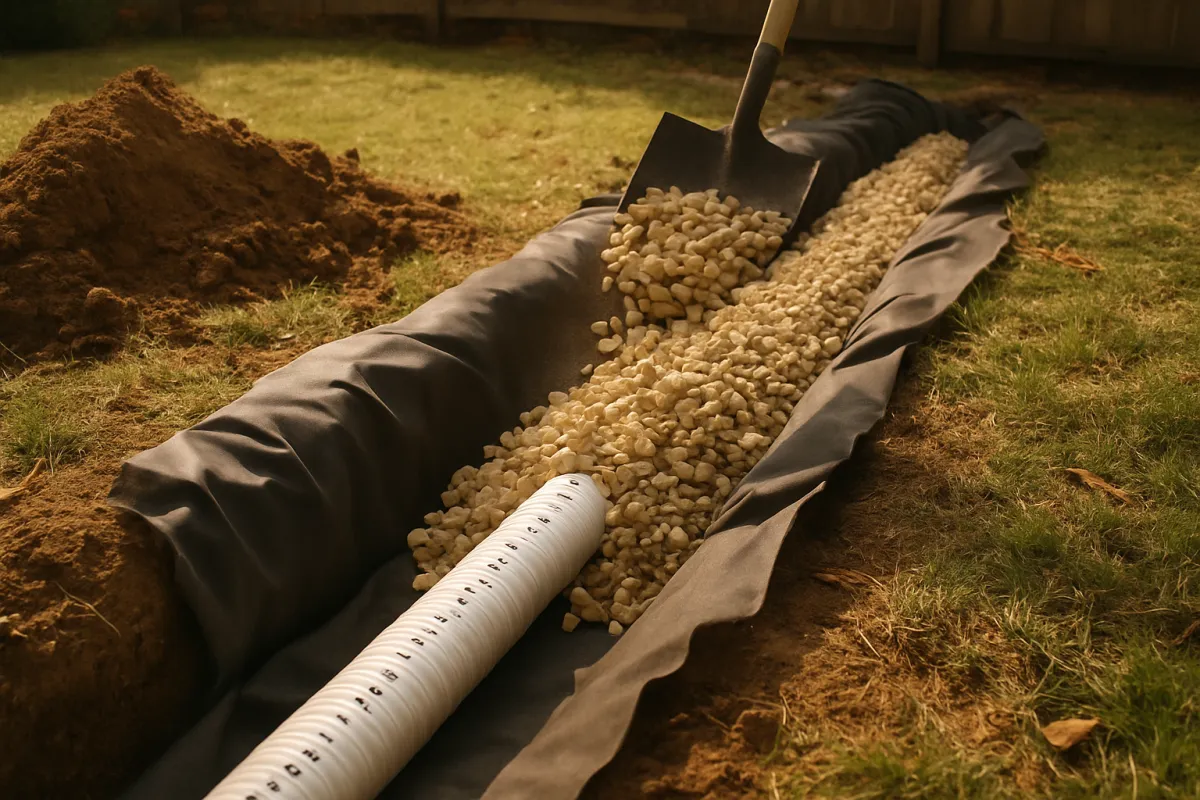
Strip away the name and a french drain is a gravel-filled trench with a perforated pipe in it, built so water underground has an easier path than the soil around it. Water moves toward the least resistance; a trench of washed stone is far more open than compacted soil, so subsurface water and surface soak-through find the trench, drop through the gravel, enter the pipe through its perforations, and flow by gravity down the pipe’s slope to somewhere harmless. The standard build wraps the gravel in landscape fabric like a burrito, so soil stays out while water passes, and that wrap is most of the difference between a drain that lasts decades and one that silts shut.
Each part earns its cost. The fabric is the filter that keeps fine soil from migrating into the stone. The washed gravel is the open structure water moves through, and washed matters, because the dust and fines on dirty stone are exactly the sediment that clogs the system from day one. The perforated pipe, commonly 4 inch, is the express lane that carries collected water away faster than gravel alone could. The slope, commonly cited near 1 percent of continuous fall, is the engine; nothing pumps, so grade does all the work. And the discharge end, daylight, an emitter, a dry well, or a sump, is where the water actually goes. Every french drain bid is these five elements plus digging, and the digging is where the money concentrates.
French drain cost by type
The type is shorthand for depth and working conditions, and it brackets the bid before any site visit. The chart below places the common variants side by side on illustrative installed cost per linear foot, and the three sections that follow take each in turn.
Illustrative installed cost per linear foot, by french drain type
Depth and working conditions set the rate; soil, access, and discharge move every bar.
The materials in every bar are nearly identical: pipe, washed stone, and fabric. What climbs from bar to bar is excavation depth and working difficulty, which is why the interior system, dug indoors through a concrete slab, tops the chart even before its sump equipment is counted.
Reading the chart is mostly reading the water. Surface water and a soggy lawn call for the shallow end; water at a basement wall calls for the deep end, outside or inside. The expensive mistake is mismatching them: a deep drain where a shallow one would do overpays by double, while a shallow trench asked to protect a foundation fails politely and the water bill comes due later anyway. Diagnosis is cheaper than either error, which is why the better contractors talk about where the water comes from before they talk price, and why a bid that quotes a type without walking the site deserves suspicion.
Curtain drain cost: the shallow yard drain
The curtain drain is the entry point of the family, an illustrative 20 dollars or so per linear foot installed, and it solves the most common problem: surface and shallow subsurface water crossing ground where you do not want it. The trench is modest, commonly around 12 inches wide and 18 inches to 2 feet deep, run across a slope uphill of the area it protects, a lawn that stays spongy, a path, a shed, a garden that drowns. Water moving downhill through the topsoil meets the gravel curtain, drops into the pipe, and is escorted sideways to a discharge point before it reaches the thing you are protecting.
Shallow digging is what keeps the rate down: a small crew or a walk-behind trencher opens this trench quickly in cooperative soil, and the spoil pile is manageable. That also makes the curtain drain the variant where DIY is most realistic, which the DIY section below prices. Two design notes protect the spend. First, placement beats length; an hour spent watching where water actually flows in a storm finds the short line that intercepts it, where a guess buys extra feet that do nothing. Second, the discharge still rules: a shallow drain with nowhere downhill to end wants a pop-up emitter or a small dry well, and that choice belongs in the plan, not the change order. For a wet lawn, this is usually the right tool, and the cheapest foot of drainage on the chart.
Exterior footing drain cost: digging to the foundation
The exterior footing drain is the same idea taken to the bottom of the house, an illustrative 60 dollars or more per linear foot, and the premium is depth. Protecting a basement wall from outside means excavating down to the footing, several feet or more, laying fabric, pipe, and washed stone at the base of the wall, and backfilling, often with the chance to waterproof the wall surface while it is exposed. Every foot of that trench moves far more soil than a yard drain does, the spoil has to go somewhere, and working beside a foundation calls for care, shoring on deeper cuts, and sometimes machine access along a side yard that was never designed for one.
The range on this variant is the widest in the family, because houses are not standard. A shallow crawlspace footing on an open lot is one job; a full basement wall behind mature planting, a fence, and a gas line is another entirely, and the rate climbs with every obstacle. Done during original construction the same drain is cheap, which is why footing drains are standard practice on new builds; retrofitting one is the expensive path, taken when chronic water at the wall leaves no choice. When bids arrive, the comparison to make is against the interior system in the next section: full-depth exterior work can approach interior pricing, and which one is right depends on where the water enters, how the lot drains, and what the wall itself needs. This is a decision worth two professional opinions, not a price list.
Interior french drain cost: the basement perimeter
The interior perimeter drain tops the family at an illustrative 80 dollars or so per linear foot, and it is a different kind of job: drainage installed from inside the basement. The crew saw-cuts the slab around the perimeter, breaks out a channel, digs alongside the footing, lays washed stone and pipe, patches the concrete over a new channel, and routes everything to a sump basin, where a pump lifts the water out and away. The sump system itself, basin, pump, discharge line, and commonly a backup, adds an illustrative 1,000 to 2,000 dollars to the per-foot work, and a typical basement perimeter of 100 to 130 feet lands the whole project in the high four figures to low five figures as a planning band.
The price reflects the working conditions: concrete demolition and excavation indoors, spoil carried out bucket by bucket, dust control, and a finished patch, all inside an occupied house. What the interior system buys is reliability where exterior access is impossible or the water table is the enemy; it does not stop water from reaching the wall, it manages water that arrives, permanently and by design. That distinction matters when comparing bids against exterior work, which tries to keep water off the wall in the first place. An interior system is the right call for chronic seepage in a finished neighborhood where excavating the foundation is impractical, and overkill for a damp corner with a fixable grading cause. The diagnosis, not the product, should pick the drain, and any contractor who quotes the big system without explaining where your water comes from is selling, not solving.
What drives french drain cost
Inside every type’s band, a familiar set of factors moves the bid, and depth leads them all because digging is the job. A trench 2 feet deep and one 4 feet deep look similar on paper and are entirely different afternoons; deeper cuts move more soil per foot, dig slower, and eventually add shoring and machine requirements. Length is the obvious multiplier, though it behaves gently by comparison, since each added foot repeats a known cost while added depth compounds it. Soil is the wildcard the estimate cannot fully see: sandy loam digs like a gift, heavy clay digs slow and heavy, and rock, roots, or buried debris can stall a machine and convert trenching into hand labor by the hour.
Access and disposal follow. A yard a mini excavator can reach prices differently from a back corner behind a fence where every tool and every bucket of spoil travels by hand, and the spoil itself, tons of it on a long or deep run, has to be spread, reused, or hauled at a cost. The discharge end can add its own line, a dry well or a long extension to reach legal daylight. Then the quiet items: utility locating before any digging, which is free in most areas and non-negotiable, permits where local stormwater rules require them, and restoration, because a trench across a lawn leaves a scar, and sod, seed, or hardscape repair is real money a bare quote may exclude. Ask every bidder what depth, what discharge, and what restoration the number includes, and the quotes become comparable.
Depth and digging: where the labor lives
If one sentence explains french drain pricing, it is that you are buying a hole by the foot, and the hole’s depth sets the price of the foot. The arithmetic is unforgiving: a trench 12 inches wide moves about 1.5 cubic feet of soil per linear foot at 18 inches deep, 3 cubic feet at 3 feet, 6 at 6 feet, and soil runs roughly a ton per 20 cubic feet, so a 60 foot run can put several tons of spoil on the lawn even at modest depth. Our cubic yard manual does this volume math for any trench. Every one of those cubic feet is dug, lifted, staged, and later backfilled or hauled, and most of the backfill is new gravel, which means much of the spoil never goes back.
Method follows depth. A shallow curtain trench yields to a shovel crew or a walk-behind trencher, an illustrative 100 to 200 dollars a day to rent, which is why shallow drains are cheap and DIY-friendly. Middle depths want a mini excavator and an operator; footing depth wants a real machine, room to swing it, and on deeper cuts, shoring for safety, none of which is optional. Working speed also collapses with depth, because a deep trench is dug in lifts and every correction happens twice. When two bids differ sharply for the same line on the same lawn, the first thing to check is whether they assume the same depth, because depth is usually the whole disagreement, and the deeper bid is sometimes the one that understood the problem.
Soil, obstacles, and access
The same trench prices three different ways in three different soils, and an estimator walking your yard is mostly reading the ground. Sand and loam dig fast and clean. Clay digs slowly, clings to every tool, weighs more per bucket, and drains poorly, which ironically is why clay yards need drains most and pay most for them. Rock is the budget-breaker: a ledge or a field of glacial cobbles can stop a trencher cold, and progress through it is slow machine work or hand labor billed by the hour. Roots split the difference, slowing the dig and raising the question of what the trench does to the tree; a drain routed through a mature tree’s root zone can cost the tree, which is its own expense.
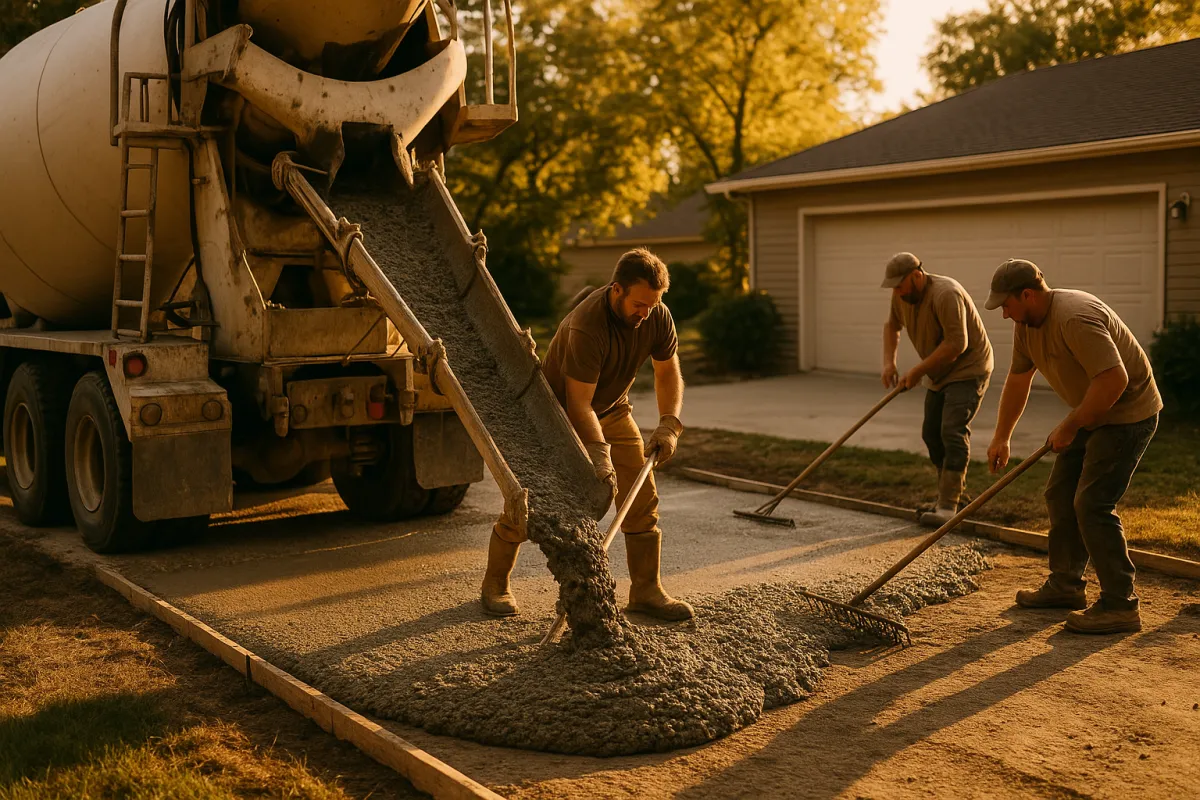
Obstacles are the surprises with utility bills attached. Before any digging, the locate call marks gas, electric, water, and communication lines, free in most areas and legally required in many, and the marks sometimes redraw the route entirely, adding length to dodge a service run. Irrigation lines, old septic components, buried downspout pipes, and forgotten dry wells all live exactly where drains want to go. Access rounds out the trio: a run along an open lawn lets a machine work at full speed, while a side yard narrower than the excavator, a fenced backyard, or a route that crosses existing hardscape converts machine work to hand work at hand-work prices, the same effect access has on a concrete patio pour. None of this is padding; it is the site charging what the site costs, and an honest bid names these lines rather than discovering them later.
Where the water goes: the discharge end
A french drain is a delivery system, and the delivery address is a design decision with its own price. Daylighting is the ideal: where the property falls away, the pipe simply exits at grade downhill, water disperses, and the discharge costs almost nothing beyond the pipe to reach it. A pop-up emitter is the suburban standard where the run ends in lawn: the pipe terminates in a small valve that lifts under flow and releases water at the surface, well away from the protected area, for a minor material cost plus the feet of pipe to get there. Both depend on grade, which is why flat lots pay more for drainage than sloped ones.
Where gravity offers no exit, storage and pumping take over. A dry well, a buried basin or gravel-filled pit that accepts the flow and soaks it into surrounding soil, commonly adds an illustrative 500 to 1,500 dollars depending on size and soil, and its capacity has to match the drain’s flow or it simply overflows in the storms that matter. Interior systems end at a sump, priced with the system in its own section above. The legal layer sits over all of it: discharging onto a neighbor’s land invites a dispute, many municipalities prohibit routing groundwater into sanitary sewers, and some regulate stormwater discharge to the street under the municipal permits the EPA’s municipal stormwater discharge page describes, so the rules get confirmed before the trench is cut. The discharge is also the maintenance point of the whole system, the end you keep clear of mulch, leaves, and landscaping, so put it somewhere you can see. A perfect trench with a bad ending is a long, expensive puddle.
Materials: pipe, gravel, and fabric priced
The materials list for a french drain is short and cheap relative to the labor around it, an illustrative 10 to 15 dollars per linear foot all-in for a standard trench. The pipe is 4 inch perforated drain pipe in one of two families: flexible corrugated, commonly an illustrative 1 to 3 dollars per foot, light, forgiving, and quick to lay, or rigid PVC at a higher price, stiffer, smoother inside so it flows and flushes better, and less likely to belly between backfill points. Corrugated wins most yard drains on cost; rigid earns its premium on long runs and systems someone intends to maintain for decades. Sleeved pipe with a fabric sock adds a small cost and a second line of defense against silt.
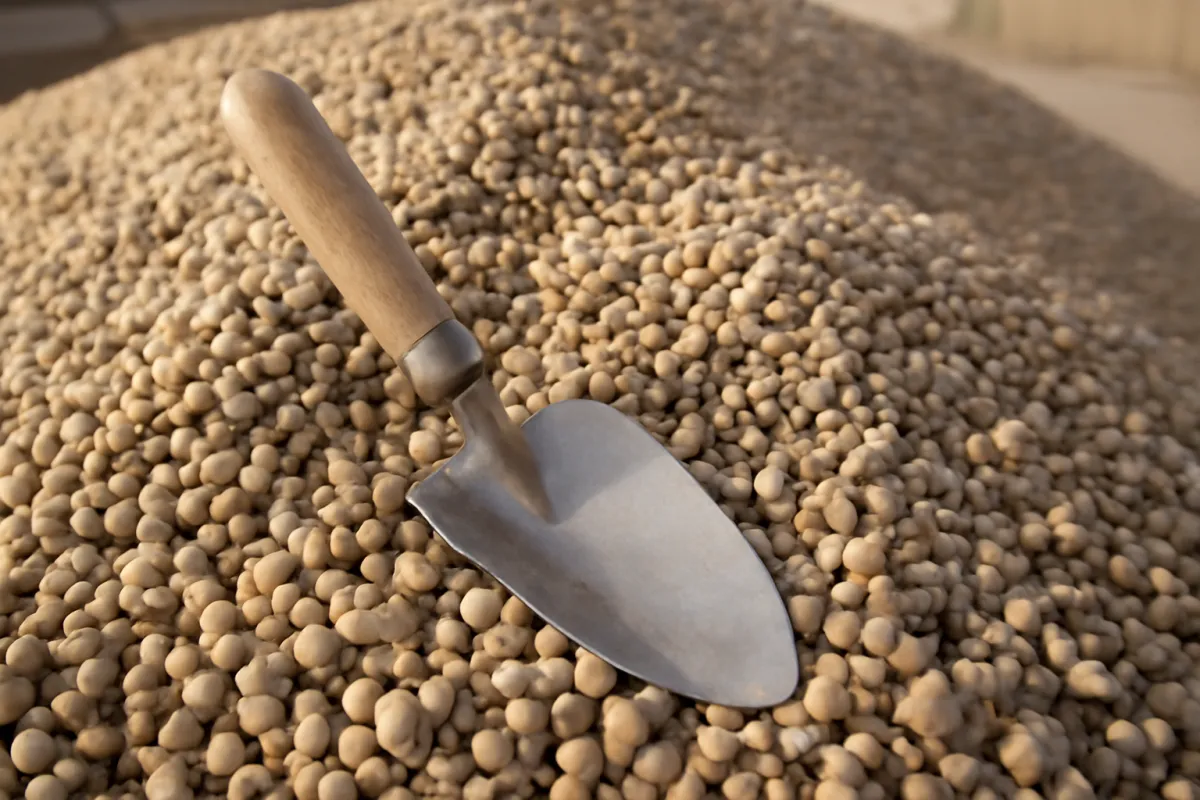
The gravel is the volume purchase: washed stone in roughly the 3/4 to 1.5 inch range, bought in bulk by the cubic yard at an illustrative 40 to 70 dollars delivered, with the quantity math in the next section. The fabric is the bargain of the list, a roll of non-woven geotextile costing tens of dollars that determines whether the system lasts decades or silts shut in a few years; it lines the trench and wraps over the top of the stone before backfill. Skipping it, or substituting cheap woven weed fabric that blinds with silt, is the most expensive saving in drainage. Buy the boring materials right and the drain’s lifespan is set; the labor only installs what the materials make possible.
How much gravel a french drain needs
Gravel is the material you order in bulk, and the estimate is trench volume math. A standard trench near 12 inches wide and 18 inches deep holds 1 foot by 1.5 feet of cross-section, 1.5 cubic feet per linear foot; the pipe displaces a little and the fabric none, so 1.5 is a safe planning figure. Divide 27 cubic feet per cubic yard, the definition in NIST Handbook 44, Appendix C, by 1.5 and one yard fills about 18 linear feet of trench. A 60 foot drain therefore wants around 3.3 cubic yards, ordered as 3.5 to 4 with a modest overage, since gravel disappears into soft trench bottoms and settles as it is placed. Our gravel manual and cubic yard manual run this method for any dimensions, and the estimator handles the area-and-depth arithmetic in seconds.

Two buying notes protect the number. First, suppliers quote washed stone by the yard or by the ton, and the conversion is roughly 1.4 tons per yard for typical stone, a translation our gravel weight manual covers, so a 4 yard order is comfortably over 5 tons: real weight that arrives in a real truck and needs a staging spot near the trench. Second, resist substitutions at the yard counter. Crusher run, screenings, and anything with fines are the wrong material no matter the discount, because fines pack tight and defeat the open structure the drain depends on. At an illustrative 55 dollars a yard, the 60 foot drain’s stone bill is a couple hundred dollars; the wrong stone costs the whole system.
Where the money goes
Splitting an installed french drain into its shares explains most of the pricing behavior in this brief, and the headline is that the dig dominates. The chart below takes an illustrative standard yard drain and divides the installed price into rough thirds of labor, materials, and everything at the edges.
Where the cost of an installed french drain goes
Illustrative split of a standard exterior yard drain; depth, soil, and discharge shift every share.
Labor's share grows with depth: on a deep footing drain or an interior system, excavation and demolition swallow most of the bill and the same materials become a footnote. That is also the DIY math in one picture, since the labor share is exactly what your own digging replaces.
Three readings follow from the split. First, regional pricing differences are mostly wage differences, so quotes from different markets are not comparable and national averages deserve mild suspicion, including as a check on the illustrative figures here. Second, the share structure explains why the type ladder climbs the way it does: from curtain drain to interior perimeter, the materials barely change while the labor multiplies, so the rate tracks difficulty, not product. Third, the levers you control map cleanly onto the segments: DIY digging attacks the biggest share, smart routing shortens every share at once, and discharge choice governs the third segment. When a bid seems high, find which segment carries the weight before assuming margin; depth, rock, access, or a dry well is usually the answer, and a contractor who can point to it is quoting honestly.
French drain vs the alternatives
A french drain is one tool in the drainage kit, and money is saved by checking the cheaper tools first. Gutters and downspout extensions are the classic overlooked fix: a surprising share of wet basements and soggy foundations trace to roof water dumped at the wall, and extensions that carry it a few feet away cost almost nothing. Regrading is next up the ladder: where soil slopes toward the house or a low spot collects water, rebuilding the grade to shed surface water can solve what looks like a groundwater problem at a fraction of a drain’s cost. A swale, a broad shallow grass channel, moves surface water across a yard for mostly machine-grading money and doubles as lawn.
The subsurface tools then earn their place. A dry well alone suits a single concentrated source, such as one downspout, without a collection line. A catch basin and solid pipe handle surface water at a point, a flooding patio corner or a driveway low spot, but collect nothing along their length. The french drain’s distinct job is intercepting water moving through soil along a line, which none of the cheaper tools do; when that is truly the problem, at a wet slope, a basement wall, or behind a retaining wall where drainage is not optional, the drain is the right spend, and it protects surfaces like an asphalt driveway or a patio whose base standing water would destroy. The honest sequence is gutters first, grading second, and the trench third, sized by our per-foot bands once the cheaper fixes are ruled out. Solving a gutter problem with an 80 dollar per foot interior system is the most expensive diagnosis in this brief.
Total french drain cost by project length
Scaling the per-foot rates to whole projects puts real budgets on the table, priced here at the illustrative standard yard drain midpoint of 35 dollars per linear foot. A short 30 foot run protecting one wet corner plans near 1,050 dollars. A 50 foot line across a modest backyard, near 1,750. A 60 foot interception drain uphill of a house, about 2,100. A 100 foot property-line run, roughly 3,500. Switch types and the same lengths re-price: at a curtain drain’s illustrative 20 dollars the 60 foot run falls near 1,200, while at footing depth’s 60 dollars it climbs to 3,600, and a 120 foot interior basement perimeter at 80 dollars reads 9,600 before an illustrative 1,000 to 2,000 in sump equipment.
The totals stay honest only if the length does, so measure the route rather than estimating it. Walk the line the water actually needs, from where the problem starts to where the discharge can legally end, and the discharge leg surprises people most: reaching daylight or a suitable dry well location can add tens of feet that do no collecting but cost like every other foot. Length is also where routing skill pays; a drain placed to intercept water uphill is often shorter than one chasing symptoms downhill. As with every figure in this brief, these are planning bands, and lot-specific depth, soil, and access will move any of them. Set your length and type in the companion below and the totals recompute as you read the rest.
From price per foot to your total
The method for a defensible planning number takes minutes. First, diagnose enough to pick the type: surface and lawn water points to the shallow end, water at the foundation to the deep end, chronic basement seepage to the interior system, and the earlier sections give each an illustrative rate of 20, 35, 60, or 80 dollars per foot. Second, measure the route in feet, collection line plus the discharge leg, walking it rather than guessing. Multiply, and the base figure lands: a 60 foot standard yard drain at 35 dollars is 2,100 dollars.
Third, adjust for what the rate cannot see. Add for a dry well or long discharge run, for suspected rock or heavy clay, for tight access, for restoration of lawn or hardscape over the trench, and for permits where local rules require them; subtract meaningfully only for the labor you will genuinely perform yourself. The result is a bracket, not a bid, and its job is calibration: it tells you whether quotes are pricing your project or a different one, which questions to ask about the outliers, and whether the fix fits the budget before anyone visits. Contractors bidding the same clearly described scope, type, depth, length, discharge, restoration, return comparable numbers; vague scopes return scattered ones. The companion below runs the whole method live, length, type, gravel volume and all, and holds your numbers as you read.
DIY french drain cost
The DIY case for a shallow french drain is strong because the split says so: when labor is over half the installed price and the labor is digging, your shovel is the discount. Materials for a standard trench run an illustrative 10 to 15 dollars per foot, so a 60 foot drain is roughly 700 to 900 dollars in pipe, stone, and fabric, against an illustrative 2,100 dollars installed, and a rented walk-behind trencher at an illustrative 100 to 200 dollars a day closes most of the effort gap on open ground. The build sequence is honest work but not mysterious: call for utility locates, lay out the route, trench to a consistent grade, line with fabric, bed and lay the pipe, fill with washed stone, wrap the fabric over, and backfill.
The failure points are specific and worth respecting. Grade is the one that ruins drains: the trench bottom must fall continuously, commonly cited near 1 percent, toward the discharge, checked with a level or laser rather than by eye, because one belly collects sediment and becomes the clog. Utilities are the one that ruins weekends or worse; dig nothing until the locate marks are down. Soil is the one that ruins estimates, since 60 feet through roots or clay is a different project from 60 feet of loam. And scope is the one to be honest about: footing-depth excavation and interior slab work are not DIY projects, for safety and for the stakes at the foundation. The middle path works here as it does on a patio: dig and haul yourself, then have a contractor set the pipe, grade, and discharge. Priced either way, the shallow drain is among the best labor-for-money trades in the yard.
Maintenance, lifespan, and clogging
A french drain’s operating cost is nearly zero, which is part of its value case, and its lifespan is decided mostly on the day it is built. Commonly cited service life for a properly built system is an illustrative 20 to 30 years or more; the qualifiers doing the work in that sentence are washed stone, real fabric, consistent grade, and a protected discharge. The failure mode is not wear but clogging: fine soil migrates into the stone and pipe until the water stops moving, and every shortcut, dirty gravel, skipped fabric, a bellied pipe, is an accelerant. A drain built right runs silently for decades; a drain built cheap announces itself again in the first wet spring a few years on.
The owner’s maintenance list is short. Keep the discharge end visible and clear, since a pop-up emitter buried in mulch or a daylight outlet crushed by a mower is a dammed system. Flush the pipe occasionally if the design allows, especially rigid pipe with cleanout access, which is one of rigid PVC’s quiet advantages. Watch what the yard does above the line over the years: new beds, regrading, or a fresh layer of topsoil dumped over the run can feed sediment into the system or bury its outlet. And when an old drain does fail, budget expectations should be for rebuilding the run, not rodding it back to life, because a silted gravel trench cannot be cleaned from inside. That arithmetic is the closing argument for the boring materials: the fabric and the washed stone are the cheapest decades of service you will ever buy.
Common mistakes that raise the cost
Most french drain money is wasted in predictable ways, and the list is worth reading before the trench is cut. Skipping the diagnosis leads the list: trenching where the symptom shows rather than where the water travels buys footage that collects nothing, and misses the gutter or grading fix that would have cost a tenth as much. Wrong materials come next, dirty stone, no fabric, or flimsy weed cloth, which build the clog into the system on day one. Wrong grade follows, a bellied or flat pipe that silts early; wrong depth, a shallow trench asked to protect a foundation; and the orphan discharge, a pipe that ends nowhere useful and turns the trench into a storage tank.
The process mistakes cost as much as the design ones. Digging without utility locates risks the most expensive afternoon in landscaping. Guessing the route instead of walking it in the rain adds feet that do nothing. Leaving restoration out of the plan turns a finished drain into a mud scar across the lawn with a surprise sod bill. Under-ordering gravel stalls an open trench over a weekend of weather, the kind of miss our gravel manual exists to prevent; over-ordering buries the yard in surplus stone. And on the hiring side, accepting a bid that names no depth, no discharge, and no restoration invites the change orders that make cheap quotes expensive. Every one of these is avoidable with an hour of observation and a written scope, which is the cheapest drainage work there is.
Ways to keep french drain cost down
The savings levers line up with the cost shares. Diagnose first, because the cheapest drain is the one you do not need: extend the downspouts, fix the grade, and see what problem remains before pricing a trench. Route smart, since an interception line placed uphill is often shorter than a collection sprawl placed at the symptom, and every foot saved is the full per-foot rate saved. Match the type to the water, shallow where shallow works; the step from a 35 dollar foot to a 60 dollar foot should be forced by the site, not by a sales pitch. Choose the cheap discharge where grade allows, daylight or an emitter over a dry well, and put the saving toward better pipe instead.
On the labor side, dig what you can safely dig, rent the trencher, and let a professional set the grade, the pipe, and the discharge if precision worries you; the digging is the share worth trading for effort, and the grading is the share worth paying for. Buy stone in bulk by the yard, not in bags, and stage the delivery close to the trench to save your own back. Get restoration into the quote up front, and time non-emergency work for a contractor’s slow season, when trenching bids soften. What should never be trimmed is the boring core: washed stone, real fabric, honest depth, and a legal discharge, because each one saved is the whole system spent. Cut feet, cut labor, cut season, never cut the burrito.
A worked example: a 60 foot yard drain priced
Put the method on one real-shaped project: a backyard that sheds water toward the house, fixed by a 50 foot interception line across the slope plus a 10 foot discharge leg to a side-yard pop-up emitter, 60 feet in all, at standard yard-drain depth in cooperative soil. At the illustrative 35 dollar midpoint, the installed planning figure is 2,100 dollars. Inside it: the trench, roughly 12 by 18 inches for about 90 cubic feet of excavation, fabric lining the run, 60 feet of 4 inch perforated pipe, about 3.5 cubic yards of washed stone at an illustrative 55 dollars delivered, call it 190 dollars, the emitter hardware, backfill, cleanup, and the crew’s day or two of labor that is most of the bill.
Now flex it. Run the same line DIY with a 150 dollar trencher rental and the cash cost falls toward an illustrative 900 dollars, materials plus rental, paid for in a hard weekend. Hit clay and roots, and the installed figure drifts toward the top of the 25 to 50 band, call it 2,700. Discover the side yard has no fall and swap the emitter for a dry well, and add an illustrative 800. Move the same 60 feet to footing depth against the foundation and the project reprices near 3,600 before wall work; take it indoors as a basement perimeter and the per-foot world changes entirely. Same tape measure, same 60 feet: the swings all came from depth, soil, and the discharge, which is this brief’s whole argument. Price your own line in the companion below and watch the same levers move it.
The bottom line
French drain cost is a per-foot price whose real variables are depth, soil, and where the water can go. Carry the illustrative bands: around 20 dollars per linear foot for a shallow curtain drain, 25 to 50 with a midpoint near 35 for a standard exterior yard drain, 60 and up at footing depth, and 80 for an interior basement perimeter plus an illustrative 1,000 to 2,000 for the sump system, with materials only 10 to 15 dollars of any of those feet. Multiply the band by a measured route, add the discharge, restoration, and site realities, and you have a bracket that makes bids legible. Check the cheap fixes first, gutters and grading solve a surprising share of drainage problems, match the drain type to where the water actually is, and never save money on washed stone, fabric, grade, or the discharge, because those four are the system. Size the trench and the gravel with the estimator and our gravel manual, run your line through the companion below, then collect written bids that name depth, discharge, and restoration. Water always wins eventually; the point of the drain is deciding where.
Read this cost brief as estimating education for drainage planning, not as engineering advice, a bid, or a diagnosis of your property’s water problem. Every figure in it, per foot, per type, and per project, is an illustrative planning number, and your actual depth, soil, water table, access, discharge options, and regional labor market will move a real quote, sometimes far outside these bands. Drainage work carries obligations general articles cannot resolve: utility locating before any digging, safe excavation practice on deeper trenches, and municipal or neighborly rules on where collected water may legally discharge, all of which vary by place and must be confirmed locally. Chronic foundation seepage can signal structural issues that deserve professional evaluation rather than a per-foot estimate. Diagnose the water with a qualified drainage or foundation professional where the stakes are more than a soggy lawn, and build your actual budget on current written bids for your specific site.
Frequently asked questions
How much does a french drain cost per foot?
As an illustrative planning range, a standard exterior yard french drain commonly runs somewhere around 25 to 50 dollars per linear foot installed, with a working midpoint near 35 dollars. That figure bundles the trenching, the landscape fabric, the perforated pipe, the washed gravel, the backfill, and the connection to a discharge point. The type moves the rate more than anything else: a shallow curtain drain can sit nearer an illustrative 20 dollars per foot, a deep exterior drain excavated down to the foundation footing nearer 60 dollars or more, and an interior basement perimeter system nearer 80 dollars per foot before the sump equipment. Depth, soil, access, and where the water can legally discharge all move the figure, so treat any single number as a starting point and collect local bids.
How much does an interior french drain in a basement cost?
An interior perimeter drain is the most expensive common variant, an illustrative 80 dollars or so per linear foot, because the work happens indoors through concrete. The crew saw-cuts and breaks out the slab edge around the basement perimeter, digs the channel, sets pipe and washed stone, patches the concrete, and routes the water to a sump basin, and a sump pump system commonly adds an illustrative 1,000 to 2,000 dollars on top of the per-foot work. A typical basement perimeter of 100 to 130 linear feet lands the whole project in the high four figures to low five figures as a planning band. It is a serious intervention for a serious problem, usually chronic seepage that exterior fixes cannot reach. Get more than one assessment before committing, because the right fix depends on where the water actually comes from.
Is a french drain worth the money?
When standing water or chronic seepage is the problem, a properly built french drain is often one of the better-value fixes in the yard, because water damage compounds while a drain's cost is fixed. A soggy lawn corner is an annoyance, but water against a foundation, under a patio, or behind a retaining wall does structural harm that costs far more to repair than a drain costs to install. The honest caveat is that a french drain only earns its cost when it matches the problem: it intercepts and moves subsurface and surface water downhill to a discharge point, and it cannot fix water that arrives from a leaking gutter, a grading fault it sits below, or a spring it cannot outrun. Diagnose first, then size the fix to the actual water path, and the spend tends to justify itself.
Can I install a french drain myself, and what does DIY cost?
A shallow exterior french drain is a genuinely realistic DIY project, and the saving is large because most of an installed price is digging labor. Materials commonly run an illustrative 10 to 15 dollars per linear foot, perforated pipe, washed gravel, and fabric, so a 60 foot drain is roughly 700 to 900 dollars in materials against an illustrative 2,100 dollars installed. A rented trencher, commonly an illustrative 100 to 200 dollars a day, turns the worst of the digging into machine work on open ground. The catches are real: the trench must hold a consistent downhill slope, commonly cited near 1 percent, utilities must be located and marked before any digging, and hand-digging through roots, rock, or clay is punishing. Deep footing drains and interior basement systems are not DIY territory.
How much gravel does a french drain need?
Work it from the trench volume. A common trench near 12 inches wide and 18 inches deep holds about 1.5 cubic feet per linear foot, so one cubic yard of gravel, 27 cubic feet, fills roughly 18 linear feet of trench, a little more once the pipe displaces some volume. A 60 foot drain therefore wants somewhere around 3.5 cubic yards once a modest overage is included, and washed drainage stone commonly runs an illustrative 40 to 70 dollars per cubic yard delivered in bulk, varying widely by region. Use washed, rounded or crushed stone in roughly the 3/4 to 1.5 inch range, never fines or unwashed material, because fines are what clog a drain. Bulk delivery beats bags decisively at this volume, and our gravel manual walks the ordering math.
What slope does a french drain need?
A french drain moves water by gravity, so the pipe needs continuous fall from the inlet end to the discharge end, and a commonly cited working figure is about 1 percent, roughly 1 foot of drop per 100 feet of run, with more being better where the site allows. What matters as much as the number is consistency: a low spot or a belly in the pipe collects water and sediment and becomes the future clog, while a section that runs uphill simply dams the flow. This is why the digging is graded carefully with a level or laser rather than by eye, and why the trench bottom, not just the ground surface, has to fall the right way. On a flat lot, achieving fall means the trench gets progressively deeper toward the discharge, which adds digging, or the system ends at a dry well or sump instead of daylight.
Where should a french drain discharge?
Every french drain is only as good as its ending, and the options are a short list. Daylighting to a lower part of the property is the cheapest and best where grade allows: the pipe simply exits on a downhill slope and the water disperses. A pop-up emitter releases water at the lawn surface away from the problem area. Where no downhill exists, a dry well, a buried gravel-filled basin, accepts the flow and soaks it into the ground, commonly adding an illustrative 500 to 1,500 dollars, and interior systems end at a sump pump that lifts water out. What a drain must never do is discharge against a neighbor's property or into a municipal sewer where that is prohibited; many areas regulate stormwater discharge, so confirm the rules before the trench is dug, because relocating a discharge after the fact is expensive rework.
How long does a french drain last?
A properly built french drain commonly lasts an illustrative 20 to 30 years or more, and the qualifier carries the sentence: the lifespan is set on installation day. Washed stone, a real fabric wrap to keep soil out, a consistent slope, and a protected discharge make a system that runs for decades with almost no attention; skipping the fabric or using dirty gravel builds a drain that silts shut in a few years. The failure mode is clogging, not wearing out: fine soil migrates into the gravel and pipe until water stops moving. Maintenance is light, keep the discharge end clear, flush the pipe occasionally if the design allows, and watch that surface changes such as new beds or regrading do not dump sediment over the drain line. When an old drain fails, the fix is usually rebuilding the run rather than repairing it, which is why the cheap materials shortcuts are expensive.