
What's on this page
- Exterior painting cost per square foot
- Measuring exterior wall area
- Exterior painting cost by home size
- Why a two-story home costs more per square foot
- What drives exterior painting cost
- Prep work: the biggest swing factor
- Siding material and how it changes the labor line
- Primer: when exterior work needs it
- Trim, doors, shutters, and fascia
- Caulking and sealing before the paint goes on
- DIY exterior painting cost
- From price per square foot to your total
- Regional and seasonal cost swings
- Ways to keep exterior painting cost down
- Comparing exterior painting bids line by line
- Lead paint and older homes
- Insurance and licensing checks before hiring
- HOA rules and historic district color restrictions
- Weather delays and scheduling around your climate
- A worked example: a single-story home exterior repainted
- Warranty on an exterior paint job
- A second worked example: a two-story home with moderate prep
- The bottom line
Short answer: As an illustrative planning range, professional exterior painting commonly runs 2 to 5 dollars per square foot of exterior wall area, materials and labor together, with a working midpoint near 3.50 dollars. A typical single-story home with about 1,800 square feet of exterior wall area lands near 6,300 dollars at the midpoint, before trim, a second-story access premium, or heavy prep work, each priced as its own line in this brief.
Exterior painting cost behaves like a different trade than the interior version of the same question, even though the can of paint looks identical on the shelf. The surface is bigger, the access is harder, the weather dictates the schedule, and the prep, pressure washing, scraping, caulking, is doing far more of the work than it does inside a climate-controlled room. Ask what it costs to paint a house exterior and the honest answer depends heavily on your siding, your home’s height, and how much the existing paint is already failing before the first coat of new paint ever goes on.
This cost brief prices exterior painting the way a painting contractor actually quotes a house: per square foot of exterior wall area, scaled from a single-story home up through a two-story premium, broken into the prep, material, and labor shares that make up an installed price. It is the exterior-specific companion to our interior painting cost brief, which prices the indoor version of this same question, and to our paint quantity manual, which this brief does not duplicate on the pure material math. Run your own home’s dimensions through the estimator or the companion below as you read.
Key takeaways
- Professional exterior painting commonly runs an illustrative 2 to 5 dollars per square foot of exterior wall area, with a working midpoint near 3.50 dollars, materials and labor together.
- Prep, washing, scraping, sanding, and caulking, is the single biggest swing factor, often adding more to a bid than the paint grade or the square footage itself.
- A second story adds a real access premium for ladders, scaffolding, or a lift, not because the paint or the labor to apply it changes.
- Siding material changes the labor line directly: smooth lap siding and stucco paint fastest, wood shingles and heavily textured surfaces take meaningfully longer.
- Every dollar figure here is illustrative and local: your siding, surface condition, home height, and region set the real number, so measure and collect written bids.
Exterior painting cost per square foot
The cleanest unit for pricing exterior painting is dollars per square foot of exterior wall area, the actual outside surface being coated, perimeter times wall height minus windows and doors, rather than the home’s floor area, which measures something different entirely. As an illustrative planning range, a professional exterior paint job commonly runs 2 to 5 dollars per square foot of that wall area, with a working midpoint near 3.50 dollars.
That installed figure bundles standard prep, a pressure wash and light scraping of any loose or peeling paint, one or two coats of exterior-grade paint, and the labor to apply it evenly across a surface exposed to weather rather than a controlled interior. It usually does not include heavy paint removal, a second-story access premium, or trim and doors painted as their own color, each priced as a separate line below. The companion below runs the math on your own wall area as you go.
Measuring exterior wall area
Measuring a home’s exterior wall area starts the same way our interior painting brief measures a room: perimeter times wall height, minus the window and door openings that do not get painted. For a simple rectangular single-story home, measure the full perimeter at ground level, multiply by the wall height from the foundation to the eave, then subtract roughly 10 to 15 percent for windows and doors as a reasonable illustrative deduction.
A home with gables, dormers, or a complex roofline has extra triangular wall sections above the main wall line that a simple perimeter-times-height calculation misses, and those sections should be measured and added separately rather than estimated by eye, since gable ends can add a meaningful amount of paintable area on an otherwise simple footprint. Our square-footage manual covers the odd-shape measuring method this situation calls for, and the estimator handles the straightforward rectangular math in seconds.
Exterior painting cost by home size
Scaling the per-square-foot rate to common home sizes shows how quickly a whole-exterior repaint adds up, even before trim or a second story enters the picture. The table below prices a few illustrative single-story exterior wall areas at the midpoint rate of 3.50 dollars per square foot.
| Exterior wall area | Illustrative total at ~$3.50/sq ft |
|---|---|
| 1,400 sq ft (small single-story) | ~$4,900 |
| 1,800 sq ft (average single-story) | ~$6,300 |
| 2,400 sq ft (large single-story) | ~$8,400 |
| 3,200 sq ft (two-story) | ~$11,200 |
Read every row as a starting point, not a quote. A home with heavy prep needs, extensive peeling paint or bare wood sections, can push toward the top of the 2 to 5 dollar range even at the same wall area, while a well-maintained home needing only a fresh coat can sit nearer the bottom. The jump from a large single-story home to a comparable two-story one reflects both the added wall area and the access premium covered in full below.
Why a two-story home costs more per square foot
A two-story home’s extra wall area alone does not fully explain why it commonly costs more per square foot to paint than a single-story home of similar quality, since the paint itself and the basic application technique do not change with height. What changes is access: reaching the upper story safely requires ladders, scaffolding, or a lift, each of which adds equipment cost, setup time, and a slower, more careful pace of work compared with painting entirely from the ground or a single short ladder.
That access premium commonly adds a meaningful increment to the per-square-foot rate for any work above the first story, so a two-story home’s overall blended rate often lands above a single-story home’s rate even when the paint grade and prep needs are otherwise identical. Taller homes, three stories or a home with unusually high gables, push this premium further, since the equipment and the safety precautions scale with height, not just with square footage.
What drives exterior painting cost
Beyond size and story count, a handful of factors decide where a real bid lands inside the illustrative ranges. Prep work, covered in its own section below, is consistently the largest swing factor. Siding material and texture change the labor line directly, with smooth surfaces painting faster than heavily textured ones. The home’s overall complexity, how many corners, gables, dormers, and trim details it has, adds cutting-in labor beyond what a simple rectangular footprint needs.
Climate and timing matter too, since exterior work is weather-dependent in a way interior painting is not, and a crew racing a forecast or working in a short seasonal window sometimes prices differently than one with an open calendar. Regional labor rates, as with every cost brief on this site, move the total more than almost any other single factor, since labor is typically the largest share of an installed exterior price.
Prep work: the biggest swing factor
Prep is where an exterior painting estimate earns or loses its accuracy, and it consistently moves a bid more than the paint grade or even the square footage does. A full prep pass commonly includes pressure washing the entire exterior to remove dirt, mildew, and chalking old paint, scraping and sanding any loose, peeling, or cracked paint back to a sound edge, caulking gaps at trim, siding joints, and window and door frames, and spot-priming any bare wood or heavily stripped sections before the finish coats go on.
A well-maintained home with sound existing paint and no significant peeling might need only the wash and a light scrape, keeping prep close to the base rate already assumed. A home with widespread peeling, especially on sun-exposed elevations, can see prep add a substantial premium, sometimes rivaling the cost of the paint and application itself, because scraping and sanding a failing coating back to bare, sound material is slow, careful hand labor that cannot be rushed without compromising how well the new paint adheres.
Siding material and how it changes the labor line
Siding material and texture change exterior painting labor directly, independent of the square footage being covered. Smooth lap siding, fiber cement, and stucco generally paint fastest and cheapest per square foot, since a sprayer or roller can cover a flat or gently textured surface efficiently in long, continuous passes. Wood shingles, shakes, board-and-batten, and heavily textured or hand-troweled stucco take noticeably longer, because the extra surface area in every groove, lap, and texture peak has to actually be covered, and a sprayer alone often cannot fully work paint into deep texture without a backbrushing or back-rolling step.
Brick is a special case worth naming directly: in most climates brick is deliberately left unpainted so the masonry can breathe and manage moisture naturally, and painting over brick is a more involved, less reversible process with its own separate cost and maintenance considerations rather than a standard siding repaint. If your home mixes siding types, a sided upper story over a brick lower level, for instance, price each material’s area separately rather than applying one blended rate across the whole exterior. Our siding installation cost brief covers the material itself in depth for anyone weighing a repaint against replacing aging siding outright, a comparison worth making honestly if the existing material is visibly failing rather than simply due for a fresh coat.
Primer: when exterior work needs it
Primer earns its own line on exterior work in several common situations: bare or newly exposed wood after heavy scraping, a dramatic color change, stain-blocking over a water mark, tannin bleed from certain wood species, or a chalky, weathered existing surface that fresh paint grips poorly without help. As an illustrative figure, exterior primer commonly runs a similar per-gallon range to interior primer, with coverage somewhat reduced on textured or porous exterior siding compared to smooth interior drywall.
On a sound, previously painted exterior in reasonable condition, a quality self-priming exterior paint often makes a separate full-exterior primer coat unnecessary, with primer used selectively only on the specific bare or problem spots exposed during prep rather than across the entire surface. Confirm with your painter which approach your home’s specific condition actually needs rather than assuming either extreme by default, and flag any wood species known for tannin bleed, cedar in particular, specifically, since an unprimed stain-blocking gap there is one of the more common causes of a brown discoloration bleeding through fresh light-colored paint within the first year.
Trim, doors, shutters, and fascia
Trim, fascia boards, soffits, shutters, and exterior doors are commonly priced separately from the main wall coating, similar to how our interior painting brief prices interior trim apart from wall paint, since trim paint is typically a different, higher-sheen product applied with more careful brushwork than a wall’s broader coverage. As an illustrative figure, trim and fascia painting commonly adds a meaningful percentage on top of the base wall rate for a typical home, scaling with how much linear footage of trim the home actually carries.
Shutters and an exterior door or two are commonly priced per piece rather than by area, since each is a discrete, detailed item rather than a continuous surface. A home with extensive trim detail, multiple gables, decorative brackets, or an ornate Victorian-style exterior, can see trim work add a substantial share of the total bid, sometimes rivaling the main wall coating cost on an especially detail-heavy home.
Caulking and sealing before the paint goes on
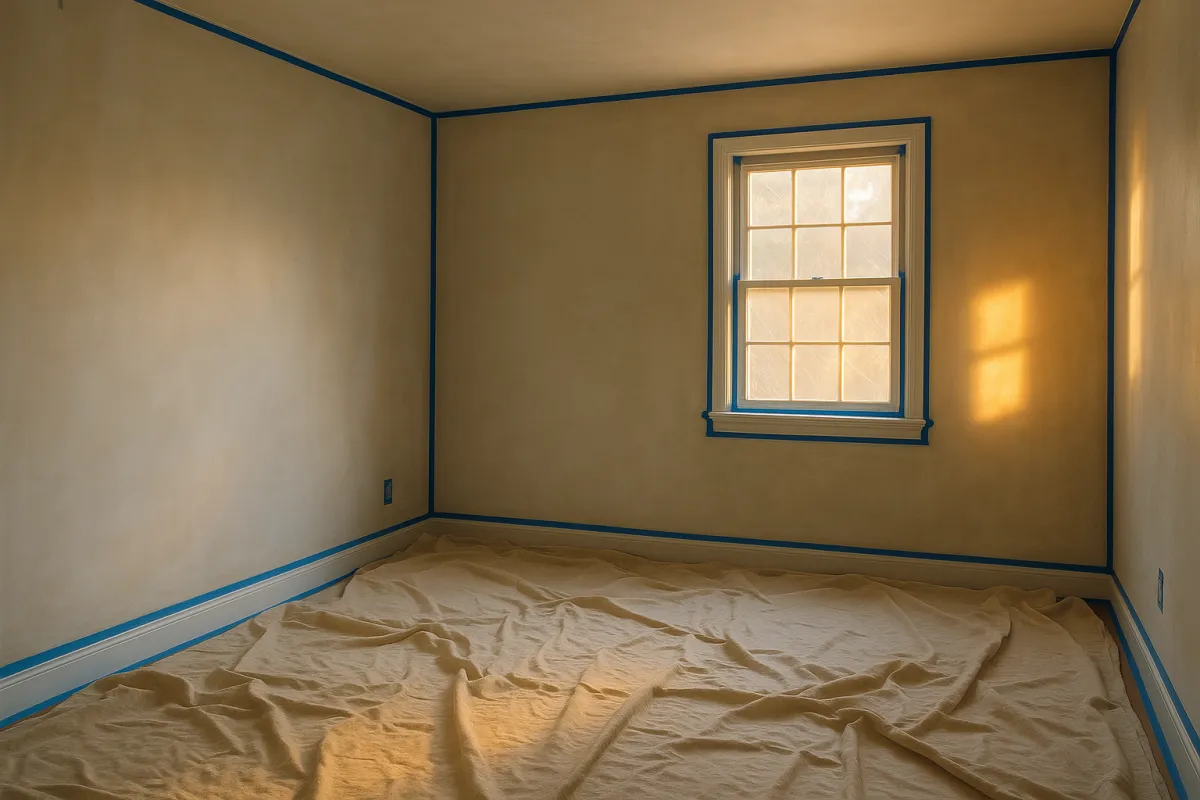
Caulking is a small line item with an outsized effect on an exterior paint job’s durability, closing the gaps at siding joints, trim-to-siding transitions, and window and door frames where water would otherwise find its way behind the finished surface. A fresh bead of quality exterior caulk at every one of these joints is standard practice on a thorough repaint, and skipping it to save a modest amount of labor time is one of the more common ways an otherwise good-looking paint job fails prematurely at its seams.
As an illustrative guide, caulking a typical home’s full perimeter of siding joints, trim transitions, and window and door frames commonly adds a modest line to the overall bid relative to the wall coating itself, but it is inexpensive insurance against water intrusion that can otherwise rot siding or trim behind a perfectly painted surface. Ask specifically whether a quote includes a full caulking pass or only spot-caulks visibly open gaps, since the two represent meaningfully different scopes.
DIY exterior painting cost
Labor is the largest share of a professional exterior bid, so the potential saving from doing it yourself is genuine, and buying just the paint, primer where needed, and supplies can run a small fraction of a full installed quote for a single-story home. A careful homeowner with the right ladder, pressure washer, and patience for the prep steps covered above can realistically tackle a single-story exterior.
The honest caution scales with height. A single-story home with ground-level or short-ladder access is a realistic do-it-yourself project for a patient, careful owner. A two-story home adds genuine fall risk that a professional crew is trained and equipped to manage in ways a one-time do-it-yourself project typically is not, which makes hiring out at least the height-related portions of a two-story job a reasonable call even for someone otherwise comfortable with every other step of the process.
From price per square foot to your total
Turning the rates in this brief into a real planning number is a short sequence. First, measure your exterior wall area: perimeter times wall height, minus an illustrative 10 to 15 percent for windows and doors, adding any gable or dormer sections separately. Second, pick a rate within the 2 to 5 dollar range, adjusted toward the low end for a well-maintained single-story home and toward the high end for heavy prep needs or a second story.
Third, multiply your wall area by that rate for the base coating figure, then add trim, doors, shutters, and caulking as their own lines since none of those are included in the bare wall rate. An 1,800 square foot single-story home at the 3.50 dollar midpoint is roughly 6,300 dollars for the walls alone, plus an illustrative several hundred dollars more once trim and caulking are added. The companion below runs this entire method live on your own numbers as you read.
Regional and seasonal cost swings
Every rate in this brief is a national illustrative figure, and the real number in your market moves with local labor costs and how many painting crews compete for exterior work in your area. Coastal and high cost of living metro markets commonly run above these illustrative midpoints on labor alone, while regions with a lower cost of living and more crews available commonly run below them.
Exterior painting runs on a far more pronounced seasonal calendar than interior work, since the paint has to cure in weather within its manufacturer-specified temperature and humidity range, which in most climates concentrates demand into spring and fall shoulder seasons and pushes many crews toward their busiest backlog in exactly those windows. Booking well ahead of your region’s peak exterior season, or scheduling in an off-peak window where your climate still allows proper curing, can sometimes find softer pricing than a last-minute summer booking.
Ways to keep exterior painting cost down
An exterior painting budget has real levers, and the biggest is addressing small problems before they become large prep jobs: catching and spot-repairing peeling paint or failing caulk early keeps a future repaint’s prep scope modest rather than letting it grow into widespread scraping across whole elevations. Choosing a quality mid-range paint over the premium tier is a reasonable place to trim cost on material without meaningfully shortening the repaint’s lifespan, since labor dominates the total far more than paint grade does.
Doing your own pressure washing and clearing plantings or furniture away from the work area ahead of a crew’s arrival is a low-effort way to save real labor time. Timing the job for your region’s shoulder season, where a contractor’s schedule allows it, sometimes finds softer pricing than a peak-season booking. What should never be cut is proper prep on genuinely failing paint or caulking on open joints, since skipping either is the most common way an exterior repaint fails well before its expected lifespan.
Comparing exterior painting bids line by line
An exterior bid that reads as a single lump sum is hard to judge fairly, since a lower total can hide a thinner prep scope rather than a genuinely better price. Ask every bidder to itemize the prep work included, washing, scraping, sanding, and caulking specifically, whether trim, doors, and shutters are in scope or priced separately, the number of coats assumed, and whether a second-story access premium is already reflected in the stated rate.
Two bids on the same home that differ by a meaningful margin commonly differ in one of a few places: how much prep time is actually budgeted for peeling or failing areas, whether caulking is a full pass or spot-only, or whether the second-story work carries its own line or is quietly blended into a single average rate. A bid unusually low relative to the others deserves a direct question about what it leaves out rather than automatic acceptance.
Lead paint and older homes
Homes built before 1978 may carry layers of lead-based paint under the current finish, a genuine health consideration rather than a routine prep detail, since scraping or sanding an exterior surface, exactly the prep steps this brief already covers in depth, can release hazardous lead dust directly into the yard and the air around the work area. A reputable contractor working on a pre-1978 home’s exterior should follow lead-safe work practices, containment, wet scraping or sanding methods, and proper cleanup and disposal, which commonly adds a real cost premium over a standard repaint on a newer home.
Exterior lead-safe work carries its own added complexity beyond an interior job’s containment, since dust and paint chips can scatter across the yard and landscaping rather than staying inside a single room’s drop cloths, and a careful contractor will typically ground-cover a wider area and take extra care around any vegetable gardens or areas children play. If your home falls in this window and the exterior has never been tested, a lead paint test kit or a professional inspection before any heavy scraping is a reasonable precaution, and any contractor working on a home from this era should be able to describe their specific containment and cleanup method in concrete, specific terms rather than a vague assurance.
Insurance and licensing checks before hiring
Confirming a painting contractor carries liability insurance and, where locally required, a business license is a basic check worth doing before signing any contract, since exterior work involves ladders, scaffolding, and sometimes a lift operating around your home, your landscaping, your vehicles, and your neighbor’s property, with real liability if an accident damages something or injures someone. A legitimate contractor should provide proof of insurance without hesitation when asked, and a contractor working from height should specifically be able to describe their fall-protection practices.
Beyond insurance, a short reference check or a look at recent review history is a reasonable step for a project of this size and visibility, since exterior work is the most publicly visible home-improvement project many owners undertake and a poorly executed job is difficult to hide or quietly redo. None of this changes the dollar figures elsewhere in this brief, but it belongs in the same careful comparison between written bids that the price itself deserves.
HOA rules and historic district color restrictions
Many homeowners associations maintain approved color palettes or require formal approval before an exterior repaint, even one using the same color the home already carries, and a historic district can impose its own separate color and material restrictions tied to preserving a neighborhood’s architectural character. Neither of these rules changes the painting cost itself directly, but both can add real time to a project’s timeline if approval has to be secured before work begins, and in rare cases can require a specific premium paint line or application method the governing body has approved.
Check your HOA’s covenants or your local historic preservation office’s rules before finalizing a color choice, particularly if you are considering any change from the home’s current color rather than a like-for-like repaint, since a rejected color choice discovered after paint is already purchased is an avoidable, entirely preventable cost. Most painting contractors who regularly work in a neighborhood with these restrictions will already know the approval process and can help navigate it as part of the planning stage.
Weather delays and scheduling around your climate
Exterior painting cannot proceed in rain, and most paints have a minimum and maximum temperature window along with a maximum humidity level for proper curing, which means a scheduled exterior job can be delayed by weather in a way an interior job almost never is. A contractor quoting exterior work in an unpredictable season should build some schedule flexibility into the timeline they give you, and a quote that promises a fixed start-to-finish date regardless of forecast is worth a direct question about how weather delays would actually be handled.
Humidity matters nearly as much as temperature for a proper cure, since paint applied when humidity is too high can fail to dry and bond correctly even if the temperature itself is within range, which is part of why many regions see the best exterior painting conditions cluster in specific shoulder-season windows rather than spreading evenly across the whole year. Building a few extra flexible days into your own expectations, rather than a fixed calendar date, is the realistic way to plan around this.
A worked example: a single-story home exterior repainted
Take a common case end to end: a single-story home with a simple rectangular footprint, 60 by 30 feet, and 9 foot wall height, no significant gables. The perimeter is 180 feet, times 9 feet of wall height, is 1,620 square feet of gross wall area, and subtracting an illustrative 12 percent for windows and doors leaves roughly 1,425 square feet of net paintable wall.
At the illustrative midpoint of 3.50 dollars per square foot, the base wall coating prices near 4,990 dollars. Add trim and fascia at an illustrative 600 dollars and a full caulking pass at an illustrative 300 dollars, and the full-exterior total reaches roughly 5,900 dollars as a planning figure, before any heavy prep premium for peeling paint. Run your own home’s dimensions through the companion below to see how your specific wall area, siding, and story count move your number.
Illustrative exterior painting cost per square foot, single-story versus two-story
The access premium above the first story, separate from any prep or trim adjustment.
The access premium between a single-story and a two-story home is real but modest next to what heavy prep adds on top of either one, which is why prep, not height alone, is the bigger lever in most real bids.
Where an installed exterior painting job's cost goes
Illustrative split for a single-story home with moderate prep needs.
Prep carries a noticeably larger share of an exterior job's cost than it does on a typical interior room, which is exactly why two homes of identical size can price far apart once their existing paint condition is factored in.
Warranty on an exterior paint job
A reputable exterior painting contractor commonly offers a workmanship warranty, separate from the paint manufacturer’s own product warranty, covering premature peeling, blistering, or adhesion failure for a stated period, often somewhere in the range of 2 to 5 years depending on the contractor and the paint line used. Ask specifically what the workmanship warranty covers and for how long, since this is distinct from a paint manufacturer’s own warranty on the product itself, which typically covers the paint’s performance rather than the quality of the surface prep and application.
A contractor using a premium paint line sometimes carries a longer manufacturer warranty on the product as a result, which is one of the legitimate reasons a higher-grade paint can be worth its added material cost beyond the straightforward durability argument already covered elsewhere in this brief. Get any warranty terms in writing as part of the contract rather than a verbal assurance, and ask what would void it, since improper prep on your end, pressure washing with the wrong technique between scheduled maintenance, for instance, is a common and reasonable exclusion many warranties carry. A contractor who hesitates to put a specific warranty term in writing is worth weighing against the rest of a bid, regardless of how competitive the quoted price looks on its own.
A second worked example: a two-story home with moderate prep
Scale the same method to a two-story home, 50 by 28 feet, two stories at 9 feet each for 18 feet of total wall height, with moderate prep needs from some peeling on the sun-exposed south wall. The perimeter is 156 feet, times 18 feet, is 2,808 square feet of gross wall area, and subtracting an illustrative 12 percent for openings leaves roughly 2,470 square feet of net paintable wall.
At the two-story illustrative midpoint of 4.25 dollars per square foot, reflecting both the moderate prep and the second-story access premium, the base wall coating prices near 10,500 dollars. Add trim and fascia at an illustrative 900 dollars for a home this size and a full caulking pass at an illustrative 400 dollars, and the full-exterior total reaches roughly 11,800 dollars as a planning figure, noticeably above the single-story example earlier in this brief despite neither home being unusually large, which is exactly the combined effect of more wall area, a second story, and real prep needs stacking together rather than any single factor alone.
The bottom line
Exterior painting cost comes down to a short list in a fixed order: wall area, prep needs, story count, and siding type. Carry the illustrative rate, 2 to 5 dollars per square foot of exterior wall area with a midpoint near 3.50, then multiply by your measured wall area for the base figure, and add trim, caulking, and a second-story premium as their own lines when they apply.
Remember that prep, not paint grade, is the factor most likely to move a real bid away from the midpoint, and that a two-story home’s higher rate reflects access equipment and the care that height demands, not a change in the paint itself or in how it is applied once a crew is safely in place. Measure with the estimator, price your own home in the companion below, read our interior painting brief for the indoor side of this same question and our siding installation cost brief if the material underneath is due for replacement rather than a repaint, then collect written bids that all cover the same prep scope, the same number of coats, and the same trim and caulking lines before you compare a single total between them. Exterior painting priced that way arrives as a decision, not a surprise, and the written bids you collect along the way are what actually protect you once the ladders go up and the first coat starts going on.
This cost brief is workbench education for planning a painting budget, not a quote or a professional estimate. Every dollar figure in it, per square foot, by home size, and by project, is an illustrative planning number, and your siding material, surface condition, story count, climate, and local labor market will each move a real bid, sometimes substantially. Build your actual budget on current written bids from local, licensed, and insured exterior painting contractors, not on any single figure printed here, and confirm any lead-safe or HOA-approval requirements that apply to your specific home before work begins.
Frequently asked questions
How much does it cost to paint a house exterior?
As an illustrative planning range, professional exterior painting commonly runs somewhere around 2 to 5 dollars per square foot of exterior wall area, materials and labor together, with a working midpoint near 3.50 dollars. A typical single-story home with roughly 1,800 square feet of exterior wall area lands near 6,300 dollars at the midpoint, before trim, a second story premium, or heavy prep, each of which this brief prices as its own line. Get a written local quote, since siding material, surface condition, and your region move the real figure more than any single table.
How much does it cost to paint a 2,000 square foot house exterior?
A 2,000 square foot home's floor area does not translate directly into exterior wall area, since wall area depends on the home's perimeter and wall height rather than its footprint alone. As a rough illustrative rule for a simple single-story rectangular home, exterior wall area often lands somewhere near the home's floor area, so a 2,000 square foot single-story home might carry roughly 1,900 to 2,200 square feet of paintable exterior wall, pricing near 6,700 to 7,700 dollars at the illustrative 3.50 dollar midpoint, before trim or a second story.
Why does a two-story house cost more to paint per square foot?
A two-story home does not simply have double the wall area of an equivalent single-story footprint, since the upper floor adds wall area but shares the same roofline and footprint, yet it commonly costs noticeably more per square foot to paint because of access, not because the paint or labor to apply it changes. Reaching the upper story safely needs ladders, scaffolding, or a lift, all of which add equipment cost and slow the crew down compared with working entirely from the ground, and that access premium shows up directly in the per-square-foot rate for any second-story work.
How much does exterior prep work add to the cost?
Prep is the single biggest swing factor in an exterior repaint, often adding more to a bid than the paint grade or even the square footage does. Pressure washing the whole exterior, scraping and sanding peeling or chalking old paint, caulking gaps at trim and siding joints, and spot-priming bare wood or stripped sections are all separate labor lines on top of the base per-square-foot coating rate. A well-maintained home with sound existing paint might need only a wash and minimal scraping, while a home with widespread peeling paint can see prep add a substantial premium over the base rate.
Does the type of siding affect exterior painting cost?
Yes, meaningfully. Smooth lap siding and stucco generally paint fastest and cheapest per square foot, since a sprayer or roller covers a flat or gently textured surface quickly. Wood shingles, board-and-batten, and heavily textured stucco take noticeably longer because of the extra surface area and the care needed to work paint into grooves and laps, which raises the labor line. Brick is not commonly painted at all in most climates, since masonry needs to breathe, and a painted brick exterior is a different, more involved process with its own separate cost considerations rather than a standard siding repaint.
Can I paint my own house exterior to save money?
Labor is the largest share of a professional exterior bid, so the potential saving from doing it yourself is real, but exterior painting is meaningfully more demanding than an interior room: it involves ladder or scaffold work, weather timing, and prep, pressure washing, scraping, and caulking, that determines most of the finished result. A careful homeowner with the right equipment and patience for prep can tackle a single-story home realistically, while a two-story exterior adds genuine fall-risk that makes hiring out the height-related work a reasonable call even for an otherwise capable do-it-yourselfer.
How long does exterior paint last before it needs repainting?
A quality professional exterior paint job commonly lasts an illustrative 7 to 10 years before it needs a full repaint, though the real figure swings with climate, sun exposure, the paint grade used, and the surface prep done at the time of painting. South and west-facing walls in sunny climates commonly fade and fail faster than shaded north-facing walls on the same house, which is why some owners repaint one or two sun-exposed elevations more often than the whole exterior. Regular inspection for early peeling, cracking, or chalking lets you catch and spot-repair small areas before they force a full repaint ahead of schedule.
What is the best time of year to paint a house exterior?
Most exterior paints cure best in moderate, dry weather, commonly an illustrative 50 to 85 degree range with low humidity and no rain in the forecast for at least a day after application, which in most climates points toward spring or fall rather than the extremes of summer heat or winter cold. Painting in direct, intense summer sun can make the paint dry too fast to level properly, leaving lap marks, while painting too close to freezing temperatures can prevent proper curing entirely. Scheduling around your specific climate's mild shoulder seasons, rather than defaulting to a convenient calendar date, is worth the planning.