What's on this page
- How much does a 10x10 concrete slab cost
- Why a small slab prices differently than a driveway or patio
- Thickness: 4 inches versus 6 inches
- The volume behind a 10x10 slab
- Bags, a truck, or a pro: the three paths at this exact size
- The bag-to-truck crossover, right at this size
- Pricing the bag path
- Pricing the DIY ready-mix path
- The short-load fee and why it hits a 10x10 slab the hardest
- Pricing the professional installed path
- A shed foundation cost compared to a 10x10 slab
- An AC pad or generator pad, sized down further
- A hot tub pad: when 10x10 needs the thicker spec
- Base prep and grading for a small pad
- Reinforcement: rebar, wire mesh, or fiber for a slab this size
- Forms and edges on a small pour
- Site access for a small slab
- DIY versus hiring a pro at this size
- Permits for a small accessory slab
- Curing time before you build on it
- Ways to keep a small slab’s cost down
- Comparing small-pad bids line by line
- A worked example: a 10x10 shed pad priced three ways
- The bottom line
Short answer: A 10x10 concrete slab, 100 square feet, commonly runs an illustrative 600 to 1,000 dollars poured and finished by a professional, with a working midpoint near 800 dollars. Bagged material alone runs roughly 350 to 400 dollars, and a ready-mix truck's material plus its short-load fee lands close to that same figure, since 1.24 cubic yards sits right at the size where bags and a truck cost about the same.
A 10x10 concrete slab is a strange size to price, because it sits exactly on top of the line where every rule of thumb about concrete cost stops applying cleanly. It is too small to interest a ready-mix plant without a penalty fee, too large to mix entirely by hand without real effort, and small enough that a contractor’s minimum job charge can matter as much as the square footage. Shed floors, AC condenser pads, generator pads, and small utility pads all land near this footprint, which is exactly why the question keeps coming up at this specific size rather than at the driveway or patio scale most concrete pricing guides are built around.
This cost brief prices a 10x10 pad at the size where it actually gets built: the volume math, the bag-to-truck crossover, the short-load fee, and the installed rate, all worked through at 100 square feet rather than at the 300 to 600 square foot scale most driveway and patio briefs assume. It is the small-pad companion to our broader concrete cost manual, which prices concrete three ways for any pour, and it sits alongside our concrete volume manual and our bagged-concrete manual for the material math behind every figure here. Run your own pad through the estimator or the companion below as you read.
Key takeaways
- A 10x10 slab commonly runs an illustrative 600 to 1,000 dollars professionally installed, with a midpoint near 800 dollars at 4 inches thick.
- At about 1.24 cubic yards, a 10x10 pad sits almost exactly at the bag-to-truck crossover, so bagged material and a short-loaded ready-mix truck often cost close to the same.
- The short-load fee, commonly 50 to 150 dollars per cubic yard short of a plant's 3 to 5 yard minimum, hits a pad this size harder than almost any other common project.
- Thickness is the first structural fork: 4 inches for a shed or utility pad, 6 inches for anything heavier, and the jump adds 50 percent to the volume.
- Every dollar figure here is illustrative and local: your base, access, and region move the real number more than the size alone, so get a written bid.
How much does a 10x10 concrete slab cost
The cleanest starting point is the professionally installed rate, the same per-square-foot figure that prices any plain concrete pad: as an illustrative planning range, 6 to 10 dollars per square foot, with a working midpoint near 8 dollars. For a 10 by 10 footprint, 100 square feet, that lands the total somewhere around 600 to 1,000 dollars, with 800 dollars a reasonable planning number before site-specific adjustments.
That installed figure bundles the same things any poured slab’s rate bundles: the concrete itself, the forming, the base work, the pour, and a basic finish. What makes the 10x10 size worth its own brief is not the rate, which matches any plain pad, but how differently the rest of the cost picture behaves at this exact volume, covered in full below. The companion below runs this math on your own footprint and thickness as you go.
Why a small slab prices differently than a driveway or patio
A driveway or a patio is big enough that per-unit rates behave the way a simple multiplication suggests: double the area, double the cost, roughly. A 10x10 pad is small enough that fixed costs, a plant’s delivery minimum, a contractor’s minimum job charge, a short mobilization trip, start to matter as much as the square footage itself, which is the whole reason this size deserves separate treatment rather than a line inside a bigger pricing table.
The practical effect is that a 10x10 slab can sometimes cost nearly as much per square foot as a 10x20, because the fixed costs do not shrink along with the footprint. Knowing this ahead of a quote changes what you should expect: a bid that looks high per square foot for a job this size is not automatically a bad bid, it may simply be reflecting the same setup cost a bigger job would also pay, just spread across fewer square feet.
Thickness: 4 inches versus 6 inches
Thickness is the first real cost lever on a small pad, and the two common choices are 4 inches and 6 inches. Four inches is the standard spec for a light-duty pad: a shed floor, a walkway-style surface, an AC condenser pad, or a generator pad, none of which carry meaningful rolling load. Six inches is the step up for anything heavier, a hot tub, a pad that might occasionally see a vehicle’s weight, or a small outbuilding meant to store genuinely heavy material.
The jump from 4 to 6 inches adds exactly 50 percent to the concrete volume, because volume scales directly with thickness at a fixed footprint, and that 50 percent carries straight through to the material cost on every path, bags, truck, or installed. Confirm which spec your specific use case actually needs before defaulting to the thicker, pricier option out of caution; a shed floor rarely needs 6 inches, while a hot tub pad almost always should have it.
The volume behind a 10x10 slab
Running the volume math is where the 10x10 size starts to show its hand. At 4 inches, the slab is 100 square feet times 0.333 feet of thickness, about 33.3 cubic feet, which divided by 27 is roughly 1.24 cubic yards. At 6 inches, the same footprint is 50 cubic feet, about 1.85 cubic yards. Our concrete volume manual walks this exact formula in full, including the inches-to-feet conversion that catches people out on their first estimate.
That 1.24 cubic yard figure at 4 inches is the number that drives everything else in this brief. It is large enough that hand-mixing every bag is genuinely tedious, but small enough that it sits comfortably below the delivery minimum nearly every ready-mix plant sets, which is exactly the tension the next several sections work through.
Bags, a truck, or a pro: the three paths at this exact size
Every concrete pour has three cost paths: buy bags and mix them yourself, order a ready-mix truck and finish it yourself, or hire a pro for the installed price. At driveway scale, the pro path almost always wins on total value once labor is counted, and at footing scale, bags almost always win. A 10x10 pad is the rare size where all three paths are genuinely live options worth pricing against each other, because the volume sits close to the point where the bag-versus-truck math flips.
The next several sections price each path in turn for this specific footprint, 100 square feet at 4 inches, so you can see where the real money moves rather than taking any single rule of thumb on faith. The companion below switches between all three paths on your own numbers as you read.
The bag-to-truck crossover, right at this size
The bag-to-truck crossover, the volume where bagged material and ready-mix material cost about the same once fees are counted, sits close to one cubic yard as a general rule, and a 10x10 slab at 4 inches lands at about 1.24 cubic yards, essentially on top of that line. Below the crossover, bags usually win outright because every delivery fee and short-load surcharge is avoided entirely. Above it, a truck’s cheaper per-yard material price typically dominates once volume climbs.
A 10x10 pad is the size where neither side wins cleanly, which is precisely why it is worth pricing both paths explicitly rather than assuming one is obviously cheaper. The sections immediately below work each path’s numbers in full, and the gap between them, once a short-load fee enters the picture, turns out to be smaller than most people expect.
Pricing the bag path
Bagged concrete is priced and bought by the 80 pound sack, each yielding about 0.6 cubic feet once mixed, with roughly 45 bags making a full cubic yard. For a 10x10 pad at 4 inches, 1.24 cubic yards works out to around 56 bags. At an illustrative 5 to 8 dollars per bag, a midpoint near 6.50, that is roughly 364 dollars in material, call it 350 to 400 dollars as a planning range once a small waste allowance is added.
The labor on this path is real but finite: mixing 56 bags by hand or with a rented mixer is a genuine day’s work for one or two people, not a casual afternoon, but it is far short of the punishing multi-day effort a driveway-scale bag order would demand. For a pad this size, bags are the path most do-it-yourselfers actually choose, and the math above explains why: the material cost is modest and entirely predictable before you ever pick up a bag.
Pricing the DIY ready-mix path
Ordering a ready-mix truck yourself for a 10x10 pad looks attractive on paper, because the per-yard material price is cheaper than bags: an illustrative 140 to 180 dollars per cubic yard, midpoint near 160, puts 1.24 yards at roughly 198 dollars in raw material, well under the bag path’s 364 dollars. The complication is the short-load fee, covered in full in the next section, which exists specifically because an order this small falls well under most plants’ delivery minimum.
Once that fee is added, the all-in cost of the ready-mix path for a 10x10 pad commonly lands somewhere near 450 to 500 dollars, which is higher than the bag path’s material cost despite the cheaper per-yard price. The lesson is not that ready-mix is a bad choice, since it still saves real mixing labor over bags, but that the sticker per-yard price badly understates what a truck actually costs at this specific small volume.
The short-load fee and why it hits a 10x10 slab the hardest
A short-load fee is a surcharge ready-mix plants add when an order falls below their economical minimum, commonly 3 to 5 cubic yards, because dispatching a truck and driver costs the plant the same whether the drum is full or nearly empty. As an illustrative figure, the fee runs 50 to 150 dollars per cubic yard short of that minimum, and some plants charge a flat small-load fee instead.
A 10x10 pad at 1.24 cubic yards, against a 4 yard minimum, is short by about 2.76 yards. At a 100 dollar midpoint rate, that adds roughly 276 dollars on top of the 198 dollar material cost, nearly 150 percent of the concrete’s own price. Few common residential pours are short by a larger share of the minimum than a 10x10 slab, which is exactly why this fee deserves its own section here rather than a passing mention: on this specific size, it is frequently the single largest line item on the ready-mix path.
Pricing the professional installed path
Hiring a pro to pour and finish a 10x10 slab prices at the standard installed rate for a plain pad, an illustrative 6 to 10 dollars per square foot, midpoint near 8 dollars, which for 100 square feet works out to roughly 600 to 1,000 dollars, 800 dollars at the midpoint. That figure bundles the concrete, the base work, the forming, the pour, and a basic broom finish into one number, with labor commonly the largest share of it.
The one wrinkle worth flagging explicitly: some contractors set a minimum job charge, separate from a concrete plant’s short-load fee, that applies regardless of how small the pour is, because their own crew’s drive time and setup cost roughly the same whether they pour 50 square feet or 150. Ask directly whether a quoted price reflects the standard per-square-foot rate or a minimum job charge, since the two can diverge meaningfully on a pad this size, and a bid that looks high per square foot may simply be the minimum at work rather than an inflated rate.
A shed foundation cost compared to a 10x10 slab
A shed foundation poured as a slab follows the exact math this brief already works through, since a shed base is simply a 10x10 pad with a specific use attached to it. Many sheds are smaller, an 8 by 10 or a 10 by 12 are both common, so the real number scales with the shed’s actual footprint plus a small overhang on each side for the walls to sit on, rather than with a fixed 10x10 figure.
A slab is the most durable and most expensive common shed foundation choice. Gravel pads and concrete deck blocks both cost meaningfully less up front, often a few hundred dollars for a comparable footprint, but neither gives the flat, rot-resistant, permanently level floor a poured slab provides, and neither is a realistic base for a shed meant to hold genuinely heavy stored items for decades. Weigh the slab’s higher cost against how permanent you want the structure to be before choosing a cheaper base purely to save money up front.
An AC pad or generator pad, sized down further
An AC condenser pad or a standby generator pad is usually far smaller than a full 10x10 footprint, often closer to 2 by 3 feet for a condenser or 3 by 5 feet for a typical residential generator, which drops the concrete volume to a fraction of a cubic yard in most cases, sometimes a tenth of what a 10x10 pad needs.
The honest complication at this smaller scale is that the job almost always gets quoted as a flat minimum charge rather than a true per-square-foot rate, since a crew’s drive time and setup cost the same whether they pour 6 square feet or 60. As an illustrative figure, a tiny equipment pad commonly carries a flat 300 to 600 dollar charge, which reads as an extremely high rate per square foot purely because the minimum, not the material, is doing almost all the pricing work. Treat a per-square-foot figure as meaningless below roughly 20 to 30 square feet and ask for a flat price instead.
A hot tub pad: when 10x10 needs the thicker spec
A hot tub is one of the few residential uses that genuinely pushes a 10x10-scale pad toward the 6 inch spec rather than the standard 4, because a filled spa carries real concentrated weight, commonly several thousand pounds once water and occupants are counted, resting on a relatively small footprint. Many manufacturers specify a minimum slab thickness and sometimes reinforcement for exactly this reason, and it is worth confirming your specific unit’s requirement rather than guessing.
At 6 inches instead of 4, the same 10 by 10 footprint needs about 1.85 cubic yards instead of 1.24, which moves the pad meaningfully past the bag-to-truck crossover and makes a ready-mix truck the clearer winner on material cost, short-load fee included, since the extra volume absorbs more of that fee’s fixed bite. A hot tub pad is also a case where confirming the base’s compaction and drainage matters more than usual, since an uneven base under a filled spa can crack the slab or tip the unit over time.
Base prep and grading for a small pad
The part of a 10x10 pad that decides whether it lasts is the same hidden layer that decides it on any slab: the compacted base beneath the concrete. Even at this small footprint, the ground has to be excavated to depth and a compacted gravel base built and leveled, because a pad poured on soft or poorly graded soil will settle unevenly and crack regardless of how good the concrete above it is.
Grading does double duty here too, setting both the level of the pad and the slope that sheds water away from it rather than letting it pool against a shed’s base or a condenser unit’s feet. A small pad’s base is genuinely less labor than a driveway’s, since there is simply less area to excavate and compact, but it is not optional labor, and a bid that skips it is not a cheaper pad, it is one more likely to need replacing.
Reinforcement: rebar, wire mesh, or fiber for a slab this size
For a light-duty 4 inch pad under a shed or a utility unit, many installers skip steel reinforcement entirely and rely on the slab’s own thickness plus a well-compacted base, sometimes adding fiber mesh mixed directly into the concrete for shrinkage-crack control rather than a grid of rebar or wire mesh. Fiber is cheap relative to steel and adds no separate placement labor, since it mixes in with the batch itself.
A 6 inch pad meant to carry a heavier fixed load, or any pad in an area with known soil movement, is a different case, where rebar or welded wire mesh is commonly specified to hold the slab together if the ground beneath it ever shifts. Our rebar manual works the spacing and quantity math in full. Treat reinforcement as a structural decision tied to your specific load and soil, not a line to cut purely to save a modest sum on a small pour.
Forms and edges on a small pour
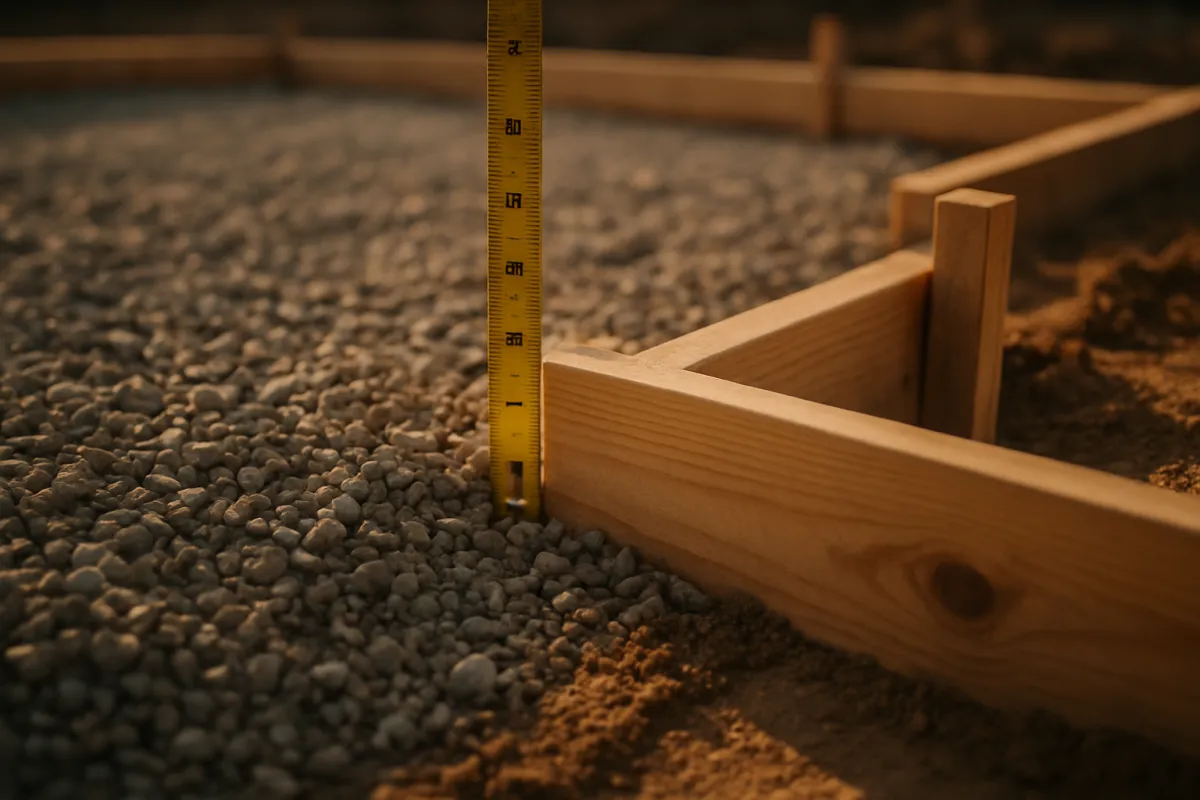
Building forms for a 10x10 pad is a manageable afternoon project, four straight 2 by 4 boards staked and leveled into a square, which is a large part of why this size is approachable for a do-it-yourselfer in a way a driveway’s long, often curved forms are not. Getting the forms square, with equal diagonals corner to corner, and level across every edge matters just as much here as on a bigger pour, since the forms set the finished slab’s exact shape and height.
Edge detail is worth a little extra attention on a small pad that will see foot traffic or equipment feet directly against its perimeter, since a clean, slightly rounded edge resists chipping better than a sharp one. A small pour’s forms also come out faster once the concrete has cured enough to hold its shape, which is one more way this size rewards a careful first attempt without the time pressure a driveway-scale pour creates.
Site access for a small slab
Site access matters less on a 10x10 pad than on a driveway, simply because there is less material to move, but it is not irrelevant. A pad reachable by wheelbarrow from a driveway or a side yard is straightforward on either the bag or the ready-mix path. A pad tucked behind a fence, up a slope, or across soft ground that cannot support a loaded wheelbarrow adds real labor, sometimes enough to tip the decision toward bags specifically, since smaller individual loads are easier to carry by hand or in a smaller container than a full wheelbarrow load from a truck’s chute.
If a ready-mix truck genuinely cannot reach within a reasonable wheelbarrow distance of the forms, ask about a pump or confirm the plant’s chute-extension reach before ordering, since a pour that needs either option adds cost that a 1.24 yard job may not justify over simply choosing bags instead.
DIY versus hiring a pro at this size
A 10x10 pad is one of the more genuinely approachable do-it-yourself concrete projects precisely because of its scale. Unlike a driveway, where the volume forces a continuous, time-pressured pour from a ready-mix truck, a pad this size can be built from bags at a comfortable pace, mixed in batches, and finished without racing a setting clock across a large area all at once.
That said, finishing concrete well, getting a flat, properly floated and troweled surface without a visible seam between mixed batches, is still a skill that takes some practice, and a visibly rough or uneven small pad is a common first-timer outcome. For a utility pad that will sit under a shed or a unit rather than be looked at directly, a rougher DIY finish is a reasonable tradeoff for the savings. For anything visible or load-bearing in a specific way, like a hot tub pad, weigh the savings against the real risk of a mistake that is expensive to fix after the fact.
Permits for a small accessory slab
Permit requirements for a small accessory slab vary enormously by jurisdiction, and unlike a driveway, which almost always needs one, a pad this size sometimes falls under a threshold that does not require a permit at all, particularly for a utility pad with no structure attached. Many places do require a permit once an accompanying shed or structure crosses a certain square footage or height, so the slab itself can end up needing one indirectly even when the pad alone would not.
The only reliable answer comes from your local building department, and it is worth a quick call before pouring rather than after, since a few jurisdictions also have setback rules governing how close any structure, including a shed on a slab, can sit to a property line. A five minute phone call is cheap insurance against having to move or alter a pad you already poured.
Curing time before you build on it
Concrete reaches enough strength to walk on within a day or two, but a 10x10 pad meant to support a shed, a unit, or a hot tub benefits from the fuller cure window before real weight goes on it. As an illustrative guide, concrete reaches a large share of its design strength within about a week and continues strengthening for weeks beyond that, so waiting several days to a week before setting a shed or unit on the pad, and longer before filling a hot tub, is a reasonable precaution rather than an overcautious one.
Our curing time manual covers the full schedule by day, including how temperature and humidity shift it. Rushing a heavy load onto a pad that has not had enough time to cure is one of the more common and most preventable ways a small slab underperforms its design life.
Weather at the time of the pour matters more on a small pad than its size suggests, because there is no large crew racing to finish before conditions turn. A hot, dry, or windy day accelerates surface drying and can crack a small pad if it is not covered or lightly misted during the first day, while a cold pour needs protection from freezing before the concrete has gained enough strength to tolerate it. Our cold and rain pouring manual covers both edge cases in full, and either is worth checking against your forecast before committing to a pour date.
Ways to keep a small slab’s cost down
A 10x10 pad has fewer cost levers than a bigger project simply because there is less to vary, but a few still matter. Choosing bags over a short-loaded truck is often the single biggest saving at this exact size, for the crossover reasons covered above, so run both numbers before assuming a truck is automatically more convenient. Keeping the footprint to exactly what the shed, unit, or pad actually needs, rather than rounding up for a margin you will not use, avoids paying for square footage that does nothing for you.
Batching this pour with another small job, a walkway section or a second small pad, into one delivery is the move that actually beats the short-load fee if you do want a truck, since combining orders is the standard fix the fee is designed to discourage people from avoiding individually. What should never be cut is the base prep and the thickness spec for your actual load, since skimping on either turns a cheap pad into an expensive do-over.
Comparing small-pad bids line by line
A bid for a job this size is easy to compare carelessly because the total dollar figures look small next to a driveway or patio quote, but the same discipline applies. Ask whether the price is a true per-square-foot rate or a flat minimum job charge, since the two can differ substantially on a pad this small and neither is wrong, they are simply different pricing structures worth knowing which one you are getting.
Confirm the thickness, whether reinforcement is included, what base prep is covered, and whether the quote assumes your site is already clear and accessible. A bid that is unusually low relative to others for the same small pad is worth a direct question rather than automatic acceptance, since the gap is more often a thinner base or a skipped reinforcement line than genuine savings.
A worked example: a 10x10 shed pad priced three ways
Take the common case end to end: a 10 by 10 foot shed pad, 100 square feet, poured at 4 inches on a reasonably accessible lot with no old surface to remove. The volume is 1.24 cubic yards across every path, since the geometry does not change, only who supplies the labor and which fees apply.
Path one, bags: 56 bags at an illustrative 6.50 dollars each is roughly 364 dollars in material, plus your own mixing labor across a full day. Path two, DIY ready-mix: 198 dollars of material plus a short-load fee of roughly 276 dollars against a 4 yard minimum, about 474 dollars total, plus the labor of forming, placing, and finishing it yourself. Path three, hire a pro: roughly 800 dollars at the installed midpoint, all labor and finishing included. The chart below places the three paths side by side for this exact job.
Illustrative total cost to build a 10x10 shed pad at 4 inches, by path
Bags and DIY ready-mix are material plus fees only; professional installed includes all labor and finishing.
Bags and a short-loaded truck land surprisingly close together at this exact volume, which is the whole lesson of the bag-to-truck crossover applied to a real job. The professional figure includes labor the first two paths do not.
Where the cost of a professionally installed 10x10 pad goes
Illustrative split for a plain 4 inch pad; shares vary by access and reinforcement.
Labor carries nearly half the installed price even on a pad this small, which is why the DIY paths above save real money for anyone willing to supply that labor themselves.
Change the thickness to 6 inches for a hot tub and every material figure above rises by half, while the installed labor share grows more modestly, since forming and finishing a 6 inch pad is only marginally more work than a 4 inch one of the same footprint. Run your own dimensions and thickness through the companion below to see how your specific pad compares across all three paths.
The bottom line
A 10x10 concrete slab costs an illustrative 600 to 1,000 dollars professionally installed, near 800 at the midpoint, but the more useful finding in this brief is that it sits almost exactly at the volume where bagged material and a short-loaded ready-mix truck cost about the same, somewhere near 350 to 475 dollars in material either way. That makes this one of the few common slab sizes where genuinely pricing all three paths, bags, DIY truck, and hiring a pro, before choosing is worth the ten minutes it takes.
Settle the thickness first, 4 inches for a shed or utility pad, 6 for a hot tub or anything heavier, then run your footprint through the estimator or the companion below, read our broader concrete cost manual for the full material math behind every figure here, and get a real local bid if you are hiring the pour out. A pad this size rewards the extra five minutes of comparison, because at this exact volume, the cheapest-looking path on paper is not always the cheapest once every fee is counted.
Treat this as workbench education, not a price quote or a construction specification. Every dollar figure here, per bag, per yard, per fee, and per project, is an illustrative planning range, and your base, your soil, your site access, your region, and your local plant’s or contractor’s minimum charges will each move the real numbers, sometimes substantially. Any slab meant to carry a structure, a heavy fixed unit, or a filled hot tub should have its thickness and any reinforcement confirmed for your specific load and soil by a qualified contractor, and many accessory structures still require a local permit even when the slab itself might not. Build your actual budget on live, written quotes and your local building department’s current rules, not on any single figure printed here.
Frequently asked questions
How much does a 10x10 concrete slab cost?
As an illustrative planning range, a 10 by 10 foot slab, 100 square feet, commonly runs somewhere around 600 to 1,000 dollars poured and finished by a professional, with a working midpoint near 800 dollars at an illustrative 8 dollars per square foot. That figure assumes a standard 4 inch pad with basic site access and no old surface to remove. Doing it yourself with bagged concrete trims the outlay to roughly 350 to 400 dollars in material, and ordering a ready-mix truck yourself runs close to that once a small-order short-load fee is added, since a 10 by 10 pad needs barely more than a cubic yard, well under most plants' delivery minimum.
How thick should a 10x10 concrete slab be?
Four inches is the standard thickness for a light-duty pad, a shed floor, a walkway-style pad, or an AC or generator unit, and it is the thickness most of the illustrative figures in this brief assume. Six inches is the step up for anything heavier or anything that might see occasional vehicle weight, a hot tub, a small outbuilding meant to hold real storage weight, or a pad near a driveway apron a car might clip. Going from 4 to 6 inches adds exactly 50 percent to the concrete volume and therefore roughly 50 percent to the material cost, so confirm which spec your specific use needs before you price it, rather than defaulting to the thicker number out of caution alone.
Is it cheaper to use bags or order a truck for a 10x10 slab?
This is close to the single size where the answer is genuinely unclear, because a 10 by 10 slab at 4 inches needs about 1.24 cubic yards, right at the bag-to-truck crossover most concrete manuals describe only in the abstract. Bagged material alone commonly runs an illustrative 350 to 400 dollars for this volume. A ready-mix truck's material is cheaper per yard, but most plants carry a delivery minimum of 3 to 5 cubic yards, and a short-load fee on the 2 to 3 yards you are short of that minimum often erases the per-yard saving entirely, landing the truck path at a similar all-in total once the fee is counted. Labor and convenience, not raw material price, usually decide this one.
How much does a concrete pad cost for a shed?
A shed foundation priced as a poured slab follows the same math as any 10 by 10 pad, an illustrative 600 to 1,000 dollars installed for 100 square feet at 4 inches, though many sheds are smaller or larger than 10 by 10, so the real number scales with the shed's actual footprint plus a few inches of overhang on each side. A slab foundation is the most durable and most expensive common choice for a shed base; gravel pads and concrete deck blocks both cost less up front but do not offer the same flat, rot-resistant floor a poured slab does, a tradeoff worth weighing against how permanent you want the shed to be.
How much does an AC pad or generator pad cost?
An AC condenser pad or a standby generator pad is usually smaller than a full 10 by 10 footprint, often closer to 2 by 3 feet for a condenser or 3 by 5 feet for a residential generator, which keeps the material volume tiny, well under half a cubic yard in most cases. The honest complication is that a job this small frequently gets quoted as a flat minimum charge rather than a true per-square-foot rate, since the crew's drive time and setup cost the same whether they pour 6 square feet or 100, so a tiny pad can carry an illustrative 300 to 600 dollar flat price that reads high per square foot purely because of that minimum.
Can I pour a 10x10 concrete slab myself?
Yes, a 10 by 10 pad is genuinely within reach for a capable do-it-yourselfer in a way a driveway is not, because the volume is small enough to mix by hand or with a rented mixer across bagged material rather than racing a ready-mix truck's setting clock. The job still rewards care: the base has to be excavated and compacted, the forms have to be square and level, and the finishing window is short once the concrete is placed. Our slab-pouring manual walks the full sequence, and a small pad like this is one of the more forgiving sizes to learn on before attempting anything larger.
Do I need rebar or wire mesh in a small slab?
For a light-duty 4 inch pad under a shed or a utility unit, many installers skip structural reinforcement and rely on the slab's own thickness and a well-compacted base, sometimes adding fiber mesh mixed into the concrete itself for shrinkage crack control rather than steel. A 6 inch pad meant to carry occasional vehicle weight or a genuinely heavy fixed load is a different case, where rebar or welded wire mesh is commonly specified to hold the slab together if the base ever shifts. Confirm the spec for your specific load and local soil with whoever pours it, since this is a structural call rather than a pure cost preference.
How much does a short load of concrete cost for a small pad?
A short-load fee is the surcharge a ready-mix plant adds when an order falls below its economical minimum, commonly around 3 to 5 cubic yards, because the truck and driver cost the plant the same to dispatch regardless of how full the drum is. As an illustrative figure, that fee runs 50 to 150 dollars per cubic yard short of the minimum. A 10 by 10 pad at 4 inches needs only about 1.24 yards, so against a 4 yard minimum it is short by roughly 2.76 yards, which at a 100 dollar midpoint rate adds on the order of 275 dollars, a fee that can rival the concrete's own material cost on a pad this size.