
What's on this page
- The fire pit calculator in one line
- Picking the fire pit’s diameter first
- Inside diameter, outside diameter, and why the difference matters
- The ring math: circumference, unit face width, units per course
- How many courses: fire pit height and the course math
- Tapered fire pit blocks versus straight pavers set on edge
- Fire pit kits versus building from loose units
- Gas inserts and how they change the unit count
- Natural stone and dry-stacked boulder rings
- Troubleshooting a ring that will not close
- The base every fire pit ring needs
- Lining the inside: heat, clearance, and what the ring itself does not do
- Capping the ring
- The waste allowance for curved cutting
- A worked example: a 36 inch inside diameter ring, three courses
- Seating area and clearance around the fire pit
- Permits, setbacks, and local burn rules
- What a fire pit ring costs, in rough terms
- Common mistakes building a fire pit ring
- Your fire pit order checklist
- The bottom line
Short answer: Treat a fire pit ring as a circumference problem, not an area problem. Add the wall thickness to the inside diameter twice for the outside diameter, multiply by pi for the outer circumference, then divide by the block or paver's face width for blocks per course. Multiply by the course count, add caps separately, and add about 10 percent for curved cutting. A 36 inch inside diameter, 4 inch wall, 7 inch face block works out to about 20 blocks per course.
A fire pit calculator answers a question that a patio or a wall calculator does not, because a ring is curved on both faces at once and the unit count depends on the circumference rather than the area most material estimates use. Most of the guesswork around sizing a fire pit comes from treating it like a short straight wall bent into a circle, which gets the course count roughly right but misses the two things that actually decide how a ring looks and holds together: the gap between a straight unit and a curve, and the difference between the circle you want to sit around and the circle the blocks actually trace.
This manual works a fire pit ring end to end: picking the diameter, the inside-versus-outside distinction that trips up most first builds, the circumference math that turns a diameter into a block count, tapered kits versus straight units, the base every ring needs, the liner question, capping, and the waste a curve adds that a straight run does not. It sits alongside our paver patio manual, which treats a fire pit as an obstacle cut into a flat surface, and our concrete blocks for retaining walls guide, which works the same segmental block family in a straight or gently curved wall. Run your own diameter through the estimator or the companion below as you read.
Key takeaways
- A fire pit ring is a circumference calculation: outer circumference divided by the unit's face width gives blocks per course, not an area formula.
- Inside diameter and outside diameter are different circles; order the units from the outside circumference, since that is the curve the blocks actually trace.
- Tapered, purpose-made fire pit blocks close a tight curve with even joints; straight pavers and standard blocks leave wedge-shaped gaps that widen as the diameter shrinks.
- The ring needs its own compacted gravel base, commonly an illustrative 4 inches deep, sized to the outside footprint plus a little overage.
- Add caps as a separate count from the wall units, since cap face width is usually different, and add roughly 10 percent for curved cutting and breakage.
The fire pit calculator in one line
Compressed to one pass: pick the inside diameter, add the wall thickness on both sides to get the outside diameter, multiply the outside diameter by pi to get the outer circumference, divide that circumference by the block or paver’s face width to get units per course, then multiply by the number of courses. Add cap units from the same circumference divided by the cap’s own face width, add a waste allowance for curved cutting, and the order is complete.
Every step after that line is either measuring one of those inputs honestly or attaching a smaller quantity, the base, the liner, the caps, to the same circle. The formula itself never changes regardless of whether you are building from segmental retaining wall blocks, fire pit specific tapered units, or straight pavers set on edge; only the face width and whether the unit tapers changes what the finished ring looks like.
Picking the fire pit’s diameter first
Before any arithmetic, the diameter is a decision, not a measurement, the same way depth is the decision that drives a topsoil or mulch order. A commonly cited comfortable range for a backyard wood burning fire pit sits around 36 to 44 inches across the inside, large enough to build a real fire that throws usable heat without needing an oversized seating area to match. Smaller rings, down toward 30 inches, suit tighter patios or a gas burner pan that does not need the same firebox depth a wood fire does.
The diameter decision has a second consequence beyond comfort: the unit count scales with the circumference, which scales with the diameter directly, not with its square the way an area does. Going from a 36 inch to a 48 inch inside diameter is a one third increase in diameter, and it is roughly a one third increase in blocks per course too, because circumference is a straight multiple of diameter. That is a gentler relationship than an area calculation, where the same jump would mean closer to a 75 percent increase in square footage, which is worth knowing before you assume a bigger ring costs proportionally more than it does.
Inside diameter, outside diameter, and why the difference matters
This is the distinction that produces the most common fire pit miscount, because the two circles are easy to confuse and only one of them is the curve the blocks actually trace. The inside diameter is the width of the usable firebox, the opening you see when you look down into the finished ring. The outside diameter is that same opening plus the wall thickness on both sides, since the wall has a real thickness and sits all the way around the circle, not just on one side of it.
Add the wall thickness twice, once for each side of the circle, to go from inside to outside. A 36 inch inside diameter with a 4 inch thick block or paver course has an outside diameter of 36 plus 4 plus 4, or 44 inches. Order the units from the outside circumference, because that is the surface the blocks actually form; using the inside diameter instead undercounts every course, and the error gets worse as the wall gets thicker relative to the opening, which is exactly the case on a small ring built from a thick unit.
The ring math: circumference, unit face width, units per course
Once the outside diameter is settled, the rest of the per-course math is one formula borrowed from basic geometry: circumference equals pi times diameter. A 44 inch outside diameter has a circumference of pi times 44, about 138.2 inches, or just over 11.5 feet around the outside of the ring. That circumference is the total curve length the first course of blocks has to close.
Blocks per course by inside diameter
Illustrative count at a 4 inch wall thickness and a 7 inch block face, one course.
Each bar is the outer circumference at that inside diameter, divided by a 7 inch block face and rounded up. Bar width is each count against the tallest. Blocks climb with diameter, but more slowly than an area would, since circumference is a straight multiple of diameter.
Divide the circumference by the block’s face width, the dimension that shows on the curve, to get units per course. At a 7 inch face, 138.2 divided by 7 is about 19.7, which rounds up to 20, because a ring has to close with whole units and a partial block leaves a gap. Round up every time on a ring count, never down, since the circle has to meet itself exactly.
How many courses: fire pit height and the course math
Once blocks per course is set, the height of the ring is just a multiplier, the same way it is on a straight retaining wall. A commonly built fire pit stands two to four courses tall before the cap, landing somewhere around 12 to 18 inches of wall height depending on the unit’s own height and how many courses you stack. Multiply the blocks per course by the course count for the total wall unit count, before the caps are added.
The one wrinkle a ring shares with a battered retaining wall and a straight paver run does not: if the units taper, which many purpose-made fire pit blocks do, each successive course can sit at a very slightly smaller or larger diameter than the one below it, by design, to keep the lean consistent. For a short fire pit ring, two to four courses, that effect is small enough that most builds use the same per-course count throughout; it only matters on a taller ring where the designed taper is pronounced.
Tapered fire pit blocks versus straight pavers set on edge
The unit you choose changes more than the look. A tapered fire pit block, a purpose-made segmental unit with a wedge shaped face narrower at the back than the front, is engineered to close a circle with consistent, tight joints: lay the units edge to edge and the taper itself creates the curve, with no gap to hide. These are the units sold specifically as fire pit kits, and they are the easiest path to a clean, even ring.
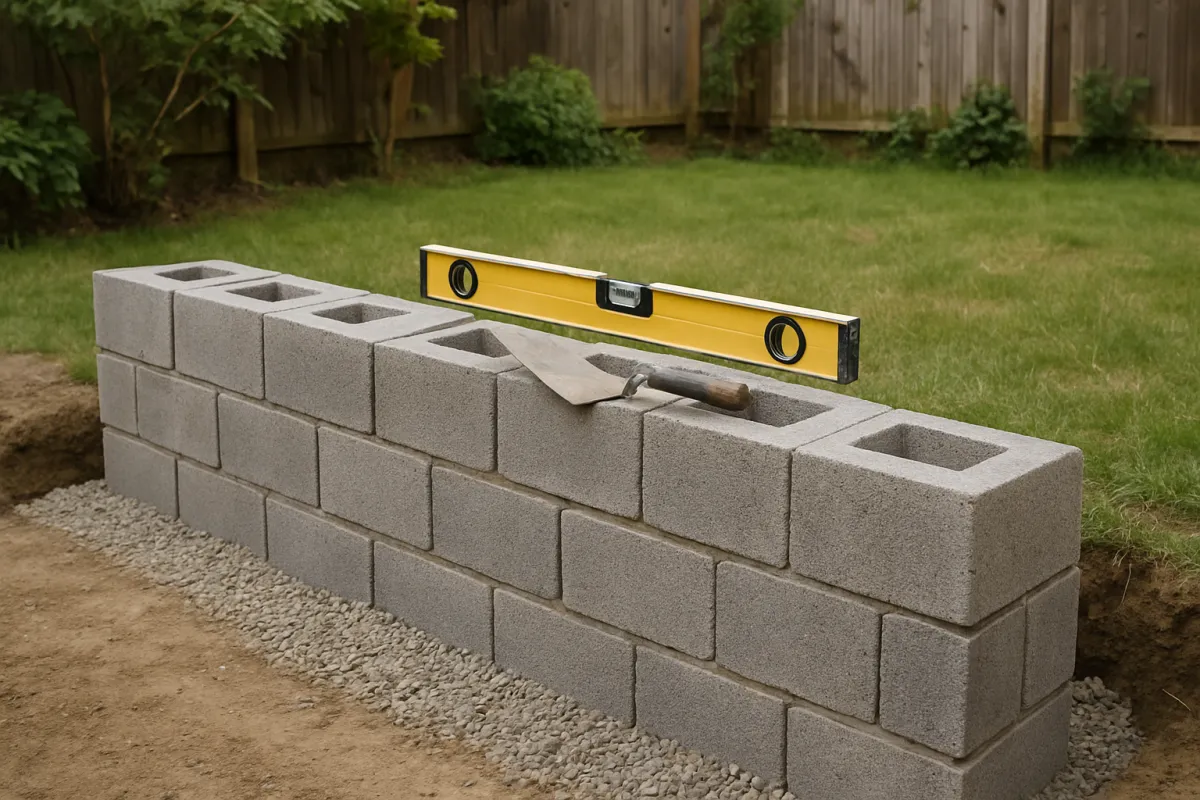
A standard rectangular paver or a non-tapered concrete block, by contrast, has parallel sides, so laying it on a curve opens a wedge-shaped gap at the back of each unit, wider at the outside of the ring than the inside. That gap is small and barely visible on a gentle curve, roughly 42 inches and larger, where each unit only turns a few degrees of arc. On a tight curve, below about 36 inches, the same gap becomes a visible V at every joint, which either gets filled with mortar or grout, or pushes you toward a tapered unit instead. Decide this before ordering, because the fix after the fact is replacing units, not adjusting the count.
Fire pit kits versus building from loose units
A packaged fire pit kit bundles a matched set of tapered wall units sized to one or a small handful of specific diameters, usually with a matching cap course included in the count, which removes the circumference math entirely for that one size. The tradeoff is less flexibility: you build at the diameter the kit offers, not the one your patio layout actually wants, and kits typically cost more per unit than buying the same number of standard blocks loose.
Building from loose retaining wall blocks, standard pavers, or natural stone gives you any diameter you want and is usually cheaper per unit, at the cost of doing the circumference math yourself and accepting the joint gap a non-tapered unit leaves on a tight curve. The practical rule: a kit earns its premium on a small, tight ring where joint appearance matters and a specific diameter is not required; loose units make more sense on a larger, gentler curve or when the diameter has to match an existing patio feature exactly.
Gas inserts and how they change the unit count
A gas fire pit swaps the open wood firebox for a burner pan and a lava rock or glass media bed, usually fed by a buried line or a hidden propane tank, and the masonry ring around it is mostly unchanged by the fuel source. The ring still needs the same circumference math, the same base, and the same cap course; what changes is the inside diameter, which is now set by the burner pan size rather than by how much wood you want to burn at once, and an access panel or removable cap section for the gas valve and ignition hardware.
Gas inserts commonly run smaller than a comparable wood-burning firebox, since a pan does not need room for stacked logs or airflow the way an open wood fire does, so a gas ring can often land at the tighter end of the diameter range, 30 to 36 inches inside, without feeling undersized. The liner question changes too: a gas pan sits on a non-combustible base rather than needing the same heat-rated firebox liner a wood fire does, though the masonry around it still has to tolerate the radiant heat of a running burner. Confirm the pan manufacturer’s clearance and ventilation requirements before fixing the inside diameter, since those come from the burner’s listing, not from the block math.
Natural stone and dry-stacked boulder rings
Not every fire pit ring is built from a manufactured segmental block or a paver. A dry-stacked ring of irregular natural stone or small boulders follows the same outer-circumference logic in principle, but the face width is no longer a single fixed number, since natural stone varies piece to piece. The practical approach is to use an average face width across a representative sample of the stone you are sourcing, then treat the resulting unit count as a rough planning figure rather than an exact order, with a noticeably larger waste and selection allowance, commonly 15 to 20 percent, to account for pieces that get set aside as poor fits.
Natural stone also usually skips a true cap course in the manufactured-block sense, since the top course is simply the flattest, most stable stones in the pile set by eye rather than a matched manufactured cap unit. That makes a natural stone ring more forgiving of small math errors, since an odd stone can be split, turned, or swapped for a better fit on site, but it also makes it harder to buy to an exact count; most natural stone fire pits are bought by the ton from a landscape supplier’s loose stone and sorted on site rather than counted unit by unit.
Troubleshooting a ring that will not close
Two failure patterns show up most often once the blocks are on the ground. The first is a ring that comes up short on the final unit, a gap too narrow for a whole block and too wide to ignore, which almost always traces back to measuring the inside diameter instead of the outside, or to rounding the per-course count down instead of up. The fix at that point is a site cut on one or two units to close the gap evenly, spread across two or three joints rather than concentrated in one visibly narrow unit.
The second is a ring that closes with extra room, overlapping or needing an extra unit jammed in, which usually means the face width used in the calculation was the unit’s overall width rather than the width it actually presents on the curve, a distinction that matters most on units with a visible bevel or chamfer along the front edge. Dry-lay the first course completely before setting anything in adhesive or mortar: a full dry run on the compacted base catches both of these errors while they still cost nothing to fix, which is cheaper than discovering either one with the second course already stacked on top.
The base every fire pit ring needs
A fire pit ring sits on a compacted base for the same reason a paver patio or a short retaining wall does: an unsupported ring settles unevenly as the ground beneath it freezes, thaws, and drains, and an uneven base shows immediately on a circle because every course copies the one below it. The base is commonly an illustrative 4 inches of compacted angular gravel, tamped level in a shallow excavation sized to the ring’s outside footprint plus a few inches of overage on every side.
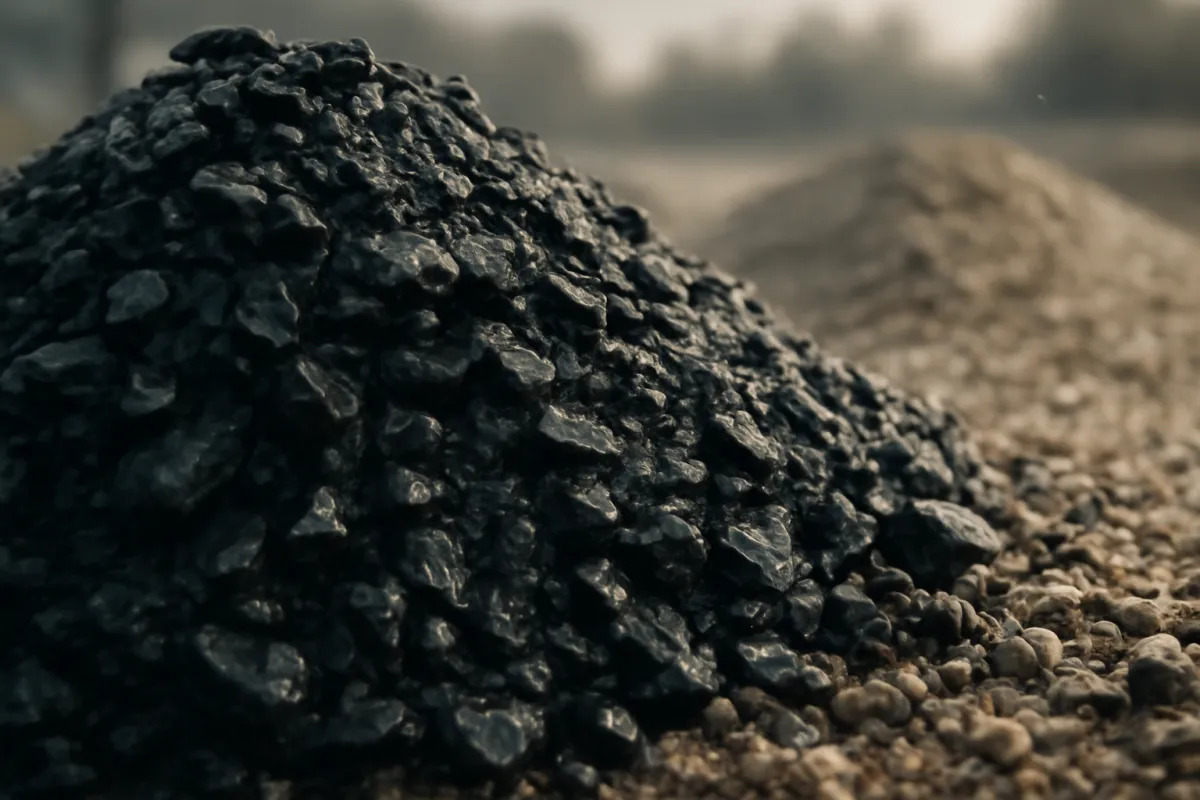
Sizing the base is an area calculation even though the ring above it is a circumference one: base area in square feet is pi times the outside radius squared, the same formula our round-area coverage uses for a circular paver field. A 44 inch outside diameter has a 22 inch, or 1.83 foot, radius, giving a base area of about 10.6 square feet. At a 4 inch compacted depth that is roughly 3.5 cubic feet, about 0.13 cubic yards before a compaction allowance, which is why most fire pit bases are bought by the bag rather than delivered in bulk. Our gravel manual and the companion below carry the same formula on your own diameter and depth.
Lining the inside: heat, clearance, and what the ring itself does not do
The blocks or pavers that form a fire pit’s wall are a structural and aesthetic shell; they are not automatically rated to take direct, repeated flame contact, and this is the step most first-time builds skip. Many finished rings use a steel fire ring insert or a refractory firebrick liner set inside the masonry, which absorbs the direct heat and the thermal cycling of repeated fires and protects the outer units from cracking over time. Some fire pit specific blocks are manufactured and rated for direct fire contact without a liner; ordinary retaining wall block, standard CMU, and most pavers generally are not, so check the manufacturer’s stated fire rating before skipping the liner.
A liner also solves a practical problem a bare ring does not: it defines a contained ash and ember area with a known, replaceable surface, rather than leaving the masonry itself to absorb soot, spalling, and the occasional crack from a too-hot fire built directly against unrated block. Price the liner into the project from the start rather than treating it as an optional add-on, since retrofitting one after the masonry is built means dismantling part of the ring.
Capping the ring
A cap course, the flat units that sit on top of the final wall course, finishes the ring’s rim into a usable, sittable, comfortable edge rather than leaving the top of a structural block exposed. Cap units are typically wider than the wall units below them, since they overhang slightly on both the inside and outside face, which means their face width for a circumference calculation is usually different from the wall unit’s and has to be counted separately rather than assumed equal.
Run the same formula with the cap’s own face width: outer circumference divided by cap face width, rounded up, gives the cap count. At the running 44 inch outside diameter and an illustrative 8 inch cap face, 138.2 divided by 8 is about 17.3, rounding up to 18 caps. Caps are usually set with a thin bead of construction adhesive rather than mortared, so no separate mortar quantity applies the way it would on a mortared CMU wall.
The waste allowance for curved cutting
Every curved masonry project earns a larger waste allowance than a straight one, and a fire pit ring is the tightest curve most residential projects attempt. Even tapered, purpose-made units occasionally need a field cut to true up the final closing joint, and non-tapered units cut to fit a curve lose material at every adjustment. A commonly used allowance is around 10 percent of the combined wall and cap count, applied after both are totaled, higher than the 5 percent a straight fence or wall run typically uses.
On the running example, 60 wall units plus 18 caps is 78 units before waste; 10 percent of 78 is 7.8, which rounds up to 8, for a total order of 86 units. That cushion covers breakage, a miscut cap, and the odd unit that chips during handling, which happens more often on a curved, hand-set project than on a straight run laid with a string line.
A worked example: a 36 inch inside diameter ring, three courses
Pull the whole calculation together on one running size. Inside diameter 36 inches, wall thickness 4 inches, so outside diameter is 36 plus 4 plus 4, 44 inches. Outer circumference is pi times 44, about 138.2 inches, or 11.5 feet.
At a 7 inch block face, blocks per course is 138.2 divided by 7, about 19.7, rounding up to 20. Three courses is 20 times 3, 60 wall blocks. Caps at an 8 inch face are 138.2 divided by 8, about 17.3, rounding up to 18. That is 78 units before waste. Add 10 percent, 7.8 rounded up to 8, for a grand total of 86 units.
What a 3-course, 36 inch fire pit order is made of
Illustrative unit split for the worked example, to 100 percent of 86 units.
Shares are illustrative and move with wall thickness, block face, and course count. The lesson is that caps are a meaningful slice of the order on a short ring, not an afterthought rounded in at the end.
The base underneath is a separate, much smaller order: at the 44 inch outside diameter, the base area is about 10.6 square feet, and at a 4 inch compacted depth that is roughly 3.5 cubic feet, about 0.13 cubic yards, typically bought as a handful of bags rather than delivered loose. Run your own diameter, wall thickness, and face width through the companion below to get the same six numbers on your project.
Seating area and clearance around the fire pit
The ring itself is only part of the footprint a fire pit actually uses, because people sit a comfortable distance back from the heat, not against the wall. A commonly cited clearance from the outside of the ring to the first row of seating is somewhere around 3 to 4 feet, which on a 44 inch outside diameter ring adds roughly 6 to 8 feet to the total usable circle, turning an under-4-foot ring into a seating area pushing 16 to 20 feet across once chairs are placed.
That seating footprint matters for planning the surrounding patio or gravel pad, not for the block count itself, but it is worth sizing before committing to a diameter: a ring that reads as modest on paper can crowd a small patio once the seating clearance is added around it. Our paver patio manual treats a fire pit cut into a larger patio as a subtracted circular obstacle, which is the complementary calculation to this one if the ring sits inside a broader hardscape rather than standing alone on gravel.
Permits, setbacks, and local burn rules
A wood burning fire pit is a fire code question before it is a masonry one, and the rules are set locally rather than nationally, which means no figure here should be treated as a confirmed local rule. A commonly cited starting setback in many jurisdictions runs somewhere around 10 to 25 feet from a structure, a fence, or overhanging trees, with a wood fire frequently held to a larger distance than a contained gas feature, and some jurisdictions require a spark screen, a permit, or restrict open burning entirely during dry seasons.
Call the local fire department or building department before building a permanent ring, not after, since a setback violation on a masonry structure is far more expensive to fix than one on a portable fire pit bought off a shelf. This is a safety and legal question, not a design preference, and it belongs at the very start of the planning sequence, before the diameter is even chosen.
What a fire pit ring costs, in rough terms
Pricing a fire pit ring follows directly from the unit count above, since the blocks are usually the largest line item on a do it yourself build. As illustrative per-unit ranges, a standard segmental retaining wall block commonly runs somewhere around 3 to 6 dollars, a matching cap unit a little more at roughly 4 to 8 dollars, and a purpose-made tapered fire pit kit unit often sits above both because the taper and the fire rating add manufacturing cost. On the 86 unit worked example above, a loose-block build in the 3 to 6 dollar range lands somewhere around 260 to 520 dollars for the masonry alone, before the base gravel, a liner, and any tools.
The base and liner are smaller lines by comparison. The 0.13 cubic yard gravel base in the worked example is typically a handful of bags rather than a bulk delivery, a modest cost next to the block order, and a steel fire ring insert or a refractory liner is its own separate purchase priced by the manufacturer rather than something this calculator estimates, since liner pricing varies widely by size and material. Confirm current unit pricing at the yard or home center before budgeting a real project, since these figures are a planning range, not a quote, and regional pricing on segmental block varies as much as it does on any other masonry unit.
Common mistakes building a fire pit ring
The failure patterns on a fire pit ring cluster around the inside-versus-outside diameter confusion and the curve itself. Ordering from the inside diameter instead of the outside is the single most common undercount, since it ignores the wall thickness entirely and comes up short by roughly one block per course for every few inches of wall thickness. Using a straight-unit waste allowance, the 5 percent a fence or straight wall uses, instead of the larger curved-cutting allowance a ring needs is the second, and it shows up as running short near the closing joint.
Skipping the liner question until the first fire is lit is a frequent regret, since retrofitting a liner into a finished ring means pulling at least part of it apart. Forgetting that caps use a different face width than the wall units, and simply adding a flat percentage for caps instead of running the circumference math a second time, tends to undercount the cap course specifically. And building directly on unexcavated soil without a compacted base invites the same uneven settling a patio or short wall would show within a season or two.
Your fire pit order checklist
The whole manual, compressed to the list worth keeping in the car on the way to the yard.
- Settle the inside diameter first. A commonly cited comfortable range is 36 to 44 inches; confirm any local minimum or maximum before committing.
- Add the wall thickness twice. Inside diameter plus wall thickness plus wall thickness equals the outside diameter you actually order from.
- Run the circumference. Outside diameter times pi gives the outer circumference in the same units.
- Divide by the face width. Circumference over the block’s face width, rounded up, gives blocks per course; multiply by the course count for the wall total.
- Count caps separately. Caps usually have a different face width; run the circumference division a second time.
- Add a curved-cutting waste allowance. Roughly 10 percent of the wall-plus-cap total, higher than a straight run’s allowance.
- Size the base as a circle. Pi times the outside radius squared gives the base area; multiply by depth and divide by 27 for cubic yards.
- Settle the liner and the setback before you build. Confirm the unit’s fire rating and your local clearance rule first, not after the first fire.
The bottom line
A fire pit ring is a circumference calculation wearing a patio project’s vocabulary: outside diameter from the inside diameter plus the wall thickness, circumference from pi times that diameter, blocks per course from the circumference over the face width, and a larger waste allowance than a straight run needs because every joint sits on a curve. Caps and the base are smaller calculations riding alongside the main one, not afterthoughts, and the liner and setback questions belong at the very start, before a single block is ordered. Run your own diameter, wall thickness, and course count through the companion below or the estimator, confirm the local setback and any permit requirement, and the ring that arrives closes clean on the first course rather than fighting a gap on the last one. Dry-lay the first course before anything is set permanently, and the whole project behaves the way the arithmetic says it should.
Treat this manual as workshop arithmetic meant to make a curved layout legible, not a fire code citation or a manufacturer’s installation instruction. The diameters, face widths, course counts, base depths, waste percentages, and setback figures above are typical illustrative values chosen to make the worked example follow, and your own units, your local fire code, and your soil will each move the real numbers. Confirm your block or kit’s actual face dimensions and fire rating with the manufacturer, confirm setback and permit requirements with your local fire or building department before building a permanent fire pit, and never leave a wood fire unattended.
Frequently asked questions
How do I calculate how many blocks I need for a fire pit?
Work it as a ring, not a patio. Add the wall thickness to your inside diameter twice to get the outside diameter, multiply that by pi to get the outer circumference, then divide by the block's face width to get blocks per course. Multiply that by the number of courses you are stacking, add the cap units separately since they usually have a different face width, then add about 10 percent for curved cutting and breakage. A 36 inch inside diameter ring with a 4 inch wall, built from 7 inch face blocks, works out to about 20 blocks per course.
What size should a fire pit be?
There is no single correct size, but a commonly cited starting range for a backyard wood burning fire pit is 36 to 44 inches across the inside, which is large enough for a real fire without needing an oversized seating circle around it. Smaller rings, down around 30 inches, suit a tighter patio or a gas insert with a smaller burner pan. Bigger rings past about 48 inches push the comfortable seating ring out further and use noticeably more material, since the course count scales with the circumference, not the diameter alone. Confirm any minimum or maximum size against your local fire code before you commit to a diameter.
How many pavers do I need for a fire pit ring?
The same ring math as blocks applies to flat pavers set on edge: find the outer circumference from the diameter plus the ring thickness, then divide by the paver's face width showing on the curve. The difference is that most standard rectangular pavers are not tapered, so they leave wedge shaped gaps on a tight curve that get worse as the ring gets smaller. Purpose made curved or tapered paver kits avoid that problem and are usually the better choice for a small diameter ring; straight pavers work better on a gentler curve, generally 42 inches and up.
What is the difference between a fire pit kit and loose blocks?
A fire pit kit is a matched set of pre-cut, tapered units sized to close a specific diameter with even joints and no wedge gaps, usually packaged with a matching cap course. Building from loose straight blocks or pavers is cheaper per unit and more flexible on size, but the joints widen toward the outside of the curve, which gets more noticeable as the diameter shrinks below roughly 40 inches. For a small, tight ring a kit is usually worth the premium; for a larger, gentler curve the joint gap is small enough that loose units are a reasonable do it yourself build.
How deep should the base be for a fire pit?
A compacted gravel base under a fire pit ring follows the same logic as a paver patio base, commonly an illustrative 4 inches of compacted angular gravel under the ring itself, extending a little past the outside edge so the base supports the full footprint rather than just the blocks. Skip the base and a ring built on bare soil typically settles unevenly within a season or two as freeze-thaw and drainage shift the ground underneath it. The companion below converts your own diameter into a base area and a gravel volume.
Does a fire pit need a metal liner or insert?
Many built fire pit rings use a steel fire ring or a refractory liner inside the masonry, which protects the blocks from direct flame contact and extreme heat cycling that can crack ordinary concrete block or paver material over repeated fires. Some purpose-made fire pit blocks are rated for direct fire contact without a liner; standard retaining wall block and ordinary pavers generally are not, so check the manufacturer's fire rating before building a ring without one. A liner also simplifies ash cleanup since it contains the burn area as a defined bowl.
How close can a fire pit be to a house or fence?
Setback distances are set locally and vary by jurisdiction, the fire pit's size, and whether it burns wood or gas, so there is no single national number to give. A commonly cited starting range in many local codes is somewhere around 10 to 25 feet from a structure, fence, or overhanging tree, with wood burning pits often held to a larger setback than a contained gas feature. Confirm the actual distance with your local fire department or building department before you place a permanent ring, since this is a safety rule, not a design preference.
How much gravel do I need under a fire pit?
Find the base area from the outside diameter, radius squared times pi, then multiply by the base depth in feet and divide by 27 for cubic yards, the same formula our general gravel manual uses for any round footprint. A ring with a 44 inch outside diameter has a base area of about 10.6 square feet, which at a 4 inch compacted depth is roughly 0.13 cubic yards before a compaction allowance, small enough that most fire pit bases are a few bags rather than a delivery. The companion below runs this on your own diameter.