What's on this page
- Why this is a bag-yield question, not a brand question
- The bag-count method: cubic feet over yield, round up
- Reading the bag: why the label beats this page
- Fence posts: the job most bagged mix is bought for
- Small pads and slabs: the other common bagged job
- Mixing: water ratio, working time, and consistency
- Dry-set posts: fast-setting mix without a mixing tub
- Deck footings and sonotubes in bagged mix
- Mortar mix, concrete mix, and why the names matter
- Buying by the pallet and bulk-bag pricing
- Storage and shelf life before you pour
- Common bagged-mix mistakes
- Buying extra: the margin that costs almost nothing
- When bagged mix stops making sense
- A worked example: five posts, one afternoon
- Temperature, curing, and when bagged mix behaves differently
- Comparing a bagged order against a short-load delivery
- Matching bag size to who is doing the mixing
- The pre-buy checklist
- The bottom line
Short answer: How much Quikrete-type bagged mix you need is cubic feet needed divided by the bag's printed yield, rounded up. As illustrative starting figures, an 80 pound bag yields roughly 0.6 cubic feet, a 60 pound bag roughly 0.45, and a 50 pound bag roughly 0.375, though fast-setting and specialty formulations differ, so the number on your actual bag always wins over any general figure. A 12 inch fence post hole 2 feet deep needs close to two and a half 80 pound bags per post.
“Quikrete” is one of those brand names that has become a stand-in for the whole category the way a tissue gets called by a brand that isn’t always the one in the box, and most people searching for it are really asking the bagged-concrete question regardless of which specific brand ends up in their cart: how many sacks of dry mix does my small project need. This brief answers that question for the bagged-mix family generally, using the same bag-yield method whether the sack on the shelf happens to say Quikrete, Sakrete, or any other brand, because the underlying math, cubic feet over yield, rounded up, is identical across the category.
Where this brief differs from our full bagged concrete manual is scope: that manual works every bagged-concrete scenario in depth, fence posts, footings, pads, mixing, storage, and the bags-versus-truck crossover. This one is the quick version, built for someone standing in an aisle with a specific small job and a specific bag in hand, who wants the bag-yield method and the common job sizes fast, with pointers to the longer manual and our slab calculator manual for anything bigger than a pallet of bags. Run your own numbers through the estimator or the companion below as you read.
Key takeaways
- The method is one line: cubic feet needed, divided by the bag's printed yield, rounded up to whole bags.
- As illustrative starting figures, an 80 pound bag yields roughly 0.6 cubic feet, a 60 pound bag roughly 0.45, and a 50 pound bag roughly 0.375, but always check the number printed on your actual bag.
- Different product lines within the same bagged-mix brand, standard, fast-setting, high-strength, yield and cure differently, so match the product to the job before trusting a single yield figure across all of them.
- A 12 inch fence post hole 2 feet deep needs roughly 1.4 cubic feet of concrete, about two and a half 80 pound bags per post, and hand-dug holes always run a little over.
- Around 45 of the 80 pound bags make one cubic yard; near that point, read our full concrete manual before committing to another pallet of bags.
Why this is a bag-yield question, not a brand question
The honest starting point is that “how much Quikrete do I need” and “how many bags of concrete mix do I need” are the same question wearing different words, because the arithmetic does not care which brand’s name is printed on the bag. What matters is the yield, how many cubic feet of placed, mixed concrete one bag of that specific product makes, and the yield is set by the product’s formulation and its weight, not by brand loyalty. A brand name tells you about the manufacturer; the yield number printed on the bag tells you about the math.
That distinction matters because a single brand sells more than one bagged product, and the products are not interchangeable in yield or in use. A standard bagged concrete mix, a fast-setting post-setting mix, and a high-strength or crack-resistant formulation from the same manufacturer can all carry different yields per pound, different water ratios, and different working times. Buy the specific product for your specific job, read the yield printed on that bag, and the method below turns that single number into a bag count.
The bag-count method: cubic feet over yield, round up
The whole calculation is one line: find the cubic feet of the shape you are filling, divide by the bag’s yield in cubic feet, and round up to whole bags. As illustrative, widely cited starting figures for a standard bagged concrete mix, an 80 pound bag yields roughly 0.6 cubic feet, a 60 pound bag roughly 0.45, a 50 pound bag roughly 0.375, and a 40 pound bag roughly 0.30. These are useful for a first pass and for sanity-checking a bag count, but the number printed on the specific bag you are holding is always the one to use for a real order, since formulations and yields can shift between product lines and even between packaging updates on the same product.
Illustrative cubic feet per bag, by bag weight
Starting figures for a standard bagged concrete mix; confirm the exact yield printed on your actual bag before ordering.
Yield tracks bag weight closely because it is the same general category of material, but fast-setting and specialty formulations can differ from these standard-mix figures, sometimes by a meaningful margin, which is exactly why the bag's own label outranks this chart.
A pad needing 5.3 cubic feet, divided by the 0.6 cubic foot yield for an 80 pound bag, is 8.8, which rounds up to 9 bags. Rounding always goes up, never to the nearest, because a job that is 0.8 of a bag short is a job that stops mid-pour while someone drives back to the store with a batch already setting in the mixing tub.
Reading the bag: why the label beats this page
Every figure in this brief is a starting point, and the single most important habit in buying bagged mix is reading the yield and the mixing instructions printed on the actual bag before you calculate anything final. Manufacturers print the yield in cubic feet directly on the packaging because it is the number their own formulation actually produces, tested under their own conditions, and it is more reliable than any general figure a brief like this one can offer across the whole category of bagged products.
This matters doubly because product lines shift. A standard mix, a fast-setting mix, a high-strength or crack-resistant mix, and a mortar or patching mix can all be sold under the same general brand umbrella with different yields, different water ratios, and different cure times, and grabbing the wrong one off the shelf because it is the familiar brand name is a common and avoidable mistake. Pick the product for your job first, by name and intended use, then read its yield, and only then run the bag-count math.
Fence posts: the job most bagged mix is bought for
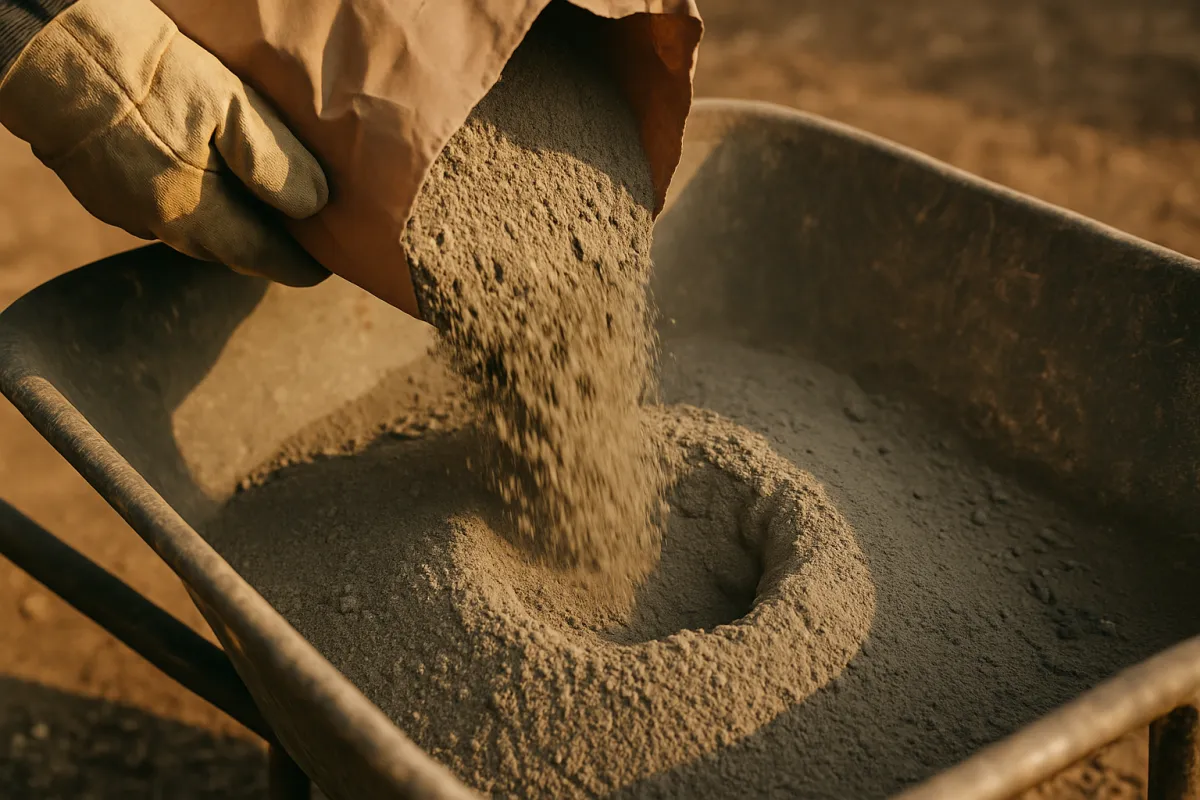
Fence and mailbox posts are the most common reason anyone buys a handful of bags rather than ordering a truck, and the volume always surprises people because a post hole is a cylinder and cylinders hold more than they look like they do. The volume of a hole is radius squared times pi times depth, then subtract the post itself. A standard case, a 12 inch diameter hole, 6 inch radius or 0.5 feet, 2 feet deep, works out to 0.5 times 0.5 times 3.14 times 2, about 1.57 cubic feet of hole. A 4x4 post is really 3.5 inches square, displacing roughly 0.17 cubic feet over that depth, leaving about 1.4 cubic feet of concrete to fill in around the post.
At an illustrative 0.6 cubic foot yield for an 80 pound bag, one post needs about 2.3 bags, which rounds to buying two to three bags per hole. A modest ten-post fence, done this way, quietly becomes twenty-five to thirty-odd bags, which is why eyeballing a fence job by the post rather than by the hole volume is one of the most common ways a bagged-mix order comes up short. Multiply your per-post figure by your actual post count, and never estimate a fence run by eye.
Small pads and slabs: the other common bagged job
Pads and small slabs are the second common bagged-mix job, and the shape is the friendliest one in this brief: length times width times thickness, all in feet. A classic small pad, 4 feet by 4 feet at 4 inches, or 0.333 feet thick, works out to 4 times 4 times 0.333, about 5.3 cubic feet. At the illustrative 0.6 cubic foot yield, that is 8.8 bags, rounding to 9 of the 80 pound bags, with a little extra for spillage and a slightly deep spot bringing a realistic order to about 10.
Watch how quickly a pad outgrows the bagged range. Stretch the same 4 inch thickness to a 6 by 6 foot pad and the volume jumps to 12 cubic feet, about 20 bags; an 8 by 10 patio at the same thickness is 26.7 cubic feet, roughly 45 bags, which is exactly one cubic yard and exactly the point our full concrete manual argues belongs to a truck rather than a stack of sacks. Bagged mix is well suited to a small pad and increasingly poor value as the footprint grows.
Mixing: water ratio, working time, and consistency
Once the bag count is set, mixing is where the work actually happens, and it has its own discipline that decides whether the bags you bought reach the strength their yield figure assumed. A standard bagged mix commonly wants roughly 6 pints, about three quarters of a gallon, of water per 80 pound bag as an illustrative starting point, scaled down proportionally for smaller bags, though the figure printed on your specific bag is the one to follow for a real pour. Add water gradually rather than all at once, and stop when the mix holds its shape on a hoe but is still workable, roughly the texture of thick oatmeal.

Working time matters as much as the ratio. Standard mix gives a window, commonly under an hour, before it stiffens past usability, and that window shrinks sharply with fast-setting products and in hot weather. Mix only as much as you can place inside that window, usually one to two bags per batch for hand mixing, since a larger batch mixed at once often means the last of it goes in half-set and weaker than the first.
Dry-set posts: fast-setting mix without a mixing tub
Setting a post is one of the few jobs where skipping the mixing tub entirely is a legitimate, common method, provided the specific bag in hand is labeled for it. Fast-setting, post-specific bagged products are designed to be poured dry directly into the hole around a plumbed post, with water then added on top; the mix pulls the water down through the dry material and cures hard in place, often in 20 to 40 minutes, letting a crew plumb, brace, and move down the fence line without waiting on a tub between posts.
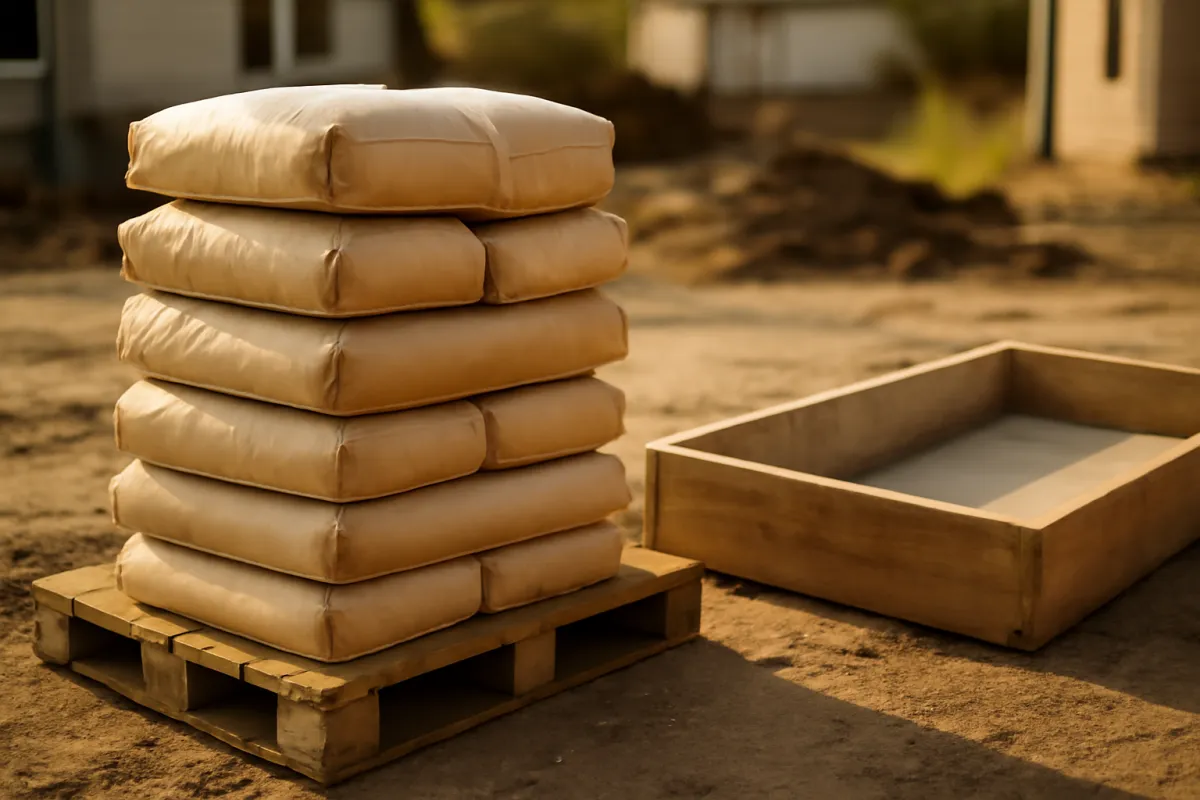
This method is specific to products labeled for it, and a standard bagged concrete mix should not be dry-poured, since it is formulated to be mixed with water first for reliable, even strength throughout the mass. Read the bag before choosing a method, because a fast-setting product and a standard mix from the same general brand family are built for genuinely different techniques, not just different speeds.
Deck footings and sonotubes in bagged mix
Deck and porch footings calculate the same way fence posts do, cylinder volume, except the cardboard sonotube form fills completely rather than having a post to subtract. A sonotube’s volume is radius squared times pi times depth, full stop. Three common diameters at a typical 4 foot depth make a handy reference: an 8 inch tube, 4 inch radius, holds about 1.4 cubic feet, a 10 inch tube about 2.2, and a 12 inch tube about 3.1 cubic feet, which at the illustrative 0.6 cubic foot yield works out to roughly 2.3, 3.7, and 5.2 of the 80 pound bags per tube before margin.
Footings punish an eyeball estimate harder than fence posts because the tubes are commonly wider and deeper, often set below the frost line, and a modest deck can need six, eight, or a dozen of them. Six 10 inch tubes at 4 feet is about 13 cubic feet, roughly 22 of the 80 pound bags; step up to 12 inch tubes at the same count and depth and the job is closer to 32 bags, well into the range where a rented mixer earns its cost and worth a second look at whether a short-load truck makes more sense for the whole job, especially if a deck footing day coincides with other concrete work on the same site.
Mortar mix, concrete mix, and why the names matter
Bagged products sold near each other on the same shelf are not interchangeable, and the most common mix-up is grabbing a mortar mix when the job needed a concrete mix, or the reverse. Concrete mix contains coarse aggregate, gravel or crushed stone, along with sand and cement, and it is the correct choice for anything structural: posts, footings, slabs, and pads. Mortar mix contains only sand and cement with no coarse aggregate, and it is formulated for bonding masonry units, brick, block, and stone, together rather than for standing on its own as a structural pour.
Using mortar mix where concrete mix belongs produces a weaker result for load-bearing work, since the coarse aggregate in concrete is what gives it most of its compressive strength and bulk; using concrete mix where mortar belongs can leave a joint too coarse and difficult to tool neatly between masonry units. Read the bag’s stated purpose, not just its general appearance as a gray powdered mix, and when a project includes both a structural pour and masonry bonding, expect to buy two different bagged products rather than one, each with its own yield and its own line in your bag count.
Buying by the pallet and bulk-bag pricing
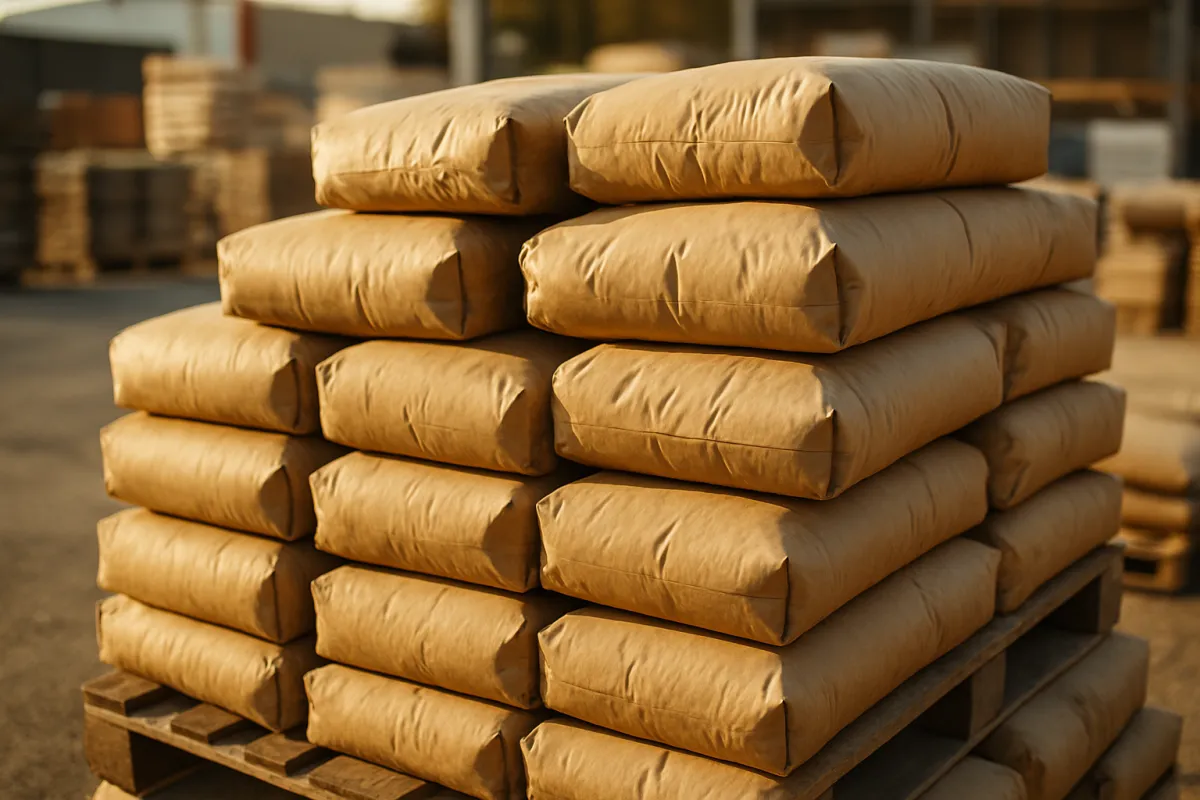
Suppliers commonly sell bagged mixes individually and by the full pallet, and once a project’s bag count climbs into the twenties or higher, it is worth asking for pallet pricing before buying the same count as loose bags. A full pallet also solves a practical problem bagged work creates on its own: a stack of forty or fifty bags is heavy enough that moving it as a banded unit by hand truck or forklift beats carrying each one individually from a store shelf to a vehicle and then to the job site.
The trade-off is storage and moisture exposure while the pallet sits before use. A full pallet left outside and uncovered through a rainy stretch risks the same partial-cure problem a single bag faces, so if you buy in bulk ahead of a pour date, cover the pallet and keep it off wet ground exactly as carefully as you would a single bag, since the economics of a bulk discount evaporate quickly if a quarter of the pallet has to be thrown out on pour day rather than mixed into the job it was bought for.
Storage and shelf life before you pour
Bagged mix is a perishable product in slow motion, because the cement inside reacts with whatever moisture it can reach, so how the bags sit between purchase and pour decides how many of your counted sacks are actually usable when the day comes. Kept dry and off the ground, an unopened bag commonly stays usable for several months up to about a year, but a bag sitting on a damp garage floor or exposed to a humid stretch of weather can partly cure inside its own wrapper well before that.
The simplest check is feel: a good bag breaks up into loose powder when pressed, while a bag with hard lumps that will not crumble has already started to set and belongs in the trash rather than the mixing tub. Store bags on a pallet or boards, sealed under plastic, in the driest space available, and buy close to your actual pour date rather than stockpiling months ahead. If a bulk or bundled order will sit for a while before use, inspect every bag before the pour starts, not after a trowel hits a lump mid-batch, and set aside anything that already feels compromised.
Common bagged-mix mistakes
A short list of mistakes repeats often enough on bagged-mix jobs to name directly. The first, and the costliest, is estimating a fence by the post instead of the hole, which undercounts by forgetting that the concrete fills the ring around the post rather than the post’s own volume. The second is grabbing the wrong product family off the shelf, mortar where concrete belongs or a slow-cure mix where a fast-setting one was actually needed for a same-day post job, simply because the bags look similar and share a shelf.
The third is mixing to a wetter, easier-to-work consistency than the bag calls for, which quietly loses the strength the yield and cure figures on the label assumed. The fourth is ordering the bare formula count with no margin, then running one bag short on the last hole with a batch already setting in the tub. All four are avoidable by reading the specific bag before buying it and building in the margin this brief recommends before the first bag is opened.
Buying extra: the margin that costs almost nothing
Every bag count from the yield formula is a minimum, and the gap between that minimum and what you actually buy is the margin that keeps a project from stalling mid-pour. An illustrative 10 percent extra is a reasonable working allowance, covering the predictable losses on a bagged job: a hand-dug hole that bellies out wider than planned, a slightly deep spot in a slab, mix left clinging to the mixing tub, and the occasional bag that has partly hardened in storage.
Bagged mix makes this margin close to free, since most suppliers accept unopened bags back for a refund, so over-buying costs a receipt and a short return trip at most, while under-buying costs a stalled pour with a setting batch and a same-day drive back to the store. Round the yield formula up to whole bags first, then add the margin on top, and lean toward the higher side on irregular, hand-dug work where the geometry is the least predictable part of the job.
When bagged mix stops making sense
Bagged concrete-type mix has a real, useful range, and it has a point where the logic flips toward a delivered truck or a rented mixer instead. A cubic yard, 27 cubic feet, is the mental tripwire, since it works out to roughly 45 of the 80 pound bags, and mixing forty-plus sacks by hand, batch by batch, against a setting clock is a genuinely different undertaking than mixing a handful for a few posts. Below about a cubic yard, bags are almost always the right call: no delivery minimum, no short-load fee, work at your own pace, and the unopened bags go back for a refund if you overbought.
As the job approaches and passes that cubic yard mark, the labor of mixing dozens of bags starts to cost more in time and effort than any delivery fee you were avoiding. Our bagged concrete manual works that crossover and the by-hand-versus-mixer labor thresholds in full detail, and our concrete calculator manual and slab calculator manual both pick up the truck side of the same material once your job’s volume says it is time.
A worked example: five posts, one afternoon
Put the method together on a small, common job: five 4x4 fence posts, 12 inch holes, 2 feet deep, using a standard bagged mix in 80 pound bags. Each hole holds about 1.57 cubic feet, the post displaces roughly 0.17, leaving 1.4 cubic feet of concrete per post. Five posts is 7 cubic feet. Add the illustrative 10 percent margin to the cubic feet first, 7.7 cubic feet, then divide by the 0.6 cubic foot yield, and the real order rounds up to 13 bags, cheap insurance against five hand-dug holes that never quite match a textbook cylinder.
The 13-bag fence-post order, by where it goes
Illustrative split for the five-post example above, 80 pound bags.
The formula alone accounts for the first segment; the second is the margin that keeps a hand-dug hole that bellies out wider than planned from stalling the pour on the last post.
That 13-bag order is a little over a thousand pounds of dry mix to carry, open, and mix across the afternoon, which is comfortably inside the range our by-hand mixing guidance calls manageable for one or two people without renting a mixer. At 50 pound bags instead of 80s, the same 7 cubic feet needs roughly 19 bags bare, 21 with margin, more bags but a lighter individual lift for each one, which is the bag-size trade-off from earlier in this brief playing out on a real order. Scale the same math to your own post count, hole size, and depth in the companion below, and swap in the exact yield printed on whichever specific bag you end up buying.
Temperature, curing, and when bagged mix behaves differently
Ambient temperature changes how bagged mix behaves in ways that can affect your bag count indirectly, by changing how much you can place before a batch stiffens rather than by changing the yield itself. In hot weather, standard mix sets faster than its printed working time suggests, shortening the window you have to place and finish each batch, which pushes toward mixing smaller batches more frequently rather than trying to stretch one large batch across more time than the heat allows. In cold weather, the opposite problem appears: concrete cures slowly below a certain temperature range, and pouring into freezing or near-freezing conditions without taking precautions can weaken the final result even though the bag count and the mix ratio were both correct.
Most bagged products print a recommended temperature range for placement on the label, and fast-setting mixes in particular can behave unpredictably outside that range, curing too fast to finish properly in a hot afternoon or too slowly to hold shape overnight in the cold. If your pour date falls at a seasonal extreme, read the temperature guidance on the specific bag before you buy, and consider whether rescheduling a few days is cheaper than a pour that has to be redone. None of this changes the cubic-feet-over-yield math in this brief, but it changes how forgiving that math is on the day you actually use it, since a correct bag count poured under the wrong temperature conditions can still produce a disappointing result that has nothing to do with how carefully you counted.
Comparing a bagged order against a short-load delivery
Once a project’s bag count climbs past the twenties, it is worth pricing a small delivered load alongside the bagged option before committing to either, since the two are not always as far apart in cost as the per-bag arithmetic alone suggests. A short-load delivery, a partial truck below a supplier’s standard minimum, commonly carries a surcharge that makes it pricier per cubic yard than a full load, but it can still land close to or even below the cost of buying and hand-mixing forty or fifty individual bags once the value of your own labor is counted honestly.
The comparison is worth running explicitly rather than assumed: take your calculated bag count and its total cost, including any bulk-pallet discount, and set it beside a short-load quote for the equivalent cubic yardage from a local supplier. If the two land close together, the deciding factor usually becomes practical rather than financial, whether a truck can access your site, whether you have the crew to place a full truckload before it sets, and whether you would rather spend an afternoon mixing bags at your own pace or coordinate a delivery window. Our concrete calculator manual prices the short-load side of that comparison in more depth.
Matching bag size to who is doing the mixing
Bag weight is a labor decision as much as a materials one, and it is worth choosing deliberately rather than defaulting to whatever size is stacked closest to the entrance. An 80 pound bag moves the most concrete per bag opened and per trip to the mixing tub, which is why it is the default this brief and its yield figures are built around, but it is also a genuinely heavy, awkward lift repeated dozens of times on a larger job. A 60 or 50 pound bag means more bags and more mixing cycles for the same total volume, but each individual lift is meaningfully easier, which matters for a solo job, an inexperienced helper, or anyone who should not be repeatedly lifting 80 pounds from an awkward angle.
There is no purely mathematical right answer here, since the total cubic feet needed does not change with bag size, only how it is divided up. Pick the bag size that matches the crew actually doing the lifting and mixing, recalculate the bag count at that size using the method above, and treat the choice as a safety and stamina decision at least as much as a cost one, since an injury from an awkward lift is a far more expensive outcome than a few extra bags of a smaller size would have been.
The pre-buy checklist
The whole method, compressed to what is worth reading at the shelf before you load the cart.
- Read the bag first. Confirm which product line it is, standard, fast-setting, high-strength, and the yield in cubic feet printed on the packaging.
- Get the cubic feet of your job. Box math for pads, cylinder math minus the post for fence holes.
- Divide by the printed yield, round up. Illustrative starting figures: about 0.6 cubic feet for an 80 pound bag, 0.45 for 60, 0.375 for 50, but the bag in hand wins over this list.
- Add about 10 percent. Irregular holes, deep spots, tub residue, and the occasional hardened bag; unopened bags go back for a refund.
- Match the product to the method. Standard mix for anything you finish with a trowel; fast-setting for a dry-poured post.
- Check the cubic yard tripwire. Around 45 of the 80 pound bags make a yard; near or past it, read the full concrete manual before buying another pallet.
The bottom line
How much bagged mix you need, Quikrete or any brand sharing the same shelf, comes down to one line of arithmetic: cubic feet needed, divided by the yield printed on the specific bag you are buying, rounded up, plus an illustrative 10 percent for the ways real holes and slabs disagree with the formula. The starting figures in this brief, roughly 0.6 cubic feet for an 80 pound bag on down, are useful for a first pass and a sanity check, but the bag’s own label is the number a real order should be built on, since standard, fast-setting, and specialty formulations yield differently even under the same general brand name. Work your own posts or pad through the companion below or the estimator, read our full bagged concrete manual for fence posts, footings, and the mixer-versus-truck decision in depth, and count the bags before pour day so the heavy work stays just heavy. Whichever specific product ends up in your cart, the discipline that protects the project is the same one this whole brief keeps returning to: read the bag, trust its printed yield over any general figure, match the formulation to the job, and buy a small margin on top, since that combination is what turns a shelf full of similar-looking sacks into the right order for the hole or the pad actually in front of you.
Read this as workbench education, not a product specification. Every yield figure, bag count, and hole volume above is an illustrative starting point, not a substitute for the instructions and yield printed on the specific product you buy, and bag yields, water ratios, and cure times vary by manufacturer, product line, and region. This brief refers to bagged concrete-type mixes generally and is not affiliated with, endorsed by, or sponsored by any specific manufacturer or brand. Anything structural or load-bearing should be sized against your local building code with a qualified professional in the loop. Confirm the yield and mixing instructions printed on your actual bag before you buy or mix, since concrete keeps its own schedule once the water goes in.
Frequently asked questions
How much Quikrete do I need?
Work out the cubic feet your job needs, then divide by the yield of the specific bagged product you are buying, and round up to whole bags. Bagged concrete-type mixes commonly yield somewhere around 0.15 cubic feet per pound of dry mix as a rough, illustrative starting point, which puts an 80 pound bag near 0.6 cubic feet, a 60 pound bag near 0.45, and a 50 pound bag near 0.375, though the exact figure differs by product line, fast-setting, high-strength, or standard, so the number printed on the specific bag you buy is always the one to trust over any general figure, including this one.
How many bags of Quikrete does it take to set a fence post?
A common setup, a 12 inch diameter hole 2 feet deep, holds roughly 1.57 cubic feet of hole volume, and a 4x4 post displaces around 0.17 cubic feet of that, leaving about 1.4 cubic feet of concrete to fill in around the post. At an illustrative 0.6 cubic foot yield per 80 pound bag, that is close to two and a half bags per post before any margin for a hand-dug hole that bellies out at the bottom. Multiply by your post count, and check the bag's printed yield against this illustrative figure before finalizing your order.
What is the difference between Quikrete's regular concrete mix and fast-setting concrete?
Both are bagged, cement-based mixes sold under the same general brand name, but they are built for different jobs. A standard bagged concrete mix is designed to be mixed with water in a tub or wheelbarrow and gives a working window, commonly under an hour, to place and finish it, which suits pads, slabs, and anything you need time to trowel. A fast-setting product is designed to be poured dry into a hole around a post, with water added on top, and it cures hard in a short window, often well under an hour, letting a crew set a whole fence line without mixing a single batch. Read the specific bag's label, since the two families are not interchangeable.
Can I use Quikrete straight from the bag without mixing it?
Only products specifically labeled for that use, commonly marketed as fast-setting or post-setting mixes, are designed to be poured dry into a hole and have water added afterward. A standard bagged concrete mix is formulated to be combined with water first in a tub or wheelbarrow, and dry-pouring it without proper mixing risks weak, inconsistent strength since the cement may not hydrate evenly through the mass. Always check the specific bag's printed instructions before choosing a dry-pour method, since different product lines within the same general brand family are built for different techniques.
How much does a bag of Quikrete cost?
Bagged concrete mix pricing varies by region, retailer, bag size, and specific product line, fast-setting and high-strength formulations commonly cost more per bag than a standard mix, so this brief will not quote a specific dollar figure that would already be dated by the time you read it. The way to price your project honestly is to check current pricing at the retailer you plan to buy from, multiply by your calculated bag count plus margin, and treat that total as your planning figure rather than relying on a number pulled from an older source.
How many cubic feet are in a bag of Quikrete?
It depends on the bag's weight and its specific product formulation, and the figure is printed directly on the bag you are holding, which is always the number to use over any general estimate. As illustrative, commonly cited figures for a standard bagged concrete mix, an 80 pound bag yields roughly 0.6 cubic feet, a 60 pound bag roughly 0.45, and a 50 pound bag roughly 0.375, but fast-setting and specialty formulations can differ from these figures, sometimes meaningfully, so confirm the yield on your actual bag before finalizing a bag count for anything beyond a rough first pass.
When should I use bagged concrete instead of ordering a truck?
Bagged mixes make sense for small, awkward-geometry jobs, fence posts, mailbox posts, small pads, anchoring a basketball hoop, where the total volume is well under a cubic yard and a delivery truck's minimum order and short-load fee make no economic sense. Once a project's volume approaches roughly one cubic yard, around 45 of the 80 pound bags, the labor of mixing dozens of bags by hand starts to outweigh any savings from avoiding a truck, and this site's bagged concrete manual and concrete calculator manual both cover that crossover and the truck side of the comparison in full.