What's on this page
- Before you start: what you need
- Step 1: Measure the slab length, width, and thickness
- Step 2: Convert the thickness to feet and find the cubic feet
- Step 3: Convert cubic feet to cubic yards by dividing by 27
- Step 4: Add a waste factor of 5 to 10 percent
- Step 5: Convert to bags or order ready-mix
- A worked example: a 10 by 12 patio slab
- How slab thickness changes the order
- A quick slab reference table
- A second worked example: a two-car garage slab
- Converting the slab order to cubic meters
- Common mistakes when calculating concrete for a slab
- Troubleshooting: irregular, thickened, and sloped slabs
- Your slab concrete checklist
- Using a concrete slab calculator
- The bottom line
Short answer: Multiply the slab's length by its width by its thickness, all in feet, then divide by 27 to get cubic yards; convert the thickness from inches to feet first. A 10 by 12 foot slab at 4 inches is about 1.48 cubic yards before waste, and 6 inches on the same footprint is about 2.22. Add a 5 to 10 percent waste factor, then use bags under about half a cubic yard and ready-mix above.
Some numbers you can look up, and some you have to work out, and how much concrete a slab needs is squarely in the second group: no chart knows the size of your form, only a formula that turns your measurements into cubic yards. That formula is short, it is the same for a shed pad or a garage floor, and once you can run it you never have to guess at a pour again.
This manual walks the whole calculation in five plain steps, from stretching a tape across the form to deciding between bags and a ready-mix truck, with a worked example carried all the way through. It builds on the general method in our how to calculate cubic yards manual and narrows it to the one job people most often need it for, a slab. You can run your own dimensions through the material coverage estimator in about a minute, and the companion below recalculates every step against your numbers as you read.
Key takeaways
- The slab formula is length times width times thickness, all in feet, then divide by 27 to get cubic yards. That single line handles any rectangular slab.
- Thickness is measured in inches, so convert it to feet first by dividing by 12, or the whole answer comes out twelve times too large.
- A 10 by 12 foot slab at 4 inches is about 1.48 cubic yards before waste. Thickness moves the order fast: 6 inches on the same footprint is about 2.22 cubic yards.
- Add a 5 to 10 percent waste factor, then round up to how the supplier sells, because concrete punishes under-ordering more than most materials.
- Under about a half a cubic yard, bags are practical; past that, order ready-mix by the yard so the whole slab pours in one go.
Before you start: what you need
This is a five minute calculation with almost no equipment, but it is worth setting up properly, because every number downstream depends on three clean measurements. Rushing the measuring stage is where most wrong orders begin, so gather what you need before you start punching numbers.
What to have on hand:
- A tape measure, ideally a 25 or 30 foot one, long enough to run a slab dimension in a single pull rather than in sections that you have to add up.
- The three dimensions: the length and width of the slab footprint in feet, and the thickness you are pouring in inches. If the form is already built, measure the inside of the form, not the outside, because the concrete fills the inside.
- A calculator, or the material coverage estimator on this page, which takes thickness in inches and handles the inch-to-foot conversion for you.
- A note of your supplier’s increments, if you already know them: ready-mix yards typically sell in quarter or half cubic yard steps, with a short-load fee below a full truck.
Time and difficulty: expect about five minutes for the arithmetic and, if you are estimating from scratch, another ten to walk the site and measure. The math itself is grade-school multiplication and one division; the only genuine skill is unit discipline, keeping length and width in feet while remembering that thickness starts in inches. Get the measurements right and honest, and the five steps that follow are mechanical. For a slab that is part of a larger job, our how to estimate materials for a project manual frames this same volume method as one line in a full takeoff.
Step 1: Measure the slab length, width, and thickness
Start with the three numbers the whole calculation rests on: the length of the slab, its width, and how thick you are pouring it. Measure the length and width in feet across the footprint the concrete will actually fill. If the forms are already built, measure the inside face to inside face, because the concrete stops at the inside of the boards, not the outside. If you are still planning, measure the marked-out area on the ground.
Thickness is the third measurement and the one people treat too casually. For a slab, thickness is a design choice with a range: 4 inches is the common minimum for a patio, walkway, or shed pad, while 5 to 6 inches is typical where vehicles or heavier loads are involved, such as a driveway or garage floor. Measure or decide the thickness in inches and write it down as inches for now; you will convert it in the next step.
Take our running example: a patio slab 10 feet wide and 12 feet long, poured 4 inches thick. Those are the three numbers, 10 feet, 12 feet, and 4 inches, and everything that follows is arithmetic on them.
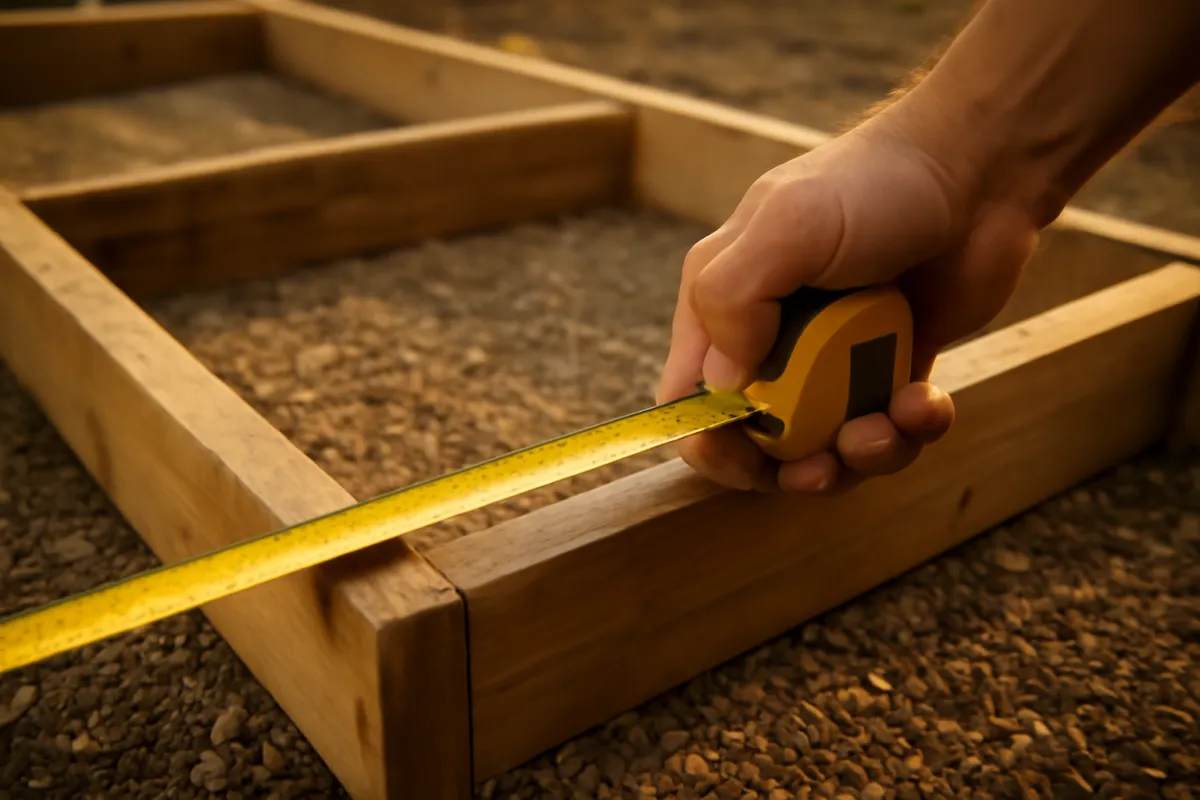
Watch out for the form thickness trap and for out-of-square forms. On a large slab, a form that bows outward in the middle can add real volume, so measure the width at both ends and in the middle and use the largest reading if they differ. And confirm the subgrade is level, because a low spot the eye misses is concrete the formula never counted.
Step 2: Convert the thickness to feet and find the cubic feet
The formula needs all three measurements in the same unit, and that unit is feet. Length and width are already in feet from Step 1, but thickness came in as inches, so convert it first: divide the thickness in inches by 12, because there are 12 inches in a foot. A 4 inch slab is 4 divided by 12, which is 0.333 feet. A 5 inch slab is 0.417 feet. A 6 inch slab is exactly 0.5 feet.
With the thickness in feet, find the volume in cubic feet by multiplying all three dimensions: length times width times thickness. For the example slab, that is 10 times 12 times 0.333, which comes to about 40 cubic feet. The three numbers can be multiplied in any order, since multiplication does not care, but they must all be in feet before you start.
This conversion is the single most important habit in the whole calculation, and it is where the most estimates go wrong. Skip it and multiply by the raw thickness in inches, 10 times 12 times 4, and you get 480 cubic feet, twelve times too large, an answer so absurd it would fill a swimming pool. When a slab result looks impossibly big, an unconverted thickness is the first thing to check.
Watch out for rounding the thickness conversion too hard. Writing 4 inches as 0.33 rather than 0.333 is close enough for a small slab, but on a large pour the small difference compounds, so keep a third decimal place or let the material coverage estimator hold the full precision for you. The same care applies to any odd thickness, like a 4.5 inch slab, which is 0.375 feet, not a number worth eyeballing.
Step 3: Convert cubic feet to cubic yards by dividing by 27
You now have the slab volume in cubic feet, but ready-mix suppliers sell and quote concrete in cubic yards, so the next step converts your figure into the unit you will actually order in. The conversion is a single division: take the cubic feet and divide by 27. For the example slab, that is 40 divided by 27, which is about 1.48 cubic yards.
The number 27 is not arbitrary, and knowing where it comes from makes it stick. A cubic yard is a cube that measures one yard, or 3 feet, along every edge. Its volume is 3 feet times 3 feet times 3 feet, which is 27 cubic feet. So one cubic yard always contains 27 cubic feet, and dividing your cubic-foot volume by 27 rephrases it as cubic yards.
The trap here is dividing by the wrong number. Because a yard is 3 feet, people reach for 3 instead of 27, but volume works in three dimensions at once, so the factor is 3 cubed, which is 27. Divide by 3 by mistake and you order roughly nine times too much concrete, a very expensive slip on a material sold by the truckload.
Watch out for a result that lands suspiciously round or suspiciously large. A residential patio or shed slab almost always falls between about 1 and 3 cubic yards; a garage or a driveway section runs higher. If your figure is far outside the range you expected for the size of slab in front of you, go back and check the thickness conversion in Step 2 and the divide-by-27 here, because those two steps account for nearly every wrong slab volume. Our how to calculate cubic yards manual covers this conversion in more depth if you want the full reasoning.
Step 4: Add a waste factor of 5 to 10 percent
The volume you just calculated is the amount of concrete that would fill a perfect, tidy form sitting on perfectly level ground. Real pours are neither perfect nor tidy, so you add a waste factor on top: commonly 5 to 10 percent, and a little more for rough subgrade, hand-dug edges, or a slab you are placing over uneven fill. To apply it, multiply the calculated volume by 1 plus the percentage as a decimal.
For the example slab, take the 1.48 cubic yards and add 10 percent: 1.48 times 1.1 is about 1.63 cubic yards. That extra 0.15 of a yard covers the concrete that spills at the chute, the low spots in the subgrade the formula assumed were flat, the slight spreading of the forms under the weight of wet concrete, and the material you sacrifice screeding to a clean edge.
Concrete earns a waste factor more than almost any other material, because it is unforgiving of under-ordering. A partial second batch is impractical to obtain and blend on short notice, and a pour that stalls waiting for more concrete can leave a cold joint, a weak seam where fresh concrete meets concrete that has already begun to set. Running slightly long costs a few dollars of leftover; running short can compromise the slab.
A concrete order: the slab plus its waste allowance
Illustrative split of a 1.75 cubic yard order built from a 1.48 cubic yard slab.
The volume you calculate and the volume you order are not the same. A waste allowance covers spillage and uneven subgrade, and suppliers round up to their nearest quarter or half yard anyway, so the final order sits comfortably above the bare formula figure.
Watch out for stacking a large waste factor on top of an already generous thickness. If you have rounded the thickness up to be safe and then add 15 percent waste, you can over-order enough to pay for concrete you wheelbarrow straight to the spoil pile. Pick a realistic thickness, then add a modest 5 to 10 percent, and let the supplier’s rounding be the final cushion.
Step 5: Convert to bags or order ready-mix
The last step turns your volume into an actual purchase, and the volume itself tells you which way to buy. Bagged concrete mix is sold by the bag, each printed with a yield in cubic feet: a 60 pound bag yields roughly 0.45 cubic feet, and an 80 pound bag about 0.60. To find a bag count, divide your slab volume in cubic feet, waste included, by the bag’s yield and round up.
For the example slab at 40 cubic feet, or about 44 with waste, that is 44 divided by 0.45, which is roughly 98 of the 60 pound bags. That number is the answer to the bags-versus-truck question all by itself: mixing 98 bags by hand is a punishing day of work, and worse, it is nearly impossible to keep a continuous pour going, so the slab risks cold joints between batches. Once a slab passes about a half a cubic yard, ready-mix almost always wins.
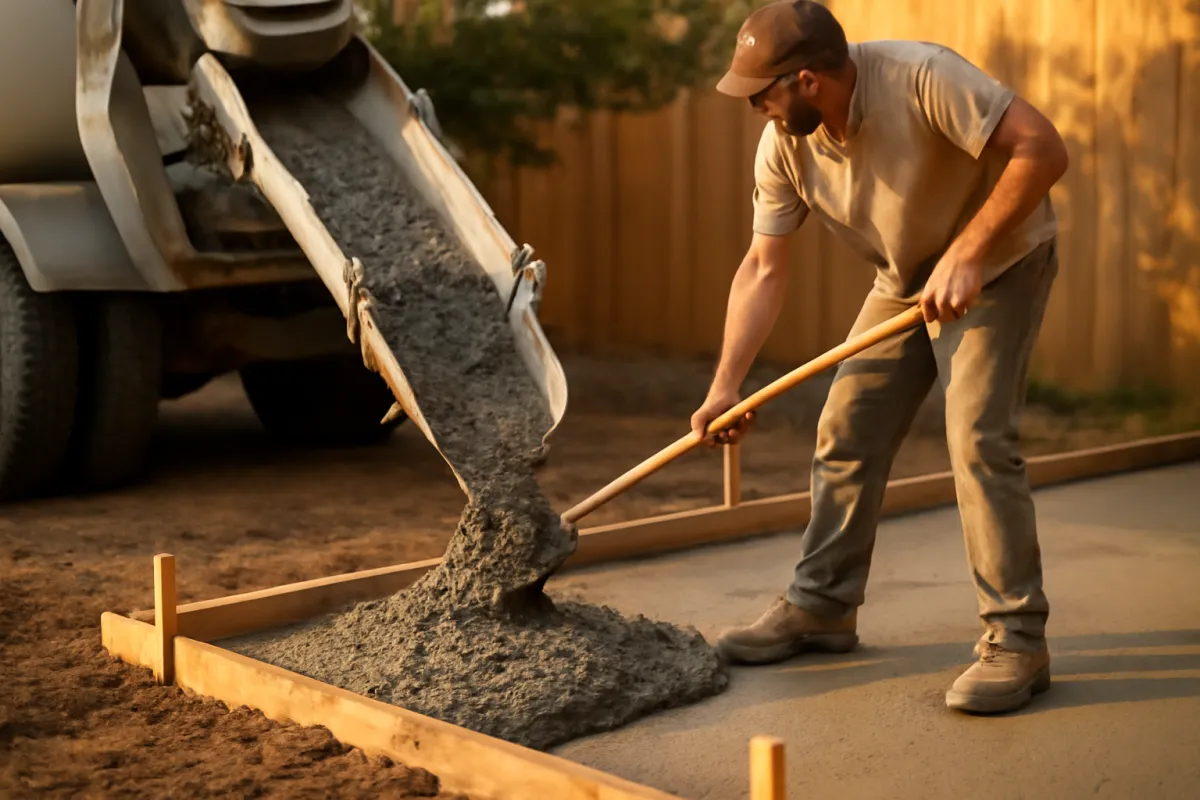
Ordering ready-mix, you buy by the cubic yard. Your 1.63 cubic yard figure, waste included, would be rounded by the yard to their nearest increment, likely 1.75 yards, and if that sits below their truck minimum you would pay a short-load fee. That fee is usually still cheaper than a weekend of bag mixing, and it buys you a single continuous pour.
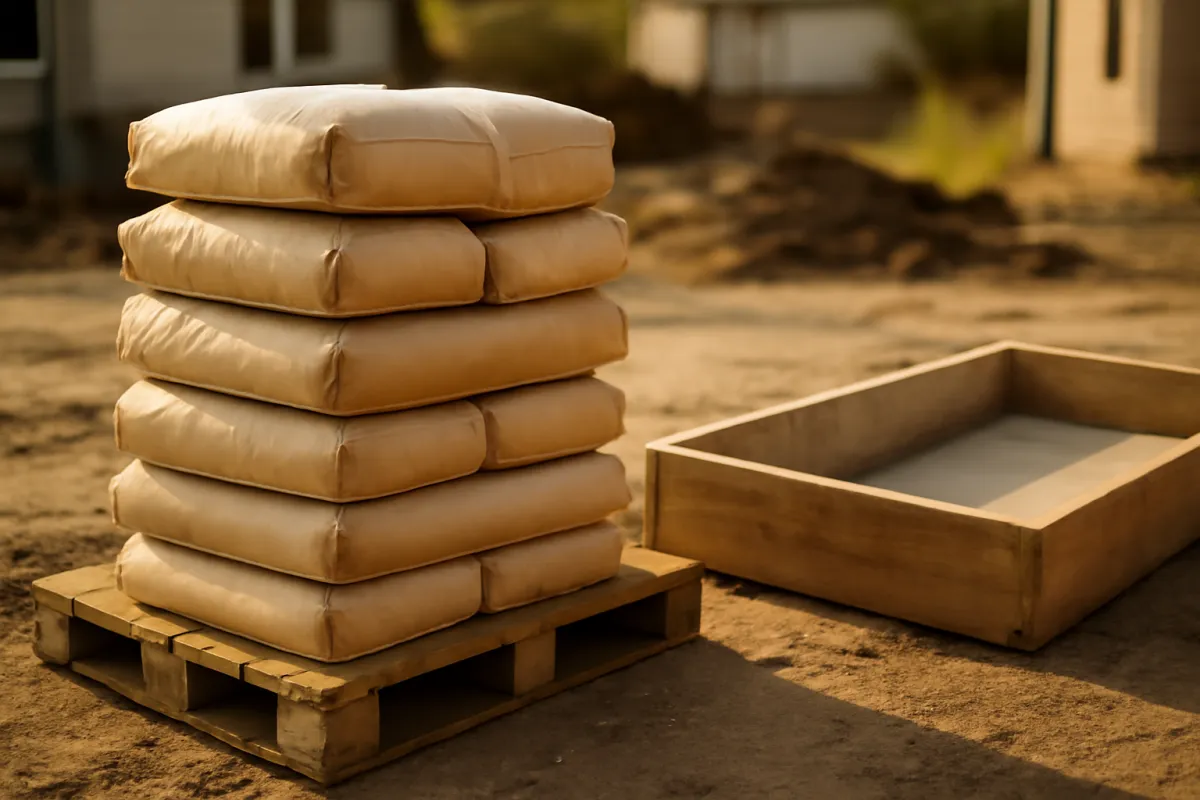
Watch out for treating bags and yards as interchangeable in your head. A cubic yard is roughly 60 of the 60 pound bags or 45 of the 80 pound bags, so a slab that sounds small in yards can be a mountain of bags. Our how many bags of concrete note works the crossover in detail, and the companion on this page reads out both the bag count and the bags-or-truck call for your own numbers.
A worked example: a 10 by 12 patio slab
Pull the five steps together on one realistic pour, a 10 foot by 12 foot patio slab at 4 inches thick, and watch the numbers flow from a tape measure to a firm order.
Step 1, measure: the footprint is 10 feet by 12 feet, and the chosen thickness is 4 inches. Step 2, convert and find cubic feet: 4 inches divided by 12 is 0.333 feet, and 10 times 12 times 0.333 is about 40 cubic feet. Step 3, convert to cubic yards: 40 divided by 27 is roughly 1.48 cubic yards. Step 4, add waste: a 10 percent factor takes 1.48 to about 1.63 cubic yards. Step 5, decide how to buy: at 44 cubic feet with waste, that is roughly 98 sixty-pound bags, clearly truck territory, so you order ready-mix, and the yard rounds 1.63 up to 1.75 cubic yards.
So one measured patio produces a clean chain: 40 cubic feet, 1.48 cubic yards, 1.63 with waste, an order of 1.75 yards of ready-mix. Change any input and the chain moves in a predictable way. Bump the thickness to 5 inches and the volume rises to about 50 cubic feet and 1.85 cubic yards; widen the slab to 12 by 12 and it climbs to about 1.78 cubic yards at 4 inches. That two-step move, calculate the honest volume then cushion it, is the pattern for every slab you will ever pour. Run your own patio through the material coverage estimator and the arithmetic, including the inch-to-foot and divide-by-27 steps, is done for you.
How slab thickness changes the order
Of the three measurements, thickness is the one people underestimate, both in how much it matters and in how a small change scales the order. Length and width feel important because they are large numbers, but they scale the volume in a single dimension. Thickness, small as it looks in inches, multiplies through the whole footprint, so a modest bump in thickness is a large bump in concrete.
Concrete volume by slab thickness, same 10 by 12 footprint
The same 120 square foot slab poured to four thicknesses, converted to cubic yards by dividing by 27.
Thickness scales the order straight up: going from 4 to 6 inches on the same footprint is a 50 percent jump in concrete, not a rounding detail. Choose the thickness deliberately, because it is the input that moves the bill fastest.
The chart makes the relationship concrete. On the same 10 by 12 footprint, moving from 4 to 6 inches lifts the order from about 1.48 to about 2.22 cubic yards, a 50 percent increase for a 2 inch change. That is why the thickness decision deserves real thought: too thin and the slab may crack under load; too thick and you pay for concrete the job does not need. Match the thickness to the use, 4 inches for foot traffic and light pads, 5 to 6 where vehicles or heavy loads sit, and let the formula tell you what that choice costs.
A quick slab reference table
For sizing a slab before you reach for a calculator, a few common footprint-and-thickness combinations are worth keeping written down. These are illustrative round figures for a rectangular slab, all following the same length times width times thickness in feet, divided by 27 method, before any waste factor.
| Slab | Thickness | Cubic yards |
|---|---|---|
| 8 x 8 shed pad, 64 sq ft | 4 in | ~0.79 yd |
| 10 x 10 patio, 100 sq ft | 4 in | ~1.23 yd |
| 10 x 12 patio, 120 sq ft | 4 in | ~1.48 yd |
| 12 x 12 slab, 144 sq ft | 4 in | ~1.78 yd |
| 20 x 20 garage, 400 sq ft | 6 in | ~7.41 yd |
Every row is length times width times thickness in feet, divided by 27. Because the relationship is linear in each dimension, you can scale a row: double the footprint or the thickness and the cubic yards double with it. Use the table as a sanity check rather than a substitute for measuring your own slab, and if your worked figure lands far from the nearest comparable row, treat it as a prompt to recheck the thickness conversion. For a slab you may also want to price, our how much concrete you need manual carries a pour from dimensions all the way to an order.
A second worked example: a two-car garage slab
The running example is a patio at the small end of slab work, so run a larger one, because a garage floor changes the thickness and adds reinforcement, and both change the order. Say the slab is 20 feet by 22 feet, poured 5 inches thick because it carries vehicle loads. Step 1, measure: 20 feet by 22 feet, at 5 inches. Step 2, convert and find cubic feet: 5 inches divided by 12 is about 0.417 feet, and 20 times 22 times 0.417 is roughly 183 cubic feet. Step 3, convert to cubic yards: 183 over 27 is about 6.8 cubic yards.
Step 4, add waste: a slab this size on a prepared base still earns its allowance, so 6.8 times 1.08 is about 7.3 cubic yards. Step 5, decide how to buy: at nearly 200 cubic feet this is far past any bag crossover, so it is a ready-mix order, and the yard rounds 7.3 up to 7.5 cubic yards. The chain reads: 183 cubic feet, 6.8 cubic yards, 7.3 with waste, an order of 7.5 yards of ready-mix.
The garage slab adds one line the patio did not: reinforcement. Vehicle floors commonly carry welded wire mesh or a rebar grid, sized from the footprint and the spacing the spec sets, and that steel is its own quantity on the order sheet, separate from the concrete. It does not change the cubic yards at all, which is the point worth keeping: the volume line prices the mix, and everything else on the slab, the steel, the base, the joints, is a separate quantity that rides alongside it. Our manual on how much concrete you need walks the reinforcement and base quantities that pair with a pour like this.
A slab this size also earns control joints, the tooled or sawn lines that tell the concrete where to crack as it cures, and those change the labor plan rather than the volume. A larger footprint holds more heat and shrinks more as it sets, so a single continuous pour matters even more here than on a small pad: the whole 7.5 yards wants to arrive on one truck and go down in one working window, because a cold joint across a garage floor is a permanent line of weakness. Size the order for the whole slab at once, and stage the crew and tools to place it without a pause.
Converting the slab order to cubic meters
If your plan or your supplier works in metric, the slab volume needs one more step, because metric yards sell concrete by the cubic meter. One cubic yard is about 0.765 cubic meters, and one cubic meter is about 1.31 cubic yards. To calculate straight into metric, find the volume in cubic feet as before, then divide by 35.3 instead of 27, because a cubic meter holds about 35.3 cubic feet.
The patio example makes the swap clear. Its 40 cubic feet came to about 1.48 cubic yards; in metric, 40 divided by 35.3 is roughly 1.13 cubic meters, and 1.48 cubic yards times 0.765 lands in the same place. The two numbers describe the identical slab, and every other step of the method, the inch-to-foot conversion for thickness, the waste factor, the round-up to the supplier’s increment, stays exactly the same. Only the final divisor and the unit on the quote change.
The reason to convert deliberately is that the two units are close enough to blur. A cubic meter is only about 31 percent larger than a cubic yard, so a slab figure that looks about right in the wrong unit can still leave a real shortfall. Label every number with its unit, convert once with the factor rather than by feel, and a metric quote reads as cleanly as a domestic one.
Common mistakes when calculating concrete for a slab
A handful of errors account for nearly every wrong slab figure, and all of them are easy to catch once you know to look.
- Using inches instead of feet for the thickness. Multiplying by 4 instead of 0.333 makes the volume twelve times too large. Always divide the thickness in inches by 12 first, before you multiply.
- Forgetting to divide by 27. Cubic feet is not cubic yards. Skip the division and you quote a number 27 times too big; divide by 3 by mistake and you over-order roughly nine times.
- Leaving out the waste factor. The bare formula assumes a perfect form on level ground. Add 5 to 10 percent for spillage, subgrade dips, and form spread, or risk running short mid-pour.
- Using a rectangle formula on an irregular slab. An L-shape or a slab with a thickened edge is not one clean rectangle. Break it into pieces, calculate each, and add the volumes.
- Confusing bags with cubic yards. A slab that sounds small in yards can be dozens of bags. Convert cubic feet by the bag yield before you decide bags are practical, and compare against ready-mix.
Every one of these is a units or dimensions slip, which is why the discipline of putting all three measurements into feet, dividing by 27, then adding a waste factor is the habit that prevents almost all of them.
Troubleshooting: irregular, thickened, and sloped slabs
Real slabs are not always tidy rectangles of even thickness, so here is how to handle the shapes the basic formula does not cover directly.
What if the slab is L-shaped or irregular? Break it into rectangles you can measure, calculate the concrete for each piece on its own, and add the volumes together. An L-shaped patio is two rectangles; a slab that widens at one end is a rectangle plus a second rectangle or a triangle you can split further. When a slab has a hole in it, an opening for a planter or a footing, calculate the outer shape and subtract the hole rather than tracing the leftover outline. Our how to estimate materials for a project manual applies this same decompose-and-add habit across a whole job.
What if the slab has thickened edges? Many slabs are poured thicker at the perimeter, a turned-down edge or edge beam that carries load. Calculate the flat slab at its normal thickness, then add the extra volume of the edge as its own long, narrow rectangle: the added depth times the edge width times the total perimeter length. That edge concrete is easy to forget and can add a meaningful fraction to the order on a slab with a deep footing edge.
What if the ground is sloped? A slab poured on a slope is thicker at the low end to keep the top level, so its average thickness is greater than the thickness at the high end. Measure the thickness at both ends, average the two, and use that average in the formula. If the slope is steep, treat the wedge of extra concrete as its own triangular volume and add it, because averaging alone can understate a strong slope.
What if the subgrade is soft or gravel-based? A slab often sits on a compacted gravel base, and a soft or uneven base lets concrete slump into low spots, quietly increasing the volume you pour. If you are prepping the base yourself, our note on how much a yard of gravel weighs helps size and plan that layer so the subgrade under your slab is firm and level before the concrete arrives.
Your slab concrete checklist
Before you place the order, run down this compact checklist. It is the save-this asset of the whole calculation.
- Measured the slab length and width in feet, from the inside of the forms.
- Chose and measured the thickness in inches, matched to the slab’s use.
- Converted the thickness to feet by dividing by 12.
- Multiplied length times width times thickness for the volume in cubic feet.
- Divided the cubic feet by 27 to get cubic yards.
- Added a 5 to 10 percent waste factor.
- Decided bags versus ready-mix from the volume, and checked the bag count if bagging.
- Rounded up to the supplier’s increment and confirmed any short-load fee.
- For odd shapes, broke the slab into pieces and added the volumes.
- Confirmed the subgrade is level and firm so the poured volume matches the calculation.
Work top to bottom and the number you hand the supplier is one you can trust. The companion below runs the first six lines automatically on your own dimensions, so you can check your hand math against it before you buy.
Using a concrete slab calculator
A concrete slab calculator is simply the five steps above run for you, and it earns its keep by removing the two slips that cause almost every wrong order, the inches-to-feet thickness conversion and the divide-by-27. Enter the length, the width, and the thickness, and a good tool returns the cubic feet, the cubic yards, a with-waste figure, and often a bag count, all from the same measurements you would otherwise punch by hand. The material coverage estimator on this page works exactly that way, and the companion below mirrors it, recalculating each step against your own numbers as you scroll.
The value of a concrete slab calculator is speed and consistency, not secret knowledge, because the method is the same either way. It multiplies, converts, and rounds the same numbers every time, which means your attention can stay on the one input a tool cannot check for you: an honest measurement of the form and the thickness. Enter a careless depth left in inches and the calculator will faithfully return an answer twelve times too large, so measure the inside of the forms first, then let the tool carry the arithmetic through to a figure you can hand the supplier.
The bottom line
Calculating concrete for a slab is five steps worn into a habit: measure the length, width, and thickness; convert the thickness to feet and find the cubic feet; divide by 27 for cubic yards; add a 5 to 10 percent waste factor; then decide between bags and ready-mix from the volume. The whole thing rests on two disciplines, converting the thickness from inches to feet before you multiply, and dividing by 27 at the end, because those two steps are where nearly every wrong slab order is born. Choose the thickness deliberately, since it moves the order faster than the footprint does, add the waste factor because real ground is not as tidy as arithmetic, and round up to how the supplier sells. Do that, and the concrete you order fills the form in a single, confident pour.
Read this manual as bench notes meant to teach the method, not as a pour you can order without checking. The thicknesses, waste factors, bag yields, and volumes here are typical illustrative values, and your real numbers shift with the slab’s use, the subgrade, the mix, and the supplier. Measure your own form, run it through the five steps, confirm the thickness and any reinforcement with the people doing the work, and verify the quantity with the yard before any truck is booked.
Frequently asked questions
How do you calculate concrete for a slab?
Measure the slab length, width, and thickness, put every measurement into feet, then multiply the three together to get cubic feet and divide by 27 to get cubic yards. Thickness is the catch, because it is almost always given in inches, so divide the inches by 12 to turn it into feet before you multiply. For a 10 foot by 12 foot slab at 4 inches thick, that is 10 times 12 times 0.333, about 40 cubic feet, and 40 divided by 27 is roughly 1.48 cubic yards. Add a small waste factor on top and round up to how the supplier sells, and you have a safe order.
How much concrete do I need for a 10x12 slab?
A 10 foot by 12 foot slab at the common 4 inch thickness works out to about 1.48 cubic yards of concrete before any waste allowance. The math is 10 times 12 times 0.333 feet, which is 40 cubic feet, divided by 27 to reach cubic yards. Add a 5 to 10 percent waste factor and you land near 1.6 cubic yards, which a ready-mix supplier would likely round up to 1.75 yards. At 6 inches thick the same footprint jumps to about 2.22 cubic yards, so thickness moves the order more than most people expect.
How many bags of concrete do I need for a slab?
Divide the slab volume in cubic feet by the yield printed on the bag, then round up. A 60 pound bag of concrete mix yields roughly 0.45 cubic feet, so a 40 cubic foot slab needs about 89 of them, and with a waste allowance closer to 98. That bag count is exactly why a slab of any real size is usually a ready-mix job: mixing 90 plus bags by hand is impractical and risks cold joints between batches. As a rough rule, once a slab passes about a half a cubic yard, price a short-load delivery against the bags.
How do I convert slab thickness in inches to feet?
Divide the thickness in inches by 12, because there are 12 inches in a foot. A 4 inch slab is 4 divided by 12, which is 0.333 feet; a 5 inch slab is 0.417 feet; a 6 inch slab is exactly 0.5 feet. This single conversion is the step that quietly wrecks the most slab estimates, because leaving the thickness in inches makes the volume come out twelve times too large. Convert the thickness first, every time, before you multiply length times width times thickness.
Why do you divide by 27 when calculating concrete?
You divide by 27 to convert cubic feet into cubic yards, which is the unit ready-mix suppliers sell and quote in. A cubic yard is a cube that measures 3 feet on every side, so its volume is 3 times 3 times 3, which equals 27 cubic feet. Because volume works in three dimensions at once, the conversion factor is 3 cubed, not 3. Dividing a cubic-foot figure by 3 instead of 27 over-orders by roughly nine times, which is a memorable and expensive way to learn the rule.
How much extra concrete should I order for waste?
A waste factor of 5 to 10 percent on top of the calculated volume is the common allowance for a slab, and a little more for rough subgrade or hand-dug edges. The overage covers uneven ground, form deflection, spillage, and the gap between a tidy calculation and a real pour. Concrete punishes under-ordering more than most materials, because a small partial second batch is impractical and a delayed pour can leave a weak cold joint. Running slightly long is cheap insurance; running short can compromise the slab.
How do I calculate concrete for an L-shaped or irregular slab?
Break the shape into rectangles you can measure, calculate the concrete for each piece separately, then add the volumes together for the total order. An L-shaped patio is two rectangles; a slab with a thickened edge is the flat slab plus the extra volume of the edge beam. Run each piece through the same length times width times thickness in feet, divided by 27 method, at its own thickness if the thicknesses differ. Decomposing the shape is far more reliable than trying to average an odd outline by eye.
How do I use a Sakrete or Quikrete bag calculator for a slab?
A bag-brand calculator runs the same method as the general one: find the slab volume in cubic feet, length times width times thickness in feet, then divide by the yield printed on that brand's bag. Sakrete and Quikrete 80 pound bags each yield roughly 0.6 cubic feet and 60 pound bags about 0.45, so a 40 cubic foot slab is near 67 of the 80 pound bags before waste. The brand on the sack changes the label, not the arithmetic, so any brand's own calculator should land close to the same count. Verify the exact yield on the bag you buy and confirm the quantity with your supplier.
Should I use bags or a ready-mix truck for my slab?
Use the volume to decide: under about a half a cubic yard, bagged concrete you mix on site is usually the cheaper and simpler path, while past that, a ready-mix delivery wins on both labor and pour quality. A single cubic yard is roughly 45 of the 80 pound bags or about 60 of the 60 pound bags, which is a great deal of mixing to do before the first batch starts to set. Ready-mix arrives blended and lets you place the whole slab in one continuous pour, which avoids the cold joints that hand-mixing many bags can create.