What's on this page
- The confusion at the heart of portland cement vs concrete
- What portland cement actually is
- What concrete actually is
- Cement vs concrete: the one-line difference
- The ingredients of concrete, part by part
- How the concrete mix ratio works
- Where mortar fits in
- Where grout fits in
- Cement vs concrete vs mortar vs grout, compared
- When you use cement alone
- When you use concrete instead
- The types of portland cement, I through V
- How portland cement is made
- How concrete gains its strength
- Why the water to cement ratio decides everything
- Common mistakes people make
- A worked example: proportioning a small batch
- Cement, concrete, and cost
- Buying cement vs buying concrete mix
- The bottom line
Short answer: Portland cement is a fine grey powder binder, one ingredient; concrete is the finished building material made by mixing that cement with sand, gravel and water, then letting it harden. The cement is only about a tenth of a slab's volume. A common general purpose recipe is roughly 1 part cement, 2 parts sand, 3 parts gravel by volume. Mortar is cement and sand with no gravel, and grout is a thin flowable cement mix.
Portland cement and concrete are not two names for the same material, and getting the difference between portland cement vs concrete straight is the single most common mix-up in construction materials. Cement is a fine grey powder, a binder, one ingredient. Concrete is the hard grey building material you actually pour and stand on, made by mixing that cement with sand, gravel, and water. Almost everyone, on job sites and off, calls a concrete driveway a cement driveway, and the habit is harmless in conversation but expensive at the checkout, because a bag labeled cement and a bag labeled concrete mix are two genuinely different products for two different jobs.
This explainer settles the whole confusion in plain terms: what portland cement actually is and where the odd name comes from, what concrete actually is and why the aggregate matters, where the related materials mortar and grout fit alongside them, the mix ratios that tie the family together, when you reach for cement versus concrete, and a brief tour of the five classic types of portland cement. These are stable, definitional facts, so this article states them plainly rather than hedging. For the how-to side of actually combining the ingredients, our how to mix concrete manual carries the method, and our material coverage reference holds the yield charts. Run a mix through the companion below or the estimator to see how the parts split on your own numbers.
Key takeaways
- Cement is an ingredient; concrete is the finished material. Portland cement is the powder binder, and concrete is cement plus sand plus gravel plus water, hardened.
- The word confusion is universal: a concrete slab is almost never called concrete in casual speech, but the cement inside it is only about a tenth of the volume.
- Mortar is cement and sand with no gravel, used to glue masonry units; grout is a thin, flowable cement mix poured into gaps and cores. Both are cement based, neither is concrete.
- A common general purpose concrete recipe is roughly 1 part cement, 2 parts sand, 3 parts gravel by volume, written 1:2:3; mortar runs closer to 1:3 cement to sand with no stone.
- Portland cement comes in five classic ASTM types, I through V, chosen by exposure and schedule; most home work uses Type I or a blended Type I/II.
The confusion at the heart of portland cement vs concrete
The reason portland cement and concrete get swapped so freely is that the visible material, the grey mass in a sidewalk or a foundation, gets named after its most famous ingredient rather than the whole recipe. It is the same slip as calling a cake flour, or a car its engine. The part gets the credit for the whole. And because the finished product is grey and dusty and the powder that binds it is also grey and dusty, the two look related enough that the language collapses them into one word without anyone deciding to.
The trouble is that the collapse hides a real, physical difference. Cement is a manufactured powder that does one job: it reacts with water to form a paste that hardens and glues things together. Concrete is what that paste holds together, which is a pile of sand and stone. You would never build a slab out of cement any more than you would bake a loaf out of raw yeast, because the binder is not the structure, it is only what locks the structure into a solid mass. Keeping the two words apart is the whole point of this article, and it pays off the first time you stand in a hardware aisle choosing between a bag of pure cement and a bag of concrete mix.
There is a practical test for which word you actually mean. If you can pour it, walk on it, and it carries load, you mean concrete. If it is a powder in a bag that does nothing until you add both water and aggregate, you mean cement. Almost every everyday use of the word cement is really pointing at concrete, and that is worth noticing before you buy.
What portland cement actually is
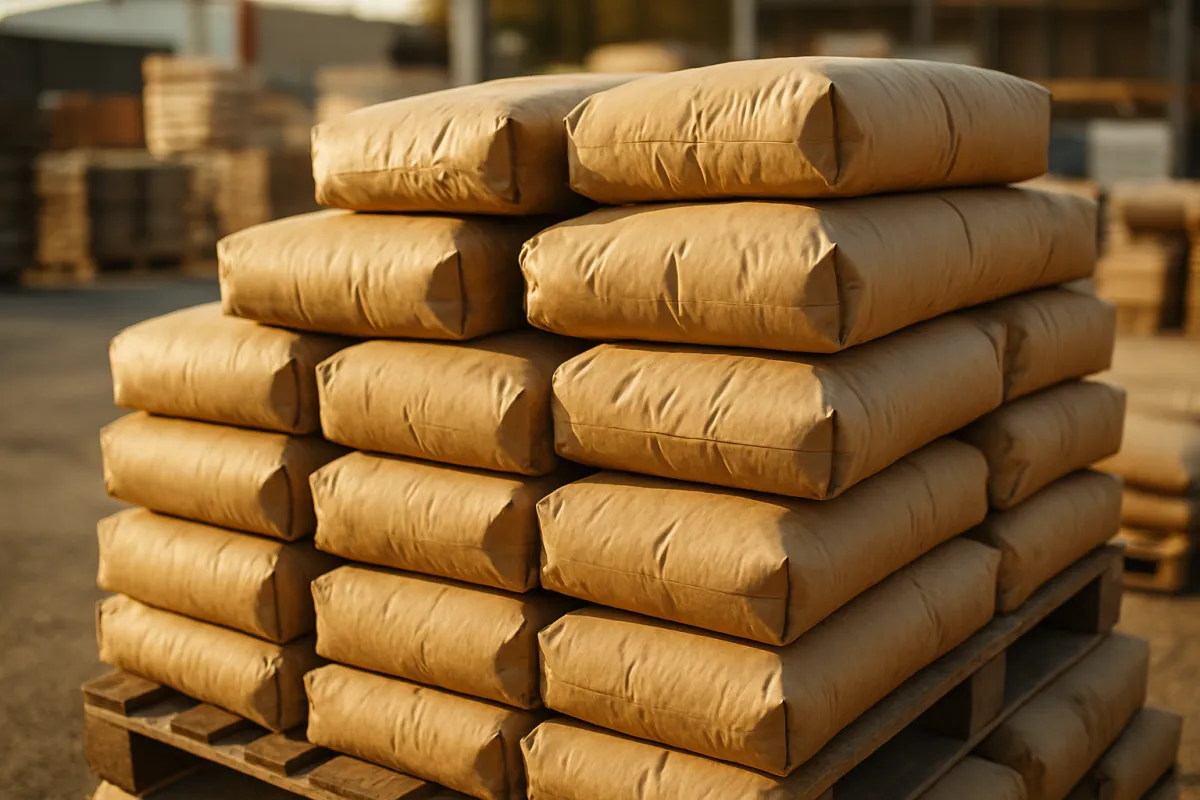
Portland cement is a manufactured binder, a fine grey powder that hardens when mixed with water and glues aggregate into a solid mass. It is not dug out of the ground in its finished form; it is made in a plant by heating a carefully proportioned blend of limestone and clay or shale in a rotary kiln to roughly 1450 degrees Celsius. At that heat the materials partly melt and fuse into hard nodules called clinker, which is then cooled and ground to a fine powder with a small amount of gypsum added to regulate the setting time. The result is a powder so fine it feels like flour and reacts with water in a process called hydration.
The name is a piece of marketing history, not chemistry. When Joseph Aspdin patented an early version in the 1820s, he called it portland cement because the hardened material resembled Portland stone, a prized building limestone quarried on the Isle of Portland in England. The name stuck and now describes the standard type of hydraulic cement used across the world, made by essentially every cement manufacturer, rather than any one brand. So a bag reading portland cement is telling you the type of product, the way whole wheat describes a kind of flour.
What matters for using it is that cement is the reactive ingredient and the expensive one. It is the only part of a concrete mix that chemically hydrates and hardens; the sand and gravel are inert. Because it does the binding, the amount of cement relative to water sets the strength of the finished concrete, which is why the water to cement ratio, covered further down, is the number that decides everything. Pure cement is rarely poured on its own, both because it is costly and because without aggregate it shrinks and cracks badly.
What portland cement is made of
Illustrative typical oxide composition of ordinary portland cement by weight; real cements vary within a few points of these figures.
These illustrative shares sum to 100 percent. Lime and silica dominate because together they form the calcium silicate compounds that react with water and harden, which is the chemistry that makes cement a binder rather than just a coloured powder.
What concrete actually is
Concrete is the finished composite building material: a mix of portland cement, fine aggregate (sand), coarse aggregate (gravel or crushed stone), and water, which hardens over time into an artificial rock. It is one of the most used building materials on the planet, and everything from sidewalks and driveways to foundations, bridges, and high rise frames is concrete, not cement. The cement is in there, doing the binding, but it is a minority of the volume. The bulk of concrete is stone and sand, held in a matrix of hardened cement paste.
The way the parts work together is worth picturing. The coarse aggregate, the gravel, is the largest share and forms a rigid skeleton that carries compressive load. The fine aggregate, the sand, fills the gaps between the stones so the mass is dense rather than full of voids. The cement and water form a paste that coats every particle and, as it hydrates and hardens, glues the whole assembly into a single solid piece. Take away the aggregate and you have a shrinking, cracking, expensive block of cement paste; take away the cement and you have a loose pile of sand and gravel. Concrete needs both, which is the entire reason it is a distinct material from cement.
Concrete’s defining strength is in compression, meaning it is very strong when squeezed and comparatively weak when pulled or bent, which is why structural concrete is usually reinforced with steel bar to handle the tension the concrete cannot. That reinforcement, and the mix design behind a load bearing pour, is engineering territory. For ordinary slabs and pads, a quality mix and correct water content carry the day, and our how much concrete do I need manual sizes the pour itself.
Portland cement is a small share of finished concrete
Illustrative typical proportions by volume of the ingredients in ordinary concrete; the exact split shifts with the mix, but cement is always a minor share.
These illustrative volume proportions sum to roughly 100 percent, and each bar's width tracks its value against the largest share, the coarse aggregate. Cement, the binder, is only about a tenth of the volume, yet it is the ingredient that holds every other part together.
Cement vs concrete: the one-line difference
If you remember one sentence from this article, make it this: cement is the glue, concrete is the whole thing that the glue holds together. Cement is a powder binder that does nothing structural on its own; concrete is the hardened material made by binding sand and gravel with that cement and water. Every batch of concrete contains cement, but cement alone is never concrete, in the same way every loaf contains flour but flour alone is never bread.
That one line resolves nearly every practical question. Is a sidewalk cement or concrete? Concrete. Is the grey powder in the bag cement or concrete? If it has no sand or stone in it, cement; if it is pre blended to just add water, concrete mix. Did the truck deliver cement or concrete? Concrete, because a ready mix truck delivers the finished, wet, aggregate filled material, mixed and ready to pour. The mixer drum is turning to keep the concrete from setting, not to make cement.
The reason the distinction is worth this much attention is that it changes what you buy and how you use it. Reach for a bag of pure portland cement expecting to pour a post footing, and you will get a weak, shrinking, cracking mess, because there is no aggregate to give it body and strength. Reach for a bag of concrete mix and add the right water, and you get exactly what you wanted. The words feel interchangeable right up until the moment they cost you a wasted bag, a failed pour, or a second trip to the store.
The ingredients of concrete, part by part
Concrete has four ingredients, and each has a distinct job, which is easiest to understand by walking through them in order of how much of the volume they take up. Understanding the parts also makes the cement versus concrete distinction concrete, so to speak, because you can see how small the cement share really is.
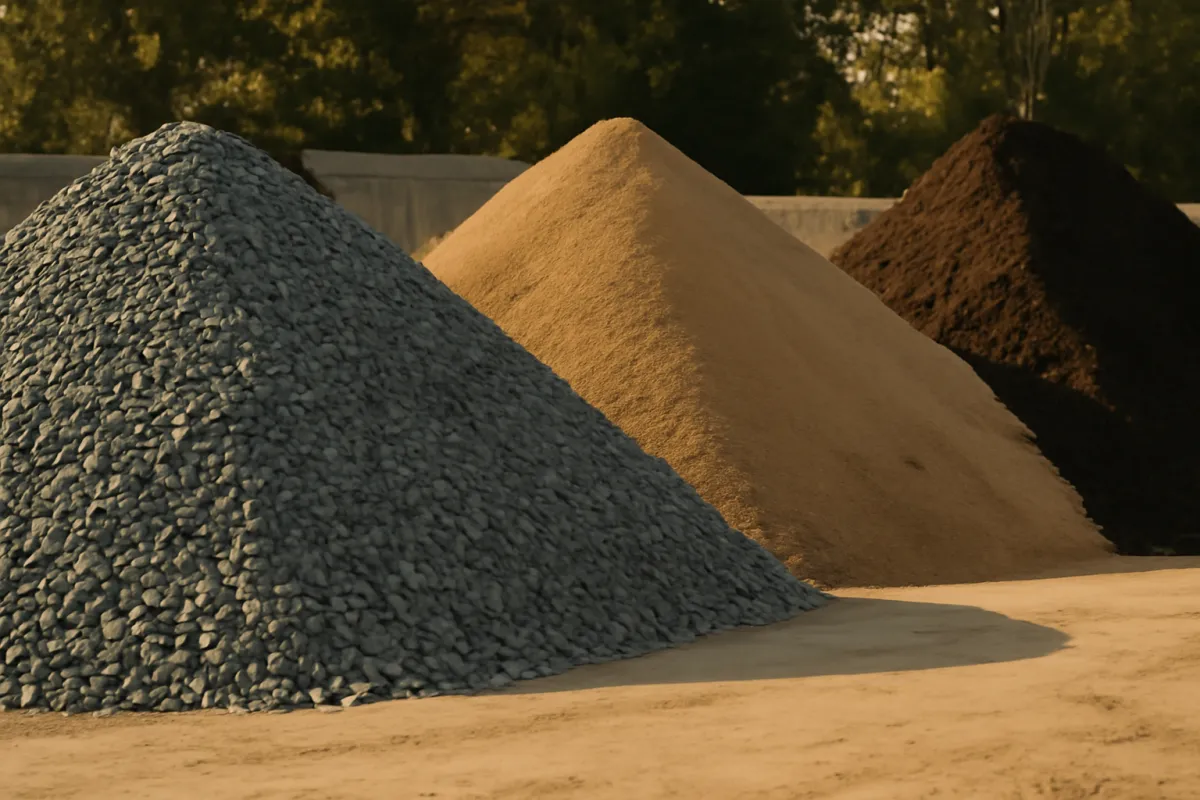
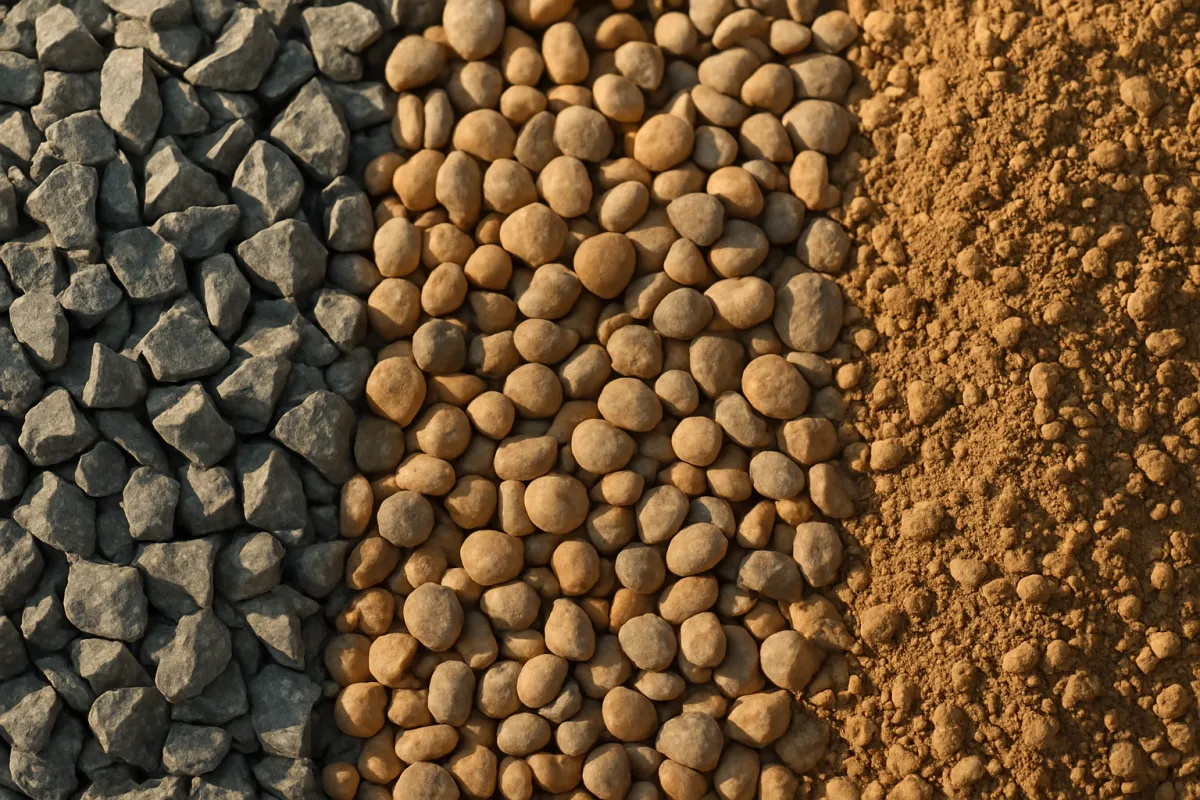
The coarse aggregate, gravel or crushed stone, is the largest ingredient by volume and the load bearing skeleton. Its hard, angular or rounded particles interlock and carry compression, and using a well graded range of stone sizes packs the mass densely. The fine aggregate, sand, is the next largest share and fills the spaces between the coarse stones, again reducing voids and adding to the packed density. Together, sand and gravel are the bulk of concrete, often on the order of two thirds to three quarters of the volume, and they are inert: they do not react, they are held in place.
The cement is the third ingredient by volume and the first in importance, because it is the binder. Mixed with water it forms a paste that coats every grain of sand and every stone, then hardens through hydration into the matrix that locks everything together. Water is the fourth ingredient and the trickiest, because it plays two roles: it triggers the hydration that hardens the cement, and it makes the mix workable enough to place. Add just enough and the concrete is strong; add too much for workability and you dilute the paste and weaken the result. Air, whether trapped or deliberately entrained for freeze resistance, rounds out the volume.
How the concrete mix ratio works
The mix ratio is the shorthand for how much of each dry ingredient goes into concrete, and the classic general purpose figure is roughly 1 part portland cement, 2 parts sand, and 3 parts gravel by volume, written 1:2:3. Read left to right, that means for every shovel of cement you add two shovels of sand and three of gravel, then water to reach a workable consistency. The ratio is by volume, not weight, and it is an illustrative rule of thumb for ordinary work rather than an engineered specification.
The logic behind the numbers follows the roles you just saw. Gravel gets the largest share because it is the structural skeleton. Sand gets the middle share because it fills the gaps between the gravel. Cement gets the smallest share because a little binder coats a lot of aggregate, and cement is the expensive ingredient you do not want to over use. One part in six of a 1:2:3 dry mix is cement, which lines up with cement being roughly a tenth of finished concrete once water is added. Change the ratio and you change the material: more cement makes a richer, stronger, but costlier and more shrinkage prone mix, while too little cement leaves a weak, crumbly result.
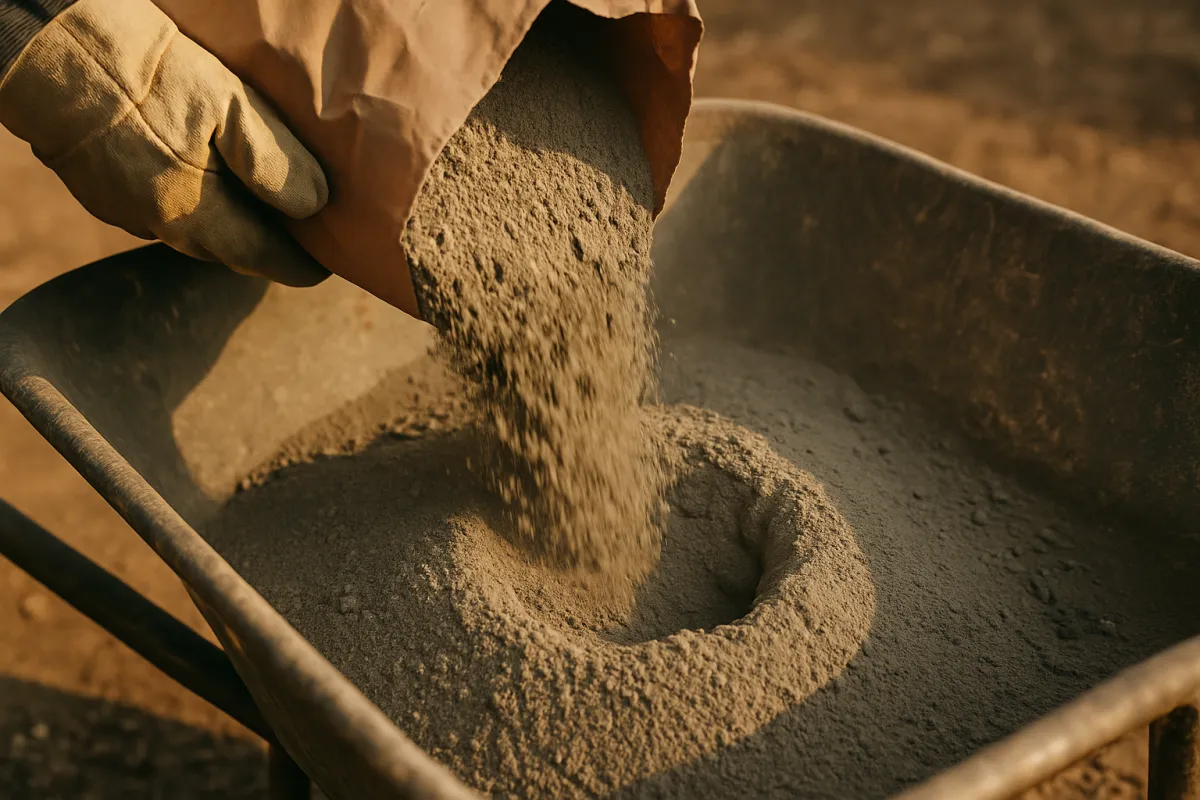
This is also where bagged products earn their keep. A bag of concrete mix has already proportioned the cement, sand, and gravel for you, so you never touch the ratio; you only add water. That is the practical payoff of understanding the ratio: it tells you what a bag of concrete mix already contains, and it tells you what you would have to measure out yourself if you bought pure cement and separate aggregate for a large, cost driven pour. Our how to mix concrete manual works the proportioning and the water in full, and the companion below splits any ratio into cement and aggregate volumes on your numbers.
Where mortar fits in
Mortar is the third member of the family, and it is cement based like concrete but built for a different job. Mortar is a mix of portland cement, sand, and water, with no coarse gravel, often with lime added for workability, and its purpose is to bond masonry units, bricks, blocks, and stone, to each other. Because it has no large stone, mortar is smoother, stickier, and more workable than concrete, which is exactly what you want when you are buttering a joint and setting one brick against the next. A common mortar proportion runs near 1 part cement to 3 parts sand, though masonry cements and lime blends vary it.
The trade off for that workability is strength. Mortar is deliberately weaker than the units it joins, so that any cracking happens in the replaceable mortar joint rather than in the expensive brick or block. It is not a structural mass in its own right; it is the flexible glue between structural units, carrying its load only in the thin joints where it sits. Trying to use mortar where you need concrete, say to pour a footing, would give you a weak, sandy result with no gravel skeleton to carry the load.
The clean way to hold mortar and concrete apart is the aggregate. Concrete has coarse aggregate, gravel, and is a load bearing mass. Mortar has only fine aggregate, sand, and is a bonding agent between other pieces. Both rely on portland cement as the binder, which is why both are sometimes loosely called cement, but neither is cement and they are not interchangeable. When you set blocks for a wall, you use mortar to bond them and, if the design calls for it, concrete or grout to fill the cores, as our how many concrete blocks do I need manual lays out.
Where grout fits in
Grout is the fourth relative, and the easiest way to place it is by consistency: grout is a cement based mixture made thin and flowable so it can be poured or pumped into spaces that a stiffer mortar could not reach. Where mortar is mixed stiff enough to hold its shape and support weight while you place a unit on it, grout is intentionally soupy so it self levels and flows into voids, gaps, and cores. It usually contains cement and fine sand, or in the case of some tile grouts, cement and very fine material, with little or no coarse aggregate.
The jobs grout does are all about filling and locking rather than bulk structure. Masonry grout is poured into the hollow cells of concrete block to lock in steel reinforcement and tie a wall together. Structural grout goes under steel base plates and machine bases to fill the gap and transfer load evenly. Tile grout fills the joints between tiles to seal the surface and hold the tiles in position. In each case the defining feature is flow: the material has to get into a space and fill it completely, which a stiff mortar or a gravelly concrete could not do.
The trade off, as with any wetter mix, is that flowability tends to come at the cost of strength, so grout is chosen where filling and locking matter more than raw structural mass. That places the family on a simple spectrum by aggregate and water: concrete is the stiffest and strongest with coarse gravel, mortar is stickier with only sand, and grout is the thinnest and most flowable with little aggregate. All three lean on portland cement as the binder, and the differences among them are about what aggregate is present and how wet the mix is.
Cement vs concrete vs mortar vs grout, compared
With all four materials on the table, a side by side view makes the distinctions stick. The table below lines up cement, concrete, mortar, and grout across the features that actually separate them: what the material is, what aggregate it contains, a typical proportion, its main role, and where you use it. Read down the aggregate column especially, because the presence and size of aggregate is the thread that runs through the whole family.
| Feature | Portland cement | Concrete | Mortar | Grout |
|---|---|---|---|---|
| What it is | A powder binder | A structural composite | A bonding paste | A flowable filler |
| Coarse aggregate (gravel) | None | Yes, the skeleton | None | None |
| Fine aggregate (sand) | None | Yes | Yes | Little or fine only |
| Typical proportion | Pure powder | ~1:2:3 cement:sand:gravel | ~1:3 cement:sand | Thin, high water |
| Consistency when placed | Dry powder | Stiff, plastic | Stiff, sticky | Soupy, self leveling |
| Main role | Binds the other materials | Carries structural load | Bonds masonry units | Fills gaps and cores |
| Where you use it | As an ingredient only | Slabs, footings, foundations | Between bricks and blocks | Block cores, base plates, tile joints |
| Sold as | Bags of pure cement | Bagged mix or ready mix truck | Bagged mortar mix | Bagged grout |
The pattern in the table is the whole lesson in miniature. Cement is the one material with no aggregate at all, because it is the ingredient the other three are built from. Concrete is the only one with coarse gravel, which is why it is the load bearing mass. Mortar and grout sit between them, both sand based cement products, distinguished mainly by how stiff or flowable they are mixed and whether their job is bonding units or filling voids. Learn the aggregate and consistency of each and you will never again call the wrong one by the wrong name.
When you use cement alone
Given how much this article stresses that cement is an ingredient, it is fair to ask when you would ever use it more or less on its own. The honest answer is: rarely, and usually only in specialty situations where a binder without coarse aggregate is exactly the point. Even then, pure cement and water, a neat cement paste, is unusual, because it shrinks heavily as it dries and cracks readily, so most so called cement only applications still include fine sand.
The situations that call for cement without gravel are things like thin bonding coats, some repair slurries, certain grouts, and cases where you are buying pure portland cement to blend your own concrete or mortar from separate materials. Someone mixing concrete from scratch for a large, cost driven pour buys cement, sand, and gravel separately and proportions them, which is the one common reason a homeowner or small contractor would have a bag of pure portland cement in the first place. Outside of that, the pure powder is an industrial input, not a finished product you pour.
The takeaway is a warning as much as a guide: if you find yourself about to use pure cement for something structural, like a post or a pad, stop, because you almost certainly want concrete instead. The aggregate is not optional filler you can skip to save a step; it is the structure. Cement alone will not give you a strong, stable, crack resistant result, and the cost per volume is far higher because cement is the expensive ingredient. Reach for cement alone only when a recipe or product specifically calls for a neat or near neat binder.
When you use concrete instead
Concrete is the answer for essentially every job where you need a solid, load bearing mass, which covers the vast majority of what people are actually trying to do when they reach for a bag in the first place. If you are pouring a slab, a footing, a fence post, a pad under a machine or a shed, a driveway, a sidewalk, or a foundation, you want concrete, because you need the gravel skeleton to carry weight and resist cracking. This is the case even when people describe the job as cement work, which they usually do.
Choosing concrete then splits into a smaller decision: bagged concrete mix or ready mix from a truck. Bagged mix suits small jobs, a few cubic feet up to a fraction of a cubic yard, where you can mix by hand or in a small mixer and the ratio is handled for you. Ready mix delivery suits larger pours, past roughly half a cubic yard, where mixing bag after bag by hand becomes impractical and a truck arrives with the material uniformly blended and ready to place. Either way you are placing concrete, not cement, and either way the strength depends on getting the water right, as our how to mix concrete manual details.
The one place the choice gets subtle is at the boundary with mortar and grout. If your job is bonding bricks or blocks, you want mortar, not concrete, because you need workable stickiness rather than a gravel mass. If your job is filling block cores or a base plate gap, you want grout, because you need flow. For everything that has to be a structural body in itself, though, concrete is the default, and the estimator will size the pour once you have measured it.
The types of portland cement, I through V
Portland cement is not a single product but a family of types, classified in the common ASTM system by roman numeral from I to V according to their properties and intended exposure. Because these are standardized definitions rather than opinions, they are worth knowing at a glance, though for anything structural the correct type is a specification to confirm with the product or an engineer rather than a choice to guess at.
Type I is ordinary, general purpose cement, the default for everyday work with no special requirements, and it is what most residential and light commercial concrete uses. Type II offers moderate sulfate resistance and generates a moderate heat of hydration, which suits structures in contact with soil or groundwater that carry modest sulfate levels; a blended Type I/II is extremely common because it covers both bases. Type III is a high early strength cement, ground finer so it hydrates and gains strength quickly, useful for fast form turnarounds, precast work, or cold weather where you want strength sooner.
Type IV is a low heat of hydration cement, developed for massive pours like dams where the heat generated by a large volume of curing concrete could crack it, and it gains strength slowly; it is uncommon in ordinary construction today. Type V is a high sulfate resistant cement for aggressive environments, such as soils high in sulfates or marine exposure, where an ordinary cement would deteriorate. Air entraining variants of several types, marked with an A, deliberately incorporate tiny air bubbles for freeze thaw durability. For the great majority of home and small trade concrete, Type I or a Type I/II blend is what you will buy, and the specialty types are selected when the exposure or schedule genuinely demands them.
How portland cement is made
Knowing how cement is manufactured makes its role as a binder intuitive rather than a fact to memorize, and it explains why the powder behaves the way it does. The process starts with quarrying and crushing the raw materials, principally limestone for its lime content and clay or shale for silica, alumina, and iron. These are blended in careful proportions, because the final chemistry, dominated by lime and silica, determines how the cement will set and how strong it will be.
The blended raw meal is fed into a long rotary kiln and heated in stages to around 1450 degrees Celsius. As it moves down the kiln, water is driven off, the limestone calcines to release carbon dioxide and form lime, and finally the materials partially fuse and react into new compounds, chiefly calcium silicates, that emerge as hard, marble sized nodules called clinker. The clinker is rapidly cooled to lock in the reactive compounds, then ground to a fine powder. A few percent of gypsum is interground at this stage, and its job is to control the setting time so the cement does not flash set the instant it meets water.
The finished powder is the portland cement you buy. When you later add water, those calcium silicate compounds react in the hydration process, forming interlocking crystals that grow and knit together, hardening the paste and binding whatever aggregate it surrounds. That is why cement is a binder and not merely a filler: it undergoes a genuine chemical reaction that turns a wet mix into artificial stone. It is also why the water to cement balance matters so much, because the reaction needs a specific amount of water and no more.
How concrete gains its strength
Concrete’s strength is not the drying out of a wet mix, a common misconception, but the product of a chemical reaction between cement and water called hydration, which proceeds whether the concrete is wet or dry inside as long as moisture is present. When cement meets water, its calcium silicate compounds dissolve and recrystallize into a dense mesh of interlocking crystals that grow over hours, days, and weeks, gluing the aggregate together and steadily stiffening and strengthening the mass. This is why fresh concrete is kept damp while it cures: letting it dry out too fast starves the reaction and leaves it weaker.
Because hydration is a reaction with water, the ratio of water to cement is the master variable for strength. The cement can only react with a certain amount of water; any water beyond that is excess that eventually evaporates and leaves tiny voids, which permanently weaken the hardened concrete. A drier, stiffer mix, within the range that is still workable, cures stronger than a wet, soupy one made from the same materials. That is the single most important practical fact tying the ingredients together, and it is covered in depth in our how to mix concrete manual, because it is where most strength is won or lost on site.
Concrete gains strength quickly at first and then more slowly over a long tail. A rough rule is that ordinary concrete reaches much of its strength in the first week and a nominal design strength around 28 days, then continues to gain slowly for months. This is why forms can often be stripped in days but heavy loading waits longer, and why a curing schedule matters. The aggregate contributes to strength too, through its hardness and how well the sizes pack together, but the reaction that binds it all is the cement hydrating with water.
Why the water to cement ratio decides everything
If the mix ratio sets what concrete is made of, the water to cement ratio sets how strong it turns out, and it deserves its own section because it is where the theory becomes a number you can get wrong. The water to cement ratio is simply the weight of water divided by the weight of cement in the mix, and lower ratios, less water per unit of cement, give stronger, more durable concrete, while higher ratios give weaker, more porous concrete. This holds regardless of the mix ratio of aggregate.
The reason is the hydration chemistry from the last section. Cement needs a modest amount of water to fully react, and mixes are usually batched with somewhat more than that minimum to stay workable enough to place. Push the water higher for easier placement and the surplus does not strengthen anything; it occupies space that becomes voids as it evaporates, and voids are weakness. This is why a mix that looks soupy and pours easily is almost always weaker than a stiffer mix of the same materials, and why adding water on site to make concrete flow better is one of the most damaging shortcuts in the trade.
The practical rule that follows is to use the least water that still lets you place and consolidate the concrete properly, and to follow the water figure printed on a bag rather than eyeballing it from a hose. Manufacturers set that figure for their specific product, and it is the number to trust. Hold some water back, add it gradually, and stop on the stiff side of workable. Understanding that the water is reacting with the cement, not just wetting the sand and gravel, is what makes this rule make sense, and it is the clearest example of why cement, the reactive ingredient, is the heart of concrete even at a tenth of its volume.
Common mistakes people make
A handful of misunderstandings account for most of the confusion around cement and concrete, and naming them plainly is the fastest way to avoid them. Each traces back to blurring the ingredient with the finished material or to treating water as harmless.
- Calling concrete cement. The universal habit is harmless in speech but leads to buying the wrong bag. Before you shop, decide whether you need pure binder or a finished, aggregate filled mix, and read the bag label rather than trusting the word in your head.
- Buying pure cement for a slab or post. Reaching for a bag of portland cement to pour a footing gives a weak, shrinking, crack prone result with no aggregate skeleton. For anything structural you want concrete mix, which already contains the sand and gravel.
- Thinking aggregate is cheap filler. Sand and gravel are not there to stretch the cement; they are the structure that carries load and controls shrinkage. Skipping or short changing the aggregate makes the material both weaker and more expensive, since cement is the costly ingredient.
- Using mortar or grout where concrete belongs. Mortar bonds masonry units and grout fills voids; neither is a load bearing mass. Using them for a slab or footing gives a sandy, weak result because they lack coarse gravel.
- Adding extra water to make it flow. A wetter mix places more easily and cures measurably weaker, because the surplus water leaves voids. Follow the bag’s water figure, add water gradually, and stop on the stiff side of workable.
- Assuming concrete dries rather than cures. Concrete hardens through a reaction with water, not by drying out, so letting it dry too fast weakens it. Keep fresh concrete damp while it cures rather than rushing it to dry.
Every one of these errors dissolves the moment you hold the two ideas apart: cement is the reactive binder, concrete is the aggregate filled material it creates, and water is a controlled ingredient, not a convenience to add freely.
A worked example: proportioning a small batch
Pull the whole family together on one small, realistic job: mixing about 6 cubic feet of concrete from separate materials at the classic 1:2:3 ratio, the kind of thing you might do for a set of footings if you had bought cement and aggregate in bulk rather than bagged mix. Working the split shows exactly how little of the pile is cement and how the ratio turns into real quantities.
Start with the ratio. At 1 part cement, 2 parts sand, 3 parts gravel, the mix is 6 parts total, so cement is 1 of 6, sand is 2 of 6, and gravel is 3 of 6. Applied to a nominal 6 cubic feet of dry materials, that is about 1 cubic foot of cement, 2 cubic feet of sand, and 3 cubic feet of gravel, before accounting for the fact that the sand and paste settle into the gaps between the stone so the placed volume is a little less than the loose sum. Since a standard bag of portland cement holds roughly 1 cubic foot of powder, this batch needs on the order of a single bag of cement against two and three cubic feet of aggregate. That is the whole lesson made physical: one bag of binder to five of stone and sand.
Now compare the two ways to buy it. Proportioning your own, as above, means handling cement, sand, and gravel as three separate materials and measuring the 1:2:3 split yourself, which is worth it only at larger, cost driven volumes. Buying bagged concrete mix instead, that same 6 cubic feet is roughly ten of the 0.6 cubic foot 80 pound bags, each already holding the cement, sand, and gravel blended in suitable proportions, so you skip the proportioning entirely and only add water. For most people the bag is the right call, which is why the pure cement path is the exception. Run your own ratio and volume through the companion below and it splits the cement from the aggregate and estimates the cement bags for you.
Cement, concrete, and cost
Cost is a quietly useful lens on the cement versus concrete distinction, because it explains why concrete is built the way it is. Cement is by far the most expensive ingredient per unit volume, while sand and gravel are cheap bulk materials. Concrete is, in part, an economical way to turn a little expensive binder into a large volume of strong material by filling most of that volume with inexpensive aggregate. If you poured pure cement, you would be paying top price for a material that also happens to shrink and crack, which is the worst of both worlds.
This is why the mix ratio leans so heavily toward aggregate. Using more cement than a job needs does buy some extra strength, but it also raises the cost and increases shrinkage, so mixes are proportioned to use only as much cement as the required strength calls for. It is also why bagged concrete mix, which is convenient and pre blended, costs more per cubic foot than buying cement and aggregate separately and proportioning them yourself: you are paying for the blending and the packaging, which is a fair trade at small volumes and a poor one at large volumes.
The cost logic points to the same practical advice as everything else here. For small jobs, buy bagged concrete mix and accept the modest premium for convenience and a guaranteed ratio. For large jobs, either buy ready mix by the truck, which is efficient at volume, or, if you have a reason to mix your own, buy cement and aggregate separately and proportion them. Buying pure cement to pour on its own is almost never the economical or the sound structural choice. Our how much does concrete cost manual weighs the bag versus truck economics in full, and the figures there, like all figures here, are illustrative and shift with your market.
Buying cement vs buying concrete mix
The place all of this becomes real is the store, where cement and concrete sit on nearby shelves in similar looking bags, and where the wrong choice costs a trip or a failed pour. The single habit that prevents the mistake is reading the bag label for the words that name what is inside, rather than trusting the generic word cement in your head.
A bag labeled portland cement is pure binder: fine grey powder, no sand, no gravel, meant to be combined with aggregate to make concrete or with sand to make mortar. You buy it when you are proportioning your own mix from separate materials, and rarely otherwise. A bag labeled concrete mix is the finished recipe: cement, sand, and gravel pre blended, needing only water, and this is what you want for a slab, a post, or a pad. A bag labeled mortar mix is cement and sand for bonding masonry, and a bag labeled grout is a flowable cement product for filling. The labels tell you exactly which family member is inside if you read them.
The clearest tell is the ingredient list and the intended use printed on the bag. If it says add water only and lists sand and stone, it is a finished concrete mix. If it is a single component powder meant to be combined with aggregate, it is cement. When in doubt, ask, because the two are genuinely different products and the staff will know the difference even if the aisle signage blurs it. Size the quantity with the estimator once you know which product you need, and check the yields in our material coverage reference so you buy the right number of bags the first time.
The bottom line
Portland cement and concrete are not the same thing, and the whole confusion resolves into one sentence: cement is the powder binder, and concrete is the finished, load bearing material made by mixing that cement with sand, gravel, and water. Cement is an ingredient, roughly a tenth of concrete’s volume, the reactive glue that hydrates and hardens; concrete is the artificial stone that glue creates. Mortar and grout are the cement based cousins, mortar the sticky, gravel free paste that bonds bricks and blocks, grout the thin, flowable mix that fills cores and joints, and neither is concrete or cement even though both rely on cement to bind. The mix ratio, near 1:2:3 for general concrete, tells you how the family is proportioned, and the water to cement ratio tells you how strong the result will be, which is why more water for easier placement quietly buys weakness. Carry away the aggregate rule, that concrete has coarse gravel and cement has none, and you will buy the right bag, use the right material, and never again pour cement where you meant to pour concrete. The companion below splits any mix into its cement and aggregate on your own numbers, so you can see the difference for the job in front of you.
Read this article as plain background on how these materials differ and relate, not as an engineered specification you can build a structural element from without checking. The compositions, mix ratios, type classifications, and proportions here are typical illustrative values that vary with the product, the standard, and the region, and any load bearing pour, cement type selection, or reinforcement detail should be confirmed against the product data and a qualified engineer or professional. The chemistry and definitions are stable, but the right mix and materials for your specific job are not something to settle from a general explainer alone, so verify the product label and any structural requirement before you build.
Frequently asked questions
What is the difference between portland cement and concrete?
Portland cement is a fine grey powder that acts as the glue, and concrete is the finished building material you get when you mix that cement with sand, gravel, and water and let it harden. Cement is one ingredient; concrete is the whole recipe. The relationship is the same as flour and bread: flour is essential to bread, but a loaf is far more than flour alone, and nobody builds a foundation out of pure flour or pure cement. When someone points at a driveway or a sidewalk and calls it cement, they almost always mean concrete, because the cement inside it is only about a tenth of the volume and is not something you would ever pour on its own for a slab.
Is cement and concrete the same thing?
No, and using the words interchangeably is the single most common mix-up in construction materials. Cement is the binding powder, and concrete is the hardened composite of cement, aggregate, and water, so every batch of concrete contains cement but cement by itself is not concrete. The habit of calling a concrete slab a cement slab is so widespread that even hardware stores sometimes blur the two on their shelves, but the distinction matters the moment you go to buy: a bag labeled portland cement is pure binder with no sand or stone in it, while a bag labeled concrete mix is a ready-blended recipe you only add water to. Buying one when you needed the other is a genuinely costly mistake.
What is portland cement made of?
Portland cement is made by heating a precise blend of limestone and clay or shale, materials rich in lime, silica, alumina, and iron, in a kiln to around 1450 degrees Celsius until they fuse into hard nodules called clinker. The clinker is then ground to a fine powder with a small amount of gypsum added to control how fast it sets. By weight, the finished cement is dominated by lime and silica, which form the calcium silicate compounds that react with water and harden, and this chemistry, not any glue or resin, is what makes cement a binder. The name portland comes from a nineteenth century resemblance to Portland stone quarried in England, and it now refers to the standard type of cement used worldwide rather than a brand.
What are the 5 types of portland cement?
The classic ASTM classification lists five types by number: Type I is ordinary general purpose cement for everyday work, Type II offers moderate sulfate resistance and a moderate heat of hydration for structures in contact with soil or groundwater, and Type III is a high early strength cement that gains strength quickly for fast turnarounds or cold weather. Type IV is a low heat cement once used in massive pours like dams to limit cracking from heat buildup, and Type V is a high sulfate resistant cement for aggressive soils and marine exposure. Most residential and light commercial work uses Type I or a blended Type I/II, and specialty types are chosen by an engineer when the exposure or the schedule calls for them. Treat the type as a specification to confirm for anything structural rather than a choice to guess at.
What is the difference between mortar and concrete?
Mortar and concrete are both made with portland cement, but mortar contains cement and sand with no coarse gravel, while concrete adds gravel or crushed stone as the coarse aggregate that gives it structural strength. Because mortar has no large stone, it is stickier, more workable, and weaker in compression, which is exactly what you want for buttering between bricks and blocks where the job is bonding units together, not carrying heavy loads on its own. Concrete, with its gravel skeleton, is the load bearing material you pour for slabs, footings, and foundations. A simple way to remember it: mortar glues masonry units, concrete is the mass itself, and the presence or absence of gravel is the line between them.
What is grout and how is it different from mortar?
Grout is a cement based mixture blended thin and flowable so it can be poured or pumped into gaps, cores, and joints that a stiffer mortar could not fill, such as the hollow cells of concrete block, the space under a base plate, or the joints between tiles. Where mortar is mixed stiff enough to hold a shape and support weight during placement, grout is intentionally soupy so it self levels and flows into voids, and it usually has little or no coarse aggregate. The trade off is that a wetter mix tends to be weaker, so grout is chosen for filling and locking things in place rather than for structural mass. Tile grout, masonry grout, and structural grout are related products tuned to their jobs, but all share the flowable, gap filling role.
What is the correct concrete mix ratio?
A widely cited general purpose recipe is roughly 1 part portland cement, 2 parts sand, and 3 parts gravel by volume, usually written 1:2:3, with clean water added to reach a workable consistency. That ratio is an illustrative starting point rather than an engineered specification, and the right mix for a structural or load bearing pour should be confirmed against the product or a professional, because strength depends heavily on the water to cement ratio and the quality of the aggregate. Bagged concrete mix already blends cement, sand, and gravel in suitable proportions, so with a bag you only add water and the ratio is handled for you. Mortar, by contrast, runs closer to 1 part cement to 3 parts sand with no gravel, and grout is thinner still.
Can you use cement without aggregate?
You can, but pure cement paste, just cement and water, is rarely the right choice for anything structural, because on its own it shrinks a great deal as it dries, cracks readily, and costs far more per volume than concrete since cement is the expensive ingredient. Aggregate is not filler added to stretch the cement; the sand and gravel form a rigid skeleton that carries load, reduces shrinkage, and makes the material both stronger and cheaper. Cement is used closer to neat only in specialty applications like certain grouts, thin repair slurries, or bonding coats, and even those usually include fine sand. For a slab, a footing, or a post, you want concrete, and the cement is there to bind the aggregate, not to stand alone.