What's on this page
- Why weather owns the pour date
- What curing concrete needs from the weather
- Concrete curing temperature: the range to hold
- Pouring concrete in rain: what actually goes wrong
- Light rain or downpour: reading the forecast
- If rain hits mid-pour: the salvage plan
- Rain before and after the pour
- Pouring concrete in cold weather: the thresholds
- What happens if concrete freezes while curing
- The first 48 hours: why early freeze is the killer
- The strength timeline a slab climbs
- Blankets, enclosures, and cold-weather protection
- Accelerators, hot water, and cold-weather mixes
- How long to protect a cold-weather pour
- Pouring concrete in hot weather: the opposite problem
- Wind and sun: the dry-out multipliers
- What happens if concrete is too wet
- The slump check: judging water on pour day
- Scheduling the pour around the forecast
- An illustrative cold-weather protection budget
- Weather mistakes that crack slabs
- The weather checklist for pour day
- The bottom line
Short answer: You can pour concrete in cold weather or rain only with protection. The commonly cited cold threshold is about 40 degrees Fahrenheit: below it, use blankets, warm water and accelerators, never pour on frozen ground, and hold the concrete above roughly 50 degrees for the first 48 hours, because an early freeze permanently costs strength. Rain matters most in the first hours before the surface sets, so stage plastic sheeting on supports.
Pouring concrete in cold weather is the hardest weather call a slab ever asks of you, because cold slows the chemistry that builds strength at exactly the moment the water inside the slab is most likely to freeze, and rain runs the same story on a shorter clock, landing on the finish in the first hours before the surface sets. Concrete has opinions about the weather, and it holds them exactly when you cannot do anything about them: in the hours after the truck leaves, while the material is soft, weak, and chemically busy. Rain on a fresh surface, a freeze in the first nights, a hot wind over a half-finished slab, or an extra bucket of water added to make spreading easy all attack the same vulnerable window, and all of them leave damage that only shows up weeks later, as dusting, scaling, and cracks.
This manual is the forecast half of our concrete series, and it leads with the cold side because that is where the damage is permanent. It covers pouring concrete in cold weather, including the commonly cited temperature thresholds, the concrete curing temperature the material actually wants, and what happens if concrete freezes while curing; the blanket, hot water, and accelerator playbook that makes cold weather concrete work; pouring concrete in rain, from drizzle rules to the mid-pour salvage plan; the hot weather problem, which is the same physics running in reverse; and the closely related question of a mix that is too wet, since water is water whether it falls from the sky or comes from the hose. It leans on our slab pouring tutorial for the pour itself and our concrete mixing manual for water discipline, and it pairs with our crack causes explainer, because weather is a crack cause you schedule around. The companion below turns your own forecast and slab into a protection plan as you read.
Key takeaways
- The vulnerable window is short and unforgiving: rain matters most in the first hours before the surface sets, freezing matters most in the first 24 to 48 hours, and both windows close as the concrete gains strength.
- Rain on an unprotected fresh surface washes out cement paste and weakens the top layer; plastic sheeting staged on site, kept off the surface on supports, is the whole rain defense.
- The commonly cited cold threshold is about 40 degrees Fahrenheit; below it, use blankets, warm water, accelerators, and never pour on frozen ground. An early freeze can permanently cost a large share of final strength.
- Hot weather runs the same physics in reverse: around 90 degrees with wind and sun, the surface can dry before finishing ends, causing plastic shrinkage cracks; pour at dawn and start curing immediately.
- A too-wet mix is the self-inflicted version of rain: weaker, shrink-prone, dusty concrete that felt easy to place. Judge the mix by the shape it holds, not how easily it flows.
Why weather owns the pour date
Every material has a moment of maximum vulnerability, and concrete’s lasts about two days. On pour day, the mix is a fluid whose surface can be rearranged by raindrops; that first evening, it is a solid so weak a bird’s footprint records itself; through the first nights, it is a chemically active mass full of water that must not freeze; and for the first week, it is a young material gaining strength on a schedule that temperature sets. The weather during that window is not background, it is an ingredient, as decisive as the cement content, and unlike the cement content it changes daily.
The good news hiding in that framing is that weather problems are scheduling problems, and scheduling is cheap. Nearly everything in this manual reduces to three moves: read the forecast for the whole vulnerable window rather than just pour day, shift the date when the window is hostile, and when the date cannot move, spend modest money on protection, sheeting for rain, blankets and admixtures for cold, shade, mist, and manpower for heat. Compare that to the alternative our crack causes explainer documents: scaling, dusting, plastic shrinkage tears, and strength loss that no repair fully reverses. A slab is a decades-long purchase, and the forecast tax on it is a few days of patience.
What curing concrete needs from the weather
To reason about any forecast, it helps to know what the concrete is asking for. Curing concrete wants exactly two things: to stay moist and to stay moderately warm. Moist, because hardening is hydration, a chemical reaction between cement and water that stops when the water leaves and never fully restarts; a slab that dries early is permanently weaker at the surface, dustier, and more crack-prone. Moderately warm, because the reaction’s speed tracks temperature: warm concrete gains strength quickly, cold concrete gains it slowly, and frozen concrete stops gaining it at all while ice physically breaks what has formed so far.
Read those two needs against a forecast and the whole manual falls into place. Rain threatens the finish for a few hours but afterward is merely water on a material that wants water; the threat is timing, not the rain itself. Cold slows the strength clock and, at the freezing line, converts from delay to damage. Heat and wind steal the moisture side, drying the surface before the material can afford it. Even the too-wet mix fits the frame: it is a moisture error committed before the sky gets a vote. Commonly cited practice keeps new concrete moist for about 7 days and above roughly 50 degrees Fahrenheit for at least the first 2, and every technique below, sheeting, blankets, misting, accelerators, dawn pours, exists to hit those two numbers when the sky refuses to cooperate.
Concrete curing temperature: the range to hold
Concrete curing temperature is the single number that decides how fast a fresh slab climbs out of danger, and it is worth separating from the air temperature everyone quotes. The forecast describes the air; the concrete has its own temperature, warmed by the heat its own hydration reaction gives off and cooled by wind, night sky, and the ground beneath it. Under blankets, a slab commonly sits well above the air around it, which is exactly why insulation works below freezing. Uncovered on a clear, still night, the surface can run colder than the reported low, because it radiates heat straight up. The number that matters is the one at the concrete, and an inexpensive infrared thermometer turns that from a guess into a reading.
The commonly cited comfortable band is roughly 50 to 70 degrees Fahrenheit at the concrete, held through the early days when most of the strength arrives. Inside that band, hydration runs at a healthy pace, setting and finishing happen on a predictable schedule, and the strength curve behaves the way the mix design assumed. The floor of the band is the number to hold onto: common practice keeps new concrete above roughly 50 degrees for at least the first 48 hours, which is precisely the window where freezing does permanent damage rather than mere delay. Below about 40 degrees of air temperature, cold weather practice applies, and the whole toolkit later in this manual, blankets, warm mix water, accelerators, extra cement, exists to keep the concrete curing temperature inside the band while the air sits outside it.
The band has a ceiling too, since temperature runs the reaction in both directions. Concrete placed hot, commonly cautioned at around 90 degrees, sets faster than a crew can comfortably finish, loses workable time, and dries at the surface before curing cover can go on, which is the direct route to plastic shrinkage cracking covered further down. There is also a quieter penalty: concrete cured hot commonly reaches early strength faster but finishes lower at the 28 day reference than the same mix cured moderate, so heat borrows strength from the end of the curve to spend at the start. Moderate and steady beats warm and fast.
Steadiness is the last part of the rule. Rapid swings in surface temperature stress young concrete, so protection comes off gradually rather than being stripped from a warm slab into a hard freeze, and heated enclosures get vented and monitored rather than run hot and dry. Read the whole first week for concrete curing temperature rather than pour day alone, plan the protection to hold roughly 50 degrees through the first two nights, and treat every figure here as an illustrative rule of thumb that mix, thickness, and local practice will move.
Pouring concrete in rain: what actually goes wrong
Rain’s attack on fresh concrete is mechanical and local: it lands on the one part of the slab where quality matters most, the top quarter inch that will take every footstep, tire, and freeze-thaw cycle for decades. Raindrops striking an unfinished surface wash the fine cement paste away from the aggregate, pit and crater the finish, and, more insidiously, raise the water-cement ratio of the surface layer. As our crack causes explainer lays out, surplus water means weaker material and more shrinkage; rain applies that penalty selectively to the wearing surface, which is how rained-on slabs end up with a soft skin that dusts underfoot and scales off in winter while the body underneath stays sound.
The damage is graded by timing. Rain during placement and finishing, on unprotected concrete, is the destructive case. Rain on a surface that has stiffened past leaving a thumbprint does progressively less harm, because the paste can no longer be rearranged. Rain on day-old concrete is, genuinely, a benefit: the material wants moisture, and the sky is providing curing water for free. This is worth internalizing because it aims all the effort correctly: the job is not keeping concrete dry forever, it is defending a window a few hours long. One tarp, staged before the truck arrives, covers the whole risk.
Light rain or downpour: reading the forecast
Not all rain votes the same way, and the pour-or-postpone call benefits from being made like an estimator rather than a gambler. Light drizzle onto a protected pour, or a passing shower forecast for hours after finishing, is a manageable nuisance: crews pour through drizzle routinely by covering finished sections as they go and keeping the working face small. A steady rain during the placement window on an open slab is a postponement, full stop, because you cannot finish concrete under falling water without troweling that water in. A downpour is a postponement that also asks questions about the subgrade, covered below.
The forecast reading has three refinements. First, read the radar timing against the concrete’s timeline, not the calendar day: rain arriving four hours after a morning pour in warm weather may land on a surface already set firm, while the same cell hitting a cool-weather pour still soft at hour four is a different event, since cold stretches setting time. Second, respect probability honestly: a 60 percent chance of thunderstorms over an unprotected 600 square foot pour is not a coin flip worth taking when the loss side is a ruined finish. Third, remember the truck changes the economics: a bagged-mix project can stop mid-job and wait, but ready-mix arrives on a schedule and must be placed, so marginal forecasts push toward rescheduling the delivery rather than racing the sky. Waiting a day is the cheapest concrete repair ever invented.
If rain hits mid-pour: the salvage plan
Sometimes the sky ignores the radar, and rain arrives with concrete on the ground and more in the truck. The salvage plan is short and mostly about what not to do. Keep placing; concrete in the forms under protection beats concrete hardening in the truck. Get sheeting up fast, plastic on lumber or blocks so it tents above the surface rather than lying on it, because plastic pressed onto soft concrete prints wrinkles and blotches into the finish. Push standing water off edges with a hose stream or squeegee where the surface has firmed enough to allow it, and then wait: finish after the rain passes, not during it.
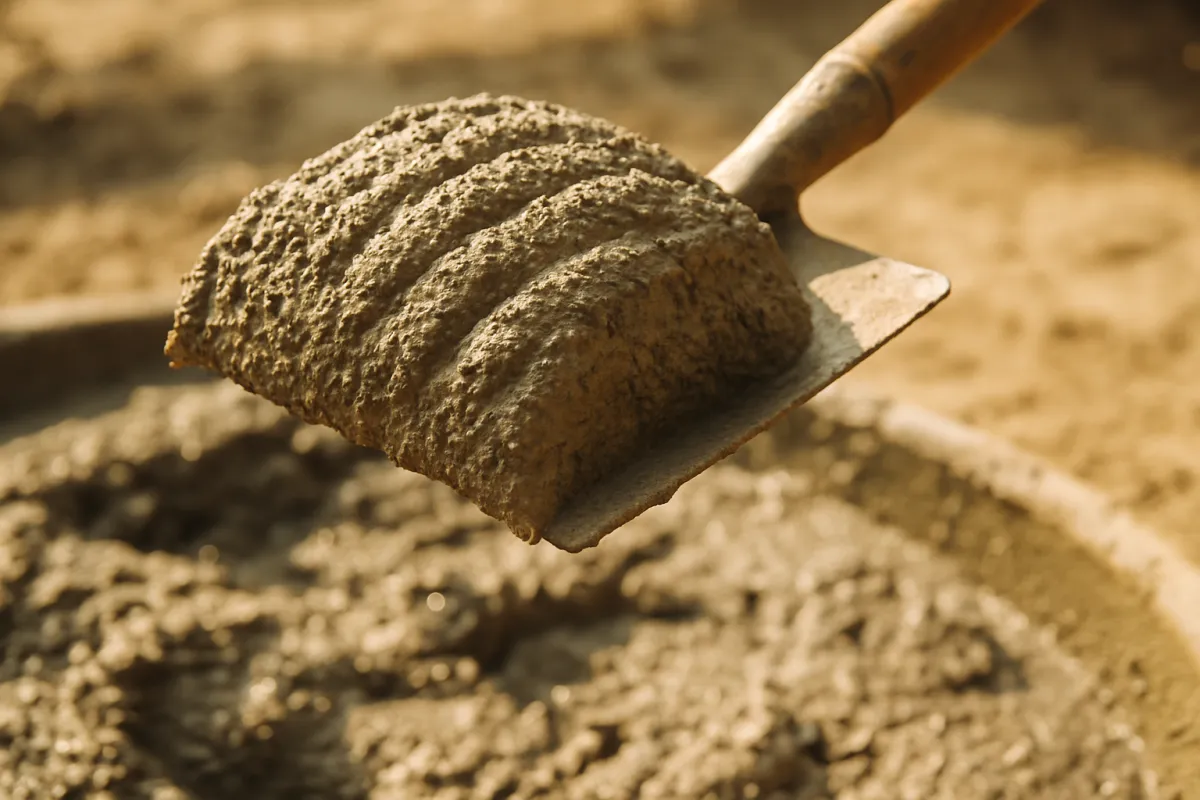
The two forbidden moves both come from the urge to make the water disappear. Do not trowel rainwater into the surface: working the water in is manually raising the surface water-cement ratio, manufacturing the weak skin the sheeting existed to prevent. And do not scatter dry cement over the wet surface to blot it up, an old-timer move that creates a thin, poorly bonded cement layer that flakes off within seasons. Water on top of concrete is a temporary problem; water mixed into the top of concrete is a permanent one. After the event, assess honestly: if paste washed away or the finish crazed and dusted, note it for sealing and maintenance, and if a section took heavy rain while fully plastic, judge it by the crack and scaling record over the next weeks rather than hoping.
Rain before and after the pour
Rain the day before a pour attacks from below. A subgrade and gravel base soaked by heavy rain can lose the uniform bearing the slab depends on: fine-grained soils turn soft and rutting, footing trenches hold water, and pumping mud replaces compacted earth. Pouring onto a spongy base builds the settlement cracks our crack causes explainer warns about, and pouring into standing water dilutes the bottom of the slab exactly the way rain dilutes the top. The checks are simple: walk the base; if boots sink or water stands, pump the puddles, let it drain, recompact soft spots, and take the day. A damp base, on the other hand, is genuinely good, since it will not suck water out of the mix; damp is the target, saturated is the stop sign.
Rain after the pour flips sign quickly. Once the surface has set firm, commonly within hours in warm weather, rain stops being able to rearrange paste, and once finishing is done and curing begins, rainfall is simply free curing moisture on a material that wants 7 damp days. The practical rule for the transition evening: keep the sheeting handy until a thumb pressed on the slab leaves no mark, then let the weather do what it likes. The one lingering caution is heavy runoff: water sheeting across a fresh slab’s surface from a downspout or slope can erode a still-young finish and undercut edges, so gutters and grading that move water around the pour, not over it, matter for the first days, and forever after for the subgrade’s sake.
Pouring concrete in cold weather: the thresholds
Cold reorganizes the pour around one fact: the strength clock runs on temperature. The commonly cited planning threshold is about 40 degrees Fahrenheit; when air temperature sits below it, or will fall below it during the first days after placement, cold weather practice applies. Between roughly 40 and 50 degrees, the job mostly needs patience: set times stretch, bleed water sits longer, finishing runs late, and forms stay on longer, but the concrete comes out fine. Below about 40, slow becomes risky, because a slab gaining strength slowly is a slab spending more days in the window where a freeze does permanent damage.
Three rules anchor the cold playbook before any gear comes out. First, never pour on frozen ground: the concrete freezes from below, and the ground settles when it thaws, taking the slab with it, a double failure no admixture fixes. Second, plan the protection before the truck is booked, not after the pour is shivering; blankets you do not own by pour day do not exist. Third, read the overnight lows for the whole first week, not the afternoon high on pour day, because a sunny 45 degree afternoon with a 25 degree night is a freeze event wearing a pleasant disguise. With full protection, cold-climate professionals pour in genuinely hard freezes; for a residential slab with a flexible calendar, the honest cold weather tool is usually the calendar itself.
What happens if concrete freezes while curing
The freeze question deserves its own section because the damage mechanism is specific and the answer changes completely with age. Fresh concrete is full of water that has not yet been consumed by hydration or locked into the hardened structure. If that water freezes, it expands roughly a tenth of its volume inside a material that may have almost no tensile strength yet, and the expanding ice physically disrupts the forming crystal matrix, breaking bonds as they are being made. Concrete frozen in the first day or so can permanently lose a large share of its potential strength, a loss commonly cited as reaching half, and the loss does not heal with later curing, because the broken early structure is the foundation everything later grows on. The visible signature arrives over following weeks: a surface that scales, dusts, and crumbles, and a slab that underperforms its mix design for life.
Age is the whole story. Once concrete has gained a commonly cited threshold of early strength, typically reached within the first 24 to 48 hours when kept warm, most of its water is bound or consumed, and a subsequent freeze causes little or no structural harm; mature concrete in cold climates freezes harmlessly every winter, protected by that maturity and by air entrainment. This is why every cold weather technique aims at the same target: buy the concrete two warm days. Blankets, accelerators, warm water, and extra cement are all just different ways of purchasing the same 48 hours, and the manual’s freeze rule compresses to one line: the forecast that matters is the first two nights.
The first 48 hours: why early freeze is the killer
It is worth pausing on why the damage window is so front-loaded, because the reason organizes every protection decision. Concrete’s strength gain is steepest at the start and long-tailed afterward: commonly cited rules of thumb put a continuously cured slab near half its design strength around day 3, roughly two thirds to three quarters by day 7, and at its reference design strength at 28 days. Flip that curve around and read it as vulnerability: the material spends its first hours with essentially no strength, its first night with almost none, and climbs out of danger fast if, and only if, it is warm enough for the reaction to run.
Cold stretches that danger zone like taffy. The hydration reaction slows dramatically as temperature falls, so a slab that would reach freeze-safe maturity in a day and a half at 60 degrees might take several times as long near 40, every extra day being another night the blankets have to win. This compounding is the real menace of cold weather, more than any single cold night: slow gain extends the window, and the extended window meets more nights. It is also the argument for accelerators and warm mix water, which do not merely comfort the concrete but genuinely shorten the vulnerable period, and for insulation over heat: concrete generates its own warmth as it hydrates, and a blanket that keeps that heat in lets the reaction feed itself through the critical nights.
The strength timeline a slab climbs
The same strength curve that defines the freeze window also answers the questions every fresh slab gets asked: when can we walk on it, when can we drive on it, when can the forms come off, when is it done? Here is the commonly cited shape of the climb.
The strength a young slab has to its name
Illustrative share of 28 day design strength at each age, for continuously cured concrete at moderate temperature; cold stretches this whole timeline.
Each bar's width equals its illustrative percentage of the 28 day reference strength. The numbers are rules of thumb, not measurements of any particular mix, and temperature moves them substantially in both directions; the shape is the lesson. Most of the strength arrives in the first week, which is why the first week gets all the protection, and almost none exists on day 1, which is why day 1 gets the blankets.
The timeline converts directly into site rules of thumb, all illustrative and all stretched by cold: foot traffic commonly waits a day or two, vehicles commonly wait about a week, and heavy loads respect the 28 day reference. It also frames what protection buys. Blankets through two nights carry the slab past the freeze-damage cliff; keeping curing going for 7 days banks the steep part of the curve, where each protected day purchases more strength than any later week will. A slab abandoned to cold and drying after day 2 does not fail on a schedule anyone sees; it simply parks permanently lower on this curve, and its owner meets the difference years later as surface wear and cracks.
Blankets, enclosures, and cold-weather protection
The cold weather toolkit starts with insulation, because fresh concrete is its own furnace. Hydration releases real heat, and the job of the classic insulated curing blanket is simply to keep that self-generated warmth in the slab instead of losing it to the night sky. Common practice lays blankets on as soon as finishing allows, overlapped, weighted at edges and corners, with corners and thin edges getting doubled cover since they lose heat fastest and freeze first. Under blankets, a slab through a commonly cited target of about 50 degrees for the first 48 hours is an achievable ask well below freezing air temperatures. Cheaper improvisations, straw under plastic, foam board, even spare tarps layered, follow the same physics: trap the reaction’s own heat.
Above insulation sit the escalations. Enclosures, plastic sheeting over simple framing, turn a pour into a tent that holds warmth and blocks the wind that strips heat from exposed surfaces. Heaters inside enclosures handle genuinely hard cold, with two cautions that come with them: fuel-burning heaters must be vented, both for the crew and because their exhaust can chemically dust a fresh surface, and heated enclosures dry the air, so the slab needs moisture attention or the cold weather save becomes a curing failure. Below the slab, protection starts before the pour: blankets or straw over the subgrade the night before keep the ground from freezing, and no protection scheme excuses pouring onto ground already frozen. The gear list is short and mostly rentable; what fails is not usually the equipment but the planning, blankets sourced at noon for a slab poured at nine.
Accelerators, hot water, and cold-weather mixes
The mix itself is the other half of the cold toolkit, because everything about the vulnerable window shortens when the reaction runs faster. Ready-mix plants adjust for cold as routine service: heated mix water so the concrete arrives warm instead of at air temperature, a touch more cement for more reaction heat, and accelerating admixtures that speed setting and early strength gain. The classic accelerator is calcium chloride, commonly dosed up to about 2 percent of cement weight, with the standard caveat that chloride accelerators are avoided around embedded steel because chlorides drive corrosion; non-chloride accelerators cover reinforced work. None of this is exotic, and the phone call that matters is simply telling the plant the pour is a cold weather pour so the mix shows up dressed for it.
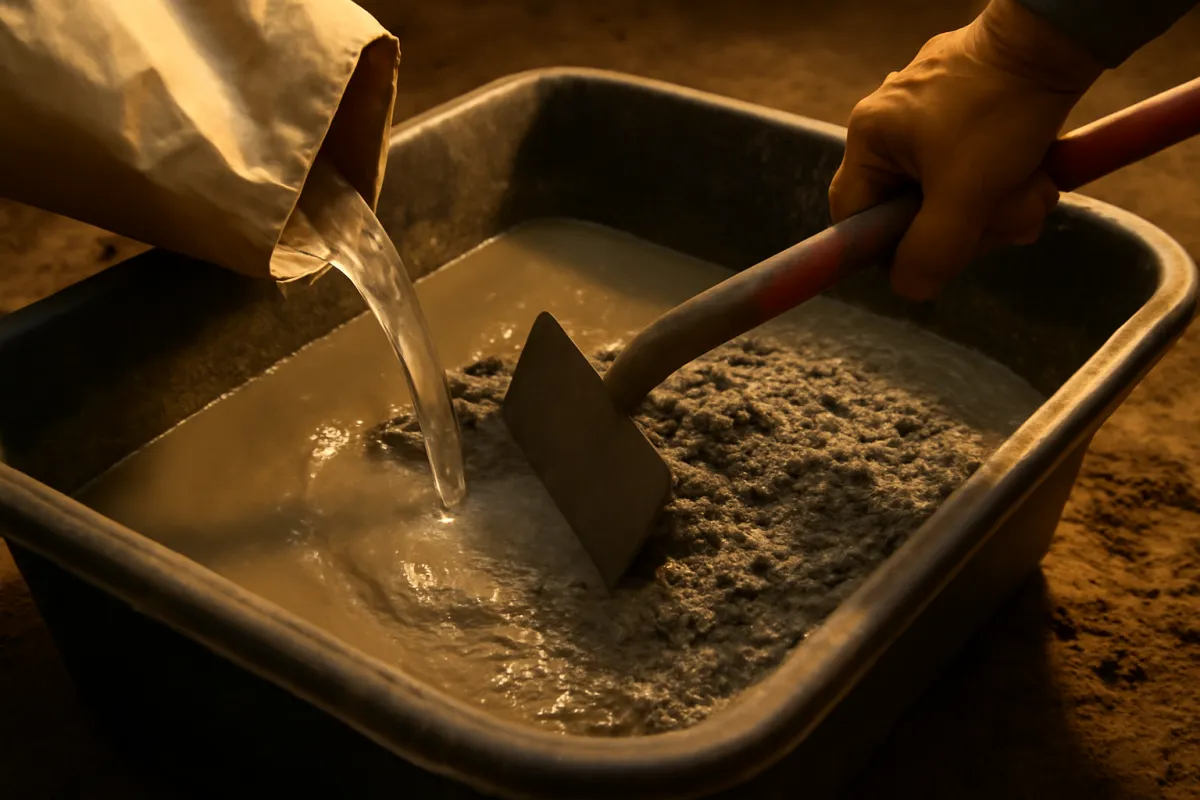
Bagged-mix projects adapt the same levers at wheelbarrow scale, per the method in our concrete mixing manual: mix with warm (not hot) water, store bags somewhere warmer than the shed overnight, favor the rapid-setting cold weather formulations that bring accelerators pre-blended, and keep the mix on the stiff side, since surplus water is extra freezable water sitting in the slab on the coldest nights. One lever that does not exist: antifreeze. Automotive antifreeze has no place in concrete, and admixtures marketed for cold are accelerators managing the freeze window, not permission to let the slab freeze. The mix buys hours; the blankets still have to buy the nights.
How long to protect a cold-weather pour
The protection schedule follows the strength curve, and common practice frames it in three spans. The non-negotiable span is the first 24 to 48 hours above roughly 50 degrees, which carries the slab past the early-freeze cliff where damage is permanent. The standard span extends protection 3 to 7 days in genuinely cold conditions, because concrete that does not freeze but sits cold gains strength at a crawl, and a slab uncovered on day 3 at one quarter of its design strength meets the world weaker than its owner assumes; structural elements and loaded slabs sit at the long end. The tapering span is the removal itself: take blankets off gradually rather than stripping a warm slab into a hard freeze, since a rapid surface temperature swing can stress and craze young concrete.
Two habits make the schedule honest. First, protect to the forecast, not the calendar: a mild week can genuinely shorten the plan, while a cold snap on day 5 argues the blankets back on, and an inexpensive infrared thermometer turns the question from guesswork into a reading. Second, remember that cold-weather curing is still curing: the slab under blankets needs its moisture, so plastic under the insulation or a curing compound applied at finishing keeps the warm days from becoming dry ones. The companion sketches an illustrative protection span from your own overnight low, and the honest footnote on every figure in this section is the same: mixes, thicknesses, and local practice move the numbers, and the cold end of concrete work is where a short conversation with the ready-mix dispatcher or a local finisher pays best.
Pouring concrete in hot weather: the opposite problem
Hot weather runs the cold chapter backward. Where cold starves the reaction, heat force-feeds it: set times shrink, workable time evaporates, and a crew that comfortably finished 500 square feet on a spring morning finds the same slab getting away from them in July. The surface is where heat collects its fee. Sun and hot air evaporate moisture from the top of the slab faster than bleed water can replace it, and the drying skin shrinks over the still-plastic interior and tears into the shallow, parallel plastic shrinkage cracks that our crack causes explainer catalogs. The commonly cited caution line is around 90 degrees Fahrenheit, but the thermometer is only one dial of the evaporation machine.
The defenses are cheap and mostly logistical. Pour at dawn, so placement and finishing happen in the coolest, calmest hours and the slab sets before peak sun. Dampen the subgrade and forms the evening before, so dry ground does not pull water from the bottom while the sky pulls it from the top; damp, again, not puddled. Staff honestly, because heat compresses the finishing window and a short-handed hot pour is how surfaces get finished late, overworked, or abandoned mid-sheen. Have curing protection staged to go on the moment finishing ends, since the gap between last trowel and first cover is the plastic-shrinkage window at its widest. Ready-mix plants carry hot weather levers too, chilled water and retarding admixtures that slow the set, and the same rule applies as in cold: tell the dispatcher the conditions and let the mix arrive dressed for them.
Wind and sun: the dry-out multipliers
The evaporation that causes plastic shrinkage cracking runs on four dials at once, and air temperature is often the least of them: hot concrete, dry air, direct sun, and wind each spin the rate up, and wind is the quiet killer of the set. A breezy, sunny 70 degree afternoon with low humidity can strip moisture from a fresh surface faster than a still, humid 90 degree one, which is why plastic shrinkage tears show up on pours that never felt hot to the crew. Professionals literally compute an evaporation rate from those four inputs before big flatwork pours; the residential translation is simply to treat wind and sun as first-class forecast items alongside temperature, and to distrust any dry windy day regardless of what the thermometer says.
The countermeasures target the air at the surface. Windbreaks, plywood, snow fence, or a strategically parked truck upwind, cut the moving air that does most of the stealing. Shade, from tarps rigged over the work, removes the direct solar load. Fog misting, a fine spray above (not onto) the surface, humidifies the boundary air during the gap between screeding and finishing; evaporation retarder films do the same job chemically on demanding pours. And the schedule remains the master lever: the same site at dawn has cooler concrete, calmer air, no sun, and a relaxed finishing window. Every one of these moves defends the surface during the few hours before curing cover goes on, which restates the section’s whole lesson: hot weather concrete work is a race to the cure, and the wind sets the pace.
What happens if concrete is too wet
The too-wet mix belongs in a weather manual because it is the same attack from a different direction: water reaching the concrete that the design never asked for, except this time by invitation. The temptation is real, because water is the workability knob, and a wetter mix flows into forms, screeds easily, and finishes like cream. The costs are the ones this manual and our crack causes explainer keep meeting. Strength falls as surplus water dilutes the paste, on the steep curve that makes a visibly soupy mix a materially weaker slab. Drying shrinkage rises, because every surplus gallon must eventually leave, so the watered mix cracks more on both counts, weaker material meeting larger movement.
A genuinely soupy mix adds two mechanical failures. Segregation: heavy aggregate sinks and watery paste rises, leaving a slab that is gravel at the bottom and weak laitance at the top, with plastic settlement cracks printing over rebar as solids settle around it. And bleed water excess: a surface that stands wet for hours invites the classic finishing sin of troweling bleed water back in, sealing a soft, dusty, scale-prone skin onto the slab, the identical skin a rainstorm builds. In cold weather, surplus water is also simply more freezable water. The fix costs nothing: measure water per the bag or the mix design, add the last portion gradually, and when more flow is genuinely needed, get it from a plasticizer admixture rather than the hose, the discipline our concrete mixing manual drills.
The slump check: judging water on pour day
Water discipline needs a field test, and concrete’s is slump: how much a molded cone of fresh mix sags when the mold lifts. The formal version fills a standard cone, lifts it, and measures the drop; commonly cited slab targets sit around 4 to 5 inches, a mix that sags but stands. The informal wheelbarrow version reads the same property by eye and hoe: good slab concrete holds a ridged, plastic shape when cut, the ridges slumping slowly rather than melting flat. A mix that flows level like batter is over-watered; a mix that stands in dry crumbles is under-watered and will not consolidate. The shape test is thirty seconds, and it is the last moment the water question is still cheap to fix.
Pour day pressure arrives from a predictable direction: concrete stiffening in the wheelbarrow or the truck as the clock runs, and a crew that wants it looser. Hold two lines. At the truck, added water is a recorded decision that trades strength away, and past modest additions within the mix’s design, the honest answer to a stiffening load is faster placement, not more hose. In hot weather, especially, the stiffening is partly false, surface drying rather than true set, and remixing revives more workability than water would. When a mix is legitimately too stiff for the placement, plasticizers exist precisely so flow can be bought without paying in strength. The slump check closes the loop this manual opened: the sky’s water and the hose’s water are the same water, and the slab records every ounce of both.
Scheduling the pour around the forecast
Assemble the chapters and pour scheduling becomes a checklist rather than a vibe. Look for a window, not a day: the pour date plus at least two protected nights, and ideally the first week, since that is where the strength curve lives. Screen the window for the four flags in order of veto power: hard freeze in the first two nights (postpone or commit to full protection), steady rain during the placement hours (reschedule the truck), hot dry wind across an exposed site (pour at dawn and rig defenses), and marginal cold that merely slows the job (plan patience, longer set, later finish, forms on longer). A mild, overcast, still day in the 50s to 60s is the material’s honest preference, and spring and fall mornings hand them out freely.
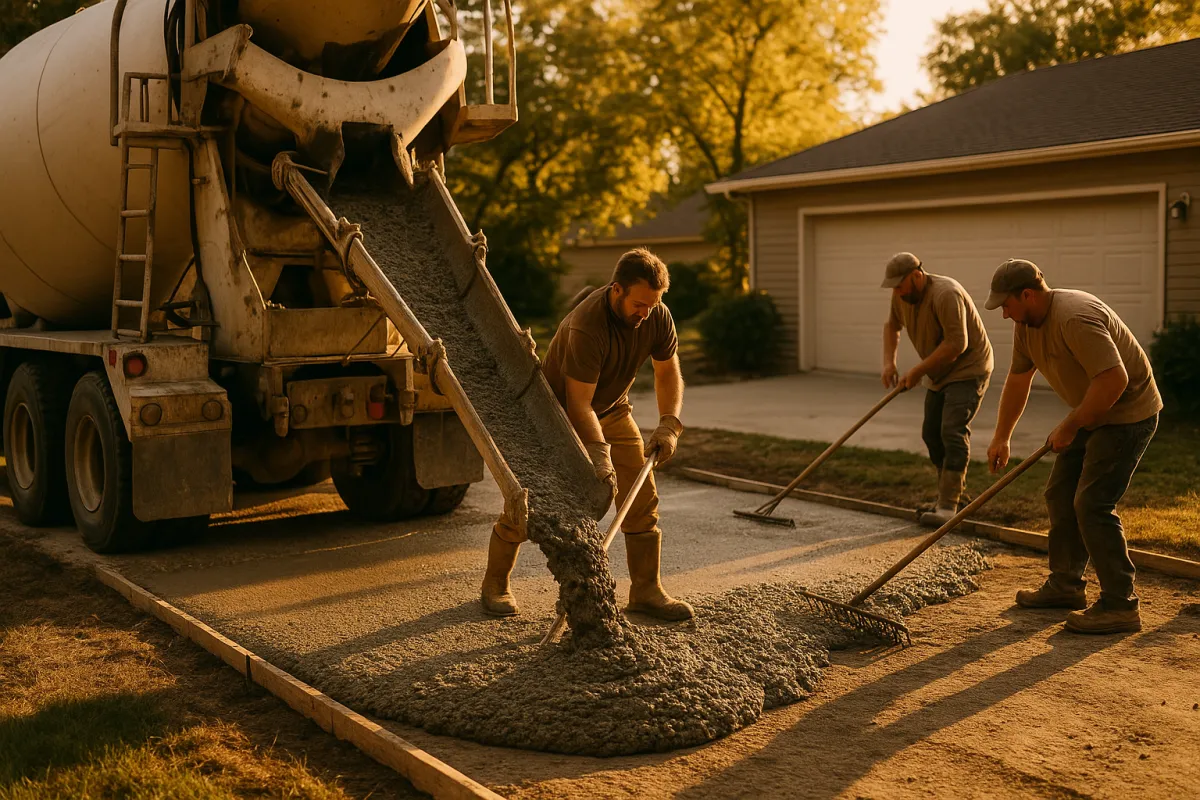
Logistics then follow the forecast. Book ready-mix with the weather conversation attached, cold weather mix or retarded hot weather mix as needed, and know the cancellation window so a bad radar morning costs a phone call instead of a load; the volume side of that order is worked in our concrete volume manual and the estimator runs it from your dimensions. Stage the weather gear before the truck: sheeting and supports for rain, blankets and a thermometer for cold, shade, mist, and extra hands for heat. The companion turns your own slab size and overnight low into the yardage and an illustrative protection plan. None of this is elaborate; it is the same modest planning the subgrade got, applied to the sky.
An illustrative cold-weather protection budget
Cold weather protection sounds expensive until it is itemized, at which point it reveals itself as one of the better trades in construction. Here is an illustrative split of where the extra effort and cost of a small cold-season slab pour goes.
Where cold weather protection effort goes
Illustrative shares of the extra effort and cost on a small cold-season residential pour; the four segments sum to 100 percent.
The shares are illustrative and sum to 100 percent; real jobs shift them with severity, and a heated enclosure on a hard-freeze job would redraw the chart entirely. The point survives every redraw: the whole package is a modest fraction of the pour's cost, set against a downside, a freeze-damaged slab, that can cost a large share of the slab's strength and eventually the slab itself.
The same asymmetry runs through every weather chapter, and pricing it out is clarifying. Rain protection is a tarp and lumber against a ruined finish. Hot weather protection is an early alarm, a hose, and extra hands against a cracked surface. Cold protection is the chart above against permanent strength loss. In each case the spend is small, single-digit percentages of the job, and the protected asset is a slab meant to outlast the house’s roof. Weather losses in concrete are almost never bad luck; they are declined insurance.
Weather mistakes that crack slabs
The recurring weather errors are few enough to name, and every one of them appears in some slab’s crack pattern eventually.
- Finishing water into the surface. Troweling in rainwater or bleed water, or dusting dry cement over either, builds the weak skin that scales and dusts. Water on the surface waits; water in the surface stays.
- Trusting pour day’s forecast alone. The mild afternoon that sold the date, followed by the 25 degree night nobody checked. The vulnerable window is the first nights, and the freeze rule lives there.
- Pouring on frozen or saturated ground. Frozen subgrade thaws and settles; soaked subgrade pumps and ruts. Both build the settlement cracks no surface care prevents.
- Blankets bought at noon. Protection that is not on site before the truck is protection the first night does without, and the first night is the one that counts.
- The extra bucket. Water added for easy spreading, weakening the slab and adding shrinkage, the self-inflicted rainstorm. The stiff mix that holds its ridges is the one that holds its strength.
- Hot day, late start, short crew. The set outruns the finishing, the surface dries mid-trowel, and plastic shrinkage tears sign the result by evening.
- Stripping protection early. Uncovering at day 2 into a cold week, or letting curing lapse after the drama passes, parks the slab permanently low on its strength curve.
Each mistake maps to a crack family in our crack causes explainer, which is the deeper point: weather does not invent new ways for concrete to fail, it amplifies the standing ones, and the standing defenses hold when they are actually deployed.
The weather checklist for pour day
The manual, compressed to the sequence worth running before any pour with weather in play.
- Read the whole window. Forecast for pour day plus the first week, with overnight lows, rain probability and timing, wind, and humidity all on the sheet.
- Apply the vetoes in order. Hard freeze in the first two nights, rain during placement hours, hot dry wind over an exposed pour: postpone, reschedule, or rig the specific defense.
- Check the ground, not just the sky. Subgrade damp but firm; no standing water, no ruts, no frost in the base. Frozen or spongy ground ends the conversation.
- Order the mix for the conditions. Cold: warm water, accelerator, the plant’s cold weather service. Heat: retarder, chilled water, dawn delivery. Wet forecast: know the cancellation window.
- Stage the gear before the truck. Rain: sheeting and supports. Cold: blankets, edge weights, thermometer. Heat: shade, windbreaks, mister, staged curing cover, and honest staffing.
- Hold the water line. Measured mix water, the ridged-shape slump check at the wheelbarrow or chute, placement speed instead of hose water as the answer to stiffening.
- Protect the first 48 hours. Above roughly 50 degrees under blankets in cold, covered and curing from the last trowel onward in heat, and no freeze on any night the concrete is younger than two protected days.
- Cure for the week. Moist for about 7 days by sheet, spray, or compound; taper protection off gradually, and load the slab on the strength curve’s schedule, not the calendar’s.
Run the list and the sky becomes what it should be on a concrete job: a scheduling input, planned for like any other.
The bottom line
Weather damage to concrete is a story about one short window told four ways. Rain matters for the few hours before the surface sets, and a staged tarp converts it from finish-killer to free curing water. Cold matters most in the first 24 to 48 hours, when freezing water can permanently break immature concrete, a loss commonly cited as reaching half its strength; blankets holding roughly 50 degrees, warm mix water, and accelerators buy the two nights that close the window, and 3 to 7 protected days carry the steep part of a strength curve that runs near half at day 3 and roughly two thirds to three quarters at day 7. Heat and wind run the attack in reverse, drying the surface into plastic shrinkage cracks, and dawn scheduling plus immediate curing cover defends it. The too-wet mix is the same water problem self-inflicted, traded for easy spreading and paid back in strength and shrinkage. None of the defenses are expensive and all of them are scheduled, which is the manual’s real thesis: the forecast is an input you plan for, and declined planning, not weather, is what actually cracks slabs. The crack causes explainer covers what happens when the window is lost, the slab tutorial runs the pour itself, and the estimator has the volume math waiting.
This manual is educational reading on how weather affects fresh concrete, not a pour-day directive for any specific job. The temperature thresholds, protection spans, strength percentages, slump targets, and admixture figures throughout are commonly cited rules of thumb, deliberately framed as illustrations, and real mixes, thicknesses, soils, and climates move all of them, sometimes a long way. Cold and hot weather concreting at the edges of the ranges described here is skilled work with real failure costs, so for structural elements, large flatwork, or any pour in genuinely severe conditions, put the forecast in front of your ready-mix supplier and a qualified concrete professional and follow local practice over anything generalized here.
Frequently asked questions
Can you pour concrete in the rain?
Light drizzle with the surface protected is workable; real rain on an unprotected fresh surface is not. The problem is water landing where the finish is forming: rain washes cement paste off the top, raises the water content of the surface layer exactly where strength and wear resistance matter most, and leaves pitting, dusting, and a weak, scaling skin. If rain arrives mid-pour, the playbook is to keep placing, cover finished sections with plastic sheeting on supports so it does not touch the surface, and never trowel rainwater into the finish or scatter dry cement to soak it up, both of which build a weak layer. Concrete that has stiffened past a thumbprint and has protection over it usually rides out rain with no harm.
What happens if it rains right after pouring concrete?
Timing decides nearly everything. Rain within the first hour or two, while the surface is still wet and unfinished, can wash out paste and ruin the finish if the slab is unprotected. Once the concrete has stiffened enough that a thumb pressed on it leaves little or no mark, commonly within a few hours depending on temperature, rain does progressively less harm, and after final set the water is actually on the useful side, since curing concrete wants to stay moist. A slab a full day old generally treats rain as free curing water. The vulnerable window is short but unforgiving, which is why sheeting on site is cheap insurance on any pour day with clouds in the forecast.
What happens if concrete freezes while curing?
Freezing in the first day or two is the worst-case weather event for new concrete. The water inside immature concrete is still doing the chemical work of hydration; if it freezes, it expands roughly a tenth of its volume inside a material that has almost no strength yet, breaking the forming crystal structure apart. Concrete frozen in that early window can permanently lose a large share of its potential strength, a loss commonly cited as reaching half, and no later curing brings it back; the surface often scales, dusts, and crumbles as well. Once concrete has gained a commonly cited threshold of early strength, typically reached within the first day or two with protection, a subsequent freeze does far less damage. That is why the entire cold weather playbook concentrates on keeping the concrete warm through the first 48 hours.
How cold is too cold to pour concrete?
The commonly cited planning threshold is about 40 degrees Fahrenheit: when the air is below that, or expected to fall below it during the first days after the pour, cold weather practice applies. Between about 40 and 50 degrees, hydration runs slowly and setting and finishing times stretch, but plain patience mostly covers it. Below about 40, protection earns its place: insulated blankets, warm mix water, accelerating admixtures, and more cement in the mix are the standard tools. Pouring onto frozen ground is a separate and firm no at any air temperature, because the slab will settle when the ground thaws, and the concrete against it freezes from below. With full protection, professionals pour well below freezing air temperatures, but for a typical residential job, waiting for a milder window is usually the cheaper and safer call.
How long does new concrete need protection from freezing?
The critical window is the first 24 to 48 hours, when the concrete has the least strength and the most freezable water; a hard freeze then can do permanent damage. Common practice keeps new concrete above roughly 50 degrees Fahrenheit for at least the first 48 hours, using insulated curing blankets, and extends protection for around 3 to 7 days in genuinely cold conditions, longer for structural work, since cold concrete gains strength slowly even when it does not freeze. The colder the forecast and the more the slab matters, the longer the blankets stay on. Treat those spans as illustrative planning figures and confirm against local practice, because mix design, accelerators, and slab thickness all move the real requirement.
What happens if concrete is too wet?
A too-wet mix is weaker, shrinks more, and wears worse, and the damage is invisible on pour day. Surplus water dilutes the cement paste, cutting final strength; it increases drying shrinkage, which multiplies cracking; it encourages segregation, with heavy aggregate sinking and watery paste rising; and it produces heavy bleed water and a soft, dusty, scale-prone surface layer. The frustrating part is that wet concrete spreads and finishes easily, so the mix that feels most cooperative in the wheelbarrow is often the slab that cracks and dusts within the year. The commonly cited check is slump and shape: a good slab mix holds a ridged, plastic shape rather than flowing flat, and water beyond the design amount is a cost, not a convenience.
Can you pour concrete in hot weather?
Yes, with the opposite playbook from cold. Heat accelerates everything: the mix sets faster, workable time shrinks, and the surface can dry out before bleed water stops rising, which is the direct cause of plastic shrinkage cracking. The commonly cited caution threshold is around 90 degrees Fahrenheit, with wind and low humidity mattering as much as the thermometer. The defenses are scheduling and moisture: pour at dawn, dampen the subgrade so it does not pull water from the mix, keep crew and tools staged so finishing keeps pace, use windbreaks or shades where the site allows, and start curing protection the moment finishing ends. A hot day pour that goes wrong usually went wrong on schedule and staffing, not chemistry.
What is the best concrete curing temperature?
The commonly cited target concrete curing temperature is roughly 50 to 70 degrees Fahrenheit at the concrete itself, not merely in the air, held through the early days while the material does most of its strength building. The practical floor is the one worth memorizing: common practice keeps new concrete above roughly 50 degrees for at least the first 48 hours, which is the span where a freeze does permanent damage, and the commonly cited planning line for calling a pour a cold weather pour is about 40 degrees of air temperature. The ceiling matters too, because the reaction runs on temperature in both directions: past roughly 90 degrees the mix sets faster than a crew can comfortably finish it and the surface dries before curing cover goes on. A steady, moderate concrete curing temperature also beats a swinging one, since sharp surface temperature changes stress young concrete, which is why blankets come off gradually rather than all at once. Treat every figure here as an illustrative rule of thumb, because mix design, slab thickness, and local practice move them.
What is cold weather concrete?
Cold weather concrete is not a separate product so much as a separate playbook that switches on when the air is around 40 degrees Fahrenheit or below, or is forecast to fall there during the first days after placement. The mix side of cold weather concrete usually means heated mix water so the load arrives warm, a touch more cement for extra reaction heat, and an accelerating admixture to shorten the vulnerable window, with non-chloride accelerators used around embedded steel because chlorides drive corrosion. The site side means insulated curing blankets on as soon as finishing allows, doubled at edges and corners, enclosures and vented heaters in genuinely hard cold, protection of the subgrade the night before, and a firm refusal to pour onto frozen ground at any air temperature. Bagged cold weather formulations bring the accelerator pre-blended for small jobs. None of it is permission to let the slab freeze; it buys the 24 to 48 warm hours the concrete needs to climb out of danger.
How long after pouring concrete does weather stop mattering?
In stages, not on one date. The finish is safe from rain once the surface has set firm, commonly within hours. The freeze-damage window closes once early strength is reached, commonly one to two protected days. Commonly cited rules of thumb put concrete near half its design strength around day 3 and roughly two thirds to three quarters by day 7, which is why light foot traffic commonly waits a day or two and vehicles commonly wait about a week. Full design strength is referenced at 28 days. After the first week, weather is mostly a curing-quality question rather than a damage question, though a slab keeps appreciating moisture and moderate temperatures for its whole first month. All of these spans are illustrative and shift with mix, thickness, and temperature.