What's on this page
- What a concrete driveway costs per square foot
- Concrete driveway cost by finish
- Plain concrete driveway cost
- Colored concrete driveway cost
- Exposed aggregate driveway cost
- Stamped concrete driveway cost
- What drives concrete driveway cost
- Thickness and reinforcement
- The base and grading
- Site access and demolition of an old driveway
- Total concrete driveway cost by size
- Concrete versus asphalt, pavers, and gravel
- From price per foot to your total
- Permits and setbacks
- DIY versus hiring a pro
- Labor’s share of a concrete driveway
- Lifespan and maintenance cost
- Ways to keep concrete driveway cost down
- A worked example: a two-car driveway priced
- The bottom line
Short answer: A plain broom-finish concrete driveway commonly runs an illustrative 6 to 12 dollars per square foot installed, with a working midpoint near 8 dollars, so a two car drive of about 480 square feet lands near 3,840 dollars. Colored finishes run an illustrative 11 dollars per square foot, exposed aggregate about 12 and stamped near 16. Thickness, base, demolition, labor and region move a real bid, so get written quotes.
Concrete driveway cost per square foot is one of those numbers that looks simple and turns out to have a dozen inputs hiding behind it. Ask what a concrete driveway costs and the honest answer starts with questions back: how big is it, how thick does it need to be, does an old surface have to come out first, and what finish do you want on top. A plain slab and a stamped one of the exact same size can quote thousands of dollars apart, because the concrete underneath is only part of the bill. The rest is thickness, reinforcement, the base below, the site, the demolition, and the labor, and any one of them can move the total more than the size does.
This cost brief prices a concrete driveway the way a contractor actually bids one: per square foot installed, then scaled up to a whole-project total by size, broken out by finish from a plain broom surface up to stamped. It covers what drives the number, how concrete compares to asphalt, pavers, and gravel, whether pouring one yourself makes sense, and what permits, lifespan, and maintenance add over time. This article is the driveway-specific companion to our broader concrete cost brief, which prices concrete three ways for any pour, and it sits alongside our gravel driveway build manual for the cheaper surface and our slab-pouring manual for the build steps. Run your own driveway through the estimator or the companion below to turn a length and a width into an illustrative total as you read.
Key takeaways
- A plain concrete driveway commonly runs an illustrative 6 to 12 dollars per square foot installed, with a working midpoint near 8 dollars, and decorative finishes climb from there.
- Total cost scales with area, so a single-car drive of about 288 square feet, a two-car drive of about 480 square feet, and a long drive of 800 square feet or more land in very different budgets.
- Concrete usually sits in the middle of the surface range: pricier than gravel or asphalt up front, cheaper than pavers, and longer-lived than any of them, so the cheapest to install is not the cheapest to own.
- Thickness, reinforcement, the base and grading, site access, demolition of an old surface, and the finish are the levers that move a quote past the base rate; labor is frequently the largest single share.
- Every dollar figure here is illustrative and local: your finish, your site, and regional labor rates move a real quote more than any rule of thumb, so get written bids.
What a concrete driveway costs per square foot
The cleanest way to price a concrete driveway is per square foot of surface installed, because that is how contractors estimate and how the finished job compares fairly across sizes. As an illustrative planning range, a plain, poured-and-finished concrete driveway commonly runs somewhere around 6 to 12 dollars per square foot, with a working midpoint near 8 dollars for a standard broom finish. That figure is not the concrete alone: it bundles the ready-mix, the forming, the reinforcement, the pour, the finish, and the labor to build the whole thing, which is exactly why it is more useful than the per-yard material price a batch plant quotes.
The reason the per-square-foot installed figure beats every other unit is that it already includes the parts of the job that a material price leaves out. A cubic-yard price tells you what the wet concrete costs off the truck, but it says nothing about the crew forming the edges, placing rebar, screeding the surface, and finishing it before it sets. For a driveway, that labor and the reinforcement are a large share of the bill, so the installed figure is the one that matches a real quote. Keep the per-square-foot number as your headline, pick the band for your finish, and you have a defensible starting point before a single bidder arrives. What moves you within the band is the subject of the rest of this brief.
Concrete driveway cost by finish
The finish is the first fork in a concrete driveway estimate, because it sets both the per-square-foot rate and the look of the finished surface. A plain broom finish sits at the bottom of the range, colored and exposed-aggregate finishes fill the middle, and stamped concrete reaches the top, often near double the plain rate. The table below lays out the common finishes with an illustrative installed cost per square foot and a short note on what each one is, so you can weigh the look you want against what it adds to the bill.
| Finish | Illustrative cost per sq ft installed | What it is |
|---|---|---|
| Plain broom finish | ~$8 | A standard gray slab with a lightly textured, slip-resistant surface swept in while wet |
| Colored (integral or stain) | ~$11 | Pigment mixed through the concrete or applied on top for a solid tone |
| Exposed aggregate | ~$12 | The top paste washed off to reveal the decorative stone in the mix |
| Stamped / textured | ~$16 | The fresh surface imprinted with a pattern and colored to imitate stone, brick, or slate |
Read the table as illustrative planning bands, not quotes, because every figure moves with your region, your access, and the exact product. A plain broom finish is the default for a reason: it is durable, slip-resistant, and the cheapest to place, and it is what most functional driveways get. The decorative finishes buy appearance, and the premium is almost entirely skilled labor and materials layered onto the same slab underneath. The next several sections take each finish in turn, and the companion below prices your own driveway at whichever finish you pick.
Plain concrete driveway cost
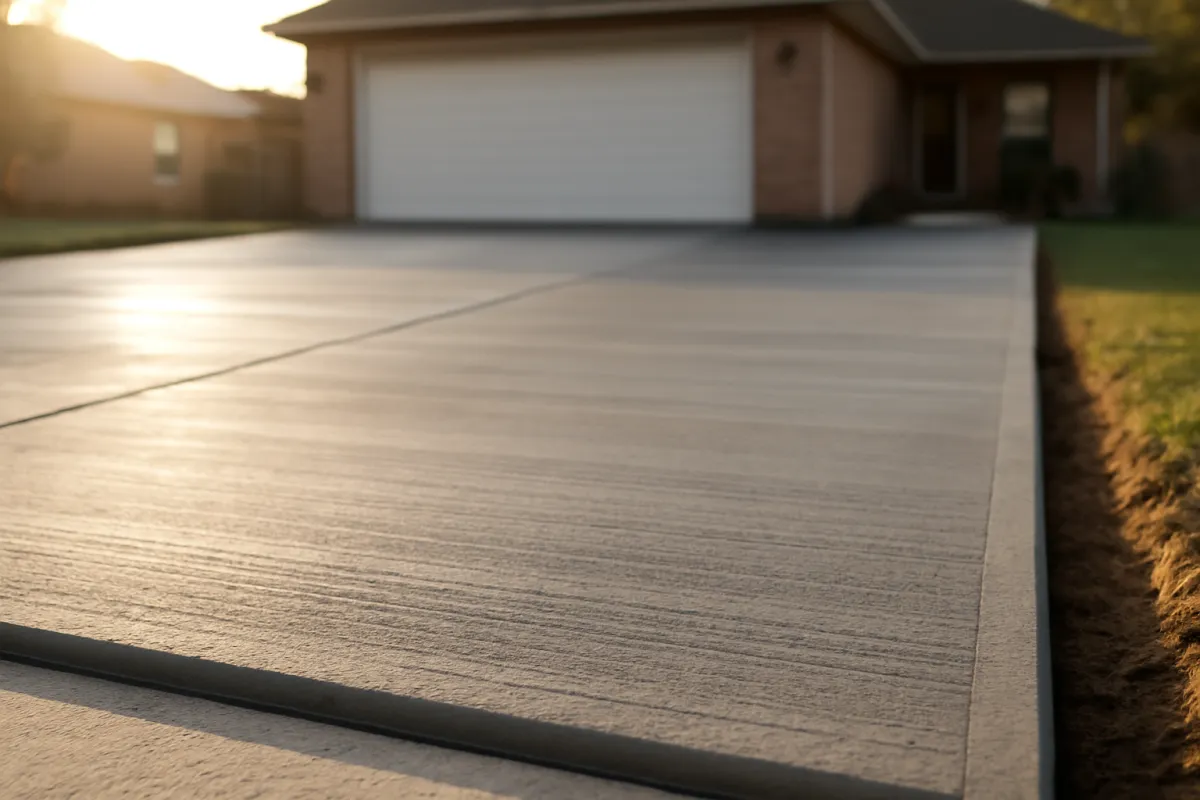
A plain broom-finished concrete driveway is the baseline, an illustrative 8 dollars or so per square foot installed as a working midpoint, and it is what the phrase concrete driveway cost usually means when no finish is specified. The surface is a standard gray slab given a light texture by dragging a broom across it while the concrete is still wet, which leaves fine lines that provide grip in rain and snow. Nothing about a broom finish is decorative, and that is the point: it is the most durable, most functional, and least expensive way to finish a driveway, which is why it is the default on the majority of poured drives.
Because a plain driveway skips the coloring and texturing steps, its cost is almost entirely the structural slab and the labor to build it: the base, the forms, the reinforcement, the concrete, and the finishing. That makes it the cleanest surface to compare across bids, since two plain-driveway quotes differ mainly on thickness, base prep, access, and local labor rather than on finish artistry. It is also the finish that leaves the most room in the budget for the things that actually protect the driveway, a proper base and adequate thickness, rather than spending on the surface look. If longevity per dollar is the goal, a well-built plain driveway is usually the strongest value on the board.
Colored concrete driveway cost
Colored concrete adds pigment to the plain slab, an illustrative 11 dollars or so per square foot installed, and it is the most economical way to move beyond plain gray. The color comes one of two ways: integral color, where pigment is mixed through the whole batch so the tone runs all the way through the slab, or a surface treatment like a stain or dye applied after the concrete cures. Integral color is more durable because it is not just on the surface, so a chip or a scratch does not expose gray underneath, while surface stains offer a wider palette and can be applied to existing concrete.
The premium over a plain driveway is modest compared to the decorative finishes above it, because coloring does not change the labor of placing and finishing the slab, it only adds the pigment and, for stains, an extra application step. For a homeowner who wants a warmer or more custom look than raw concrete without the cost of stamping, color is often the sweet spot. It pairs naturally with a broom or a smoother finish, and it can be combined with a stamped border or a contrasting saw-cut pattern for more visual interest without stamping the whole surface. As with any decorative finish, colored concrete benefits from periodic sealing to keep the tone from fading under sun and traffic.
Exposed aggregate driveway cost
Exposed aggregate is a decorative finish where the top layer of cement paste is washed away before it fully hardens, revealing the decorative stone and gravel already in the concrete mix, an illustrative 12 dollars or so per square foot installed. The result is a textured, pebbled surface that is both attractive and unusually slip-resistant, which makes it a popular choice for driveways and pool surrounds where grip matters. The look depends heavily on the aggregate chosen, since the stone is what shows, so the mix is often specified with a particular color or size of stone for the effect.
The cost premium over a plain driveway comes from the extra step and its timing rather than exotic materials. After the concrete is placed, the crew has to remove the surface paste at exactly the right moment, too early and the aggregate dislodges, too late and the paste will not wash off, so it is skilled, time-sensitive work. The exposed surface is durable and hides minor wear and staining well because it is already textured and varied, which is a practical advantage over a smooth colored slab. Like other decorative finishes, it wants periodic sealing to keep the aggregate crisp and to lock the surface against water and salt. Exposed aggregate is a middle path: more character than plain or colored concrete, and less cost than stamped.
Stamped concrete driveway cost
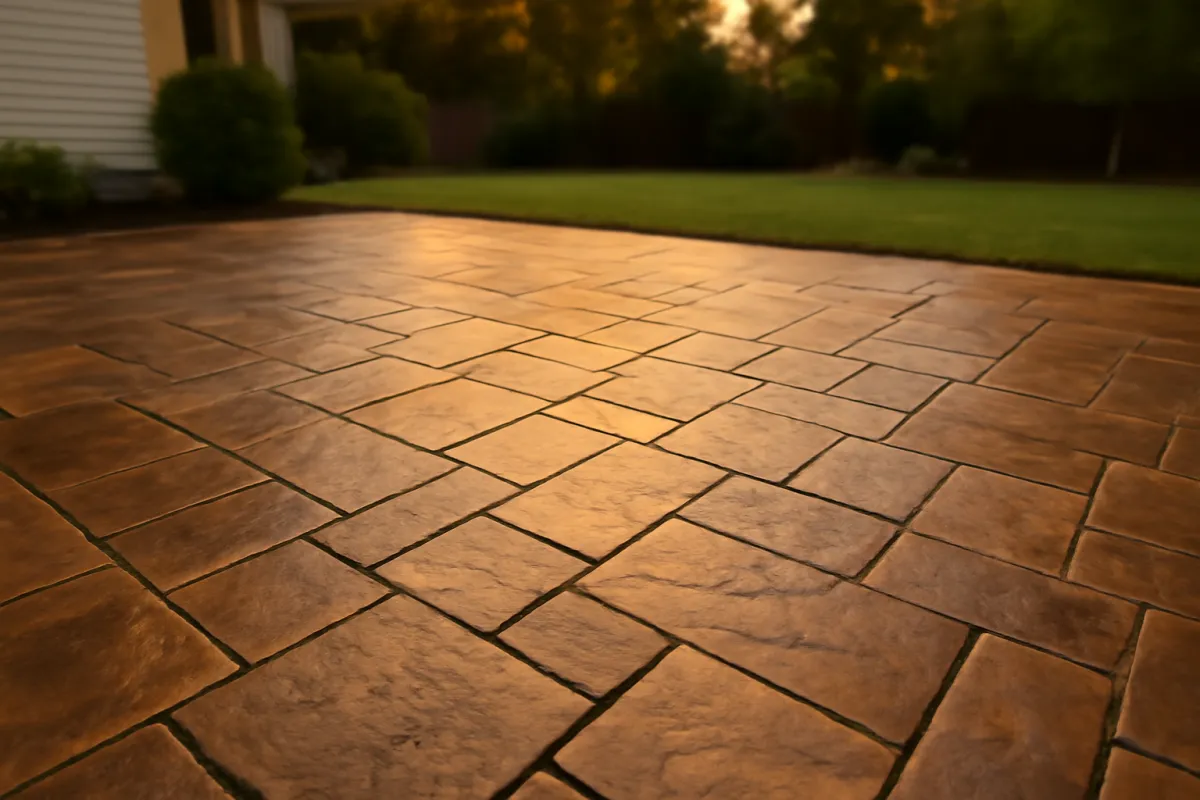
Stamped concrete is the top of the common finish range, an illustrative 12 to 20 dollars per square foot installed and sometimes higher, because it imprints a pattern into the fresh surface and colors it to imitate stone, brick, slate, or wood. The appeal is a decorative surface that looks like an expensive paver or natural-stone driveway at a fraction of the price, because underneath the pattern it is still a single monolithic slab rather than hundreds of individually set units. That is also why stamped concrete competes directly with pavers on looks while undercutting them on cost.
Almost all of the premium over a plain driveway is skilled, unforgiving labor. Coloring and stamping happen in a narrow window while the concrete is still workable, so a crew has to place, color, and imprint a large area before it sets, with no chance to redo a botched stamp once the slab hardens. Complex patterns, multiple colors, and detailed borders push the figure toward the top of the range and beyond. Stamped surfaces also ask for more upkeep than a plain slab, since the color and the sealer that protects it wear over time and want periodic resealing to stay crisp. For a homeowner who wants the look of stone without the cost, stamped concrete is the value play, but it is the finish where the labor premium is largest, so price it separately when you compare bids.
What drives concrete driveway cost
Beyond the finish, a handful of factors move a concrete driveway quote, and knowing them explains why two bids for the same-size drive can differ by a wide margin. Thickness comes first, because a driveway carries vehicle loads and commonly wants more concrete than a patio or a walkway, which is both more material and often reinforcement. The base and grading below the slab are next: a driveway is only as good as the compacted base it sits on, and preparing that base is real labor and material that never shows on the finished surface. Reinforcement, rebar or wire mesh, adds another line.
The site itself is the quiet multiplier that surprises people most. A driveway a ready-mix truck can reach and a crew can work with room to move is far cheaper to pour than one on a tight or sloped lot where access is awkward. Demolition and disposal of an old driveway, if one exists, is a whole cost category before any new concrete is poured. On top of all this sits the local labor rate, which for an installed slab is frequently the largest single share of the bill and moves the total more than the concrete does. The rest of this brief takes these drivers one at a time, starting with thickness and reinforcement.
Thickness and reinforcement
Thickness is the first structural lever on a concrete driveway, and it separates a driveway from a patio in the estimate. A walkway or a patio slab is commonly poured at about 4 inches, but a driveway that carries cars, and especially one that might see a heavier vehicle, commonly wants 5 to 6 inches of concrete instead. That extra inch or two is extra material across the whole area, so it raises the concrete volume and the cost noticeably, and it is one of the first things to confirm in a quote because a driveway poured too thin will crack and fail under load. Our concrete manual works the volume math that turns a thickness into cubic yards.
Reinforcement is the companion decision. Most driveways include either steel rebar in a grid or welded wire mesh, set within the slab, to help control cracking and hold the concrete together if the ground shifts. Reinforcement is both material and the labor to place it, and while it does not make a thin slab thick enough, it makes an adequately thick slab far more durable. Some driveways add fiber reinforcement mixed into the concrete instead of or alongside steel. The right thickness and reinforcement are structural decisions driven by the soil, the climate, and the loads, not places to cut corners, so confirm both with your contractor and treat them as the foundation of a driveway that lasts.
The base and grading
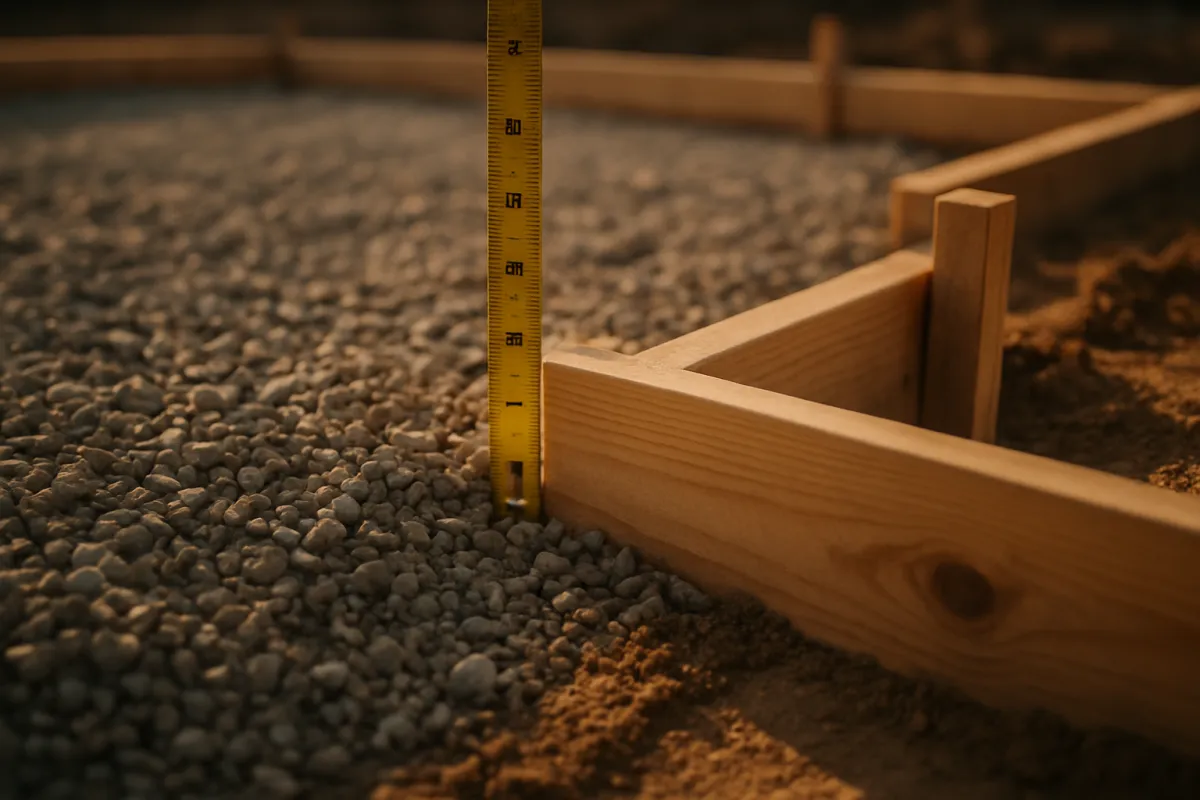
The part of a concrete driveway that decides whether it survives is entirely hidden below the slab: the compacted base and the grading it sits on. Before any concrete is poured, the ground is excavated to depth, and a layer of compacted gravel base is built and leveled so the slab has firm, well-draining support. A driveway poured directly on soft or poorly drained soil will settle unevenly and crack, no matter how good the concrete is, so the base is not optional, it is the foundation of the whole job. Preparing it is excavation, base material, and compaction, all real cost that a cheap bid may have quietly skimped on.
Grading is the related step, and it does two jobs at once. First, it establishes the level and slope of the base so the finished driveway sheds water toward the street or a drain rather than pooling or running toward the house. Second, it sets the depth so the slab thickness is consistent across the whole area. A driveway that does not drain lets water sit on and under the slab, which in a freezing climate is one of the fastest ways to crack and heave concrete. When you compare bids, ask each one what base depth and compaction it includes and how the driveway is graded to drain, because a quote that skips the base is not a cheaper driveway, it is one that will fail sooner and cost more to replace than the saving ever justified.
Site access and demolition of an old driveway
Site access is the cost factor most often underestimated, because it does not appear on any material list yet can move the labor bill substantially. A driveway a ready-mix truck can back up to, with room for the crew to work and stage material, is far cheaper to pour than the same driveway on a tight, steep, or awkward lot where the concrete has to be moved by wheelbarrow or pump from a truck parked at a distance. Every yard of concrete carried rather than chuted adds labor and time, and a pour that has to be pumped adds a pump cost on top. Two identical driveways can quote well apart on access alone.
Demolition is the other big variable, and it applies whenever an old surface has to come out first. Removing and disposing of an existing driveway, whether cracked concrete, old asphalt, or a gravel surface, is a whole cost category before the new pour begins: breaking it up, hauling it away, and disposing of it all take equipment, labor, and dump fees. Concrete demolition and disposal in particular can add a meaningful figure per square foot, since broken concrete is heavy and disposal is priced by weight or volume. When you budget a replacement rather than a fresh pour on bare ground, get the demolition priced as its own line, because it is easy to forget and it is rarely small. The companion below lets you add old-surface removal to see how much it shifts the total.
Total concrete driveway cost by size
Scaling the per-square-foot rate up to whole-project totals is where the numbers become concrete, so here are a few common driveways priced illustratively as plain slabs at roughly 8 dollars per square foot. A single-car driveway, about 12 feet wide by 24 feet long, is roughly 288 square feet, an illustrative 2,000 to 3,500 dollars depending on thickness, base, and access. A two-car driveway, about 20 feet wide by 24 feet long, is roughly 480 square feet, in the 3,500 to 6,000 dollar range plain. A long or wide drive of 800 square feet or more, a longer approach or a three-car width, climbs past that, often well into five figures once finish and reinforcement are added.
The pattern is that totals climb directly with area, and area grows with both width and length, so a small increase in each can add up fast. Change the finish and the whole range shifts: the same two-car driveway in stamped concrete at an illustrative 16 dollars a square foot is closer to double the plain figure, while a colored or exposed-aggregate finish lands in between. Add extra thickness, reinforcement, poor access, or demolition of an old surface, and every figure moves up. Treat these as starting points, not quotes: measure your own area with our square-footage manual, pick a rate for your finish, and get local bids, because regional labor and site conditions will move your total more than any table can predict.
Concrete versus asphalt, pavers, and gravel
Concrete is one of several driveway surfaces, and where it sits on cost depends on which alternative you compare it to. On up-front installed cost, concrete usually falls in the middle of the field: more expensive than gravel or asphalt, and less expensive than clay or concrete pavers. Gravel is the cheapest to install because it is loose stone spread and compacted, with no pour or finish, which our gravel driveway build manual covers in full. Asphalt is poured hot and rolled, typically cheaper than concrete up front but with a shorter life and more frequent resurfacing. Pavers are individual units set by hand on a prepared base, the most labor-intensive and usually the most expensive per square foot, as our paver patio manual shows.
The chart below places these surfaces side by side on illustrative installed cost per square foot, and it makes the middle position of concrete clear. What the chart cannot show is the other half of the decision: lifespan and maintenance. Concrete typically outlasts asphalt and gravel by a wide margin and needs less frequent attention, so a higher installed cost can pay back over the decades it stands. Gravel is cheap to install but needs regular regrading and topping up. Asphalt is moderate up front but wants periodic sealcoating and resurfacing. Pavers cost the most but individual units can be lifted and reset. The right surface is the one whose installed cost and lifetime upkeep together fit your budget and your patience, not the one with the lowest sticker.
Illustrative installed cost per square foot, by driveway surface
Plain concrete against the common alternatives; local rates, site prep, and access move every bar.
Concrete sits in the middle up front, but installed cost is only half the story. Concrete's longer lifespan and lighter maintenance can make it cheaper to own than a surface that costs less to pour, which is why a full comparison weighs upkeep too.
From price per foot to your total
Turning a per-square-foot rate into a real total is a short calculation, and it starts with the driveway’s area. Measure the length and the width in feet and multiply them for the surface area in square feet, adding the pieces if the drive is an L-shape or has a flared apron. Then multiply that area by the per-square-foot installed rate for your finish: plain near the low end, colored and exposed aggregate in the middle, stamped at the top. A two-car driveway of 20 by 24 feet is 480 square feet, which at an illustrative 8 dollars a square foot for a plain finish is around 3,840 dollars as a planning figure. Our estimator handles the area in seconds from your length and width.
Two adjustments make the total honest. First, apply a factor for the structural choices: extra thickness and reinforcement above the base spec, which a bare per-square-foot rate may not fully include. Second, add for the site: poor access, heavy grading, and especially the demolition and disposal of any old surface, which is a real line that never shows in the finished driveway. Run your own length and width through the estimator to get the area, then apply a local rate and these adjustments, and you have a number you can take into a bidding conversation. The companion below does the same math on your own driveway and lets you add old-surface removal to see how it moves the total.
Permits and setbacks
The most overlooked line in a concrete driveway budget is not a material at all, it is the permit, and it can shape the whole project. Many municipalities require a permit to build or replace a driveway, particularly where the driveway meets a public road, because the apron and the curb cut affect drainage and the public right-of-way. A permit carries a fee, and any required inspection is a step in the schedule that has to be planned around the pour. The rules are set locally rather than nationally, so the only reliable answer comes from your building or public-works department, and it is worth asking before you design the driveway, not after.
Beyond the permit itself, local rules can shape the driveway’s size and placement. Setback requirements govern how close a driveway can sit to a property line, maximum impervious-surface limits can cap how much of a lot can be paved, and drainage requirements can dictate how the driveway sheds water and where it goes. Historic districts and homeowner associations sometimes add their own restrictions on materials and finishes. None of this is meant to be a code citation, since the specifics vary everywhere, but the point is that the permitting and setback rules can change what you are allowed to build before cost even enters the picture. Confirm the local requirements early, because a driveway built outside them can have to be altered or removed at your expense.
DIY versus hiring a pro
Whether to pour a concrete driveway yourself comes down to volume and timing, and for most people the answer is to hire it out. Unlike a small pad or a footing you can build from bags, a driveway is measured in cubic yards and is poured from a ready-mix truck, which means several yards of concrete have to be placed, screeded, and finished in one continuous session before it sets. That is genuinely skilled work under time pressure, and a driveway is large and visible enough that mistakes are both permanent and expensive. Forming the edges, placing reinforcement, controlling the pour, and finishing a large area evenly are not beginner tasks, and a decorative finish adds a whole layer of difficulty on top.
There is still room for owner effort to trim the bill even on a hired job. Some homeowners handle the demolition of an old surface, the excavation, or the base preparation themselves and bring in a crew for the forming, pour, and finish, which is the hardest and most time-sensitive part. A small plain apron or a short single-car pad on easy ground is a plausible do-it-yourself project for a capable person who has poured concrete before, and our slab-pouring manual walks the sequence. But a full driveway, and especially a colored, exposed, or stamped one, is where hiring a pro pays off most, because the finish and the timing leave no margin for a learning curve. Match the decision to the driveway in front of you, not to the saving alone.
Labor’s share of a concrete driveway
Labor is the quiet giant of an installed concrete driveway, frequently the largest single share of the bill, which is why regional wage rates move the total more than the concrete does and why owner-supplied effort saves real money. Building a driveway is skilled, physical work from start to finish: excavating and grading, building and compacting the base, setting forms, placing rebar or mesh, receiving and placing the concrete, screeding it level, floating and finishing the surface, tooling control joints, and cutting or brooming the final texture. Every one of those steps is time, and on a decorative driveway the finishing steps multiply. The concrete you can see poured off the truck is often the minority of the total once all that labor is counted.
The chart below splits a built concrete driveway into roughly where the money goes, and the labor share is the point of the picture. Because labor dominates, two things follow. First, the same driveway costs differently in different markets, since local wages move the largest line on the bid. Second, the parts of the job an owner can supply, demolition, excavation, or base prep on a hired job, are where the savings actually live, and supplying the whole build on a small plain pad captures the most. When you compare bids, remember you are largely comparing labor and site conditions, not the price of concrete, so ask each bidder what the quote includes and how the site will be worked.
Where the cost of a built concrete driveway goes
Illustrative split of a plain, poured-and-finished driveway; shares vary by finish, site, and access.
The concrete off the truck is only about a third of a built driveway. Labor and the hidden base and prep make up the rest, which is why a per-yard concrete price alone badly understates the real cost and why a decorative finish, all added labor, climbs so fast.
Lifespan and maintenance cost
Part of what justifies a concrete driveway’s higher up-front cost against asphalt or gravel is how long it lasts, an illustrative 25 to 40 years or more when it is built well and maintained. A concrete driveway that has an adequate thickness, a solid base, proper reinforcement, and good drainage can stand for decades with only modest upkeep, which spreads its installed cost across far more years than a surface that needs frequent resurfacing. That longevity is the strongest argument for concrete on a whole-life-cost basis, and it is why the cheapest surface to install is not always the cheapest to own.
Maintenance is real but light. Sealing the surface periodically helps it resist water, de-icing salt, and staining, and our driveway-sealing note covers when and how. Filling small cracks early keeps them from spreading, which our crack-repair note walks through, and it is far cheaper than letting a crack grow. Some cracking is normal and not a defect: the control joints tooled or saw-cut into the slab exist to make the concrete’s inevitable shrinkage cracking happen along those straight lines instead of randomly across the surface. Keeping water draining off the driveway and away from its edges protects the base underneath, which is the real key to a long life. A driveway that is sealed occasionally, has its cracks filled early, and drains properly will comfortably reach the top of its lifespan range.
Ways to keep concrete driveway cost down
A concrete driveway cost has real levers, and pulling them before you order beats haggling after. The largest single choice is the finish: a plain broom surface is a fraction of a stamped one, so if the budget is tight, spending on structure rather than decoration buys a driveway that lasts longer for less. Right-sizing the driveway is the next lever, since cost scales directly with area, so paving only the width and length you actually need, rather than an oversized apron, cuts material and labor together. Choosing an efficient shape, a simple rectangle over a complex curved outline, keeps forming labor down too.
More savings hide in the site and the labor. Supplying your own demolition of an old surface, or handling the excavation and base prep on a hired job, converts some of the largest labor lines into your own time. Pouring on easy, accessible ground rather than a tight or steep site avoids the pumping and hand-carrying that inflate a difficult-access quote, so improving access where you can helps. Timing the work outside a contractor’s peak season can find softer bids. What you should never cut is the structure: skimping on thickness, the base, or the reinforcement saves a little now and risks the whole driveway later, since a thin slab on a poor base will crack and fail. Cut on the finish, the size, and your own labor, never on what holds the driveway up.
A worked example: a two-car driveway priced
Nothing clarifies the method like one driveway costed end to end, so take a two-car drive, 20 feet wide by 24 feet long, poured as a plain broom-finished slab on a reasonably accessible lot with no old surface to remove. The area is 20 times 24, or 480 square feet. At an illustrative 8 dollars per square foot installed for a plain finish, the base figure is around 3,840 dollars, which bundles the concrete, the reinforcement, the base, the forming, the pour, and the finishing labor. That is the planning number before any finish, structural, or site adjustment, and it is exactly what the area method produces from a width and a length.
Now flex the inputs to see the levers. Swap the finish to stamped at an illustrative 16 dollars a square foot and the same driveway climbs toward 7,700 dollars, roughly double, for the identical footprint. Add the demolition of an old concrete driveway at an illustrative couple of dollars a square foot, and that is another several hundred to a thousand dollars before the new pour begins. Move the same driveway to a tight, sloped lot that needs the concrete pumped, and the labor share rises again. The 480 square feet of area is fixed by the dimensions in every case; what moves the total is the finish, the structure, and the site, which is the whole lesson of this brief. Run your own driveway through the companion below and watch each lever move the number.
The bottom line
Concrete driveway cost is set by a short list of things in roughly this order: the size, the finish, the structure below the surface, and the site. As an illustrative planning range, a plain driveway runs about 6 to 12 dollars per square foot installed, near 8 at the midpoint, and you turn that into a total by multiplying by the area, width times length, not by guessing from the size alone. The finish is the biggest single choice, with a plain broom surface at the bottom and stamped concrete near double it, while thickness, reinforcement, the base, access, and any demolition move the figure further. Concrete sits in the middle of the surface field up front, pricier than gravel or asphalt and cheaper than pavers, but its long life and light upkeep can make it the cheapest to own. Price the finish, size the area with our estimator or the companion below, read our broader concrete cost brief for the material side, then get more than one written bid. Do that and the quote you receive becomes a number you can judge rather than one that simply surprises you.
Treat this as workbench education, not a price quote or a construction specification. Every dollar figure here, per square foot, per finish, and per project, is an illustrative planning range, and your finish, your driveway’s size and thickness, your soil and drainage, your site access, the demolition of any old surface, your region, and the season will each move the real numbers, often significantly. A driveway carries vehicle loads and must be built with an adequate thickness, base, and reinforcement for your conditions, all of which are engineering and code decisions before they are cost decisions, and many places require a permit to build or replace one. Confirm your local permit, setback, and drainage requirements with your municipality, and have the thickness and reinforcement specified for your soil and climate by a qualified contractor. Build a budget only on live, written quotes for your driveway in your area.
Frequently asked questions
How much does a concrete driveway cost per square foot?
As an illustrative planning range, a plain, poured-and-finished concrete driveway commonly runs somewhere around 6 to 12 dollars per square foot installed, with a working midpoint near 8 dollars for a standard broom finish. That figure bundles the concrete, the forming, the reinforcement, the pour, and a basic finish, which is why it is far more useful than the per-yard price of the concrete alone. Decorative finishes climb from there: colored concrete commonly lands near 11 dollars, exposed aggregate near 12 dollars, and stamped concrete often runs 12 to 20 dollars a square foot. Thickness, reinforcement, site prep, and the removal of any old surface all move the figure, so treat any single number as a starting point and get local bids.
How much does a concrete driveway cost in total?
Total cost scales with the driveway's area, so it depends heavily on whether you are pouring a single-car or a two-car drive. A single-car driveway, roughly 12 by 24 feet or about 288 square feet, might land somewhere near 2,000 to 3,500 dollars plain as an illustrative range. A two-car driveway, roughly 20 by 24 feet or about 480 square feet, often runs near 3,500 to 6,000 dollars plain, and a long or wide drive of 800 square feet or more climbs past that. Decorative finishes, extra thickness, reinforcement, poor access, or demolition of an old surface can each add a meaningful sum. These are planning ranges, not quotes, so measure your own area and get written bids before you budget.
Is a concrete driveway cheaper than asphalt or pavers?
Concrete usually sits in the middle of the driveway surface range on up-front cost: more expensive than gravel or asphalt, and less expensive than clay or concrete pavers. As illustrative installed figures, gravel might run a couple of dollars per square foot, asphalt around 5 dollars, plain concrete around 8 dollars, and pavers 15 dollars or more because each unit is set by hand. Up-front price is only half the picture, though, since concrete typically lasts far longer than asphalt or gravel and needs less frequent resurfacing, so the cheapest to install is not always the cheapest to own. Weigh the installed cost against the lifespan and the maintenance each surface asks for before you choose on the sticker alone.
What makes a concrete driveway more expensive?
A handful of factors move a concrete driveway quote well beyond the base per-square-foot rate. Thickness is one: a driveway wants more concrete than a patio, commonly 5 to 6 inches rather than 4, and that extra depth is extra material and often reinforcement. Reinforcement itself, rebar or wire mesh, adds material and labor. The base and grading below the slab, the site access for the truck and crew, the demolition and disposal of any old driveway, and the finish you choose all add lines to the bill. Labor is frequently the largest single share, so regional wage rates move the total more than the concrete does. Ask each bidder what thickness, reinforcement, base prep, and finish the quote includes so you are comparing like for like.
How much does a stamped concrete driveway cost?
Stamped concrete, where the fresh surface is imprinted with a pattern and usually colored to imitate stone, brick, or slate, is the most expensive common finish, an illustrative 12 to 20 dollars per square foot installed and sometimes higher for complex patterns and multiple colors. The premium buys a decorative surface at a fraction of the cost of real pavers or stone, since it is still a single monolithic slab underneath. Most of the added cost over a plain slab is skilled, time-sensitive labor: the stamping and coloring happen in a narrow window while the concrete is still workable, so there is no room for error. Stamped surfaces also want periodic resealing to keep the color and pattern crisp. Price the finish premium separately when you compare bids, because it can nearly double a plain-slab figure.
Can I pour a concrete driveway myself?
A driveway is usually a job most people hire out, even capable do-it-yourselfers, because the volume of concrete and the timing make it unforgiving. A driveway pour is measured in cubic yards, not bags, which means a ready-mix truck and a crew placing and finishing several yards before the concrete sets, all in one continuous session. Forming, reinforcing, screeding, and finishing that much concrete correctly is skilled work, and mistakes set permanently within hours. A small plain pad at the apron is a plausible do-it-yourself project, but a full driveway is where hiring a pro pays off most, and a decorative finish even more so. If you do tackle it, our slab-pouring manual walks the sequence, and the labor you supply is where any real saving lives.
Do I need a permit for a concrete driveway?
Often yes, and the rules are set locally rather than nationally, so the only reliable answer comes from your municipality. Many jurisdictions require a permit to build or replace a driveway, especially where it meets a public road, because the apron and the curb cut affect drainage and the right-of-way. Setback rules, maximum impervious-surface limits, and drainage requirements can also apply and can shape how wide or how long you are allowed to pave. A permit itself carries a fee, and any required inspection is a step in the schedule. Check with your local building or public-works department before you design or price the driveway, since an unpermitted driveway can have to be altered or removed.
How long does a concrete driveway last, and what maintenance does it need?
A well-built concrete driveway commonly lasts several decades, an illustrative 25 to 40 years or more, which is longer than a typical asphalt or gravel surface and part of why its higher up-front cost can pay back over time. Maintenance is modest but real: sealing the surface periodically helps resist water, salt, and staining, and filling small cracks early keeps them from spreading. Control joints, the grooves cut or tooled into the slab, are there to make the inevitable shrinkage cracking happen along straight lines rather than randomly, so some fine cracking is normal and not a defect. Keeping water draining off the surface and away from the edges is what protects the base underneath. Our driveway-sealing and crack-repair notes cover the upkeep, which is far cheaper than an early replacement.