What's on this page
- What stamped concrete costs per square foot
- Stamped concrete cost by grade
- Basic stamped concrete cost
- Mid stamped concrete cost
- Premium stamped concrete cost
- What drives stamped concrete cost
- Pattern complexity and detail
- Color: single, two-tone, and custom
- Site prep and thickness
- Sealing and the finish coat
- Stamped concrete vs pavers vs regular concrete vs stone
- Cost by application: patio, driveway, walkway, pool deck
- Total stamped concrete cost by project size
- From price per foot to your total
- Where the money goes
- Maintenance and resealing cost
- Cracks and repairs: the hidden cost
- DIY feasibility
- Ways to keep stamped concrete cost down
- A worked example: a stamped patio priced
- The bottom line
Short answer: Stamped concrete commonly runs an illustrative 12 to 22 dollars per square foot installed, with a working midpoint near 16 dollars for a two-color job with a border. A basic single-color stamp sits near 12, premium multi-color or hand-detailed work near 22, against about 8 for a plain slab. A common 350 square foot patio at the midpoint plans near 5,600 dollars. Labor is often the largest share, so get written bids.
Stamped concrete cost is one of those numbers that looks simple and turns out to have a dozen inputs hiding behind it. Ask what stamped concrete costs and the honest answer starts with questions back: how big is the area, how complex is the pattern, how many colors do you want, and where is it going. A basic single-color patio and a premium multi-color driveway of the exact same size can quote thousands of dollars apart, because the concrete underneath is only part of the bill. The rest is the pattern, the color, the site prep, the sealer, and the skilled labor, and any one of them can move the total more than the size does.
This cost brief prices stamped concrete the way a contractor actually bids it: per square foot installed, then scaled up to a whole-project total by size, broken out by grade from a basic single-color stamp up to premium custom work. It covers what drives the number, how stamped concrete compares to pavers, regular concrete, and natural stone, what it costs across patios, driveways, walkways, and pool decks, and what maintenance, cracks, and resealing add over time. This article is the finish-focused companion to our broader concrete cost brief, which prices concrete three ways for any pour, and it sits alongside our concrete driveway cost brief for the vehicle surface and our paver patio manual for the hand-set alternative. Run your own project through the estimator or the companion below to turn a length and a width into an illustrative total as you read.
Key takeaways
- Stamped concrete commonly runs an illustrative 12 to 22 dollars per square foot installed, with a working midpoint near 16 dollars for a two-color job with a border, and grade moves the figure most.
- Total cost scales with area, so a small 200 square foot walkway, a common 350 square foot patio, and a large 500 square foot or bigger surface land in very different budgets.
- Stamped concrete is cheaper to install than pavers or natural stone while imitating their look, but a crack across it is far harder to repair invisibly than a liftable paver or stone.
- Pattern complexity, the number of colors, site prep, thickness, and the sealer are the levers that move a quote past the base rate; labor is frequently the largest single share.
- Every dollar figure here is illustrative and local: your pattern, your colors, your site, and regional labor rates move a real quote more than any rule of thumb, so get written bids.
What stamped concrete costs per square foot
The cleanest way to price stamped concrete is per square foot of surface installed, because that is how contractors estimate and how the finished job compares fairly across sizes. As an illustrative planning range, stamped concrete commonly runs somewhere around 12 to 22 dollars per square foot, with a working midpoint near 16 dollars for a two-color job with a border. That figure is not the concrete alone: it bundles the ready-mix, the forming, the reinforcement, the color, the stamping labor, and the sealer that protects the whole thing, which is exactly why it is more useful than the per-yard material price a batch plant quotes.
The reason the per-square-foot installed figure beats every other unit is that it already includes the parts of the job that a material price leaves out. A cubic-yard price tells you what the wet concrete costs off the truck, but it says nothing about the crew coloring the surface, pressing the stamps in a narrow timing window, and sealing the finished pattern. For stamped concrete, that decorative labor is a large share of the bill, often larger than the concrete itself, so the installed figure is the one that matches a real quote. Keep the per-square-foot number as your headline, pick the band for your grade, and you have a defensible starting point before a single bidder arrives. What moves you within the band is the subject of the rest of this brief.
Stamped concrete cost by grade
The grade of the stamping work is the first fork in a stamped concrete estimate, because it sets both the per-square-foot rate and the look of the finished surface. A basic single-color, single-pattern job sits at the bottom of the range, a mid-grade two-color finish with a border fills the middle, and premium multi-color or hand-detailed work reaches the top. The table below lays out the common grades with an illustrative installed cost per square foot and a short note on what each one is, along with the plain slab, pavers, and natural stone for reference, so you can weigh the look you want against what it adds to the bill.
| Grade or surface | Illustrative cost per sq ft installed | What it is |
|---|---|---|
| Plain concrete (reference) | ~$8 | A standard gray slab with a broom or trowel finish, no pattern or color |
| Basic stamped | ~$12 | One color and one pattern pressed into the fresh slab, the entry point |
| Mid stamped | ~$16 | Two colors with a border or accent band, the common middle grade |
| Premium stamped | ~$22 | Multiple colors, custom or hand-detailed patterns, the top of the range |
| Pavers (reference) | ~$18 | Individual units set by hand on a prepared base |
| Natural stone (reference) | ~$28 | Cut or natural stone set individually, the premium hand-laid surface |
Read the table as illustrative planning bands, not quotes, because every figure moves with your region, your access, and the exact pattern. A basic stamp is the default for a budget-minded job: one color, one pattern, and the least skilled time on top of the slab. The higher grades buy appearance, and the premium is almost entirely skilled labor and coloring materials layered onto the same slab underneath. The next several sections take each grade in turn, and the companion below prices your own project at whichever grade you pick.
Basic stamped concrete cost
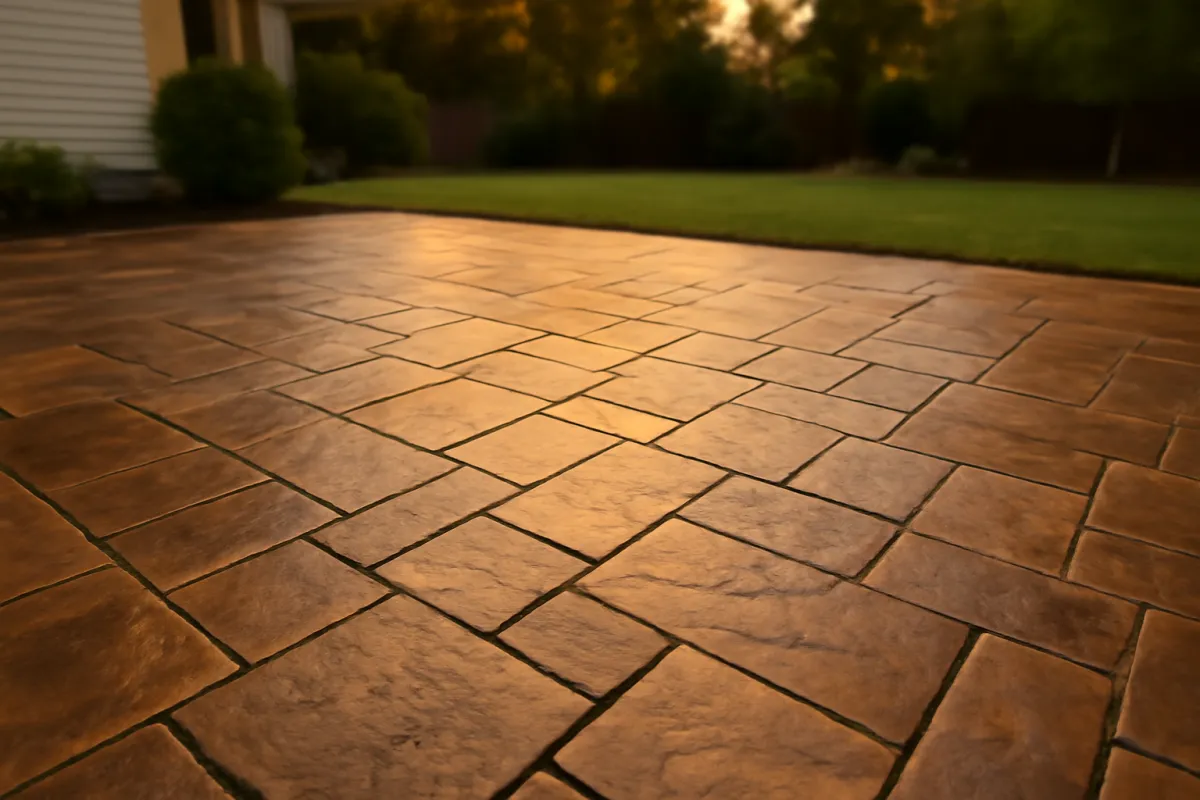
A basic stamped concrete surface is the entry point, an illustrative 12 dollars or so per square foot installed, and it is what the phrase stamped concrete cost usually means when no grade is specified. The surface gets a single color, applied as a color hardener broadcast onto the fresh concrete or mixed integrally, and a single stamp pattern pressed across the whole area, commonly a running-bond brick or a simple slate texture. Nothing about a basic stamp is elaborate, and that is the point: it is the most economical way to move beyond a plain gray slab while still getting a patterned, colored surface that reads far more expensive than it is.
Because a basic job uses one color and one pattern, its cost is the plain slab plus a relatively modest labor and materials premium for the coloring and stamping. That makes it the cleanest stamped surface to compare across bids, since two basic-stamped quotes differ mainly on the slab work, the pattern chosen, and local labor rather than on decorative complexity. It is also the grade that leaves the most budget for the things that actually protect the surface, a proper base and adequate thickness, rather than spending on multi-color detail. For a homeowner who wants the stamped look at the lowest defensible price, a well-built basic job is usually the strongest value on the board, and it still delivers most of the visual payoff of the finish.
Mid stamped concrete cost
Mid-grade stamped concrete adds a second color and usually a border or accent band, an illustrative 16 dollars or so per square foot installed, and it is the most common grade because it balances character against cost. The second color comes from an antiquing release agent or a secondary stain that settles into the pattern’s low points, giving the surface depth and a more convincing stone or slate appearance than a single flat tone. A contrasting border stamped or saw-cut around the perimeter frames the field and lifts the whole look, which is why the mid grade tends to be the sweet spot for patios and pool surrounds.
The premium over a basic job comes from the extra coloring step and the added skilled time, not from exotic materials. Applying and working a second color, and stamping or cutting a border, is more labor in the same narrow timing window while the concrete stays workable, so the crew has to move quickly and precisely across a larger sequence of steps. For a homeowner who wants a richer, more custom look than a flat single color without the cost of full premium detailing, the mid grade is often the right call. As with any stamped surface, it benefits from periodic sealing to keep both colors rich and the pattern crisp, which our concrete sealer guide covers in full.
Premium stamped concrete cost
Premium stamped concrete is the top of the range, an illustrative 22 dollars per square foot installed and sometimes higher, because it layers multiple colors and intricate or hand-detailed patterns onto the slab. The appeal is a surface that is genuinely hard to distinguish from real stone or aged brick, with variegated color, hand-tooled grout lines, and custom accents that a basic stamp cannot match. This is the grade chosen for a showpiece patio, an entry courtyard, or a pool deck where the finished look is the whole point, and it competes directly with natural stone on appearance while still undercutting it on installed cost.
Almost all of the premium over a basic job is skilled, unforgiving labor. Multiple colors mean multiple coloring passes, each in the same tight window before the concrete sets, and hand-detailing the pattern after stamping is meticulous work that a botched step cannot undo once the slab hardens. Complex patterns, three or more colors, custom borders, and inlays push the figure toward the top of the range and beyond. Premium surfaces also carry the same resealing need as any stamped finish, and the richer the color, the more visible its fade if resealing lapses. For a homeowner who wants the look of high-end stone without its installed cost, premium stamped concrete is the value play, but it is the grade where the labor premium is largest, so price it separately when you compare bids.
What drives stamped concrete cost
Beyond the grade, a handful of factors move a stamped concrete quote, and knowing them explains why two bids for the same-size project can differ by a wide margin. Pattern complexity comes first, because a simple running-bond or ashlar slate stamp is far quicker to place than an intricate cobblestone, a random flagstone, or a hand-detailed pattern, and stamping labor is where the premium lives. The number of colors is next: each additional color is another application step in the same tight window, and multi-color work is skilled time. Site prep, slab thickness, and reinforcement all add lines below the surface.
The sealer and the finish work are the quiet multipliers that surprise people. The sealer is both a material cost and a labor step, and a stamped surface may get a release agent, a color treatment, and one or more coats of sealer before it is done. Borders, accent bands, and inlays each add cutting and coloring labor. On top of all this sits the local labor rate, which for a decorative slab is frequently the largest single share of the bill and moves the total more than the concrete does. The rest of this brief takes these drivers one at a time, starting with the pattern and the color.
Pattern complexity and detail
Pattern complexity is the first decorative lever on a stamped concrete estimate, and it separates a quick job from a slow one. A single, repeating pattern like a running-bond brick or a large ashlar slate stamps quickly and predictably, because the crew presses the same mat across the whole field in a steady rhythm. An intricate pattern like a random cobblestone, an irregular flagstone, or a European fan is slower and more demanding, since the mats have to be aligned, rotated, and touched up so the repeat does not read as obviously mechanical. Every extra minute of stamping is labor in the narrow window before the concrete sets, so complexity translates directly into cost.
Hand-detailing is the step that pushes a pattern from good to premium, and it is pure skilled time. After the mats come off, an experienced finisher can hand-tool the grout lines, vary the texture, and touch up the color so the surface loses its stamped-from-a-mat look and reads as genuine stone. That artistry is what separates a convincing high-end job from an obviously stamped one, and it is why premium patterns cost what they do. When you compare bids, ask what pattern each quote assumes and whether hand-detailing is included, because a lower number may simply be a simpler, faster stamp, which is a fair choice if the look suits you but not an apples-to-apples comparison.
Color: single, two-tone, and custom
Color is the second decorative lever, and it moves both the look and the cost. A single color is the simplest and cheapest: one integral pigment in the mix or one broadcast color hardener across the surface, giving a uniform tone. Most of the visual jump from plain gray to stamped comes from this first color, which is why a basic single-color job already reads as a decorative surface. A single flat tone, though, can look less like real stone, since natural materials are rarely one uniform color.
Two-tone and custom coloring is where the surface gains depth. A second color, usually an antiquing release agent worked into the pattern’s low points, settles into the grout lines and texture to mimic the shading of aged stone, and it is the single change that makes a stamped surface most convincing. Custom multi-color work goes further with three or more tones, highlights, and blended accents, each an added application step in the same tight timing window. Every color past the first is more skilled labor and more material, which is why coloring is one of the clearest lines between the grades. Color choice is also where personal taste and the surrounding materials matter most, so it is worth sampling before the pour, since the color is permanent once the slab sets.
Site prep and thickness
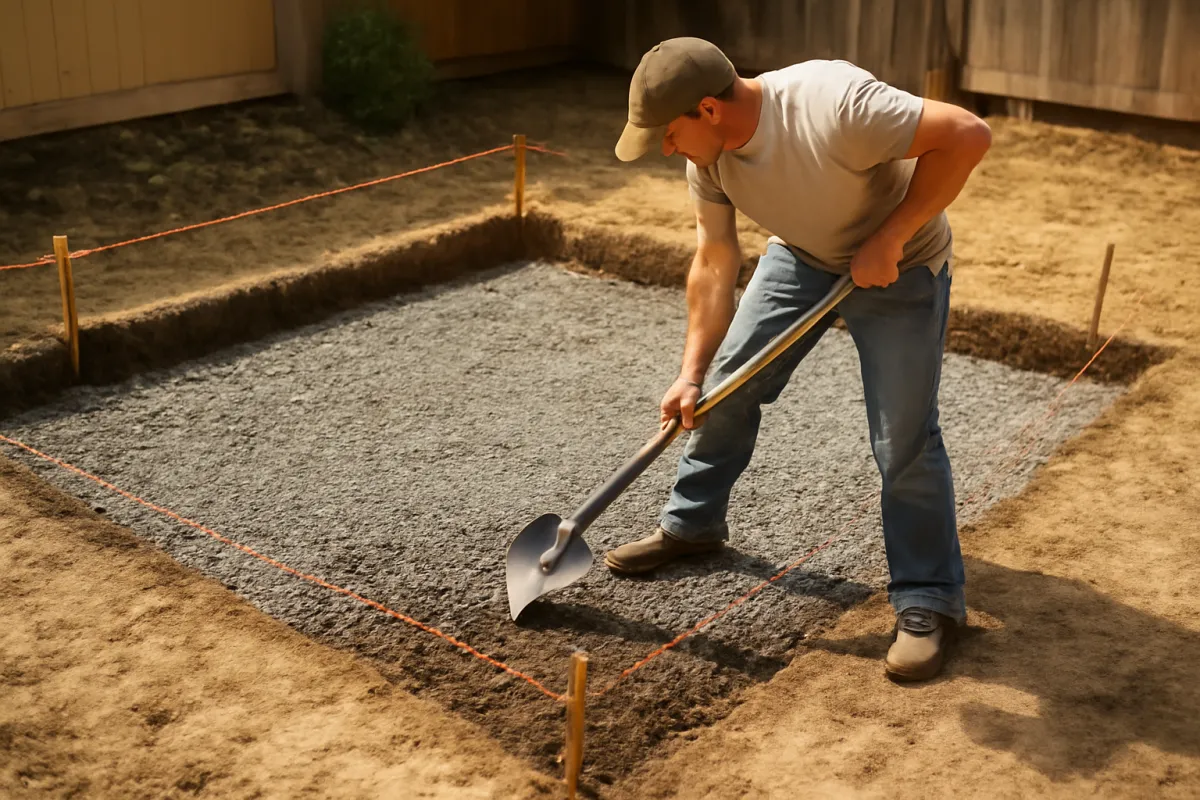
Site prep is the structure below the decorative surface, and it is real cost that never shows. Before any concrete is poured, the ground is excavated to depth, and a compacted gravel base is built and leveled so the slab has firm, well-draining support. A stamped slab poured on soft or poorly drained soil will settle and crack, no matter how beautiful the pattern, so the base is not optional, it is the foundation of the whole job. Preparing it is excavation, base material, and compaction, all real labor a cheap bid may have quietly skimped on, and our slab-pouring manual walks the sequence.
Thickness is the companion structural decision, and it depends on the application. A patio or a walkway is commonly poured at about 4 inches, while a driveway that carries vehicle loads wants 5 to 6 inches and usually reinforcement, which is more material across the whole area. Reinforcement, steel rebar or welded wire mesh set within the slab, helps control cracking and hold the concrete together if the ground shifts, and for a stamped surface, where a crack is hard to repair invisibly, that crack control matters even more than usual. The right thickness and reinforcement are structural choices driven by the soil, the climate, and the load, not places to cut corners, so confirm both with your contractor. Our concrete manual works the volume math that turns a thickness into cubic yards.
Sealing and the finish coat
Sealing is the step that finishes a stamped surface and the one that keeps it looking new, and it is both a material and a labor cost in the original quote. A stamped slab is typically sealed after it cures, and the sealer does several jobs at once: it deepens and enriches the color, it gives the surface a subtle sheen, and it protects the concrete against water, stains, and de-icing salt. Without a sealer, the color looks flat and the surface is far more vulnerable to weather and traffic, so sealing is not an optional extra, it is part of what makes stamped concrete look like stamped concrete. Most jobs include at least one sealer coat in the installed price.
The finish coat is also where a stamped surface’s ongoing cost begins, because the sealer wears and has to be renewed. This is covered in full in the maintenance section below, but it is worth flagging here that the initial sealing is only the first application, not the last. Some jobs add a non-slip additive to the sealer, especially on pool decks and walkways where a wet sealed surface can be slick, which is a small material cost that pays off in safety. When you compare bids, ask how many sealer coats are included and whether a non-slip additive is part of the quote, since the sealer is a genuine line item and its quality affects both the look and the maintenance interval. Our concrete sealer guide covers the sealer families and how they differ.
Stamped concrete vs pavers vs regular concrete vs stone
Stamped concrete is one of several ways to get a decorative hard surface, and where it sits on cost depends on which alternative you compare it to. On up-front installed cost, stamped concrete usually falls between plain concrete and the hand-set surfaces: more expensive than a plain slab, and less expensive than pavers or natural stone. Plain concrete is the cheapest because it skips the color and pattern entirely, which our concrete cost brief prices in full. Pavers are individual units set by hand on a prepared base, more labor-intensive and usually more expensive per square foot, as our paver patio manual shows. Natural stone is the premium hand-laid surface, cut or fitted individually, and the most expensive of the group.
The chart below places these surfaces side by side on illustrative installed cost per square foot, and it makes the value case for stamped concrete clear. What the chart cannot show is the other half of the decision: how each surface ages and repairs. Stamped concrete imitates stone and brick at a fraction of their cost, but it is a single monolithic slab, so a crack across it is hard to repair invisibly. Pavers and stone cost more up front, but a damaged unit can simply be lifted and replaced, and settling can be corrected by resetting units rather than breaking out a slab. The right surface is the one whose installed cost and repair story together fit your budget and your tolerance for future work, not the one with the lowest sticker.
Illustrative installed cost per square foot, by decorative surface
Stamped concrete against the common alternatives; local rates, pattern, and site prep move every bar.
Stamped concrete sits below pavers and stone up front while imitating their look, which is its whole value case. What the bars leave out is repair: a crack in a monolithic stamped slab is harder to fix invisibly than a liftable paver or stone unit, so weigh the saving against the upkeep.
Cost by application: patio, driveway, walkway, pool deck
Where the stamped concrete goes changes both the price per square foot and the structural spec, so the same grade costs differently across applications. A patio is the most common stamped project and the most straightforward: a flat, well-drained slab at about 4 inches where the pattern and color do the work, and the illustrative per-square-foot bands in this brief fit it directly, while our concrete patio cost brief prices the plain and colored grades of the same footprint. A walkway is small in area, which can push the per-foot rate higher, because the fixed costs of mobilizing a crew, mixing color, and setting up stamps spread over less surface, so a narrow path can cost more per foot than a large patio of the same grade.
A driveway is the most demanding application, because it carries vehicle loads and wants a thicker slab, commonly 5 to 6 inches, plus reinforcement, so its structure costs more per foot before the stamping is even priced. Our concrete driveway cost brief covers the driveway case in full, including how a stamped finish compares to plain. A pool deck adds its own requirements: a slip-resistant texture and additive in the sealer for safety around water, and often coping and edge detailing that add finish labor around the perimeter. Match the grade and the spec to the application, because a patio, a driveway, and a pool deck of the same square footage are genuinely different jobs even in the same stamped pattern. The companion below lets you switch the application and read how the spec shifts.
Total stamped concrete cost by project size
Scaling the per-square-foot rate up to whole-project totals is where the numbers become concrete, so here are a few common projects priced illustratively at the mid grade of roughly 16 dollars per square foot. A small stamped surface, about 200 square feet, a walkway or a compact patio, is an illustrative 3,200 dollars. A common patio, about 350 square feet, lands near 5,600 dollars. A large patio or a stamped area of 500 square feet or more climbs past 8,000 dollars, and a full stamped driveway of 600 square feet or more, with its thicker slab, higher still. These are planning ranges, not quotes.
The pattern is that totals climb directly with area, and area grows with both width and length, so a small increase in each can add up fast. Change the grade and the whole range shifts: the same 350 square foot patio in a basic single-color stamp is closer to 4,200 dollars, while a premium multi-color job pushes past 7,700 dollars for the identical footprint. Add extra thickness for a driveway, reinforcement, a difficult site, or a premium sealer, and every figure moves up. Treat these as starting points, not quotes: measure your own area with our square-footage manual, pick a rate for your grade, and get local bids, because regional labor and site conditions will move your total more than any table can predict.
From price per foot to your total
Turning a per-square-foot rate into a real total is a short calculation, and it starts with the project’s area. Measure the length and the width in feet and multiply them for the surface area in square feet, adding the pieces if the area is an L-shape or wraps a corner. Then multiply that area by the per-square-foot installed rate for your grade: basic near the low end, mid in the middle, premium at the top. A patio of 20 by 16 feet is 320 square feet, which at an illustrative 16 dollars a square foot for a mid-grade finish is around 5,120 dollars as a planning figure. Our estimator handles the area in seconds from your length and width.
Two adjustments make the total honest. First, apply a factor for the structural choices: extra thickness and reinforcement for a driveway, or a rebuilt base on poor soil, which a bare per-square-foot rate may not fully include. Second, add for the finish and site: extra colors or a complex pattern above the grade you priced, a premium or non-slip sealer, and any borders or inlays. Run your own length and width through the estimator to get the area, then apply a local rate and these adjustments, and you have a number you can take into a bidding conversation. The companion below does the same math on your own project and lets you switch the grade and application to see how each moves the total.
Where the money goes
Labor is the quiet giant of an installed stamped concrete surface, frequently the largest single share of the bill, which is why regional wage rates move the total more than the concrete does and why the decorative grade drives the price so hard. Building a stamped surface is skilled, physical work from start to finish: excavating and grading, building and compacting the base, setting forms, placing reinforcement, receiving and placing the concrete, coloring it, pressing the stamps in a narrow timing window, hand-detailing the pattern, tooling control joints, and sealing the finished surface. Every one of those steps is time, and the coloring and stamping steps are what separate stamped concrete from a plain slab.
The chart below splits a built stamped surface into roughly where the money goes, and the labor share is the point of the picture. Because labor dominates, two things follow. First, the same project costs differently in different markets, since local wages move the largest line on the bid. Second, the decorative choices that add labor, more colors, a complex pattern, hand-detailing, are exactly where the grades pull apart in price. When you compare bids, remember you are largely comparing labor and decorative complexity, not the price of concrete, so ask each bidder what pattern, how many colors, and what sealer the quote includes so you are comparing the same scope.
Where the cost of a built stamped concrete surface goes
Illustrative split of a mid-grade stamped patio; shares vary by grade, pattern, site, and access.
Labor is the majority of a stamped surface, more than on a plain slab, because the coloring and stamping are skilled, time-sensitive steps on top of the pour. That is why a more complex pattern or an extra color, all added labor, climbs the price so quickly.
Maintenance and resealing cost
Part of owning stamped concrete is the resealing, and it is a small, recurring cost that keeps the surface looking new. Stamped concrete commonly wants resealing every two to three years, though the interval depends on traffic, sun exposure, and climate: a shaded, low-traffic patio can go longer, while a sunny pool deck or a driveway wears its sealer faster. The sealer is what gives stamped concrete its depth of color and its resistance to water, stains, and de-icing salt, so as it wears, the color dulls and the surface grows more vulnerable. As an illustrative figure, professional resealing runs somewhere near 0.50 to 0.75 dollars per square foot, and less if you apply it yourself with the correct product, since resealing an existing surface is far more forgiving than the original pour.
Resealing is genuinely a do-it-yourself task for most homeowners, which is where the saving lives, and our concrete sealer guide covers the product families and how to choose. The process is straightforward: clean the surface thoroughly, let it dry, and roll or spray on a fresh coat of the correct sealer, usually one compatible with what is already down. Between reseals, the maintenance is light: rinse off debris, clean stains promptly, and avoid harsh de-icing chemicals that can damage the surface. Budget the reseal as a normal cost of ownership rather than a surprise, and factor it into any lifetime comparison against pavers or stone, which have their own upkeep of joint sand and occasional resetting. A stamped surface that is resealed on schedule holds its color and pattern for decades.
Cracks and repairs: the hidden cost
The honest weak point of stamped concrete is cracking, and it is the main reason to weigh it carefully against pavers and stone. Concrete shrinks as it cures and moves with the ground and temperature, so some cracking is not a defect but a certainty, which is why control joints are cut or tooled into the slab to steer the inevitable cracking along straight lines rather than randomly across the pattern. Fine cracking along those joints is normal. The trouble is that a stamped surface is one continuous slab, so a crack that does appear runs across the decorative field, and unlike a plain slab, the crack is visible against the pattern and color.
Repairing a crack in stamped concrete invisibly is difficult, and that is the real hidden cost. Matching the exact color, texture, and pattern of an aged, sealed surface is a specialist job, and even a skilled repair is rarely a perfect match, because the surrounding surface has weathered and the sealer has aged. This is the clearest disadvantage against pavers and natural stone, where a cracked or stained unit is simply lifted out and replaced with a matching one, and settling is corrected by resetting units rather than breaking out concrete. The defense is prevention: a solid compacted base, adequate thickness, proper reinforcement, well-placed control joints, and good drainage are what keep cracking rare, and our crack-repair note covers the options when a crack does appear. Spend on the base and the joints, because they are what protect the pattern you paid for.
DIY feasibility
Whether to install stamped concrete yourself comes down to timing and skill, and for most people the answer is to hire it out, even those who would happily pour a plain slab. The challenge is the narrow window: the coloring and stamping have to happen while the concrete is still workable, which is a matter of a short period after the pour, and there is no chance to redo a botched imprint once the slab hardens. Placing, coloring, and stamping a large area before it sets is skilled, time-sensitive work under real pressure, and mistakes are permanent and visible on a decorative surface where the whole point is the look. A misaligned stamp, a color that goes on wrong, or a slab that sets before it is fully stamped cannot be fixed after the fact.
There is still a realistic do-it-yourself path for the right project. A small, simple, single-color pad, a compact patio or a short walkway, is a plausible project for a confident person who has poured concrete before, has the stamps and release agent ready, and ideally has a helper for the timing. The base preparation and the pour follow the same steps as any slab, which our slab-pouring manual walks through, and the stamping is the added skill to practice. But a large patio, a multi-color pattern, or a driveway with its structural demands is firmly a professional job, and a decorative finish leaves no margin for a learning curve. Match the decision to the project in front of you, not to the saving alone, because a failed stamp on a large slab is an expensive lesson.
Ways to keep stamped concrete cost down
A stamped concrete cost has real levers, and pulling them before you order beats haggling after. The largest single choice is the grade: a basic single-color, single-pattern surface is a fraction of a premium multi-color one, so if the budget is tight, choosing a simpler pattern and one well-chosen color captures most of the visual payoff for far less. Right-sizing the project is the next lever, since cost scales directly with area, so paving only the surface you actually need, rather than an oversized patio, cuts material and labor together. Choosing an efficient shape, a simple rectangle over a complex curved outline, keeps forming and stamping labor down too.
More savings hide in the scope and the upkeep. A stamped border around a plain or lightly colored field gives a decorative frame at less cost than stamping and detailing the whole surface. Doing your own resealing on schedule, rather than paying for it, converts a recurring labor line into your own time, and it is a genuinely accessible task. Timing the work outside a contractor’s peak season can find softer bids. What you should never cut is the structure: skimping on thickness, the base, or the reinforcement saves a little now and risks the whole surface later, since a thin slab on a poor base will crack, and a crack in stamped concrete is exactly the repair you most want to avoid. Cut on the grade, the size, the pattern complexity, and your own maintenance labor, never on what holds the slab together.
A worked example: a stamped patio priced
Nothing clarifies the method like one project costed end to end, so take a stamped patio, 20 feet wide by 16 feet long, at the mid grade: two colors with a border, on a reasonably accessible site with a standard 4-inch slab. The area is 20 times 16, or 320 square feet. At an illustrative 16 dollars per square foot installed for a mid-grade finish, the base figure is around 5,120 dollars, which bundles the concrete, the base, the forming, the color, the stamping labor, and a sealer coat. That is the planning number for the grade as specified, and it is exactly what the area method produces from a width and a length.
Now flex the inputs to see the levers. Drop to a basic single-color stamp at an illustrative 12 dollars a square foot and the same patio falls toward 3,840 dollars for the identical footprint. Step up to a premium multi-color, hand-detailed finish at an illustrative 22 dollars a square foot and it climbs toward 7,040 dollars. Add resealing at an illustrative 0.60 dollars per square foot every couple of years, and that is roughly 190 dollars a reseal to keep the color rich over the surface’s life. The same 320 square feet of area is fixed by the dimensions in every case; what moves the total is the grade, the pattern, the colors, and the upkeep, which is the whole lesson of this brief. Run your own project through the companion below and watch each lever move the number.
The bottom line
Stamped concrete cost is set by a short list of things in roughly this order: the size, the grade, the pattern and color complexity, and the structure below the surface. As an illustrative planning range, stamped concrete runs about 12 to 22 dollars per square foot installed, near 16 at the midpoint, and you turn that into a total by multiplying by the area, width times length, not by guessing from the size alone. The grade is the biggest single choice, with a basic single-color stamp at the bottom and premium multi-color work near double it, while site prep, thickness, and the sealer move the figure further. Stamped concrete sits below pavers and natural stone up front while imitating their look, which is its whole value case, but a crack across the monolithic slab is harder to repair than a liftable unit, and periodic resealing is a real cost of ownership. Price the grade, size the area with our estimator or the companion below, read our broader concrete cost brief for the material side, then get more than one written bid. Do that and the quote you receive becomes a number you can judge rather than one that simply surprises you.
Treat this as workbench education, not a price quote or a construction specification. Every dollar figure here, per square foot, per grade, and per project, is an illustrative planning range, and your pattern, your colors, your slab thickness, your soil and drainage, your site access, your region, and the season will each move the real numbers, often significantly. Stamped concrete is a decorative finish over a structural slab, and that slab must be built with an adequate thickness, base, reinforcement, and drainage for your conditions and any loads it carries, which are engineering and code decisions before they are cost decisions. A stamped surface will crack like any concrete, and those cracks are harder to repair invisibly than a replaceable paver, so weigh that trade-off honestly. Confirm any permit and drainage requirements with your municipality, have the slab specified for your soil and climate by a qualified contractor, and build a budget only on live, written quotes for your project in your area.
Frequently asked questions
How much does stamped concrete cost per square foot?
As an illustrative planning range, stamped concrete commonly runs somewhere around 12 to 22 dollars per square foot installed, with a working midpoint near 16 dollars for a two-color job with a border. A basic single-color, single-pattern surface sits near the bottom of that band, close to 12 dollars, while a premium multi-color or hand-detailed finish reaches 22 dollars or more. That figure bundles the concrete, the color, the stamping labor, and a sealer, which is why it is far more useful than the price of the plain slab alone. Pattern complexity, the number of colors, site prep, thickness, and the sealer all move the figure, so treat any single number as a starting point and get local bids.
Is stamped concrete cheaper than pavers or natural stone?
Stamped concrete is usually cheaper to install than either pavers or natural stone, which is the whole reason it exists. As illustrative installed figures, plain concrete might run near 8 dollars per square foot, stamped concrete near 16 dollars, pavers near 18 dollars, and natural stone near 28 dollars or more. Stamped concrete buys the look of stone, brick, or slate on a single monolithic slab, so it undercuts the hand-set alternatives while imitating them closely. The trade-off is repair: a cracked paver or stone can be lifted and replaced, while a crack in stamped concrete is harder to fix invisibly. Weigh the lower installed cost against how each surface ages and repairs before you choose on the sticker alone.
How much does a stamped concrete patio cost in total?
Total cost scales with the patio's area, so it depends heavily on size. A small patio of about 200 square feet at an illustrative 16 dollars per square foot lands near 3,200 dollars, a common patio of about 350 square feet near 5,600 dollars, and a large patio of 500 square feet or more climbs past 8,000 dollars, all as planning ranges. Change the grade and the whole figure shifts: a basic single-color job costs less, a premium multi-color job more. Site prep, thickness, and the sealer add to the base figure. These are illustrative starting points, not quotes, so measure your own area and get written bids before you budget.
What makes stamped concrete more expensive?
A handful of factors move a stamped concrete quote well beyond the base rate. Pattern complexity is one: a single running-bond stamp is far quicker to place than an intricate cobblestone or a hand-detailed pattern, and labor is where the premium lives. The number of colors is another, since a two-tone or multi-color finish adds coloring steps and skilled time. Site prep, slab thickness, reinforcement, the sealer, and any borders or accent bands all add lines to the bill. Labor is frequently the largest single share, so regional wage rates move the total more than the concrete does. Ask each bidder what pattern, how many colors, what thickness, and what sealer the quote includes so you are comparing like for like.
Does stamped concrete crack, and is it expensive to repair?
Stamped concrete cracks like any concrete slab, and that is the honest weak point of the surface. Concrete shrinks as it cures and moves with the ground and temperature, so control joints are cut or tooled into the slab to steer the inevitable cracking along straight lines rather than randomly. Fine cracking along those joints is normal and not a defect. The harder problem is that a crack across the stamped field is difficult to repair invisibly, because matching the exact color and pattern of an aged, sealed surface is a specialist job and rarely perfect. That is the main downside against pavers or stone, where a damaged unit can simply be lifted and replaced. Good base prep, adequate thickness, and proper joints are what keep repairs rare.
How often does stamped concrete need resealing, and what does it cost?
Stamped concrete wants periodic resealing to keep the color rich and the surface protected, commonly every two to three years, though the interval depends on traffic, sun, and climate. The sealer is what gives stamped concrete its depth of color and its resistance to water, stains, and de-icing salt, and it wears over time under use and weather. As an illustrative figure, resealing runs somewhere near 0.50 to 0.75 dollars per square foot when done professionally, and less if you apply it yourself with the correct product. Skipping resealing is the fastest way to let a stamped surface fade and dull. Budget the reseal as a small, recurring cost of ownership, not a one-time expense, and factor it into the lifetime comparison against pavers or stone.
Can I install stamped concrete myself?
Stamped concrete is one of the harder finishes for a do-it-yourselfer, and most people hire it out even when they would pour a plain slab themselves. The challenge is timing: the coloring and stamping have to happen in a narrow window while the concrete is still workable, and there is no chance to redo a botched imprint once the slab hardens. Placing, coloring, and stamping a large area before it sets is skilled, time-sensitive work, and mistakes are permanent and visible. A small, simple, single-color pad is a plausible project for a confident person who has poured concrete before and has the stamps and release agent ready, but a large patio or a multi-color pattern is firmly a professional job. If you do tackle it, our slab-pouring manual walks the base sequence.
How long does stamped concrete last?
A well-built stamped concrete surface commonly lasts an illustrative 25 years or more when it is poured on a solid base at an adequate thickness and resealed on schedule. The concrete underneath is as durable as any slab, so longevity comes down to the same fundamentals as plain concrete: a compacted base, enough thickness for the load, proper reinforcement, control joints, and good drainage. The decorative layer, the color and the sealer, is what asks for upkeep, since it wears and wants periodic resealing to stay crisp. Cracking is the main thing that shortens a stamped surface's good looks, which is why the base and joints matter so much. Maintained properly, stamped concrete rivals the lifespan of the pavers and stone it imitates at a lower installed cost.